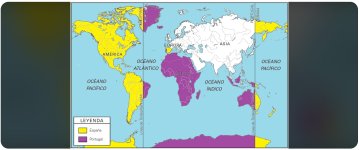
When the Age of Discovery started, there was a mad rush to find India. During this time, in 1494, Spain and Portugal decided to split the world between themselves. This led to great power competition with other rival countries and a mad rush to find new colonies, including the colonization of the Americas. That's why the Portuguese came to India, but no Spaniards.
View attachment 50592
So globalism started with colonization first. And of course, with most colonies under the the thumb of companies (all the different * East India Companies), they didn't wanna share power with their captive empires, so they made idealistic plans to rule over the world as a cartel with the support of empires. This required some level of interconnectedness between the companies.
With more countries coming to play, the world map got further divided between the powers. A fair competition ensued and losers withdrew from those territories, that's how the British got India.
But empires later took control of the colonies, which was a great loss to bankers and merchants. The American Revolution showed that the empires were not all they were cracked up to be. The French revolution followed, which was a people's revolution. Then India revolted a few decades later. Post which the bankers and merchant class realized empires can be made to fall, so it was time for them to go. Political schools and parties formed, Marx's works became foundational, the bankers and merchant class loved the idea of taking control of a nation's economy. That's how bankers got the fed reserve too. And why stop there? Why have nations at all? So back to interconnectedness via internationalism.
A bunch of new political parties showed up starting with SPD in 1875 and SDF in the UK in 1881, both German workers-led. Fabian Society was created in 1883 and INC formed in 1884. And so on. These guys are the OGs who trained Lenin and Trotsky. While Lenin chose violence, Fabian Society decided on revolution through peaceful means over long periods of time.
This went on for a few decades and empires started falling and democracies took root. It all collectively happened during and after WW1, including in Russia.
Then came WW2, and this gave birth to the modern idea of globalism based on the beliefs of Fabian Society. The Fabians established schools and universities (London School of Economics) and influenced Oxford and Cambridge, followed by American universities, and the end result is what we have today. For India, and pretty much the rest of the world, Cambridge's Trinity College is where all this began. Nehru, Old RaGa, and New RaGa were indoctrinated in Trinity.
Ashkenazi Jews that migrated from Eastern Europe to Western Europe and the US picked communism to represent their cause. Plus Jewish bankers and businessmen had outsized influence in the Weimar Republic, and the communists in general were very aggressive and operated like gangs. This scared the crap out of young German mothers for their sons who collectively voted Hitler into power.
The biggest weakness of the Bolsheviks is their weak executive, which allows capable populist leaders to come to power quite easily. That's why they hate strong leaders that they cannot control from behind the scenes, be it emperor, czar, or president/PM. That's why Hitler, Stalin, Mao, Putin, Trump, Modi, Xi, even Netanyahu etc are all grouped under the same category. Indira Gandhi was also supposed to be a puppet, but she took power and purged them instead, which earned her the loyalty of the Indian Army. That's also why they are so supportive of Modi today, hence all the attacks on them by the ecosystem.
During the colonization era, the Czars were opposed to it because they couldn't play the game, that's all. The Americans too opposed it in their isolation. But both countries concentrated on Imperialism and national power and eventually became superpowers whereas the Bolsheviks with their weak leadership and distributed power could only fall. They are trying to correct that with systems like the UN and EU while concentrating on capturing the ruling seats of major powers, but they seem to be facing difficulties staying in power 'cause they only know how to be parasites within the system, which in turn helps the cause of populist leaders.
So yeah, colonization led to internationalism, and now globalism is just new wine in an old bottle.





 . US nuclear arsenal is far larger, more capable, more tested and more deadly than China's will ever be in the next 10 years across multiple domains, only edge where China and even we are ahead are land based ICBMs but the US will regain the lead with Sentinel. In terms of SLBMs and air launched/delivered nukes US wipes the floor with anyone and everyone.


