

Indo-Pacific : News & Discussion
- Thread starter dray
- Start date
You are using an out of date browser. It may not display this or other websites correctly.
You should upgrade or use an alternative browser.
You should upgrade or use an alternative browser.
Indo-Pacific: Experts say Canada must deepen strategic ties with India
Canada has been working on a fresh Indo-Pacific strategy since November 2019 and that is expected to be announced later this year
Published on Jul 12, 2022 10:40 AM IST
TORONTO: Canada should deepen strategic ties with India, as it otherwise risk being excluded from the democratic alignment that has emerged in the Indo-Pacific region, experts in the bilateral space have stressed.
“Canada has already fallen behind its closest allies, the US and Australia, in building a partnership with India. As the Indo-Pacific continues to rise in importance, it is in the Canadian interest to define a leading role for itself with India towards a more secure and prosperous world,” new commentary published by the Ottawa-based think tank MacDonald Laurier Institute (MLI), and also featured in the Canadian daily National Post, said.
The opinion, posted on Monday, came from the head of MLI’s Foreign Policy & National Security Programme Shuvaloy Majumdar and senior fellow at India’s Observer Research Foundation Sameer Patil.
The ”bad news”, they noted, was that as US President Joe Biden and other leaders were “working to improve western cooperation with India, Canada is entirely missing in action”.
Given Canada’s security interests in the region, “one would think that Ottawa would bring ambition to this growing relationship between India and the West”. But whether it pertained to security of the Quad, comprising India, the US, Australia and Japan, or AUKUS, the Australia, US and United Kingdom groups, negotiations for the Indo-Pacific Economic Framework for Prosperity (IPEF), launched this March, or cooperation with Pacific island states, “Canada has simply been left out of the conversation”, they said.
They added, “With its advanced defence industry and leading innovation ecosystem, Canada has a lot to offer India and the Indo-Pacific in building the 21st century defence industry base.”
The Russian attack on Ukraine “serves as a reminder that democracies ought to assess Indo-Pacific security more seriously, in what might be considered Nato’s Pacific flank. The West need not wait for similar crises to erupt to start building security cooperation with Asian democracies, particularly India and Japan”, they argued.
Canada has been working on a fresh Indo-Pacific strategy since November 2019 and that is expected to be announced later this year. A special secretariat has been established by the country’s foreign ministry, Global Affairs Canada, to develop the policy.
When the prime ministers of the two countries met in person on the margins of the G7 summit last month in Germany, it was their first such meeting in over four years. A readout of that encounter from the Canadian prime minister’s office said they discussed, among other issues, “cooperation” in the “free, open, and inclusive Indo-Pacific region”.

Indo-Pacific: Experts say Canada must deepen strategic ties with India
Canada has been working on a fresh Indo-Pacific strategy since November 2019 and that is expected to be announced later this year
Germany says it will expand military presence in Indo-Pacific
BERLIN, Aug 31 (Reuters) - Germany will expand its military presence in the Indo-Pacific by sending more warships and joining drills with allies as it keeps an eye on the "enormous" build-up of China's armed forces, the German defence chief told Reuters.Germany is joining other Western nations in showing more muscle in the region amid growing alarm over Beijing's territorial ambitions.
Last year, Berlin sent its first warship in almost 20 years to the disputed waters of the South China Sea - at the risk of irking its top trade partner - and this month it sent 13 military aircraft to joint exercises in Australia.
General Eberhard Zorn told Reuters the Bundeswehr planned on sending troops to participate in training exercises in Australia next year, while the navy would send a fleet of several more ships to the region in 2024.
"This is how we want to consolidate our presence in the region," Zorn said in an interview at the defence ministry in Berlin.
Germany has historically been more timid in its security policy than its allies due to its role in two world wars, focusing more on trade in its international relations - with China's rapid economic expansion driving its own growth and the country becoming its top trade partner in 2016.
But partners have in recent years called on Germany to show more leadership, inkeeping with its might as Europe's largest economy and most populous country.
In 2020, Berlin published a new Indo-Pacific strategy with a focus on strengthening alliances with democracies in the region, marking a turning point. Then German Chancellor Olaf Scholz in February pledged a dramatic hike in spending on the military after Russia's invasion of Ukraine.
Tensions in the Indo-Pacific are running especially high at the moment after China carried out its largest-ever military drills around democratically-governed Taiwan, which it claims as its own territory, at the start of August.
Asked whether Germany might send a warship sailing through the Taiwan Strait as has the United States, Zorn said it was a sensitive matter decided upon at the highest political level.
"We do not want to provoke anyone with our presence but rather send a strong sign of solidarity with our allies," he said. "We stand for the freedom of navigation and the safeguarding of international norms."
Zorn said China's military strength once lay in its number of soldiers; now its armed forces were also getting technologically well equipped.
"We are observing an enormous buildup of Chinese forces," he said.

Germany says it will expand military presence in Indo-Pacific
Germany will expand its military presence in the Indo-Pacific by sending more warships and joining drills with allies as it keeps an eye on the "enormous" build-up of China's armed forces, the German defence chief told Reuters.
India accepts three out of four pillars of US-led IPEF, so why has it stopped short of a total agreement?
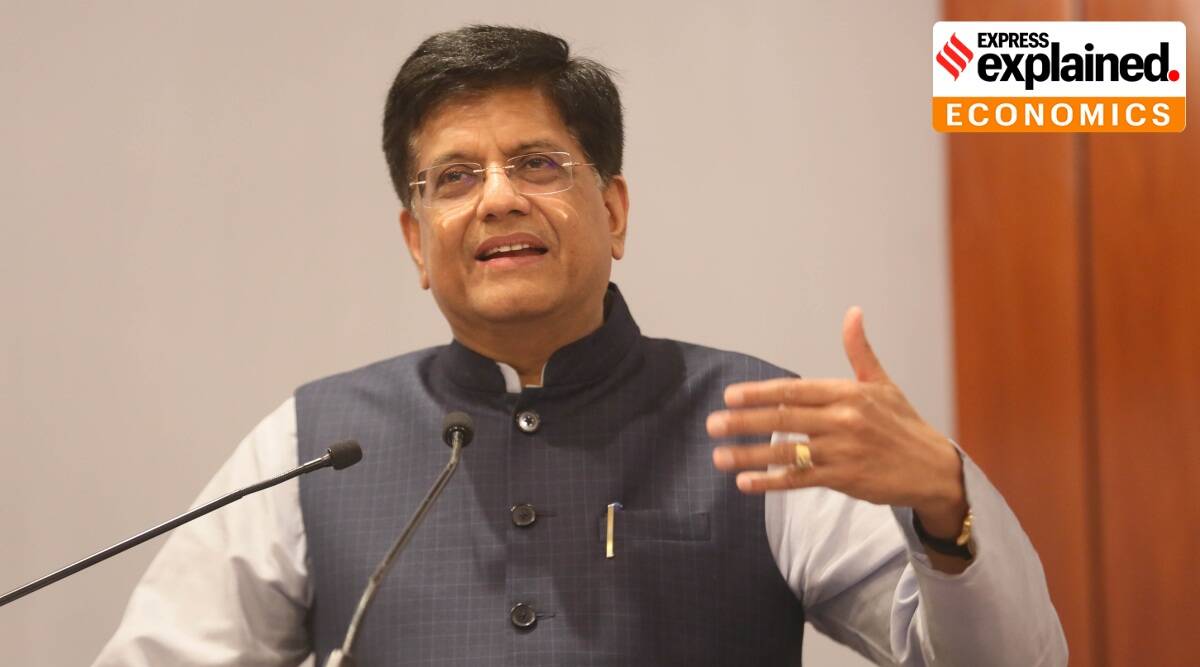
Speaking at a press conference after the Indo-Pacific Economic Framework (IPEF) Ministerial meeting in Los Angeles in the US, Minister of Commerce & Industry Piyush Goyal said India had agreed to three out of four pillars of trade relating to supply chains: tax, anti-corruption and clean energy. “India was comfortable with the outcome and text and have joined the declaration”, said the minister.An important US-led trade agreement that has been in the works for a while now and according to a September 10 press release, the Indian government said it is waiting for “contours to emerge” on one pillar, which deals primarily with trade and commitments to the environment, labour, digital trade and public procurement.
The minister said India will be watching “what benefits member countries will derive and whether any conditionalities on aspects like environment may discriminate against developing countries”.
How did the IPEF come about?
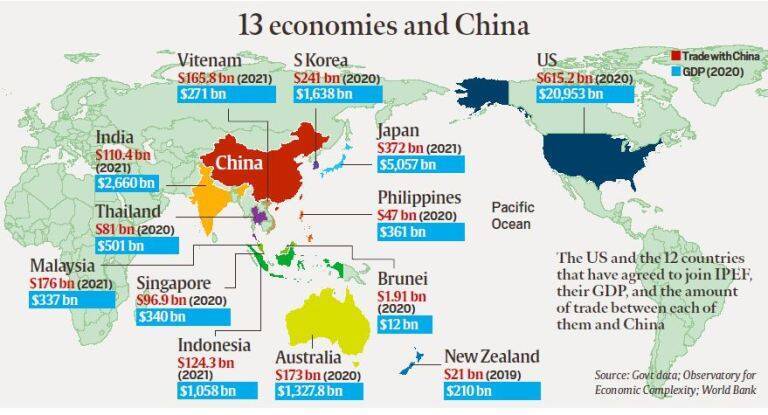
Given the emergence of multi-country trade agreements such as the China-led Regional Comprehensive Economic Partnership (RCEP) among east Asian countries and the Trans-Pacific Partnership (TTP) from which former US President Donald Trump walked out of, the US has been looking to have a setup of its own.
US President Joe Biden first discussed the IPEF in the East Asia Summit on October 2021, saying “United States will explore with partners the development of an Indo-Pacific economic framework that will define our shared objectives around trade facilitation, standards for the digital economy and technology, supply chain resiliency, decarbonization and clean energy, infrastructure, worker standards, and other areas of shared interest”.
US officials had said IPEF is not a free trade agreement, and not the “same old, same old” kind of trade agreement, but allows members to negotiate the parts they want to. The negotiations will be along four main “pillars”.
Currently, India and 13 countries located in the Pacific ocean are its members: Australia, Brunei, Fiji, India, Indonesia, Japan, South Korea, Malaysia, New Zealand, Philippines, Singapore, Thailand, United States, and Vietnam.
What is India’s position on the IPEF?
While some countries had expressed interest in joining negotiations, India did not declare a definitive position for some time. In ‘Deciphering the IPEF’, a research paper from March 2022, Prabir De of the Research and Information System for Developing Countries, a think tank of the MEA, wrote India “may also be uncomfortable with the US high standards, and would like to avoid risks”.
He further added, “Some areas proposed in the IPEF do not appear to serve India’s interests. For example, the IPEF talks about digital governance but the IPEF formulation contains issues that directly conflict with India’s stated position.” Piyush Goyal also said at the press conference that India was in the process of firming up its own digital framework and laws, particularly regarding privacy and data, and it would wait for more information. In the meantime, officials will be participating in the discussions “with an open mind”.
In August this year, the Indian government withdrew the Personal Data Protection Bill from Parliament, saying it would consider “comprehensive legal framework” to regulate the online space, laws on data privacy, and data localisation, the overall Internet ecosystem, cybersecurity, etc.
What are some of the concerns?
The US has earlier expressed concerns about the possibility of the Indian side demanding data localisation or the storage and processing of Indian users’ data in servers located in India and not the US, even in the case of data of US-based companies.
India accepts three out of four pillars of US-led IPEF, so why has it stopped short of a total agreement?
So far, India has agreed to three pillars relating to supply chains: tax, anti-corruption and clean energy, but the fourth pillar on data and privacy is yet to be completely agreed upon.
 indianexpress.com

India to take decisions on IPEF aspects based on national interest: Piyush Goyal
Interacting with media on the sidelines of the meeting, he said that there have been useful engagements with the 14 members of the IPEF and the officials from member nations had worked hard to prepare a ground for such fruitful interactions. He expressed hope that in a day's time, IPEF would...

India joins US-led Indo-Pacific group
The statements outline an ambitious agenda which will entail greater information sharing and investment in supply chains, and more robust efforts to promote a rules-based, transparent and clean trading system.

Keep up pressure: India-US teaming up on Pacific Islands will trouble China. That’s welcome
China’s ambassador to India Sun Weidong has said that the border situation is “switching to normalised management and control” and that bilateral ties have shown positive momentum this year. The ambassador’s comments contrasts with the...