

Indo-Pacific : News & Discussion
- Thread starter dray
- Start date
You are using an out of date browser. It may not display this or other websites correctly.
You should upgrade or use an alternative browser.
You should upgrade or use an alternative browser.

America’s Pivot to Asia 2.0: The Indo-Pacific Economic Framework
On his Asia trip, U.S. President Joe Biden announced on Monday that Japan, India and 10 other countries have committed to join the U.S.-led Indo-Pacific Economic Framework (IPEF). Those countries include Australia, Brunei, Indonesia, South Korea, Malaysia, New Zealand, the Philippines, Singapore, Thailand, and Vietnam. Not included, at least for now, are Taiwan, three ASEAN member states (Cambodia, Laos, and Myanmar) and China (obviously). But the door to their future membership remains (at least theoretically) open.Through IPEF, the United States hopes to economically engage the Indo-Pacific and counter China’s increasing economic and political influence in the region. With around 60 percent of global population, the region is going to be the main driver of economic growth in the world in the next few decades. According to the White House, the region “supports 3 million American jobs” and is “the source of nearly $900 billion in foreign direct investment in the United States,” while U.S. FDI in the region totaled around $969 billion in 2020. What’s more, the United States is the “primary exporter of services to the region.”
In short, U.S. (and many global) policy and economic elites see the course of this century’s geopolitics and geoeconomics to be determined in this region.
From Pivot 1.0 to Pivot 2.0
In 2011, then-U.S. President Barack Obama, on a trip to Asia, introduced the U.S. Pivot to Asia, which had both geopolitical components (such as increasing the U.S. military presence in the region) and geoeconomic ones (such as the Trans-Pacific Partnership, or TPP). Through the TPP, Obama wanted the United States, not China, to write “the rules of the road in the region” or “write the rules of the global economy” in this century. Obama hoped the TPP would be materialized by December 2012; as it turned out, negotiations lasted until 2015.
In their 2016 electoral campaigns, both Hillary Clinton and Donald Trump opposed the TPP due to anti-globalization (i.e. anti-FTA) sentiments in the United States. President Trump then torpedoed the TPP immediately after taking office in 2017. Since then, the U.S. Indo-Pacific policy has been increasingly lopsided, defined more by geopolitical formations (such as the Quad and AUKUS) than (geo)economic initiatives and trade pacts.
In the meantime, in 2021, after around 10 years of painstaking negotiations, China and other Indo-Pacific countries signed the Regional Comprehensive Economic Partnership (RCEP), the largest free trade deal in the world. All ASEAN countries and some close U.S. allies (Australia, Japan, New Zealand, and South Korea) joined RCEP. It entered into force on January 1, 2022.
On the other hand, Japan and others negotiated and revived the TPP (or what was left of it after the U.S. withdrawal) and called it Comprehensive and Progressive Transpacific Partnership (CPTPP). It was ratified in 2018. The United States has ruled out the possibility of rejoining this FTA, however. Instead, Washington has argued that the region needs to move beyond it. Enter IPEF, the second coming of the U.S. Pivot to Asia.
While the Pivot’s geopolitics developed substance (through the likes of the Quad and AUKUS), the U.S. Indo-Pacific policy lacks geoeconomic heft. IPEF aims to fill this gap. According to the White House, the goal of the IPEF is to tackle:
Obama’s legacy of the Pivot is almost impossible to miss in IPEF. His discourse about the TPP’s objective (“writing the rules of the road”) resonates clearly in the quote above. In this sense, IPEF is the United States’ second attempt at a Pivot to Asia. U.S. policymakers have noticed that the United States is left sitting on the outside of the Indo-Pacific’s two main trade blocs (RCEP and CPTPP).21st century economic challenges ranging from setting the rules of the road for the digital economy, to ensuring secure and resilient supply chains, to helping make the kinds of major investments necessary in clean energy infrastructure and the clean energy transition, to raising standards for transparency, fair taxation, and anti-corruption.
How to Interpret IPEF and Its Challenges
In what follows, I offer seven observations about the visions behind and the challenges ahead of IPEF.
First, it is important to determine what IPEF is not. It is certainly not an FTA like RCEP and the CPTPP. It has not involved, nor has it promised to involve in the future, negotiations to remove tariffs or increase market access. For now, IPEF is best understood as a vision, a signal, a statement of purpose, or an attempt by the United States to catch up with the Indo-Pacific’s evolving history, geography, and (geo)economics.
Second, IPEF’s ultimate vision is to reinstate U.S. “economic leadership” in the Indo-Pacific region and enable the United States – as both Obama and Biden have envisioned – “to [re]write the rules of the road” for the Indo-Pacific, and global, economy.
Third, a major contradiction here is that “rules of the road” require a framework with binding commitments based on specific rules and regulations. This specificity is normally formalized through FTAs with clear rules and dispute settlement mechanism. IPEF does not offer any of that. Even before this trip, the Biden team had to water down IPEF to attract more countries to it.
The White House has argued that this aspect of IPEF is a “feature,” not a “bug,” as it gives more flexibility to the participants to act upon the components that are completed without having to wait for all of IPEF to be completed. While this is a theoretically beautiful thought process, we do not have many – in fact, any – historical precedents of such a loosely defined framework creating enough obligations and incentives to create history-changing momentum.
Fourth, the conceptual baggage of IPEF (setting “rules,” “standards,” and “principles”) has already appeared and been tested in both the Blue Dot Network (BDN) launched in 2019 by the Trump administration and the Build Back Better World (B3W) initiative launched in 2021 by the Biden administration. BDN was defined as “a mechanism to promote robust standards […] for quality infrastructure projects” and B3W as an initiative to promote “high standards and principles” in areas that overlap with IPEF’s issue areas. Both B3W and BDN were defined in terms of countering China and its Belt and Road Initiative (BRI). Neither has so far produced much tangible substance and momentum. The United States should watch out that IPEF does not meet the same fate as BDN and B3W.
Fifth, from the list of excluded countries (China and its close ASEAN partners such as Myanmar, Cambodia, and Laos), it is hard not to infer that IPEF’s trajectory has been – and will likely be – defined more by the United States’ geopolitical objectives than global economic dynamics. Another layer of complexity for the U.S. is that, since 2011, the Pivot to Asia has been constantly derailed by geopolitical emergencies elsewhere, such as in the Middle East or now in Ukraine.
Sixth, the most herculean challenge for the United States is to persuade IPEF members to disentangle their economies from China’s. It is worth remembering that other than the U.S., each and every country that has joined IPEF previously joined China in signing an actually binding FTA, namely, RCEP. For them, that was much more of a commitment than joining IPEF.
This challenge becomes even greater given that IPEF, in trying to set standards and principles, will inevitably create obligations while “lacking incentives.” It remains to be seen if, how, and why IPEF partners should not be “skeptical” and should work against their own economic interests (i.e., economic engagement with China) in the absence of IPEF incentives (such as access to the U.S. market).
Seventh and finally, for IPEF to succeed, U.S. policymakers should try to do two things simultaneously: They should, first, get their domestic act together by properly addressing the U.S. population’s anti-globalization sentiments and economic concerns; and, second, merge initiatives such as IPEF (and B3W and BDN) with already existing FTAs, such as the Japan-led CPTPP, which are the results of years of painstaking negotiations. Only then can the United States use its economic might, soft power, and geopolitical leverage to start writing – or better, co-writing with partners – the rules of the road for the global economy.

America’s Pivot to Asia 2.0: The Indo-Pacific Economic Framework
As long as IPEF lacks clear incentives, it will be hard to transform the framework into meaningful action.
thediplomat.com

Solomons media condemns ‘secrecy’ controls over China delegation
The Media Association of Solomon Islands (MASI) has urged its members to boycott a media conference for a visiting Chinese delegation in protest over “ridiculous” restrictions.China’s Foreign Minister Wang Yi leads the high-level delegation which arrives in Solomon Islands today.
Wang is expected to sign a host of new agreements, including the security pact that has sparked anger in the United States, Australia and New Zealand.
MASI president Georgina Kekea said it was disappointed that the media were only allowed limited access to the visit.
Kekea said Solomon Islands was a democratic country and when media freedom was dictated on someone else’s terms, it impeded the country’s democratic principles.
“The Chinese delegation’s visit is an important and historical one for our country and our members play an important role in making sure it provides the right information and awareness on the importance of the visit to our people,” she said.
She said only two questions could be asked, one from a local journalist directed to the Solomon Islands foreign affairs minister, and one from Chinese media, directed to their foreign affairs minister.
“How ridiculous is that? If we want to interview our foreign affairs minister, we can just do it without the event,” she said.
‘What’s the purpose?’
“What is the purpose of hosting such an event for the press when they are only allowed one question and directed to their foreign minister only?”
Kekea said even the discriminatory manner in which journalists were selected to cover the event did not bode well with the association.
China’s Foreign Minister Wang Yi … Pacific influencing travel includes Fiji, Kiribati, Papua New Guinea, Samoa, Solomon Islands, Tonga and
Vanuatu. Image: MFA/Chinese govt
“MASI thrives on professional journalism and sees no reason for journalists to be discriminated against based on who they represent. Giving credentials to selected journalists is a sign of favouritism,” she said.
“Journalists should be allowed to do their job without fear or favour.”
She said the reason given that the arrangements were done that way because of covid-19 protocols did not stack up.
“We have community transmission, people are crowded in buses, shops, markets, banks and so forth, so this is a very lame excuse,” she said.
Kekea said press freedom is enshrined as a fundamental element in the Solomons’ constitution.
‘MASI defending democracy’
“Same as the prime minister has defended democracy in Parliament after the November riots, MASI is also defending democracy in this space,” Kekea said.
She added that the boycott was not to disrespect the government or its bilateral partners in any way, but to showcase the media’s disagreement in this matter.
Solomons Islands opposition leader Mathew Wale has again raised concerns at the secrecy surrounding links with Beijing.
Wale said only a few top aides know what is in the agreements, and that there’s no justification for the secrecy.
“Solomon Islands is a democratic country, owned by the people and they are entitled to know what is being transacted in their name,” he said.
This article is republished under a community partnership agreement with RNZ.


[Asia’s Next Page] Tokyo’s Power Projection: The NATO Calculus
If 2020 was an inflection point with the COVID-19 pandemic forcing the world to readjust its economic overdependence on China, then the year 2022 is colored by the Russian invasion in Ukraine.This year has been a significant turning point for geopolitical allegiances between state actors and reconfiguration of security mechanisms: The China-Russia “no-limits” friendship forged right before the Ukraine war; transatlantic and European unity; conditional (yet unbitter) support among allies (India vs. the rest of the Quadrilateral Security Dialogue); and the emergence of Japan as a credible partner and potential great power are some of the highlights.
Moreover, the ongoing war has also put the launch of Europe’s new Security Compass in perspective, even as it has tested the United States and the North Atlantic Treaty Organization (NATO)’s credibility in ensuring European security.
The changed security landscape in Europe has reverberated in the Indo-Pacific – the world’s perpetual theater of tension – too. Asia’s response to the war has been unsurprisingly disparate. India and China have not supported the Western sanctions and maintained a strategic silence on their partner Russia. The Association of Southeast Nations (ASEAN) has been likewise divided. South Korea initially hesitated, but ultimately caved into US pressure and sanctioned Russia.
But Japan has “stood up in remarkable ways” to galvanize support for Ukraine. Prime Minister Fumio Kishida’s visit to India and Southeast Asia was an appeal not just to solidify stance for Ukraine, but also to coalesce allies in the event of further aggression from China in the Indo-Pacific, primarily South and East China Seas.

Japan’s Power Projection
Japan’s consolidated moves – including outreach, sanctions, and humanitarian plus non-combat military assistance – have not only drawn praise from the United States and European countries, but also projected Japan’s greater power ambitions. Notably, Japan’s response to the war in Ukraine has deepened its strategic relationship with NATO, which is fighting for greater credibility amid Europe’s turn to strategic autonomy.Japan is also a “like-minded” partner in NATO’s outreach to the Indo-Pacific in its bid to “no longer be confined by geography.”
In this context, how far would Japan’s emerging dynamics with NATO influence their geopolitical interests? What does it mean for the existing Indo-Pacific frameworks, including the military pact between Australia, the UK, and the US (AUKUS)?
Tokyo-NATO Multifaceted Chemistry
The Ukraine war and the changing global security architecture have renewed the focus on the strength of alliances and their ability to ward off urgent threats. Ahead of its Madrid summit, NATO has been making concerted efforts to reconfigure its deterrence and collective defense capabilities amid fears of growing China-Russia convergence. Given the globalized security threats today, it is not just focusing on the extended European neighborhood, but also developing broader relationships in the Indo-Pacific.Naturally, the alliance is seeking to strengthen its long-standing multi-sectoral practical and political cooperation with Japan, one of its major “partners across the globe,” to address shared challenges. For example, on May 19, as a representative of the Indo-Pacific states (along with Australia, New Zealand, and South Korea), General Koji Yamazaki, Chief of Staff, Joint Staff, of the Japan Self-Defense Forces, attended the NATO Military Committee meeting that included a discussion on regional security developments impacting global security challenges. In turn, the chair of the NATO Military Committee will pay an official visit to the Joint Staff in June.
This military exchange is supplemented by Japan’s diplomatic overtures that include Foreign Minister Hayashi’s first-time participation in the NATO Foreign Ministers’ meeting earlier in April, Prime Minister Kishida’s G7 visit in March (hosted by NATO and by Japan next year), and Japan’s likely participation in the forthcoming NATO summit in June.
Such focused, back-to-back engagements with NATO highlight the mutual urgency for enhanced collaboration. Hence, a potential China-centered trilateral with the US cannot be ruled out. Moreover, for Japan, such meetings ensure broader outreach with other states in attendance.
Leadership Styles
Under Shinzo Abe, NATO-Japan ties remained largely focused on maritime security, cyberspace, humanitarian assistance and disaster relief, and issues involving women, peace, and security. Now, the addition of cyber defense, new technologies, and countering disinformation have led to accentuated cooperation, driving forward Japan’s importance in NATO’s Asia-Pacific outlook.Importantly, a discernible arc is visible, which is shaping Kishida’s NATO approach above and beyond that of Abe’s. It is further linked to the focus of both leaders on remitting Japan’s postwar constitution.
The amendment (or abandonment) of Article 9 is an unfinished goal Abe had sought as a core priority. Kishida took up the mantle upon his election, and has now moved it further up in his domestic and foreign policy agenda, accelerating attempts away from a slow dismantling. Kishida’s recent call for revisions to the constitution to “better match the current times” has been accompanied by the submission of a proposed review of Japan’s national defense strategy to remove restrictions on striking enemy bases.

China’s Take, Public Perceptions
Amidst such developments, Chinese state media has sought to classify Japan’s growing NATO outlook as connected to its remilitarization goals. Calling Japan an “active caterer” of NATO’s “Eastward Crossing,” China has portrayed Japan’s NATO connection as a move away from Asia and toward Europe.The reality of Japan’s NATO pull, however, is a lot more nuanced. Japan’s strategic alignment with the EU is growing, while Kishida’s eagle-eye on the US-Japan alliance is strong.
Concurrently, Japan’s security ties with European countries like France and the UK are on the rise. Renewing cooperation with NATO emerges as a natural progression of Kishida’s European vision, while also building a stronger Asian representation in Brussels.
Having been Japan’s longest-serving foreign minister, Kishida’s diplomatic maneuvering of the Ukraine situation and its cross-continental ramifications show his expertise in action.
At the same time, Kishida has been able to swerve public perception, a vital variable to political success, to his side despite the upsurge in geopolitical volatility (or in hindsight, maybe because of it.)
Support for Kishida’s administration exceeded 60 percent, according to a survey in May by the Nikkei and TV Tokyo. Japan’s unusual response to Ukraine, as compared to the 2014 Crimean crisis or the 1991 Gulf War when Japan’s political status was not as strong as it is today, has reflected in stronger support from its public as well.
A key factor in this change could also be the public perception of the invasion, what Kishida has termed, as a “unilateral change to status quo by force.” Constant Chinese incursions into Japanese territory amid the Senkaku Islands sovereignty dispute and the North Korean threat have precipitated the awareness of imminent danger.
A Low-Risk, High Reward Approach?
The forthcoming Madrid NATO summit will likely emerge as a critical summation of Kishida’s recent foreign policy overtures at strengthening ties with Brussels. Support of the United States for Japan is at an all-time high and sets the stage for furthering Japan’s NATO engagements.The recent statement by President Joe Biden to defend Taiwan militarily in the case of a Ukraine-like invasion by Russia was lauded as a major policy shift. Having been announced in Tokyo, the statement further renewed Chinese fears that Japan would fully stand with the US with respect to Taiwan, threatening the One-China policy.

Japan has also long attempted to build European consensus against Chinese continued aggression in the Indo-Pacific region. Hence, recent “pivots” to the region by the European Union (EU) and NATO have been welcomed by Tokyo. But it recognizes the need to advance concrete cooperation.
As multilateralism in multipolar Asia grows, Japan’s push is to ensure continued US and European presence in the region as it seeks to stall regional hostilities and assertive actions by Beijing, especially as Tokyo itself remains economically dependent on China. Already, China has labeled Japan a “traitorous guide” for its recent collaboration with NATO.
AUKUS Expansion Yes or No?
Notwithstanding the pressure from China, Japan is also pursuing “multilayered” security cooperation through bilaterals and multilaterals. But none has received as much attention as the speculations around AUKUS and Japan’s inclusion in its (as yet non-existent) expansion.That Japan already has security arrangements with each of the AUKUS partners is fueling the fire. Yet both Japan and the US have denied the media reports, even as the potential for a “JAUKUS” (despite the stranger acronym) does appear to have a “sound strategic logic.”
Such dynamics nevertheless highlight Japan’s criticality in global politics, and hence NATO’s considerable interest in the partnership that goes beyond the China threat.
Moreover, Japan is a democratic trusted regional leader in Asia and the largest official development assistance (ODA) donor, with large scale investments in infrastructure (Expanded Partnership for Quality Infrastructure, EPQI), technology, and multilateral trade pacts.
For Japan, the cooperation with NATO has multifold objectives: neutralizing the threats from China and North Korea, greater presence in European policy, solidifying its role as the foremost leader in regional geopolitics, and above all, achieving its great power ambitions.
So far, Kishida’s diplomacy for the “new era” seems to be heading in the planned direction.
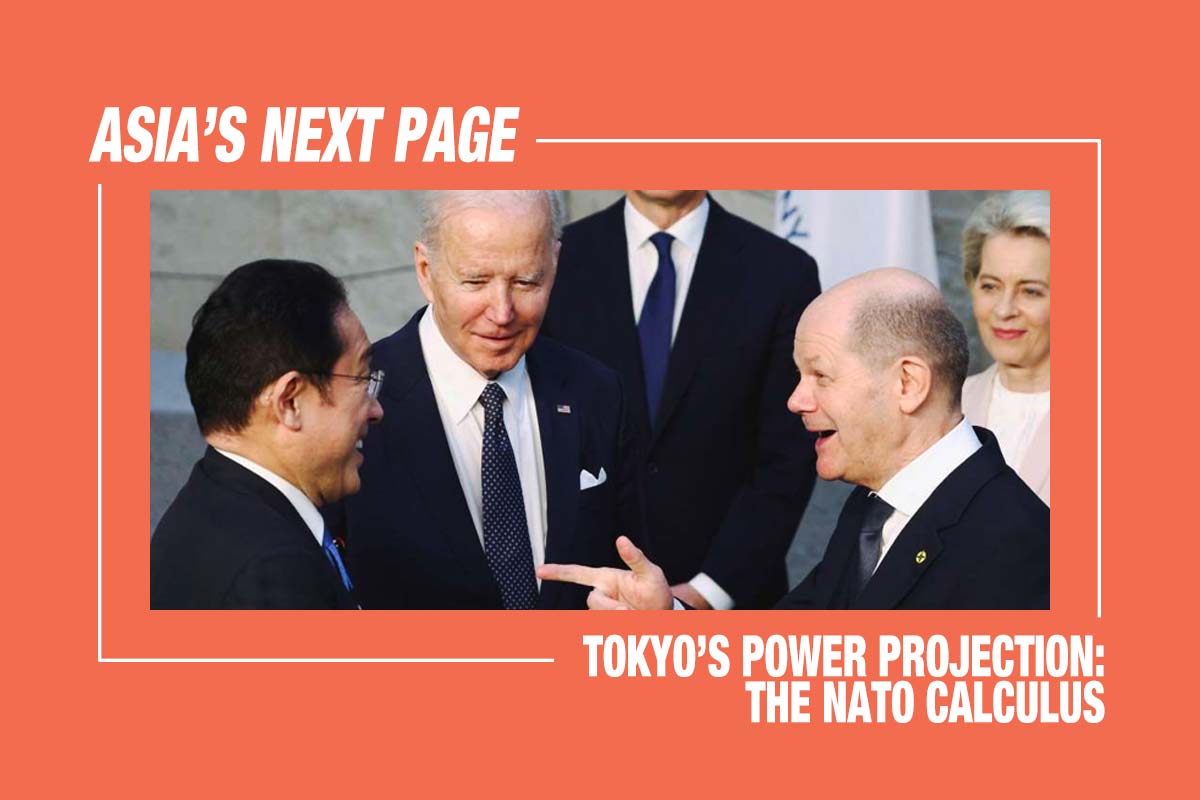
[Asia’s Next Page] Tokyo’s Power Projection: The NATO Calculus | JAPAN Forward
Recent back-to-back engagements with NATO show Japan’s growing strategic alignment with the EU, while Kishida’s eye on the US-Japan alliance is strong.
 japan-forward.com


Issue is Japan is too shy for a serious strategic confrontation involving hard power.[Asia’s Next Page] Tokyo’s Power Projection: The NATO Calculus
If 2020 was an inflection point with the COVID-19 pandemic forcing the world to readjust its economic overdependence on China, then the year 2022 is colored by the Russian invasion in Ukraine.
This year has been a significant turning point for geopolitical allegiances between state actors and reconfiguration of security mechanisms: The China-Russia “no-limits” friendship forged right before the Ukraine war; transatlantic and European unity; conditional (yet unbitter) support among allies (India vs. the rest of the Quadrilateral Security Dialogue); and the emergence of Japan as a credible partner and potential great power are some of the highlights.
Moreover, the ongoing war has also put the launch of Europe’s new Security Compass in perspective, even as it has tested the United States and the North Atlantic Treaty Organization (NATO)’s credibility in ensuring European security.
The changed security landscape in Europe has reverberated in the Indo-Pacific – the world’s perpetual theater of tension – too. Asia’s response to the war has been unsurprisingly disparate. India and China have not supported the Western sanctions and maintained a strategic silence on their partner Russia. The Association of Southeast Nations (ASEAN) has been likewise divided. South Korea initially hesitated, but ultimately caved into US pressure and sanctioned Russia.
But Japan has “stood up in remarkable ways” to galvanize support for Ukraine. Prime Minister Fumio Kishida’s visit to India and Southeast Asia was an appeal not just to solidify stance for Ukraine, but also to coalesce allies in the event of further aggression from China in the Indo-Pacific, primarily South and East China Seas.
Kishida announces further sanctions against Russia (February 2022).
Japan’s Power Projection
Japan’s consolidated moves – including outreach, sanctions, and humanitarian plus non-combat military assistance – have not only drawn praise from the United States and European countries, but also projected Japan’s greater power ambitions. Notably, Japan’s response to the war in Ukraine has deepened its strategic relationship with NATO, which is fighting for greater credibility amid Europe’s turn to strategic autonomy.
Japan is also a “like-minded” partner in NATO’s outreach to the Indo-Pacific in its bid to “no longer be confined by geography.”
In this context, how far would Japan’s emerging dynamics with NATO influence their geopolitical interests? What does it mean for the existing Indo-Pacific frameworks, including the military pact between Australia, the UK, and the US (AUKUS)?
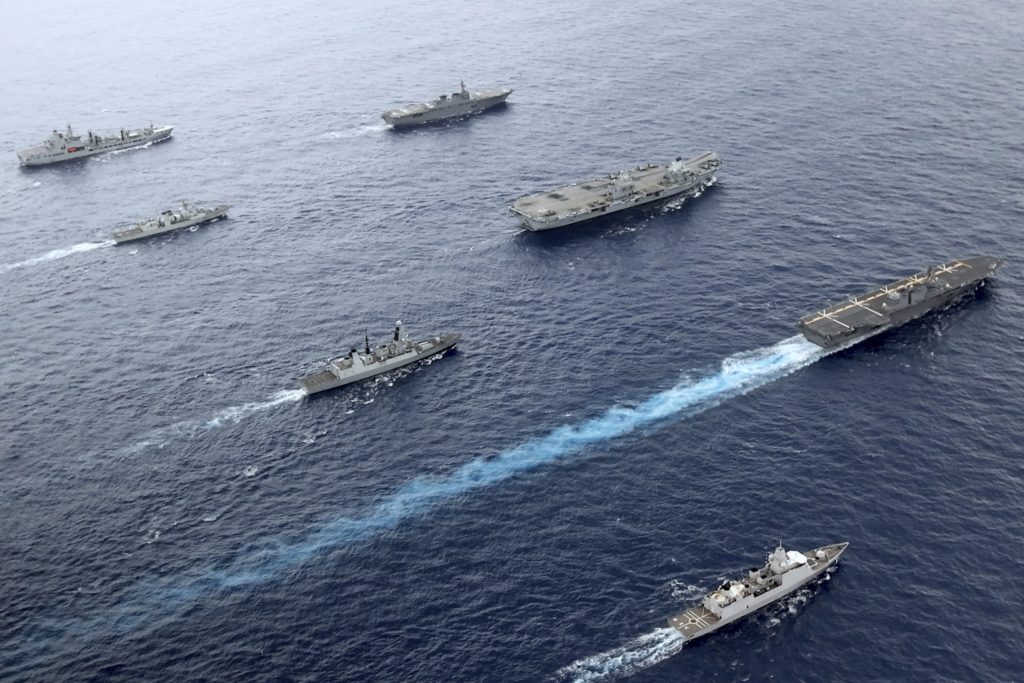
UK, Japan, Canada joint exercises in the Pacific, September 2021. (UK Ministry of Defence via AP)
Tokyo-NATO Multifaceted Chemistry
The Ukraine war and the changing global security architecture have renewed the focus on the strength of alliances and their ability to ward off urgent threats. Ahead of its Madrid summit, NATO has been making concerted efforts to reconfigure its deterrence and collective defense capabilities amid fears of growing China-Russia convergence. Given the globalized security threats today, it is not just focusing on the extended European neighborhood, but also developing broader relationships in the Indo-Pacific.
Naturally, the alliance is seeking to strengthen its long-standing multi-sectoral practical and political cooperation with Japan, one of its major “partners across the globe,” to address shared challenges. For example, on May 19, as a representative of the Indo-Pacific states (along with Australia, New Zealand, and South Korea), General Koji Yamazaki, Chief of Staff, Joint Staff, of the Japan Self-Defense Forces, attended the NATO Military Committee meeting that included a discussion on regional security developments impacting global security challenges. In turn, the chair of the NATO Military Committee will pay an official visit to the Joint Staff in June.
This military exchange is supplemented by Japan’s diplomatic overtures that include Foreign Minister Hayashi’s first-time participation in the NATO Foreign Ministers’ meeting earlier in April, Prime Minister Kishida’s G7 visit in March (hosted by NATO and by Japan next year), and Japan’s likely participation in the forthcoming NATO summit in June.
Such focused, back-to-back engagements with NATO highlight the mutual urgency for enhanced collaboration. Hence, a potential China-centered trilateral with the US cannot be ruled out. Moreover, for Japan, such meetings ensure broader outreach with other states in attendance.
Leadership Styles
Under Shinzo Abe, NATO-Japan ties remained largely focused on maritime security, cyberspace, humanitarian assistance and disaster relief, and issues involving women, peace, and security. Now, the addition of cyber defense, new technologies, and countering disinformation have led to accentuated cooperation, driving forward Japan’s importance in NATO’s Asia-Pacific outlook.
Importantly, a discernible arc is visible, which is shaping Kishida’s NATO approach above and beyond that of Abe’s. It is further linked to the focus of both leaders on remitting Japan’s postwar constitution.
The amendment (or abandonment) of Article 9 is an unfinished goal Abe had sought as a core priority. Kishida took up the mantle upon his election, and has now moved it further up in his domestic and foreign policy agenda, accelerating attempts away from a slow dismantling. Kishida’s recent call for revisions to the constitution to “better match the current times” has been accompanied by the submission of a proposed review of Japan’s national defense strategy to remove restrictions on striking enemy bases.
Chinese Foreign Ministry spokesperson Zhao Lijian (AP Photo)
China’s Take, Public Perceptions
Amidst such developments, Chinese state media has sought to classify Japan’s growing NATO outlook as connected to its remilitarization goals. Calling Japan an “active caterer” of NATO’s “Eastward Crossing,” China has portrayed Japan’s NATO connection as a move away from Asia and toward Europe.
The reality of Japan’s NATO pull, however, is a lot more nuanced. Japan’s strategic alignment with the EU is growing, while Kishida’s eagle-eye on the US-Japan alliance is strong.
Concurrently, Japan’s security ties with European countries like France and the UK are on the rise. Renewing cooperation with NATO emerges as a natural progression of Kishida’s European vision, while also building a stronger Asian representation in Brussels.
Having been Japan’s longest-serving foreign minister, Kishida’s diplomatic maneuvering of the Ukraine situation and its cross-continental ramifications show his expertise in action.
At the same time, Kishida has been able to swerve public perception, a vital variable to political success, to his side despite the upsurge in geopolitical volatility (or in hindsight, maybe because of it.)
Support for Kishida’s administration exceeded 60 percent, according to a survey in May by the Nikkei and TV Tokyo. Japan’s unusual response to Ukraine, as compared to the 2014 Crimean crisis or the 1991 Gulf War when Japan’s political status was not as strong as it is today, has reflected in stronger support from its public as well.
A key factor in this change could also be the public perception of the invasion, what Kishida has termed, as a “unilateral change to status quo by force.” Constant Chinese incursions into Japanese territory amid the Senkaku Islands sovereignty dispute and the North Korean threat have precipitated the awareness of imminent danger.
A Low-Risk, High Reward Approach?
The forthcoming Madrid NATO summit will likely emerge as a critical summation of Kishida’s recent foreign policy overtures at strengthening ties with Brussels. Support of the United States for Japan is at an all-time high and sets the stage for furthering Japan’s NATO engagements.
The recent statement by President Joe Biden to defend Taiwan militarily in the case of a Ukraine-like invasion by Russia was lauded as a major policy shift. Having been announced in Tokyo, the statement further renewed Chinese fears that Japan would fully stand with the US with respect to Taiwan, threatening the One-China policy.
PM Kishida, European Council President Charles Michel and European Commission President Ursula von der Leyen in Tokyo on May 12, 2022 (Photo by Yasuhiro Yajima)
Japan has also long attempted to build European consensus against Chinese continued aggression in the Indo-Pacific region. Hence, recent “pivots” to the region by the European Union (EU) and NATO have been welcomed by Tokyo. But it recognizes the need to advance concrete cooperation.
As multilateralism in multipolar Asia grows, Japan’s push is to ensure continued US and European presence in the region as it seeks to stall regional hostilities and assertive actions by Beijing, especially as Tokyo itself remains economically dependent on China. Already, China has labeled Japan a “traitorous guide” for its recent collaboration with NATO.
AUKUS Expansion Yes or No?
Notwithstanding the pressure from China, Japan is also pursuing “multilayered” security cooperation through bilaterals and multilaterals. But none has received as much attention as the speculations around AUKUS and Japan’s inclusion in its (as yet non-existent) expansion.
That Japan already has security arrangements with each of the AUKUS partners is fueling the fire. Yet both Japan and the US have denied the media reports, even as the potential for a “JAUKUS” (despite the stranger acronym) does appear to have a “sound strategic logic.”
Such dynamics nevertheless highlight Japan’s criticality in global politics, and hence NATO’s considerable interest in the partnership that goes beyond the China threat.
Moreover, Japan is a democratic trusted regional leader in Asia and the largest official development assistance (ODA) donor, with large scale investments in infrastructure (Expanded Partnership for Quality Infrastructure, EPQI), technology, and multilateral trade pacts.
For Japan, the cooperation with NATO has multifold objectives: neutralizing the threats from China and North Korea, greater presence in European policy, solidifying its role as the foremost leader in regional geopolitics, and above all, achieving its great power ambitions.
So far, Kishida’s diplomacy for the “new era” seems to be heading in the planned direction.
[Asia’s Next Page] Tokyo’s Power Projection: The NATO Calculus | JAPAN Forward
Recent back-to-back engagements with NATO show Japan’s growing strategic alignment with the EU, while Kishida’s eye on the US-Japan alliance is strong.
Penny Wong targets Asia’s missing middle
As the PM talks to NATO, Penny Wong has toured the anxious middle nations of South-East Asia keen to hedge their bets with the great powers.This week, Penny Wong delivered her first major address in South-East Asia since taking office. Speaking shortly before visiting her birthplace, Kota Kinabalu in Malaysia, the foreign minister invoked her own story to redefine Australia’s regional engagement, as a partner tied to South-East Asia through not just geography but tangible lived connections.
More than the past, Wong was focused on the future.
Penny Wong is welcomed to Chinatown in Kota Kinabalu, her birthplace in Malaysia. Jeremiah Chan
The foreign minister spoke of the need to achieve a “strategic equilibrium” that enables countries to make their own choices regarding their partnerships and alignments. And she spoke of ASEAN as the foundation of this equilibrium – with its institutions and member states holding the political centre of the Indo-Pacific.
The speech provided an early indication of how the new government is nuancing a one-size-fits-all strategic approach to the Indo-Pacific in favour of a more regionally tailored articulation of Australia’s national interests.
Canberra is seeking to square the circle between two objectives: building a strategic counterweight to China with like-minded partners on the
one hand and, on the other, co-operating with a more geopolitically diverse set of countries in shoring up the regional order.
There are in fact three concentric rings in Australia’s Indo-Pacific strategy, each defined by a distinct set of circumstances and challenges. The first is our Pacific “inner ring” where Australia must reinforce its position as a leading provider of public goods – in terms of addressing security challenges and the threat posed by climate change to the Pacific Islands.
Then there is an “outer ring” of major powers, the members of the Quad or AUKUS. Australia’s standing among democracies fringing the Indo-Pacific has never been stronger.
The prime minister’s presence at the NATO summit in Madrid shows a broad convergence of strategic interests is at hand. Amid Russia’s war in Ukraine, there is stiffening of resolve by liberal democracies in standing up to authoritarian states including China.We must rid ourselves of the notion that South-East Asian powers will eventually assimilate our anxieties about China.
But the fact remains that there is a missing middle in our Indo-Pacific strategy. Australia has experienced a loss of relevance and strategic drift at the centre, in South-East Asia.
A new bipolar front in Europe has galvanised Western unity. But the ripple effect from the Ukraine war has played out differently in South-East Asia, hastening the arrival of what Richard Maude at Asia Society has termed a “trifurcated order”.
There are clear geopolitical antagonisms, but in South-East Asia this does not add up to consolidated blocs. What we are seeing is the formation of polarities rather than blocs. Most resident countries will hedge doggedly in between.
Balancers and hedgers: bridging the gap
The challenge for Canberra is to communicate a vision of our strategy that resonates beyond a coterie of the converted. In particular, we must look for ways to bridge the divergence between two camps of middle powers: between the balancers and the hedgers.Wong’s call for strategic equilibrium in that sense marks an interesting departure from the usual articulation of Australia’s objective of forging a balance of power.
It creates space to recognise that middle powers, including Australia, will take different positions in respect of the great powers but can still find common ground on the role and purpose of the ASEAN-led regional architecture, and the importance of ensuring the sovereignty of smaller states within it.
Australia’s divergence with South-East Asia stems from different threat perceptions. For Canberra, China’s economic and military power, and its willingness to use both in coercive ways, poses the greatest threat to regional security, whereas ASEAN members are inclined to view US-China rivalry as the main driver of regional instability.
There is little point and some hypocrisy in denying our differences. Rather, we should be upfront and seek to move beyond them.
Equally, we must rid ourselves of the notion that South-East Asian powers will eventually assimilate our anxieties about China and become net contributors to a broader Indo-Pacific balance of power.
Disappointment that the region fails to weigh more decisively on the big strategic challenges stems not from ASEAN itself — which as an institution is often less than the sum of its parts — but rather from the strategic inclinations of its member states.
Balance of power and the regional order
President Joko Widodo’s trip to Moscow this week should shed any expectations that Indonesia will join us soon in counterbalancing China and Russia.We should also remember that South-East Asia’s non-alignment policies are grounded in the region’s history and an interpretation of strategic realities often more plausible than what passes through Canberra and Washington.
Above all, we should recognise that shaping the balance of power and shaping the regional order are distinct pursuits for Australia. In fact, in the absence of a functioning, broad-based regional architecture, a balance of power tout court is a negative proposition. It portends a return to the Cold War.
Australia must engage the middle powers of South-East Asia on their own terms and concerns. Whether the region can continue to be defined by a common peace and a common prosperity that maximises the options and for all its players, large or small, should be a first-order concern for Australia.
Navigating a path through our differences and forging constructive ties with our neighbours should be the work of a high-level roving regional ambassador. Preferably one who is also a serving politician with a direct line to Canberra decision making.
Some have queried the justification for the role, or suggested expanding the envoy’s scope to make it Indo-Pacific-wide. That misses the point. What’s needed now is greater differentiation in Australia’s engagement in the three theatres of the Indo-Pacific, and a greater appreciation of the types of diplomacy needed in each.
Penny Wong targets Asia’s missing middle
As the PM talks to NATO, Penny Wong has toured anxious middle nations of South-East Asia keen to hedge their bets with the great powers.