

Indo-Pacific : News & Discussion
- Thread starter dray
- Start date
You are using an out of date browser. It may not display this or other websites correctly.
You should upgrade or use an alternative browser.
You should upgrade or use an alternative browser.
Europe pushes back against Beijing with shows of Indo-Pacific muscle
SYDNEY/LONDON -- After its recent arrival in the Philippine Sea, the U.K.'s largest aircraft carrier and its strike group are set to join the U.S., Japan, Australia and New Zealand, along with fellow European power France, in exercises close to the South China Sea."It's rare for a British aircraft carrier to participate" in such events, a source in Japan's Defense Ministry said, highlighting the importance of the drills.
The foray by the HMS Queen Elizabeth is part of a trend this year of major European countries sending naval firepower to the Indo-Pacific in a show of support for Washington's efforts to curb Beijing's militarization of the South China Sea.
The U.K. and France have joined the U.S. and Japan in contending that Chinese claims and activities in the South China Sea violate the United Nations Convention on the Law of the Sea, and the Philippine Sea exercises tie in to this.
"As we witness a tilt in power towards the Indo-Pacific region, we are committed to working with our partners here to defend democratic values, tackle shared threats and keep our nations safe," British Defense Secretary Ben Wallace said in a July news release.
The British carrier departed in May and participated in drills with the Indian Navy in the Indian Ocean in July before transiting through the Luzon Strait South of Taiwan around Sunday. After the Philippine Sea exercises, it is slated to dock in Japan in September.
France in May sailed a frigate and an assault ship near the South China Sea's disputed Spratly Islands, where Beijing has built up its military presence. A French nuclear-powered attack submarine passed through the South China Sea early this year, and French fighter jets and transport aircraft are set to conduct drills this month over Southeast Asia, in an area running from India to Australia.
The German frigate Bayern set off Monday en route to the Indo-Pacific with 230 crew members aboard. The ship is set to cross the South China Sea, according to the foreign ministry.
Europe is not exactly a military force to be reckoned with in Asia, however. The U.K. has a total of around 340 regular-forces military personnel in Oceania and Asia outside the Middle East, with many in Brunei, according to the Defense Ministry. This represents just 0.2% of the British regular forces and 6% or so of their foreign deployments.
The deepening engagement by the U.K. and France in a distant part of the world in which they have little direct stake reflects a sense that a country's international clout is tied to its presence in fast-growing Asia. This goes double for policies toward China, the region's largest economic power.
Even if London and Paris have only limited forces in Asia, that combined with their status as permanent members of the U.N. Security Council can strengthen their diplomatic position with regard to Beijing and provide a card to play in economic negotiations, the thinking goes.
The British and French moves have ruffled China's feathers.
"The Queen Elizabeth carrier strike group's navigation to the South China Sea was the U.K.'s effort to show its presence in the region," the Chinese Communist Party-affiliated Global Times said in an editorial last week.
"China has been strengthening its military capabilities in the South China Sea," and aircraft carriers deployed by the U.S. and its allies "would be very vulnerable to extreme military conflicts," the paper warned. The People's Liberation Army is scheduled to hold drills in the South China Sea from Friday to Tuesday.
Southeast Asian countries' views on the situation are mixed. An Indonesian military insider took a positive view of the warship deployments as "a response that shows China that the South China Sea does not belong to it."
But the same source also said that "the U.S. and Europe should refrain from actions that would excessively provoke China." Indonesia is among the many Southeast Asian countries that have been building stronger economic ties with China and are counting on it for coronavirus vaccines.
Nick Childs, senior fellow for naval forces and maritime security at the London-headquartered International Institute for Strategic Studies, said the moves by European countries in Asia are "a reflection that the center of gravity economically is shifting to that part of the world."
"Also, different countries have slightly different policies and approaches," he added.
Germany, for example, hopes to avoid head-on confrontation with largest trading partner China and is not participating in the Philippine Sea exercises.
Berlin wants to "take on responsibility for upholding the rules-based international order" with the frigate deployment, Foreign Minister Heiko Maas said in a news release this week, using language similar to that of the U.S. and its partners. But the vessel's itinerary includes a stop in Shanghai.

Europe pushes back against Beijing with shows of Indo-Pacific muscle
UK and France join exercises with US and partners on doorstep of South China Sea
 asia.nikkei.com
UK Becomes Dialogue Partner Of ASEAN In Indo-Pacific Push
London:The UK has agreed to a new partnership with ASEAN which the British government said on Thursday will lead to closer cooperation with the strategically important Indo-Pacific region on a range of issues such as trade, investment, climate change and science and technology.
The UK's Dialogue Partner status, which is the first such pact Association of Southeast Asian Nations (ASEAN) has agreed to in 25 years, puts the country at the heart of the Indo-Pacific, it said.
The 10 member countries of ASEAN are Indonesia, Malaysia, the Philippines, Singapore, Thailand, Brunei, Vietnam, Laos, Myanmar and Cambodia.
The partnership will lead to closer cooperation between the UK and the region on a range of issues such as trade, investment, climate change, environment, science and technology, and education.
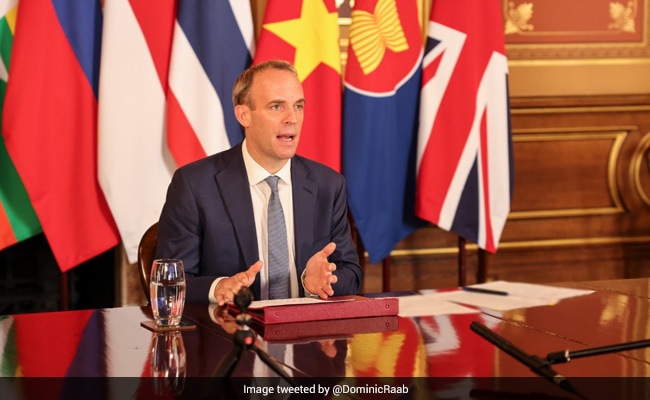
UK Foreign Secretary Dominic Raab joined a virtual ceremony with ASEAN Foreign Ministers where they welcomed the UK as an ASEAN "Dialogue Partner".
"I am delighted that the UK has, today, formally become a Dialogue Partner of the Association of Southeast Asian Nations (ASEAN) bloc - the first new country in 25 years," said Raab.
"This is a landmark moment in the UK's tilt towards the Indo Pacific. Our closer ties with ASEAN will help create green jobs, reinforce our security cooperation, promote tech and science partnerships, and safeguard key pillars of international law like the UN Convention on the Law of the Sea," he said.
India is a Sectoral Dialogue Partner of the ASEAN economic bloc and the UK submitted its application to become a Dialogue Partner in June 2020.
Since then, the Foreign, Commonwealth and Development Office (FCDO) said Raab has attended two UK-ASEAN Ministerial Meetings and hosted the ASEAN Chair at the G7 Foreign and Development Ministers meeting in May.
The FCDO described ASEAN as an influential group of 10 member countries in the Indo-Pacific and with its new status, the UK will formalise its relations with the group - including through attending annual Foreign and Economic Ministers meetings along with other ministerial engagements.
It said that the UK will work with ASEAN and its members on key shared challenges such as maritime security and transnational crime, boost our economies through trade, and strengthen our cooperation on issues such COVID-19 and climate change.
The new agreement will also help the UK to deepen economic links with ASEAN, which has a combined GDP of USD 3.2 trillion.
Total trade between the UK and ASEAN was 32.3 billion pounds in the four quarters to the end of Q1 2021 with huge potential to boost this trade, creating jobs at home.
"This is great news and shows Global Britain in action, forging stronger relationships around the world as an independent trading nation," said UK International Trade Secretary Liz Truss.
In June, the UK formally launched accession negotiations with the Comprehensive and Progressive Agreement for Trans-Pacific Partnership (CPTPP) nations.
The CPTPP is one of the largest free trade areas in the world, accounting for 13 per cent of global GDP in 2019. Four ASEAN states - Singapore, Vietnam, Malaysia and Brunei - are members of the CPTPP.
"Along with CPTPP accession and deals with countries like Singapore and Vietnam, this will help unlock opportunities for British businesses in a high-growth region of more than 650 million people, allowing them to expand and create jobs across the UK," said Truss.
Raab has visited Southeast Asia five times since becoming Foreign Secretary, demonstrating the growing importance of the Indo-Pacific, as set out in the Integrated Review.
The FCDO said the ASEAN announcement comes at a time of growing UK defence and security cooperation in the Indo-Pacific, as the UK's Carrier Strike Group, led by Queen Elizabeth, is in the region and has completed a series of engagements, including with the Indian Navy.
The ties between India and ASEAN have been on an upswing in the last few years with focus being on ramping up cooperation in the areas of trade and investment as well as security and defence.
The ASEAN region along with India together comprises a combined population of 1.85 billion people, which is one fourth of the global population and their combined GDP has been estimated at over USD 3.8 trillion.
UK Becomes Dialogue Partner Of ASEAN In Indo-Pacific Push
The UK has agreed to a new partnership with ASEAN which the British government said on Thursday will lead to closer cooperation with the strategically important Indo-Pacific region on a range of issues such as trade, investment, climate change and s
 www.ndtv.com
Palauan President, Austin Discuss Indo-Pacific Security Concerns
The Republic of Palau is 340-plus islands strategically placed in the Western Pacific bordering the Philippines. The nation became independent in 1981 and entered a Compact of Free Association with the United States in 1994.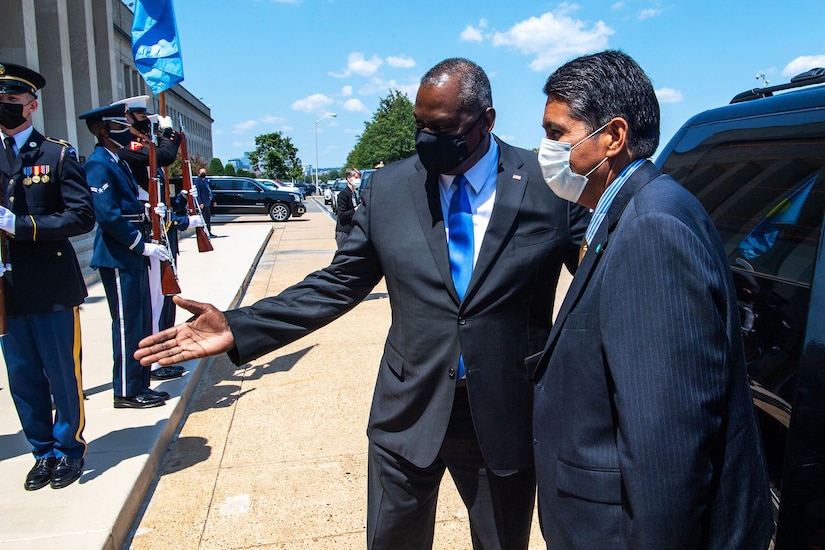
Palau is heavily dependent on tourism and has some of the best scuba diving spots in the world. While the nation has felt the effects of the COVID-19 pandemic — tourism has been curtailed — it has been very successful in combating the virus itself. "Today, you have, as I understand it, zero confirmed cases," Austin said at the beginning of the meeting with the president. "And Palau is the first country that vaccinated 80 percent of the population," said Austin, adding that the statistic is impressive.
Austin began the meeting by thanking President Whipps for the service of his father in the U.S. Army during the 1960s. As part of the compact, Palauns serve in the U.S. military. Austin noted that 500 of the president's countrymen serve today.
"I want to underscore that the Department of Defense is deeply committed to our defense responsibilities as a part of the Compact of Free Association, and we look forward to successful negotiations of the economic assistance provisions of that compact that will strengthen our strategic partnership and help us to promote a free, open and secure region," Austin said.

Palau hosts U.S. forces, and, as the Indo-Pacific becomes ever more important to the United States, the nation will play a greater role. "We appreciate the opportunity to also deploy equipment to Palau that lets us exercise our joint capability and enhanced deterrence," the secretary said. "The U.S. military presence in Palau and across the Pacific Islands is deeply important to our shared goals of partnership and prosperity, and we are grateful for your cooperation and hospitality."
Whipps told Austin that the partnership between Palau and the United States is special. He said during a recent meeting on Guam, the DOD personnel said they were committed to defending the homeland, and Palau is part of the homeland, he said.
"I always say that presence is deterrence," Whipps said. "I was fortunate a few weeks ago to be watching U.S. special forces conduct exercises in Palau. It was extremely exciting to see what they're capable of doing. We want to continue to strengthen the partnership because we believe in a free and open Indo-Pacific."
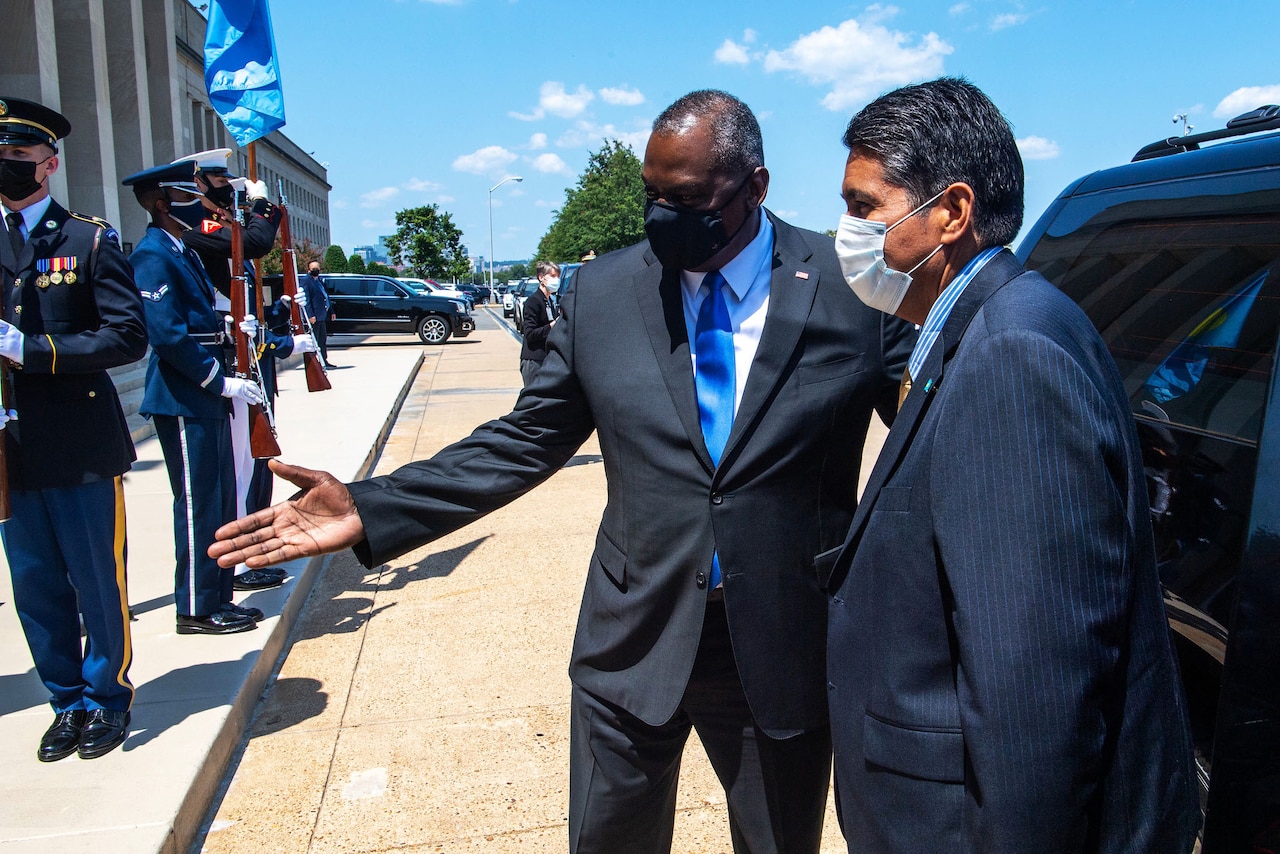
Palauan President, Austin Discuss Indo-Pacific Security Concerns
Palauan President Surangel Whipps Jr. met with Secretary of Defense Lloyd J. Austin III at the Pentagon to discuss ways to strengthen the ties between the two nations to provide for a secure and free
www.defense.gov

What is the ‘Indo-Pacific’ and why does the US keep using this term?
The vast stretch of territory between Australia and India was long referred to in Washington as the Asia-Pacific, before the ‘strategic lexicon’ shifted under Trump.
 www.scmp.com

6 Naval Task Groups From U.S., U.K., India, Japan and Australia Underway in Pacific
KUALA LUMPUR – Six task groups from the U.S, U.K., Australian, Japanese and Indian navies are currently on operational deployments in the Indo-Pacific region amidst an intense fall and early winter period of multilateral exercises.Currently operating in the region are the Navy’s Carl Vinson Carrier Strike Group and Japan-based America Expeditionary Strike Group, the U.K. Royal Navy’s Queen Elizabeth Carrier Strike Group 21 (CSG 21), Australian Defense Force Indo-Pacific Endeavour 21 (IPE 21) task group, Japan Maritime Self-Defense Force (JMSDF) Indo-Pacific Deployment 2021 (IPD21) force and the Indian Navy Eastern Fleet task group.
USS Carl Vinson (CVN-70) arrived at Fleet Activities Yokosuka on Aug. 28 for a scheduled port visit. The strike group deployed on August 2 for the Western Pacific and consists of Vinson, cruiser USS Lake Champlain (CG-57), and destroyers USS Dewey (DDG-105), USS O’Kane (DDG-77), USS Michael Murphy (DDG-112), USS Chafee (DDG-90) and USS Stockdale (DDG-106). The Carl Vinson CSG is expected to conduct an exercise with the U.K.’s CSG 21, which is now currently off the coast of South Korea for a scheduled bilateral exercise with the Republic of Korean Navy.
The America Expeditionary Strike Group – consisting of the USS America (LHA-6), USS New Orleans (LPD-18) and USS Germantown (LSD-42) with the 31st Marine Expeditionary Unit embarked – are in the Philippine Sea conducting routine operations, with America and New Orleans coming off an intensive 12-day exercise and engagement period with both CSG 21 and JMSDF ships in the area. These exercises include the Large Scale 21 and Exercise Noble Union.
The 31st MEU said in a photo release that “Exercise Noble Union is part of the 31st Marine Expeditionary Unit’s Noble Series of exercises which are used to test the Family of Naval Concepts, develop techniques and procedures for the employment of MEU assets in support of sea denial and fleet maneuver and inform future force design and experimentation efforts.”
JMSDF ships taking part in the exercise included helicopter destroyer JS Ise (DDH-182) and destroyer JS Asahi (DD119). A photo released by the JMSDF showed Ise carrying an embarked JGSDF AH-64D Apache helicopter, while the JMSDF release said that “from August 24-25, JS Ise and JS Asahi participated in the Multinational Advanced Aviation Cooperative Deployment as part of the Large-Scale Global Exercise 2021 in the west Pacific with [Japan Air Self-Defense Force], [Japan Ground Self-Defense Force], the Queen Elizabeth Carrier Strike Group, America and F-35B fighters from both the U.S. and Royal Navy.” A separate exercise called Pacific Crown 21-1 took place from Aug 25-26 off Okinawa between the two JMSDF ships and CSG 21.
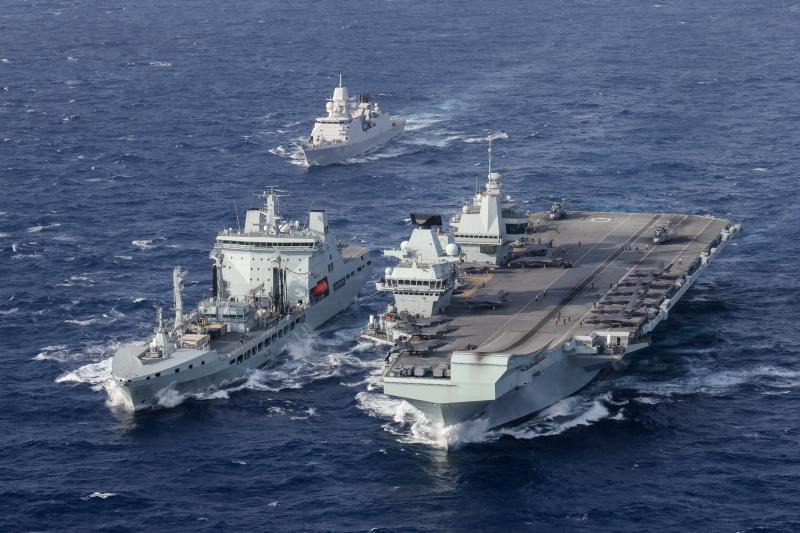
HMS Queen Elizabeth (R-08) on Aug. 30, 2021. UK Royal Navy Photo
The UK CSG 21 elements that took part in the exercise were the carrier HMS Queen Elizabeth (R08) and embarked aircraft, which include The “Wake Island Avengers” of U.S. Marine Corps Fighter Attack Squadron (VMFA) 211. The squadron is integrated with the Royal Air Force’s 617 Squadron “The Dambusters.” The multi-national U.K.-led CSG also includes destroyers HMS Defender (D36) and HMS Diamond (D34), frigates HMS Kent (F78) and HMS Richmond (F239), Dutch frigate HNLMS Evertsen (F805), and American destroyer USS The Sullivans (DDG-68). CSG 21 also includes Royal Fleet Auxiliary’s RFA Fort Victoria (A387) and RFA Tidespring (A136) and an Astute-class submarine. Destroyer HMS Diamond (D34) was forced to drop out of the group in July and dock in Italy due to problems with its engine. The ship was initially expected to get fixed and re-join the group in the Indo-Pacific, but the destroyer’s repairs are still not complete. Richmond had detached earlier from the group in July and is now in Guam following an equipment reset in Sasebo, Japan.
Kent also detached from the main group and docked on Aug. 27 at Sasebo, where it is slated to carry out a short maintenance period. The Astute-class submarine also supporting the deployment docked at the naval base in Busan, Republic of Korea on Aug. 11. The submarine was originally believed to be HMS Artful (S121), which was with CSG 21 during its Mediterranean deployment, but spotters of the submarine in Korea claimed that the nameplate on it said HMS Astute (S119), meaning a switch occurred prior to the strike group’s entry to the Indo-Pacific. Queen Elizabeth was scheduled to make a port call also in Busan along, conducting on-shore engagement activities, but that has been canceled due to the COVID-19 pandemic and instead only an at-sea exercise between the Republic of Korea Navy (ROKN) and CSG 21 will take place from Aug. 30 to Sept. 1 before CSG 21 moves on to Japan.
On Aug. 23, the JMSDF Indo-Pacific Deployment 2021 (IPD21) force departed from Japan, with the task force consisting of the destroyer helicopter carrier JS Kaga (DDH 184), destroyers JS Murasame (DD 101) and JS Shiranui (DD 120), and a total of four embarked helicopters. Supporting the deployment is a submarine and a P-1 Maritime patrol aircraft. The IPD has been an annual deployment for the JMSDF since 2019, with this year’s deployment running until Nov. 25. The goal is to improve the JMSDF’s tactical capabilities and to strengthen cooperation with partner navies in the Indo-Pacific region by conducting joint exercises. The list of countries that the group would drill with include Australia, French New Caledonia, India, Indonesia, Philippines, Palau, Singapore, Sri Lanka and Vietnam.
IPD21’s first engagement activity was phase 1 of the Malabar 2021 exercise between Australia, India, Japan and the U.S. that took place from Aug. 26 to 29 in the Philippines. The U.S. fielded destroyer USS Barry (DDG-52) and oiler USNS Rappahannock (T-AO-204), along with Naval Special Warfare forces and P-8 maritime patrol and reconnaissance aircraft from Task Force 72 for the drills, while India participated with frigate INS Shivalik (F47), corvette INS Kadmatt (P29) and a P-8I. Australia was represented by frigate HMAS Warramunga (FFH 152). Both the JMSDF P-1 and submarine supporting IPD21 also took part in the exercise. Mention of the submarine was omitted from all releases, but shown in the photos the JMSDF released of the exercise.
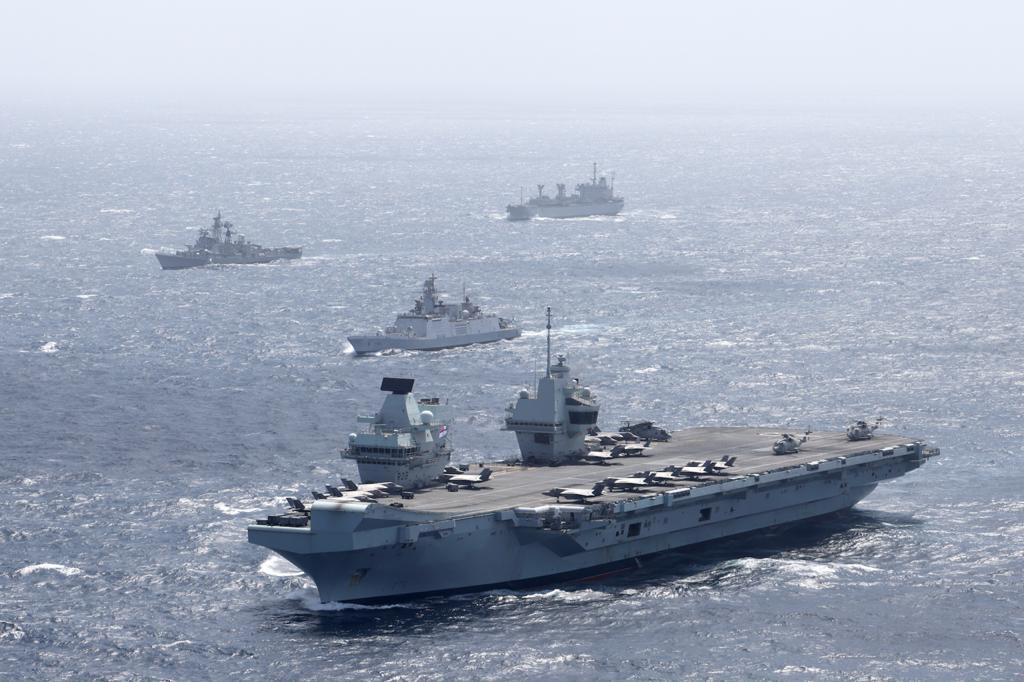
HMS Queen Elizabeth (front) with an Indian Shivalik Multi-role Frigate (second from front) in the Bay of Bengal. Royal Navy Photo
Sivalik and Kadmatt are part of a four-ship Indian Navy Eastern Fleet Task Group that left India in early August for a two-month deployment in South East Asia, the South China Sea and Western Pacific, according to an Indian Ministry of Defence press release. The other two ships in the task group are destroyer INS Ranvijay (D55) and corvette INS Kora (P61). The exercises will include drills with the Vietnamese Peoples’ Navy, the Republic of Philippines Navy, Republic of Singapore Navy, the Indonesian Navy and the Royal Australian Navy. Ranvijay and Kora carried out the exercise with the VPN frigate VPNS Ly Thai To (HQ-012) in the South China Sea on Aug. 18 and then carried out an exercise with the Philippine Navy frigate BRP Antonio Luna (FF 151) on Aug. 23 in the West Philippine Seas. The Indian Navy’s Eastern Fleet deployments to Southeast and Northeast Asia have been a regular occurrence over the years, in line with the Indian navy’s extensive bilateral engagements with countries there, along with engagements under the Quad partnership.
On Aug. 26 the Royal Australian Navy LPD HMAS Canberra (L02) and frigate HMAS Anzac (FFH150) left Darwin to begin the ADF’s Indo-Pacific Endeavour Deployment 21 (IPE21). The deployment has been an annual activity for the ADF since the beginning of 2017, with odd years taking place in Southeast Asia and even years taking place in the Southwest Pacific. The 2020 IPE was canceled due to COVID-19.
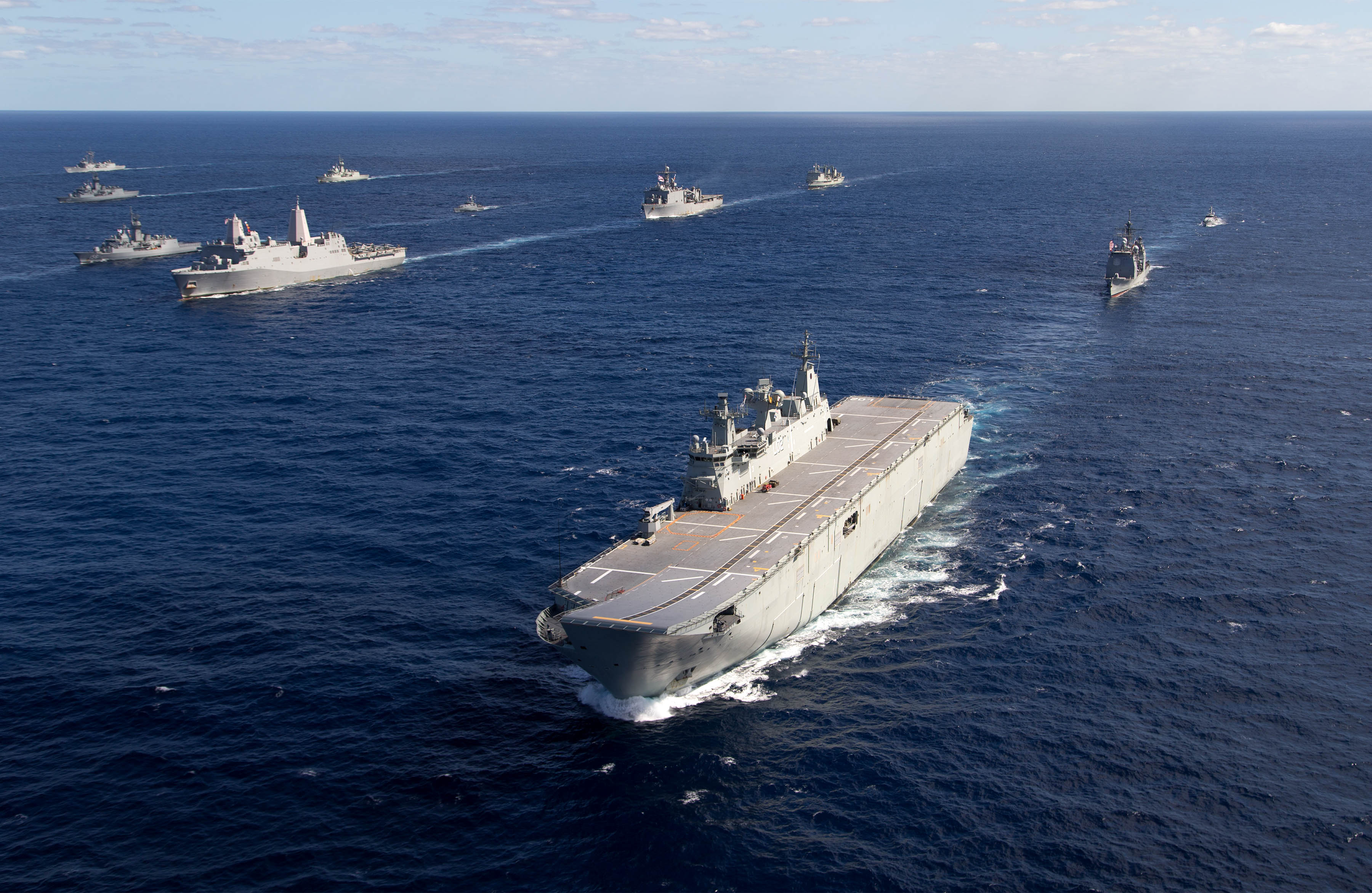
HMAS Canberra forms up with Navy Ships from United States of America and New Zealand on completion of Exercise Talisman Saber 17.
The deployment is run as a joint service deployment centered around a maritime task group built around one of the two Canberra-class landing helicopter dock ships. Australia’s Department of Defence said IPE21 involves approximately 700 people – including Australian Defence Force and civilian defense personnel, and sea riders from partner nations – and that the engagements have been modified in response to the COVID-19 pandemic. The engagements will be carried out primarily through contactless port visits, including a range of virtual workshops and at-sea activities. The IPE21 deployment will see the task group engage with Australia’s partners in Southeast Asia, in addition to participating in the Five Power Defence Arrangements Bersama Gold exercise in October, which marks the 50th anniversary of the defense arrangement between Australia, Malaysia, New Zealand, Singapore and the United Kingdom. Because of the COVID-19 situation in Malaysia, which is slated to host the exercise, Australian, U.K. and New Zealand naval and air assets will stage out of Singapore, rather than Malaysia as originally planned. Activities will mainly include contactless at-sea and in-air engagements, though a scaled-down formal ceremony involving Ministers and Defense Chiefs of the five countries is still on schedule. It is unclear whether the ADF’s MRH90 fleet – grounded in June 2021 and what normally forms the helicopter component for the IPEs – are embarked for the IPE21 deployment. The IPE21 task group is expected to return to Australia in November.

6 Naval Task Groups From U.S., U.K., India, Japan and Australia Underway in Pacific - USNI News
KUALA LUMPUR – Six task groups from the U.S, U.K., Australian, Japanese and Indian navies are currently on operational deployments in the Indo-Pacific region amidst an intense fall and early winter period of multilateral exercises. Currently operating in the region are the Navy’s Carl Vinson...
 news.usni.org
Moving closer: European views of the Indo-Pacific
Summary
- The launch of the EU’s strategy for the Indo-Pacific should mark the beginning of a new approach to the region.
- But ECFR research shows that, despite the Indo-Pacific’s growing economic and political importance, many member states are still largely uninterested in events there.
- It will take more than just strong support from France, Germany, and the Netherlands to ensure that the new EU strategy for the Indo-Pacific is effective in the long term.
- The three countries have an opportunity to convince other member states that the region is vital to European sovereignty and prosperity.
- They can do so by creating visible projects that demonstrate their presence and intent in the Indo-Pacific, and by establishing coalitions for greater European engagement in areas such as technology and maritime security.
Introduction
The world’s economic and political centre of gravity has been shifting towards the Indo-Pacific for years. With China playing an increasingly dominant role in everything from trade to military power and technology, the relative decline of American supremacy is palpable. This poses a new challenge for Europe, whose economic future and geopolitical relevance is inextricably linked to developments in Asia.It has been decades since policymakers across Europe focused intensively on any strategic development in the Indo-Pacific that did not involve trade. Since the early 2000s, the European Union has been busy dealing with issues at home or in its immediate neighbourhood.
The concept of the “Indo-Pacific” first emerged within the region – particularly in Japan and Australia – and reshaped the previously dominant “Asia-Pacific” narrative, mainly as a way to articulate these countries’ requirements for prosperity vis-à-vis China and their reliance on the US security guarantee. The Trump administration appropriated the concept and gave it a distinctly anti-China connotation. Until last year, the EU had not engaged with the idea of the Indo-Pacific on a broad conceptual basis, let alone defined its policy priorities for the region. The union feared that doing so would indicate alignment with the US and would alienate China. Therefore, the notion that there was an Indo-Pacific to deal with had gained little traction in Europe. But several EU member states have now begun to push Brussels to embrace the Indo-Pacific as a strategic concept.
France, Germany, and the Netherlands have, in different ways, drawn up national Indo-Pacific strategies in recent years. They have been the driving force behind the EU’s effort to find a more decisive approach to the region. This effort led to the release in April 2021 of the European Council’s conclusions on the “EU Strategy for Cooperation in the Indo-Pacific”, which paved the way for the union to adopt an official strategy that can now initiate a new approach. To move from the drawing board to implementation, Europeans will need to answer several tough questions that are in tension with the consensual language of EU documents.
Can the EU really ‘get strategic’ about its interests and its member states’ priorities in the Indo-Pacific? Beyond countries that have a clear preference for a more active approach, are any member states strongly opposed to greater European engagement in the region? Will indifference prevail, or has the EU undergone a strategic awakening that will recentre its policymaking on the region’s enormous potential for European interests? (A question that applies to areas ranging from trade to the defence of the rules-based order, to the European Green Deal, to infrastructure finance and development assistance.) And what role does the China factor play?
It will likely take more than a strong push from France, Germany, and the Netherlands to ensure that the EU implements a long-term strategy in the Indo-Pacific. So, where do member states stand on these issues?
This paper draws on a survey that the European Council on Foreign Relations carried out to understand how key policy stakeholders in each member state view the prospect of a new form of European engagement with, and conceptual framing of, the Indo-Pacific. The results of this expert survey show that, despite the region’s growing economic and political importance, indifference to it prevails in many EU member states. This suggests that those leading the debate should make a greater effort to present a convincing story about why Europe should be active in the Indo-Pacific and how it can engage more effectively with its partners in the region – aiming to make use of its own strengths in a world of increasing great power rivalry.
The results of the survey highlight the intensity – or lack thereof – of the debate about the Indo-Pacific in each member state. These differences could eventually limit the impact of any strategic reorientation. There is a risk that the EU’s approach to the Indo-Pacific will be no more than the sum of disparate policies that are only weakly linked and that have no capacity to generate new partnerships between Europe and Indo-Pacific countries and organisations. To prevent this from happening, key players will have to turn the strategy into reality.
The data indicate that they can do so: given that indifference is a bigger issue than real opposition among member states, it should be possible to establish more decisive and visible European positions on Indo-Pacific matters. If select groups of member states create visible projects that signify their presence and seriousness in the region, they can generate momentum for greater European engagement – and thereby strengthen European sovereignty and prosperity. In this context, the Indo-Pacific strategy can be important to how Europe reshapes its role in the world.
An emerging strategy
In April, the Council of the EU released its conclusions on the “EU Strategy for Cooperation in the Indo-Pacific” and the 27 EU foreign ministers formally invited Josep Borrell to present a new, fully fledged strategy for the region by September 2021. By EU standards, this was an achievement – 20 months earlier, the term “Indo-Pacific region” was not even used in official documents in either the EU or its member states. One exception was France, which had developed its own strategy in 2018 (before revising it in 2021) and had been pushing ever since for the adoption of an EU-level equivalent. With regard to its overseas territories in the region, France is the only European country that sees itself as a “resident power” in the Indo-Pacific. Without such a role, other member states seemed wary of formally adopting the concept. This is due to its geopolitical connotations. Germany’s release of its “Policy guidelines for the Indo-Pacific region” in September 2020, soon followed by the Netherlands’ own guidelines, marked the beginning of a demonstration on the part of countries beyond France that one does not need to be a resident power to have, and clearly formulate, one’s interests in the Indo-Pacific.The debate on the region has, therefore, now begun to gain traction. It has ultimately led to the release of the Council’s conclusions – which will, in turn, result in an actual EU strategy. The publication of the conclusions needed to be approved by all 27 EU foreign ministers, meaning that every member state was forced to deal with the issue of the Indo-Pacific at this level.
The speed of the shift, though, is symptomatic of a change in perceptions of international power relations and their potential impact on Europe. Europeans have been forced into a rethink by their fears about the consequences of China’s rise – and by their uncertainty about the United States’ commitment to European security and its willingness to protect European interests from the potentially negative consequences of the Sino-American rivalry. Together, these factors point to the centrality of the China question – leading to increasingly difficult questions about the posture the EU should adopt vis-à-vis Beijing. And, while the transatlantic relationship cooled significantly during the Trump era, Beijing’s geopolitical activities – from its “mask diplomacy” during the covid-19 pandemic to its actions in Hong Kong and Xinjiang – have dispelled Europeans’ relative optimism about the future trajectory of EU-China relations. There has been a significant rise in pressure on Europe to adjust to the increasingly polarised and tense relationship between China and the US.
So far, Europeans have fallen short in their efforts to articulate a response to these developments. The US strategy for the Indo-Pacific explicitly names China as a “strategic rival”. In contrast, the national strategies of France, Germany, and the Netherlands seek to avoid difficult positioning on the China question by insisting on “inclusivity” – suggesting that Beijing should be more of a partner than a rival. The real division within Europe, though, does not seem to concern whether China is part of the Indo-Pacific concept. Rather, it involves two opposing approaches to inclusivity. The first approach reflects nothing more than a desire to avoid the China question by insisting on the need for cooperation with all, and by glossing over the potentially problematic aspects of the relationship. The second approach acknowledges conflicts of interest and differences in values with Beijing, but nevertheless calls for continued cooperation with China, as a way to push Beijing to adhere to internationally accepted standards and forms of behaviour.
The division that runs through Europe’s ambivalent approach to Beijing comes from fundamental differences in the ways that member states address the China challenge. This becomes particularly obvious when one compares the French strategy with the German guidelines. The French insisted from the beginning on the need to prevent the emergence of a new hegemon and to re-establish a “level playing field” in Europe’s relations with China. However, the German text only carefully alludes to the notion of countering China and devotes significantly more attention to the economic opportunities offered by the Indo-Pacific “region” rather than to the underlying security questions.
The survey
ECFR’s pan-European network of national researchers conducted qualitative interviews with stakeholders in their respective EU member states. The stakeholders included policymakers, members of parliament, relevant ministries, and leading experts from academia and the not-for-profit sector. A questionnaire was designed to help facilitate the interviews and produce comparable results. The answers selected were predefined in a survey but were chosen on the basis of researchers’ overall assessment of views in their member states. Participants’ responses only relate to the EU’s emerging strategy, and may differ from national preferences.The French had been pushing for an EU strategy since 2018, but it was only after the publication of the German guidelines that enough momentum was generated for other member states to endorse the Indo-Pacific concept. The fact that the two countries, as well as the Netherlands, jointly pushed for a pan-European strategy eased the process. Yet it did nothing to eliminate the divides between European states in their willingness to stress their differences with China. Nor will the EU’s resulting Indo-Pacific strategy. While it is still unclear how significant the strategy will be, this will be determined by two things: its content and, ultimately, its implementation. Europe will need to set measurable goals and work to achieve them by making a sustainable financial and security commitment to the region.
It is remarkable that the EU has got as far as it has. Member states do not yet even agree on a geographical definition of the Indo-Pacific or what the concept means. The Indo-Pacific is not a predetermined space in which one can apply the national strategies of states – let alone a European strategy. Instead, the specific interests of states shape their understanding of what and where the Indo-Pacific is. This is by no means an academic debate. Divergent definitions indicate divergent interests – and, potentially, varying degrees of involvement in the creation of an EU Indo-Pacific strategy. More importantly, these differences in countries’ concepts of the Indo-Pacific as a geographical area could limit their participation in policies.
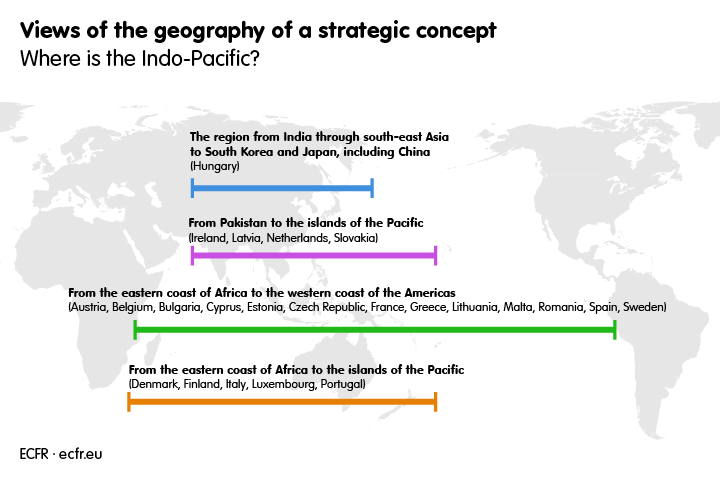
European countries face many of the same challenges as their partners in the Indo-Pacific. And geography is relatively unimportant on some of these issues, such as the potential risks of emerging technologies, ensuring supply chain resilience, countering disinformation, and managing China’s growing assertiveness. Therefore, Europe’s new outlook on the Indo-Pacific stems from a political recognition of the need to shoulder greater global responsibility. But it also reflects a desire to have an impact on the affairs of a region that is far away but whose fate is intertwined with Europe’s own.
The strategic significance of an EU Indo-Pacific strategy
Europe’s divisions over how to approach the Indo-Pacific clearly emerge in ECFR’s expert survey. Ten EU member states from across the continent view the adoption of an Indo-Pacific strategy as both a way to deal with China and a way for Europe to take advantage of new economic and other opportunities. But, for 13 states, the Indo-Pacific concept is merely a field of opportunity to pursue economic interests, and the China question does not figure prominently. Only Latvian policy elites appear to see an upgrade of Indo-Pacific policy as truly an anti-China tool. This split reflects member states’ differing views about whether to consider the Indo-Pacific in strategic terms or economic terms. As many of them lack major military capabilities, they may assume that the broader geopolitical shift taking place is one that can be dealt with only by larger EU member states or the US. Some may not even have strong economic connections but may assume this would still be the main way to engage with the Indo-Pacific. The lack of consensus is illustrative of the ambivalence in Europe about how or even whether to devise a comprehensive and strategic approach to the region.In terms of how the question relates to the transatlantic partnership, 11 member states regard the adoption of an EU Indo-Pacific strategy as an assertion of “European strategic autonomy” – Europe striking out on its own, without the need for the US to support it. Eight view it as a way of managing the transatlantic alliance – potentially keeping the US engaged as Washington focuses more on the Pacific rather than on Europe. Six countries see the launch of an EU Indo-Pacific strategy as part of an explicit effort to align with the US and support it in the region. These views are not mutually exclusive. And, ultimately, the emerging strategy has not expressed a clear geopolitical position on why the EU is drawing up new plans. While a clearer articulation of its stance could no doubt prove controversial, it would be necessary to ensure the strategic approach has a backbone that holds the whole concept together.
If any pattern is to be discerned, western European countries tend to perceive the coming launch of an Indo-Pacific strategy as an assertion of strategic autonomy, as do the Czech Republic and Slovakia. In contrast, almost all countries that see the creation of an Indo-Pacific strategy as a sign of alignment with the US were once members of the Soviet bloc. The one exception is Portugal. But many states categorise the launch of the Indo-Pacific strategy in more than one way. Western European states tend to view the prospect of an EU Indo-Pacific strategy as both a way to manage the transatlantic alliance and an assertion of strategic autonomy; eastern European states regard it as a way to manage the transatlantic alliance and align with the US.
But this geopolitical positioning goes far beyond the transatlantic dimension. When asked which partners in the region the EU should work with to ensure its strategy succeeds, only five countries name the US – the same number as those that select India. Even after Brexit, the United Kingdom receives seven mentions. This could be because several states – especially those in eastern Europe and the Baltic region – implicitly rely on the US to ensure the security of their interests in the Indo-Pacific. Accordingly, they may take this cooperation as a given. But it might also be the direct consequence of the launch of the UK’s Integrated Review only a few weeks before the survey was conducted; the document had a strong focus on the Indo-Pacific and a consistency of intent that is difficult to achieve in a union of 27 countries. The perception may also have been reinforced by Britain’s past colonial relationship with significant parts of the Indo-Pacific region, creating the impression that it is an important player with which close ties are not only possible but also likely.
Remarkably, 12 EU member states name China among their top three key partners in the Indo-Pacific. This is logical, as a number of European states still see China primarily as a potential market. That said, five countries – Belgium, Bulgaria, Latvia, Portugal, and Romania – also define the Indo-Pacific strategy as being at least partly an anti-China tool.
The Association of Southeast Asian Nations (ASEAN) emerges as the most popular candidate for cooperation in the Indo-Pacific: 21 countries regard the organisation in this way. Supporting the ASEAN-led regional architecture makes strategic sense from an EU standpoint, because strong relations with several partners in the region may also support EU member states’ posture against China’s political influence. Europe clearly favours a multilateral approach to foreign policy – as opposed to the bilateral one Beijing prefers. Therefore, engaging with individual members of ASEAN such as Indonesia, Vietnam, and the Philippines does not appear to be a priority for most European governments. European countries see other multilateral formats as significantly less potent – each received only one mention: the Asia-Europe Meeting (Cyprus), the Indian Ocean Rim Association (Italy), the Community of Portuguese Language Countries (Portugal), and the South Asian Association for Regional Cooperation and the Bay of Bengal Initiative for Multi-Sectoral Technical and Economic Cooperation (Sweden).
The EU and security in the Indo-Pacific
For Europe as a trading power, the security dynamics that matter most in the Indo-Pacific region are playing out in the maritime realm. When speaking about maritime security, EU countries often focus on the security of the sea lines of communication. But the concept of maritime security is evolving to cover far more than guarantees of safe passage for commercial vessels. Europe needs to focus on the protection of not only maritime routes but also freedom of navigation, the exclusive economic zones of several actual and potential partner countries, the oceans, data traffic through undersea cables, and marine biodiversity.As ECFR’s survey shows, 23 EU member states consider security, broadly defined, to be an important component of an EU strategy for the Indo-Pacific. Only four states see security as unimportant to such a strategy. Those that characterise security as “very important” for an EU Indo-Pacific strategy are mainly from eastern Europe and the Baltic region: the Czech Republic, Estonia, Latvia, Lithuania, Romania, and Slovakia. Estonia, Latvia, and Romania explicitly link this assessment to their relationship with the US. This relates to the importance they ascribe to the US as a partner in general and the understanding that supporting Washington in a range of policy areas will strengthen the American commitment to providing security in Europe. The survey results suggest that Latvian policy elites think the US should be an explicit part of any European approach to the Indo-Pacific.
The US dimension is also key for some states that view the security dimension of the EU strategy for the Indo-Pacific as “somewhat important”. Finland, for example, explicitly refers to the importance of cooperating with like-minded countries such as the US. For Belgium and Bulgaria, there is a strong connection between China’s rise and the security dimension of an EU Indo-Pacific strategy. But there are also outliers: Portugal appears to be against linking any security strand to specific interstate territorial or maritime disputes. Surprisingly, France – which is the most militarily engaged EU country in the Indo-Pacific – sees the security dimension of the EU strategy as only “somewhat important”. ECFR’s research suggests that this dimension ought only to complement France’s own security policies, in which cooperation with the US – as well as Australia, India, and Japan – is an important component.
Interestingly, the US factor also influences thinking in countries that see security as unimportant for the EU strategy for the Indo-Pacific. Lithuania has little security interest and capacity in the region, but it agrees that it is important to include security in a future Indo-Pacific strategy – as this may help sustain the United States’ involvement in Europe. Overall, the importance of security to the EU strategy for the Indo-Pacific is, explicitly or implicitly, a function of its value in demonstrating dedication to the alliance with the US, thereby securing the American commitment to Europe. These considerations at least partly explain why states with limited military capacities to dedicate to the Indo-Pacific – the Czech Republic, Estonia, Lithuania, Luxembourg, Poland, and Slovakia – support the idea of the EU increasing its investment in maritime security activities in the region. It is questionable whether this will translate into an actual mobilisation of resources from these countries for security in the Indo-Pacific. However, political support from these countries could be useful if the EU wants to build a coalition of individual EU states, one that commits to doing more to defend European interests in the region.
The survey asked what types of security cooperation or support member states would like the EU to invest in, as well as those to which they are ready to contribute. Twenty-one states view cyber security as a priority for the EU – more than see maritime security in this way. Their perceptions could be partially explained by the fact that Indo-Pacific maritime security involves only a limited direct threat to European territorial sovereignty and integrity, while the immediate effects of cyber attacks are already palpable in Europe itself. Equally, cyber security is an area in which there could be a huge opportunity to not only strengthen Europe’s defensive capabilities at home but also enhance European security through information exchange with partners in the region that face similar challenges.
Austria, Bulgaria, Croatia, Cyprus, the Czech Republic, Denmark, France, Germany, Greece, Italy, Luxembourg, the Netherlands, Poland, Slovakia, and Sweden say that counter-terrorism should be included as part of the security dimension of any future strategy. This may be because of these countries’ history of terrorist attacks on their territory.
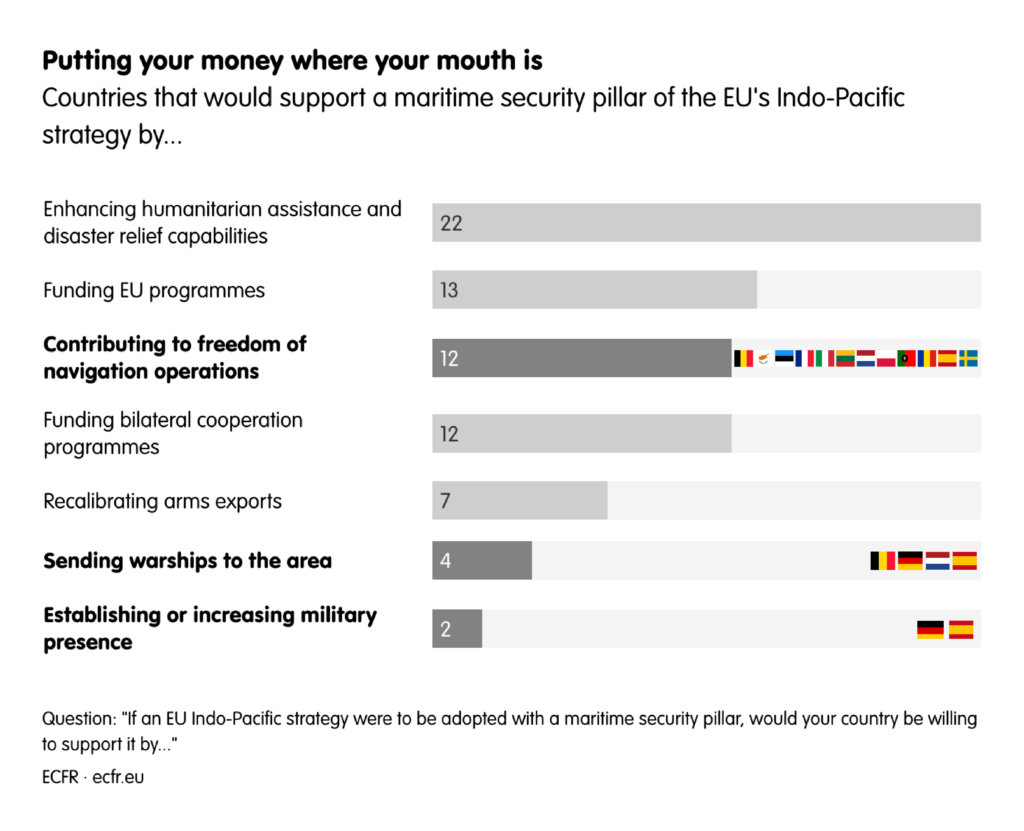
Stating that security is important is one thing, but how many countries are prepared to put their money where their mouth is? Only a limited number of member states are willing to contribute to maritime security activities. Twelve states are prepared to participate in freedom of navigation operations, but only Germany and Spain say they are willing to establish or increase their military presence in the Indo-Pacific. And both are ready to send warships to the region – as are Belgium and the Netherlands. With only these countries happy to contribute, there may be a disconnect between actions that countries recognise as important and the means they are willing to commit to them. This could mean that the EU will make little active contribution to the security of the Indo-Pacific. But it could also serve as an incentive for the EU to become involved in Indo-Pacific security based on its actual capacities – such as by, for example, helping littoral states in the region control their exclusive economic zones.
In this context, policymakers in some member states also highlight the link between maritime security and support for the sustainability of the oceans. Fisheries management is of particular importance, as this activity is an economic, environmental, and – increasingly – geopolitical issue. As demonstrated by long-standing territorial disputes between China and neighbouring countries in the South China Sea, fisheries management contributes to the evolution of the strategic landscape. This landscape is characterised by not just the military balance of power – an area in which Europe has clear deficits that it can hardly address in the short term – but also a mixture of capabilities to deal with various challenges.
By including the issue of fisheries in an Indo-Pacific strategy, the EU would not only do justice to European interests in this realm but would also establish a presence in a contentious area in which it has ample experience. Fisheries management is a highly relevant issue in the region and has enormous security implications. It is one in which Europe can be of value beyond its military capacity and can help contribute to security by supporting multilateral approaches that are non-confrontational, inclusive, and consistent with EU interests and values.
Similarly, most member states are ready to contribute to humanitarian assistance and disaster relief capabilities. Thirteen states are willing to contribute funds to EU operations, and 12 are willing to operate through a bilateral cooperation programme, in these areas. These last two options are not mutually exclusive: eight countries are willing to contribute to both EU and bilateral cooperation programmes. This suggests that Europe has options when it comes to engaging with the region – and that it can support its Indo-Pacific partners through both bilateral and multilateral engagement as appropriate.
The survey data indicate that member states generally support an increased European commitment to maritime security in the Indo-Pacific, but that only a few of them are willing to dedicate military capabilities to protecting European interests. There is a clear preference for limiting involvement to non-military activities. The EU will continue to lack credibility on ‘hard security’ in the region. But, even if its non-military contributions are not decisive, it could still be an important source of support for its partners in the region as they manage a multitude of new security scenarios.
Diversifying economic relations and developing markets
The Indo-Pacific is key to global growth. Currently, it is the second-largest destination for exports from the EU and home to four of the bloc’s top ten trading partners. In 2019 the region accounted for more than 40 per cent of Germany’s non-European trade in goods – a share that will only increase (particularly during the post-coronavirus recovery). India, for instance, is the world’s largest openly accessible data market. And, by 2025, India and Indonesia will collectively account for almost 25 per cent of the world’s data users.[1]The vast majority of EU member states see the Indo-Pacific as an area of huge economic opportunity. At a time of increasing great power rivalry and enormous localisation pressure in China, there is a growing need for diversification within the region away from the dominant Chinese market. This is particularly true for German industry, which is heavily involved in the Chinese markets and deeply intertwined with China through its supply chains. German companies have woken up to this challenge and are also pushing for a diversification agenda, reinforcing the political dynamic at the EU level.
As shown by ECFR’s survey, nine member states – Austria, Belgium, Bulgaria, Croatia, the Czech Republic, Lithuania, Poland, Portugal, and Romania – regard enhanced economic engagement with the region as not only part of a diversification strategy but also a tool to counter China.
In EU member states’ bilateral relations with countries in the region, differing assessments of China – of how to constrain or accommodate the country – are currently less relevant. However, as soon as the EU wants to act jointly and use its collective leverage and resources, these differences could create significant tensions. This holds true for inclusive multilateral trade agreements and the EU’s oft-mentioned connectivity strategy.
Connectivity
Connectivity – as defined by Brussels in the EU-Asia connectivity strategy – is intended to bring countries, people, and societies closer together. It is supposed to facilitate closer economic and personal relationships. ‘Hard’ connectivity includes the construction of physical infrastructure, electricity transmission systems, and the bases for data transfers; ‘soft’ connectivity includes people-to-people exchanges and the harmonisation of regulatory standards to enhance cross-border trade. Connectivity is one of the key areas in which the EU can enhance cooperation and deepen its relationship with the Indo-Pacific.The adoption of the EU-Asia connectivity strategy by the European Commission in September 2018 came to feature prominently on the evolving EU agenda on the Indo-Pacific. This was widely interpreted as an attempt to provide countries in the region with an alternative to Beijing’s Belt and Road Initiative. European officials view connectivity as a geopolitical tool that can help promote the strategy, interests, and values of the EU in the Indo-Pacific by enhancing the EU’s strategic autonomy and its ability to act. But the wide range of topics that fall under the broad definition of “connectivity” also means that individual member states are often driven by very different priorities.
When asked to describe the nature of the debate on connectivity, 12 EU member states reported that the domestic discussion on the issue was rudimentary or non-existent. Among those reporting that debates on connectivity were taking place within their country, 11 stated that they focused on digital and transport issues, while seven said that energy was the main concern – underlining a focus on hard connectivity that produces tangible structures such as roads, bridges, and energy grids. Six countries see trade as the key feature of connectivity.
When asked how to choose connectivity infrastructure projects in the region, 19 states said that European economic interests should be the main priority. This rests on the prevailing logic in Europe that projects should only be funded if they are economically viable and sustainable. It also is indicative of the commercial opportunities for European companies in this context. European companies have not played a massive role in China’s Belt and Road Initiative, meaning that they have been missing out on market share and massive public spending. Only four countries directly said that countering China should be a priority of Europe’s connectivity push in the region. But the interviews ECFR conducted in ten countries – Austria, Belgium, Finland, France, Germany, Hungary, Latvia, Lithuania, Poland, and Slovakia – indicated that China or the Belt and Road Initiative serve at least as a backdrop for the strategic thinking on connectivity in the Indo-Pacific region.
From trade as strategy to trade versus strategy?
For decades, trade and investment have been at the heart of Europe’s approach to the Indo-Pacific, and have dominated its relationship with countries in the region. Does Europe, following its Indo-Pacific awakening, want to become a strategic partner for these states? And how important will trade be in their relationships?The results of the survey indicate that most EU member states still mainly view the Indo-Pacific as a region of economic opportunity. But as the covid-19 pandemic has laid bare the risks of globalised supply chains and markets, deglobalisation trends are becoming more apparent around the world. Some countries in Europe have remained relatively immune to this: ECFR’s survey indicates that Cyprus, the Czech Republic, Greece, Italy, Malta, the Netherlands, and Slovakia believe that the benefits of globalisation outweigh its costs.
However, as this paper’s country reports show, there has only been a debate on deglobalisation in 19 member states (in differing forms and intensities), correlating with their exposure to international trade. In most countries, the debate has revolved around how to balance the risk of overdependency, notably on China, and the vulnerability of supply chains with the risk that deglobalisation will have a negative impact on their economies, resulting in a loss of global market share, international business, and jobs at home.
As such, the survey shows that European countries largely see the globalisation debate as a search for ways to manage risk and better balance national and international interests – leading to considerations about opportunities to modernise national industries and, often, about reshoring or nearshoring, as well as the ‘reindustrialisation’ of Europe. This debate is sometimes opportunistic: some countries hope to benefit from nearshoring by major European producers such as Germany, which might decide to relocate their production facilities from China and other Asian countries to states closer to home. Overall, though, the survey suggests that debate in Europe focuses more on trade diversification than on reshoring production capacities. This is partly due to the difficulty of moving production away from China. It is also due to the fact that growing demand in south and south-east Asia means that there will be an increasing number of customers close to the site of production.
These considerations are also reflected in the preferences EU member states express about potential trade agreements between the EU and Indo-Pacific countries. Their views on the matter are particularly important in the context of an EU strategy for the Indo-Pacific, as the union’s competencies in trade allow it to act in a more unified fashion than it can in most other areas. Additionally, trade agreements involve not only economic but also geopolitical interests, as they encompass a broad set of values, norms, and standards. The EU has engaged in a broad push to sign additional free-trade agreements (FTAs) in the Indo-Pacific region since the effective failure of the Doha round negotiations at the World Trade Organization (WTO) in 2008. This has already led the EU to conclude FTAs with countries such as Japan, South Korea, Singapore, and Vietnam, and to negotiate with a number of others, including Australia and Indonesia. Within the scope of its latest Indo-Pacific push, the EU restarted negotiations with India in 2021. A multitude of bilateral FTAs, however, is only the second- or third-best option. In the absence of a reformed WTO structure, these FTAs serve European interests in supporting free and equal trade, while adding important new areas such as data and digital trade to the regulatory framework. A broader FTA that encompassed many states in the Indo-Pacific – and that harmonised the trade environment for European businesses active in the region – would be preferential to a series of bilateral arrangements. Such a deal would make it easier to do business across a larger geographical space and different legal environments. But, so far, this has not been possible.
In this sense, Europeans’ attitudes towards the possibility of an FTA with China, and China’s inclusion in larger trade agreements that the EU may conclude in the Indo-Pacific, are significant. EU member states are divided on these issues. Ten of them support the conclusion of an FTA with China or the inclusion of the country in an all-encompassing agreement. Policy elites in Austria, Bulgaria, Croatia, Cyprus, Denmark, Greece, Ireland, Malta, Poland, and Sweden believe that China cannot or should not be excluded from potential trade agreements with the EU. However, they express some ambivalence on the issue. Senior officials in Bulgaria, for example, fear that China could sabotage an all-encompassing trade agreement by putting pressure on other Indo-Pacific actors.
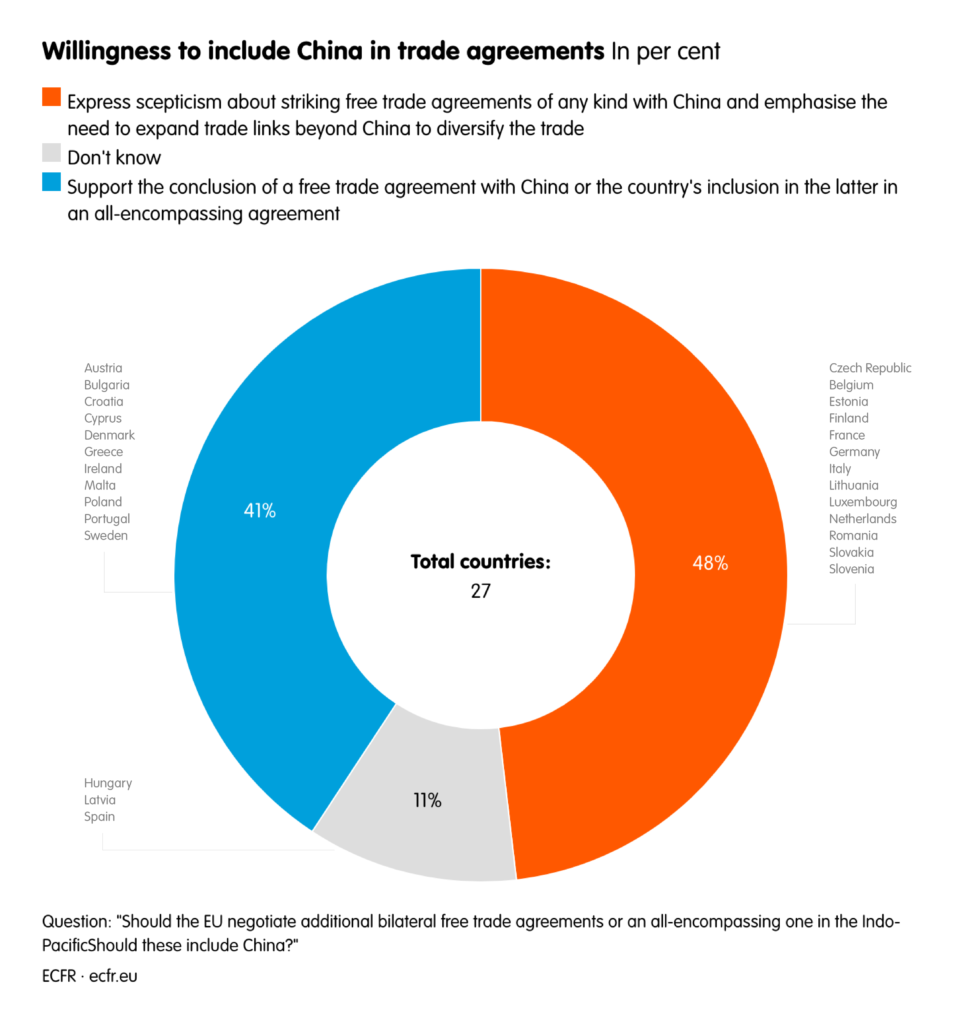
Unsurprisingly, however, 14 member states’ scepticism about China’s potential participation in EU trade agreements reflects ambivalence more than principled and blunt opposition. In Belgium, for instance, key stakeholders suggest that the country would support the conclusion of a trade agreement with China conditioned on Beijing’s respect for international law. Stakeholders in Finland and Portugal express similar views, declaring that China should not be excluded but ought to be held to the same standards as others. It appears that the Netherlands would make a deal with China conditional on the latter adopting the standards and norms that Europe incorporates in all its free-trade arrangements – ranging from environmental protection to labour rights and data privacy. German policymakers do not openly question a comprehensive trade relationship with China but do emphasise the need to extend its trade links beyond the country, aiming to strike the right balance between rivalry and partnership. Their French counterparts express political concerns about including China in a future trade agreement.
There is a broad consensus in attitudes towards the overall approach the EU should adopt. All member states support the conclusion of bilateral FTAs with countries such as Australia, Indonesia, Japan, and India rather than all-encompassing agreements – which are more complex, lengthier, and sometimes unrealistic. Eleven countries see ASEAN as one of the top three entities with which the EU should aim to create an FTA. Eight would rank members of the Comprehensive and Progressive Agreement for Trans-Pacific Partnership as key partners. But, even for a country such as Germany, which has made the conclusion of an FTA with ASEAN one of the objectives of its own policy guidelines on the Indo-Pacific, such an agreement should only be the outcome of a gradual process in which the creation of a network of FTAs will be the basis of a future interregional agreement between the EU and ASEAN.
The quasi-consensus among the 27 EU member states on a high-standards agreements may make it difficult for the EU to conclude FTAs with groupings of any kind. At least 25 member states agree that there is a need for strong environmental standards, intellectual property protections, competition regulations, and measures on subsidies or state-owned companies. These preferences are already reflected in the way in which the EU concludes FTAs in the region, generally by negotiating with a number of smaller, less developed countries. The union’s FTA with Vietnam stands in contrast to this. The fact that the EU has been able to conclude this agreement suggests that it is the gold standard for FTAs with a developing economy in the region.
Technology
Against the backdrop of the strategic rivalry between the US and China, competition over technology is set to become a major area of friction between states. More than any other domain, technology presents EU member states with a dilemma in which their relative weakness is difficult to address. To foster digital governance based on international norms and standards, Brussels will need to work closely with its like-minded partners in the Indo-Pacific. The EU has already acknowledged the region as critical to Europe’s digital interests – and is, therefore, widely expected to include technology in a comprehensive Indo-Pacific strategy.There is no discernible pattern in member states’ priorities on technology. Fifteen countries regard the issue of 5G as important within Europe, but only Sweden and Latvia view 5G partnerships – which, in the past few years, have been at the centre of EU discussions on the connectivity strategy – as the top priority. Research and development cooperation is the top priority for nine countries and the lowest priority for seven others. Concern about cyber security is not concentrated in any geographical area, with Croatia, the Czech Republic, Finland, and Slovenia regarding it as their top priority. Seven countries – among them Denmark, France, the Netherlands, and Slovakia – list cyber security among their two lowest priorities for the technological dimension of the EU’s Indo-Pacific strategy.
Conclusion
ECFR’s survey confirms the centrality of the China question to Europe’s relationship with countries in the Indo-Pacific and its foreign and economic policymaking more broadly. The EU’s Indo-Pacific awakening has been largely prompted by shifting geopolitical realities and changes in its relationship with China – as well as developments within the country.The EU’s long-term strategic approach to the Indo-Pacific will need to account for these drivers. Concerns about China appear to shape all the views that member states expressed on the potential components of Europe’s future engagement with the region. Most member states are not significantly dependent on trade with China. Yet the Chinese market’s potential as a future source of growth and prosperity looms large across Europe, often affecting member states’ willingness to clearly position themselves on contentious policy issues.
As China’s growing assertiveness and rivalry with the US increase tensions in the Indo-Pacific, it will be increasingly hard for Europeans to remain neutral. However, the results of the survey suggest that European capitals have not yet fully understood the significance of the strategic shifts that have taken place in the region and the effects they will have on Europe’s capacity to act. Instead, a sense of economic opportunity and the notion of strategic neutrality often prevail among member states – as seen in their overwhelming support for partnering with multilateral organisations such as ASEAN.
Only France, the Netherlands, and Germany have the security capabilities and the willingness to protect Europe’s interests related to the rule of law and stability in the region, as well as to provide military support to countries there that face increasing challenges to their territorial and economic sovereignty. Some other European countries (particularly the Baltic states) recognise the security challenges in the Indo-Pacific but are likely unable to help address them in a significant way.
Leaders in member states and the upper echelons of the EU are increasingly aware that greater strategic engagement with the Indo-Pacific is crucial to defining Europe’s role in the world, but most of them currently intend to do so at a minimal cost. Few are willing to push this logic to its conclusion. In this context, many European capitals conceive of strategic autonomy as an assertion of neutrality – the ability to not have to choose between the US or China – rather than as a way of leveraging the collective power of Europe’s strategic partners and actively shaping decisions and the political environment.
This is evident on issues such as connectivity, for which there is no clear set of criteria for the initiation, administration, and financing of projects identified by EU member states. Most member states favour a purely economic approach rather than a strategic one. This approach, which is in line with the business interests of some European companies, could create a policy to foster green and sustainable growth, as well as labour rights and other forms of European standards-setting. The same factors that have hindered the EU-Asia connectivity strategy could ensure that this issue is irrelevant to Europe’s overall approach to the Indo-Pacific – if a lack of measurable outcomes, such as visible connectivity projects, convinces third parties that there is no reason to adopt European norms and standards.
Similar strategic confusion prevails on almost all matters, including technology and trade. In both cases, the challenge created by China’s rise is becoming clearer, but the EU is yet to take a more assertive approach to the Indo-Pacific or clearly prioritise its partners in the region.
Ultimately, there is a real risk that Europe’s strategic approach to the Indo-Pacific may be no more than a set of principles without any real substance to back them up. This would convey no real political message to either friend or foe.
In the near future, the EU may still need to take a cautious approach to the region, to ensure that its engagement remains commensurate with its evolving capabilities. But the new strategic landscape makes it increasingly clear that neutrality is no longer an option. The EU and its member states will have to acknowledge their differences with China even more directly than they already do.
In the current context, it is unlikely that all member states will agree on a single concept of the Indo-Pacific and, accordingly, develop common and consistent policies on all its components. Instead, EU member states should adopt an approach that uses the forthcoming EU Indo-Pacific strategy as a framework in which to develop policies that will be implemented by various European coalitions. This could enhance Europeans’ capacity to act, increase Europe’s visibility in the region, and underscore the EU’s willingness to play an active role in shaping the emerging geopolitical dynamics.
The creation of an Indo-Pacific strategy is a remarkable step forward for the EU and most member states – but it remains a self-centred effort. Europe should work more closely with Indo-Pacific countries to shape its longer-term approach. It will be key for Europe to understand its Indo-Pacific partners’ differing expectations. Making these expectations known and understood is the responsibility of the partners themselves. An institutionalised consultation process could help the EU move from strategy – which serves as a starting point for a new approach – to effective and mutually beneficial implementation. The EU’s connectivity partnerships with India and Japan show how an institutional dialogue, if done right, can lead to real change and can lend Europe greater visibility and political weight in the Indo-Pacific.
It would be unrealistic to expect all 27 member states to suddenly engage with issues such as maritime security, for example, when they lack the basic assets to do so (and acquiring these assets would take years of sustained development and investment). But European countries can focus on high-demand, if slightly more niche, contributions in line with their capacity – fisheries management being a case in point.
Limited capabilities can no longer serve as an excuse for inaction. The development of an effective strategy on the Indo-Pacific will take years; Europe will not address all issues at the same pace. But Europeans no longer have the luxury of ignoring these challenges. The adoption of an Indo-Pacific strategy is dictated by necessity. It is not a choice between confrontation or accommodation vis-à-vis China. It is a choice between carefully balancing the relationship with China or capitulation – between asserting oneself on the international scene or becoming irrelevant.
Europeans would be well advised to look at the strategic constraints of some of their main economic and strategic partners in the Indo-Pacific, including Australia, India, and Japan. All these countries are much more economically dependent on China, and are at much greater security risk due to geographical proximity. None of them can afford to provoke Beijing, but they all know that complacency is no solution. Each of them has developed an Indo-Pacific strategy to balance economic necessity with security imperatives. None of them has better capabilities than Europe. But, equally, none regards Chinese hegemony as inevitable. All of them maintain some level of economic and political engagement with China while looking for security guarantees in their respective partnership with the US and, increasingly, building coalitions with one another. Therefore, it would make sense to discuss the implementation of the forthcoming EU strategy with each of them.
Ultimately, the process of developing an EU Indo-Pacific strategy has been inherently valuable. It has triggered a debate in Europe beyond France, Germany, and the Netherlands and thereby moved the Indo-Pacific up the European agenda. It is reasonable to expect that the process of bringing forward this strategy will contribute to a more accurate awareness of both Indo-Pacific dynamics and their importance for Europe – as well as a new mindset that could lead to more coherent and significant policies. As Europe gradually abandons a naive China policy, this could be a historic opportunity to fulfil the potential of a pan-European approach to the Indo-Pacific.

Moving closer: European views of the Indo-Pacific – European Council on Foreign Relations
It will take more than just strong support from France, Germany, and the Netherlands to ensure that the new EU strategy for the Indo-Pacific is effective in the
 ecfr.eu