

India’s electric vehicle drive: Challenges and opportunities
- Thread starter RISING SUN
- Start date
You are using an out of date browser. It may not display this or other websites correctly.
You should upgrade or use an alternative browser.
You should upgrade or use an alternative browser.
India's EV Battery Cells Could Be Localised in 2-3 Years: Shailesh Chandra
By Darshan Nakhwa
03 Nov 2026
Tata Motors PV's CEO expects domestic cell manufacturing to begin within a year, with deeper localisation of battery materials over the next two to three years, although critical minerals will remain import-dependent.

India could achieve substantial localization of electric vehicle battery cells and their underlying components within the next two to three years, with domestic cell manufacturing expected to begin within a year, according to Tata Motors Passenger Vehicles' Managing Director and CEO Shailesh Chandra.
Speaking at Autocar Professional's India EV Conclave 2026, Chandra said the country's EV supply chain was steadily becoming more localized, although battery cells and certain electronic components continued to depend on imports.
"I think two to three years down the line we will be heavily localized," Chandra said during a panel discussion on scaling India's EV market.
He explained that several components used in battery packs, including cooling plates and busbars, were already being manufactured domestically. However, battery cells, which store the energy used to power electric vehicles, remain a major area of import dependence.
"What is not localised is cell. Within one year the cell manufacturing will start," Chandra said.
He added that domestic manufacturing of cathodes, anodes and their underlying active materials could develop over the next two to three years. "So, cell will be localised in two to three years," he said.
The timeline is significant as India seeks to move beyond assembling battery packs using imported cells towards developing a domestic battery manufacturing ecosystem. While battery packs are increasingly assembled in India, manufacturing the cells and the materials used in them requires a more complex supply chain and substantial investments.
The Tata Group is among the companies investing in domestic cell manufacturing through its battery business, Agratas. Agratas is developing a battery cell manufacturing facility at Sanand in Gujarat, with an initial planned annual capacity of 20 GWh. The facility is expected to start operations in 2027.
In September 2026, Agratas announced the arrival of its first process equipment at the Sanand facility, marking a transition from construction towards manufacturing readiness. The company said equipment installation, commissioning and preparations for operations would form the next phase of the project.
The push towards localisation also comes as India continues to rely heavily on imported battery cells despite government incentives for domestic manufacturing. The government has allocated Rs 18,100 crore under the Production Linked Incentive (PLI) scheme for Advanced Chemistry Cell (ACC) battery storage, targeting 50 GWh of domestic manufacturing capacity.
Of this, 40 GWh has been awarded to four companies, including Ola Cell Technologies, Reliance New Energy Battery Storage and ACC Energy Storage. However, as of March 2026, only 1 GWh of installed capacity had been reported under the scheme, entirely attributable to Ola Cell Technologies.
The ministry acknowledged that domestic battery demand continued to be met largely through imports.
Chandra said India's approach to localisation would need to account for China's advantages in manufacturing scale and vertical integration. China has built an extensive supply chain covering battery materials, cells, components and finished vehicles, giving its manufacturers a strong competitive position.
However, Chandra believes India could use its relative advantages in electricity and labour costs to become more competitive as domestic manufacturing capacity expands.
He also highlighted the progress made in localising power electronics, another critical part of an electric vehicle's powertrain. While India has developed manufacturing capabilities for several components, including printed circuit boards, deeper localisation remains a challenge.
Chandra cautioned that manufacturing or assembling a component domestically should not necessarily be treated as complete localisation, as several underlying parts may still be imported.
"When you go to semiconductor level or even the resistors which all go in making the PCB, you are still importing it and I think that might still remain as an imported bit," he said.
The dependence on imports is also expected to continue further upstream in the battery supply chain, particularly for lithium and other critical minerals.
Chandra said India would need to learn from countries such as the United States and Japan, which are pursuing strategies to secure access to critical raw materials through overseas investments and acquisitions.
He argued that securing raw material sources would be necessary even as India builds domestic capabilities in battery cells and related components.
The push towards deeper localisation is expected to become increasingly important as India's electric vehicle market expands and manufacturers seek greater control over costs and supply chains.
Chandra said the combination of domestic manufacturing, lower labour and electricity costs, and a more developed supplier ecosystem could improve India's ability to compete with established global EV manufacturing centres over the next two to three years.
India's EV Battery Cells Could Be Localised in 2-3 Years: Shailesh Chandra | Autocar Professional

By Darshan Nakhwa
03 Nov 2026
Tata Motors PV's CEO expects domestic cell manufacturing to begin within a year, with deeper localisation of battery materials over the next two to three years, although critical minerals will remain import-dependent.
India could achieve substantial localization of electric vehicle battery cells and their underlying components within the next two to three years, with domestic cell manufacturing expected to begin within a year, according to Tata Motors Passenger Vehicles' Managing Director and CEO Shailesh Chandra.
Speaking at Autocar Professional's India EV Conclave 2026, Chandra said the country's EV supply chain was steadily becoming more localized, although battery cells and certain electronic components continued to depend on imports.
"I think two to three years down the line we will be heavily localized," Chandra said during a panel discussion on scaling India's EV market.
He explained that several components used in battery packs, including cooling plates and busbars, were already being manufactured domestically. However, battery cells, which store the energy used to power electric vehicles, remain a major area of import dependence.
"What is not localised is cell. Within one year the cell manufacturing will start," Chandra said.
He added that domestic manufacturing of cathodes, anodes and their underlying active materials could develop over the next two to three years. "So, cell will be localised in two to three years," he said.
The timeline is significant as India seeks to move beyond assembling battery packs using imported cells towards developing a domestic battery manufacturing ecosystem. While battery packs are increasingly assembled in India, manufacturing the cells and the materials used in them requires a more complex supply chain and substantial investments.
The Tata Group is among the companies investing in domestic cell manufacturing through its battery business, Agratas. Agratas is developing a battery cell manufacturing facility at Sanand in Gujarat, with an initial planned annual capacity of 20 GWh. The facility is expected to start operations in 2027.
In September 2026, Agratas announced the arrival of its first process equipment at the Sanand facility, marking a transition from construction towards manufacturing readiness. The company said equipment installation, commissioning and preparations for operations would form the next phase of the project.
The push towards localisation also comes as India continues to rely heavily on imported battery cells despite government incentives for domestic manufacturing. The government has allocated Rs 18,100 crore under the Production Linked Incentive (PLI) scheme for Advanced Chemistry Cell (ACC) battery storage, targeting 50 GWh of domestic manufacturing capacity.
Of this, 40 GWh has been awarded to four companies, including Ola Cell Technologies, Reliance New Energy Battery Storage and ACC Energy Storage. However, as of March 2026, only 1 GWh of installed capacity had been reported under the scheme, entirely attributable to Ola Cell Technologies.
The ministry acknowledged that domestic battery demand continued to be met largely through imports.
Chandra said India's approach to localisation would need to account for China's advantages in manufacturing scale and vertical integration. China has built an extensive supply chain covering battery materials, cells, components and finished vehicles, giving its manufacturers a strong competitive position.
However, Chandra believes India could use its relative advantages in electricity and labour costs to become more competitive as domestic manufacturing capacity expands.
He also highlighted the progress made in localising power electronics, another critical part of an electric vehicle's powertrain. While India has developed manufacturing capabilities for several components, including printed circuit boards, deeper localisation remains a challenge.
Chandra cautioned that manufacturing or assembling a component domestically should not necessarily be treated as complete localisation, as several underlying parts may still be imported.
"When you go to semiconductor level or even the resistors which all go in making the PCB, you are still importing it and I think that might still remain as an imported bit," he said.
The dependence on imports is also expected to continue further upstream in the battery supply chain, particularly for lithium and other critical minerals.
Chandra said India would need to learn from countries such as the United States and Japan, which are pursuing strategies to secure access to critical raw materials through overseas investments and acquisitions.
He argued that securing raw material sources would be necessary even as India builds domestic capabilities in battery cells and related components.
The push towards deeper localisation is expected to become increasingly important as India's electric vehicle market expands and manufacturers seek greater control over costs and supply chains.
Chandra said the combination of domestic manufacturing, lower labour and electricity costs, and a more developed supplier ecosystem could improve India's ability to compete with established global EV manufacturing centres over the next two to three years.
India's EV Battery Cells Could Be Localised in 2-3 Years: Shailesh Chandra | Autocar Professional
TEXMiN, IIT (ISM) Dhanbad, Magnora RE Tech ally to develop rare earth magnet ecosystem
The partnership aims to strengthen indigenous capabilities in the rare earth permanent magnet sector. This area is becoming central to India’s economic and technological security.
ETElectronicsWorld
Published On Nov 03, 2026 at 02:06 PM IST

Highlights
ELITech Earth Science would provide project management consultancy and technical coordination support.
The partnership aims to strengthen indigenous capabilities in the rare earth permanent magnet sector. This area is becoming central to India’s economic and technological security.
The collaboration addresses India’s increasing demand for REPMs, which are essential for electric vehicles, renewable energy systems, and advanced electronics. The partners intend to build a stronger domestic value chain, from critical mineral resources to finished magnet products.
Sukumar Mishra, director, IIT (ISM) Dhanbad and chairman (hub governing board), TEXMiN, said that building indigenous capability in REPMs requires research, industry, and execution to work together. He added that this alliance with Magnora RE Tech, supported by ELITech, is a step towards translating research into solutions for India’s strategic and industrial priorities.
Dheeraj Kumar, director, TEXMiN, said the association aims to combine TEXMiN’s technological and institutional strengths with the industry and project expertise of its partners. He noted the goal is to strengthen the domestic value chain for critical minerals, rare earth elements, and rare earth permanent magnets, contributing to India’s critical minerals ecosystem.
The collaboration aligns with national priorities such as the National Critical Mineral Mission (NCMM), Atmanirbhar Bharat, and Viksit Bharat 2047. This reflects a shared commitment to reduce import dependence and build self-reliance in critical mineral technologies.
TEXMiN, Magnora, and ELITech aim to deliver a robust solution to meet the country’s demand for REPMs. This also contributes to India’s growing critical minerals ecosystem.
TEXMiN, IIT (ISM) Dhanbad, Magnora RE Tech ally to develop rare earth magnet ecosystem
The partnership aims to strengthen indigenous capabilities in the rare earth permanent magnet sector. This area is becoming central to India’s economic and technological security.
ETElectronicsWorld
Published On Nov 03, 2026 at 02:06 PM IST
Highlights
- TEXMiN, IIT (ISM) Dhanbad, and Magnora RE Tech formed an alliance for critical minerals.
- The partnership aims to strengthen India's indigenous rare earth permanent magnet capabilities.
- Collaboration addresses demand for REPMs in EVs, renewable energy, and advanced electronics.
- The initiative aligns with India's National Critical Mineral Mission and Atmanirbhar Bharat goals.
ELITech Earth Science would provide project management consultancy and technical coordination support.
The partnership aims to strengthen indigenous capabilities in the rare earth permanent magnet sector. This area is becoming central to India’s economic and technological security.
The collaboration addresses India’s increasing demand for REPMs, which are essential for electric vehicles, renewable energy systems, and advanced electronics. The partners intend to build a stronger domestic value chain, from critical mineral resources to finished magnet products.
Sukumar Mishra, director, IIT (ISM) Dhanbad and chairman (hub governing board), TEXMiN, said that building indigenous capability in REPMs requires research, industry, and execution to work together. He added that this alliance with Magnora RE Tech, supported by ELITech, is a step towards translating research into solutions for India’s strategic and industrial priorities.
Dheeraj Kumar, director, TEXMiN, said the association aims to combine TEXMiN’s technological and institutional strengths with the industry and project expertise of its partners. He noted the goal is to strengthen the domestic value chain for critical minerals, rare earth elements, and rare earth permanent magnets, contributing to India’s critical minerals ecosystem.
The collaboration aligns with national priorities such as the National Critical Mineral Mission (NCMM), Atmanirbhar Bharat, and Viksit Bharat 2047. This reflects a shared commitment to reduce import dependence and build self-reliance in critical mineral technologies.
TEXMiN, Magnora, and ELITech aim to deliver a robust solution to meet the country’s demand for REPMs. This also contributes to India’s growing critical minerals ecosystem.
TEXMiN, IIT (ISM) Dhanbad, Magnora RE Tech ally to develop rare earth magnet ecosystem
Amazon set to deploy more than 3,000 TATA electric delivery trucks
Jo Borrás | Nov 6 2026 - 5:43 pm PT
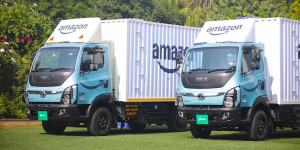
Amazon isn’t just electrifying its American delivery operations. The virtual big box stores that Bezos built understands the benefits of EVs as well as anyone, and they’re working hard to deploy electric vehicles everywhere they can. And now, that global push is extending to India.
Indian automaker TATA Motors has announced a deal with Amazon to deploy 3,000 electric trucks across Amazon’s transportation network in India. When it goes live, it will be the largest electric truck deployment by in India and mark Amazon’s most significant move to extend its Indian fleet electrification beyond last-mile logistics.
“India is accelerating towards electric mobility and the realization of Viksit Bharat 2047,” says Shri H.D. Kumaraswamy, Hon’ble Union Minister for Heavy Industries and Steel, Government of India. “The collaboration between TATA Motors and Amazon shows what that looks like in practice: sustained demand from a nationwide logistics network met by electric trucks manufactured in India. Through PM E-DRIVE, the Government will continue to support this transition, and I look forward to more such efforts in powering green logistics.”
Good deal
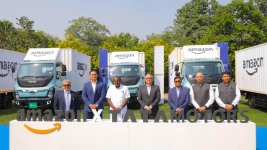
In addition to being a big deal for TATA, the 3,000 electric truck deal represents a serous bump to India’s deployed electric truck fleet, and are a major step towards the wide-scale electrification of freight transportation across the country – that’s not just good for Amazon’s fuel bills, it’s good for everyone and everything that breathes air, too.
“Electrifying our logistics and transportation network is an important part of Amazon’s goal to achieve net-zero carbon emissions by 2040,” says Abhinav Singh, Vice President, Operations, Amazon, APAC, Middle East, Africa and Turkey. “We have made significant progress in India, with more than 15,000 electric vehicles operating across 500-plus cities. To enable this transition, we are also supporting the development of infrastructure and solutions that make EV adoption easier for our carrier partners and drivers. We are now setting a bold vision to scale electric trucking, addressing one of the toughest challenges in decarbonizing transportation. Our collaboration with TATA Motors marks an important step towards realizing this vision. By combining our strengths, we aim to accelerate the deployment of electric trucks across more routes, starting with intracity operations and expanding to India’s major freight corridors.”
The truck, itself
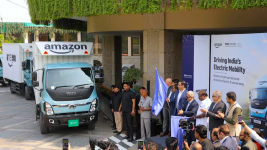
The truck Amazon will be deploying in these record numbers is a version of the Tata Ultra E.7, a 7.5-tonne (~16,000 lb.) straight truck powered by a 240 kW (~320 hp) electric motor drawing power from a 96 kWh LFP battery pack. The truck’s makers claim a loaded range of up to 130 km (~80 miles) on a single charge, with DC fast-charging that’s capable enough to keep the trucks charged up between deliveries.
Amazon’s new TATA electric delivery trucks will support the transport of goods between warehouse facilities – which means traveling across cities and along India’s national freight corridors.
Amazon set to deploy more than 3,000 TATA electric delivery trucks
Jo Borrás | Nov 6 2026 - 5:43 pm PT
Amazon isn’t just electrifying its American delivery operations. The virtual big box stores that Bezos built understands the benefits of EVs as well as anyone, and they’re working hard to deploy electric vehicles everywhere they can. And now, that global push is extending to India.
Indian automaker TATA Motors has announced a deal with Amazon to deploy 3,000 electric trucks across Amazon’s transportation network in India. When it goes live, it will be the largest electric truck deployment by in India and mark Amazon’s most significant move to extend its Indian fleet electrification beyond last-mile logistics.
“India is accelerating towards electric mobility and the realization of Viksit Bharat 2047,” says Shri H.D. Kumaraswamy, Hon’ble Union Minister for Heavy Industries and Steel, Government of India. “The collaboration between TATA Motors and Amazon shows what that looks like in practice: sustained demand from a nationwide logistics network met by electric trucks manufactured in India. Through PM E-DRIVE, the Government will continue to support this transition, and I look forward to more such efforts in powering green logistics.”
Good deal
TATA executives at project launch; via Amazon.
In addition to being a big deal for TATA, the 3,000 electric truck deal represents a serous bump to India’s deployed electric truck fleet, and are a major step towards the wide-scale electrification of freight transportation across the country – that’s not just good for Amazon’s fuel bills, it’s good for everyone and everything that breathes air, too.
“Electrifying our logistics and transportation network is an important part of Amazon’s goal to achieve net-zero carbon emissions by 2040,” says Abhinav Singh, Vice President, Operations, Amazon, APAC, Middle East, Africa and Turkey. “We have made significant progress in India, with more than 15,000 electric vehicles operating across 500-plus cities. To enable this transition, we are also supporting the development of infrastructure and solutions that make EV adoption easier for our carrier partners and drivers. We are now setting a bold vision to scale electric trucking, addressing one of the toughest challenges in decarbonizing transportation. Our collaboration with TATA Motors marks an important step towards realizing this vision. By combining our strengths, we aim to accelerate the deployment of electric trucks across more routes, starting with intracity operations and expanding to India’s major freight corridors.”
The truck, itself
TATA truck deal, via Amazon.
The truck Amazon will be deploying in these record numbers is a version of the Tata Ultra E.7, a 7.5-tonne (~16,000 lb.) straight truck powered by a 240 kW (~320 hp) electric motor drawing power from a 96 kWh LFP battery pack. The truck’s makers claim a loaded range of up to 130 km (~80 miles) on a single charge, with DC fast-charging that’s capable enough to keep the trucks charged up between deliveries.
Amazon’s new TATA electric delivery trucks will support the transport of goods between warehouse facilities – which means traveling across cities and along India’s national freight corridors.
Amazon set to deploy more than 3,000 TATA electric delivery trucks


Ola Electric expects its homegrown LFP battery cells to achieve cost parity with imports by FY27-end, with 10–15% savings once production yields reach 85%. The economics hinge on manufacturing efficiency. At 70% yield, in-house cells become cost-neutral against external procurement, while the target is 90% yield by Q1 FY28.
Ola has commissioned 6 GWh of cell manufacturing capacity and expects its automotive business to consume 2–3 GWh in FY28. Its planned battery mix is 70% LFP and 30% NMC.
The timing matters for India. Battery cell imports surged 103% YoY to ₹28,454 crore in April–August 2026. Domestic cell manufacturing can reduce import dependence, improve EV cost structures and create a local supply chain.

