
Indian Space Industry : Updates & Discussions
- Thread starter Ashwin
- Start date
You are using an out of date browser. It may not display this or other websites correctly.
You should upgrade or use an alternative browser.
You should upgrade or use an alternative browser.
PM to Inaugurate Skyroot’s Infinity Campus on 27th November
Infinity Campus is a state-of-the-art facility spread across 200,000 square feet workspaceCampus to Boost India’s Private Space Capabilities through designing, developing, integrating and testing multiple launch vehicles
PM to also unveil Vikram-I: Skyroot’s first orbital rocket
Prime Minister will inaugurate Indian space startup Skyroot’s Infinity Campus on 27th November at 11 AM via video conferencing. He will also unveil Skyroot’s first orbital rocket, Vikram-I, with capability to launch satellites to orbit.
The state-of-the-art facility will have around 200,000 square feet workspace for designing, developing, integrating and testing multiple launch vehicles, with a capacity to build one orbital rocket every month.
Skyroot is India’s leading private space company, founded by Pawan Chandana and Bharath Dhaka, both alumni of Indian Institutes of Technology and former scientists of ISRO turned entrepreneurs. In November 2022, Skyroot launched its sub-orbital rocket, Vikram-S, becoming the first Indian private company to launch a rocket to space.
The rapid rise of private space enterprises is a testament to the success of the transformative reforms carried out by the Government in the last few years, reinforcing India’s leadership as a confident and capable global space power.


PM to Inaugurate Skyroot’s Infinity Campus on 27th November
Infinity Campus is a state-of-the-art facility spread across 200,000 square feet workspace
Campus to Boost India’s Private Space Capabilities through designing, developing, integrating and testing multiple launch vehicles
PM to also unveil Vikram-I: Skyroot’s first orbital rocket
Prime Minister will inaugurate Indian space startup Skyroot’s Infinity Campus on 27th November at 11 AM via video conferencing. He will also unveil Skyroot’s first orbital rocket, Vikram-I, with capability to launch satellites to orbit.
The state-of-the-art facility will have around 200,000 square feet workspace for designing, developing, integrating and testing multiple launch vehicles, with a capacity to build one orbital rocket every month.
Skyroot is India’s leading private space company, founded by Pawan Chandana and Bharath Dhaka, both alumni of Indian Institutes of Technology and former scientists of ISRO turned entrepreneurs. In November 2022, Skyroot launched its sub-orbital rocket, Vikram-S, becoming the first Indian private company to launch a rocket to space.
The rapid rise of private space enterprises is a testament to the success of the transformative reforms carried out by the Government in the last few years, reinforcing India’s leadership as a confident and capable global space power.


It should clear launch tower: Skyroot founder reveals when Vikram-I will launch
Skyroot Aerospace prepares Vikram-1 rocket for maiden orbital launch from Sriharikota. India's first private rocket company aims to reach low-Earth orbit within two months.
Sibu Tripathi, Hyderabad
UPDATED: Dec 14, 2025, 15:24 IST

Hyderabad-based startup Skyroot Aerospace is preparing to become the first Indian private company to put a homegrown rocket into orbit (Photo: Skyroot)
Skyroot Aerospace is gearing up for a landmark moment in India’s private spaceflight story, with its Vikram-1 rocket now on track for a maiden launch.
The Hyderabad-based startup is preparing to become the first Indian private company to put a homegrown rocket into orbit, marking a major milestone in the country’s nascent commercial launch sector.
Co-founder Bharat Daka told IndiaToday.in in an exclusive conversation that the first stage of the Vikram-1 launch vehicle has already reached the Satish Dhawan Space Centre in Sriharikota, where integration and assembly are currently underway. He said all subsystems are expected to be ready within about a month, after which the rocket will move into its final round of validation ahead of the debut flight.
The upcoming mission will use roughly 25 per cent of the vehicle’s intended payload capacity to low Earth orbit, a typical strategy to de-risk an inaugural launch.
LAUNCH PREP UNDERWAY
Vikram-1 is a four-stage rocket designed to serve the growing small satellite launch market, combining solid propulsion stages with advanced guidance and control systems. As the hardware comes together on the launch pad side, Skyroot’s mission control team is also in high gear, testing software, communication links and real-time monitoring tools for what is expected to be a high-octane countdown.
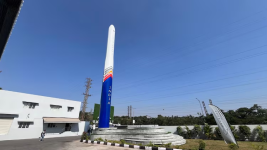
Skyroot Aerospace is gearing up for a landmark moment in India’s private spaceflight story, with its Vikram-1 rocket now on track for a maiden launch. (Photo: Sibu Tripathi)
Engineers are running simulations and rehearsals to ensure that ground systems can track the rocket’s performance from liftoff through stage separations.
WHEN WILL VIKRAM-I LAUNCH?
Skyroot aims to launch Vikram-I on its maiden flight to space within the next two months from the Satish Dhawan Space Centre in Sriharikota, using Isro's launchpad.
AIMING FOR ORBIT, READY FOR FIRST-FLIGHT JITTERS
Skyroot, which recently inaugurated a 2,00,000 sq ft wide Infinity campus, is targeting nothing less than reaching orbit on this maiden attempt, but the team remains realistic about the risks that come with flying a new rocket for the first time.
Company leaders acknowledge that first launches are always tense, with multiple critical phases that can end the mission in seconds if anything goes wrong. Internally, they have set a more modest success threshold focused on validating core systems in flight.
Bharat indicated that the team will consider the mission a meaningful achievement even if the rocket simply clears the launch tower, survives the period of maximum aerodynamic pressure and successfully separates its first stage.
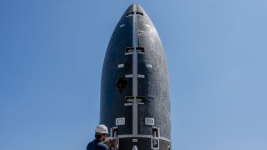
Vikram-1 is a four-stage rocket designed to serve the growing small satellite launch market, combining solid propulsion stages with advanced guidance and control systems. (Photo: Skyroot)
Crossing those milestones would demonstrate that key structural, propulsion and guidance elements are working as designed under real flight conditions.
Just as important, the company expects to gather what he described as a “treasure trove of data” from the flight, which will feed back into refining Vikram-1 and future launchers.
For India’s private space ecosystem, Vikram-1’s debut will be closely watched as a test of how quickly homegrown companies can move from suborbital demonstrations to fully orbital missions.
Whether the first flight reaches its ultimate target or not, Skyroot’s push toward the launchpad signals a new phase in the country’s commercial space ambitions.
It should clear launch tower: Skyroot founder reveals when Vikram-I will launch
Skyroot Aerospace prepares Vikram-1 rocket for maiden orbital launch from Sriharikota. India's first private rocket company aims to reach low-Earth orbit within two months.
Sibu Tripathi, Hyderabad
UPDATED: Dec 14, 2025, 15:24 IST
Hyderabad-based startup Skyroot Aerospace is preparing to become the first Indian private company to put a homegrown rocket into orbit (Photo: Skyroot)
Skyroot Aerospace is gearing up for a landmark moment in India’s private spaceflight story, with its Vikram-1 rocket now on track for a maiden launch.
The Hyderabad-based startup is preparing to become the first Indian private company to put a homegrown rocket into orbit, marking a major milestone in the country’s nascent commercial launch sector.
Co-founder Bharat Daka told IndiaToday.in in an exclusive conversation that the first stage of the Vikram-1 launch vehicle has already reached the Satish Dhawan Space Centre in Sriharikota, where integration and assembly are currently underway. He said all subsystems are expected to be ready within about a month, after which the rocket will move into its final round of validation ahead of the debut flight.
The upcoming mission will use roughly 25 per cent of the vehicle’s intended payload capacity to low Earth orbit, a typical strategy to de-risk an inaugural launch.
LAUNCH PREP UNDERWAY
Vikram-1 is a four-stage rocket designed to serve the growing small satellite launch market, combining solid propulsion stages with advanced guidance and control systems. As the hardware comes together on the launch pad side, Skyroot’s mission control team is also in high gear, testing software, communication links and real-time monitoring tools for what is expected to be a high-octane countdown.
Skyroot Aerospace is gearing up for a landmark moment in India’s private spaceflight story, with its Vikram-1 rocket now on track for a maiden launch. (Photo: Sibu Tripathi)
Engineers are running simulations and rehearsals to ensure that ground systems can track the rocket’s performance from liftoff through stage separations.
WHEN WILL VIKRAM-I LAUNCH?
Skyroot aims to launch Vikram-I on its maiden flight to space within the next two months from the Satish Dhawan Space Centre in Sriharikota, using Isro's launchpad.
AIMING FOR ORBIT, READY FOR FIRST-FLIGHT JITTERS
Skyroot, which recently inaugurated a 2,00,000 sq ft wide Infinity campus, is targeting nothing less than reaching orbit on this maiden attempt, but the team remains realistic about the risks that come with flying a new rocket for the first time.
Company leaders acknowledge that first launches are always tense, with multiple critical phases that can end the mission in seconds if anything goes wrong. Internally, they have set a more modest success threshold focused on validating core systems in flight.
Bharat indicated that the team will consider the mission a meaningful achievement even if the rocket simply clears the launch tower, survives the period of maximum aerodynamic pressure and successfully separates its first stage.
Vikram-1 is a four-stage rocket designed to serve the growing small satellite launch market, combining solid propulsion stages with advanced guidance and control systems. (Photo: Skyroot)
Crossing those milestones would demonstrate that key structural, propulsion and guidance elements are working as designed under real flight conditions.
Just as important, the company expects to gather what he described as a “treasure trove of data” from the flight, which will feed back into refining Vikram-1 and future launchers.
For India’s private space ecosystem, Vikram-1’s debut will be closely watched as a test of how quickly homegrown companies can move from suborbital demonstrations to fully orbital missions.
Whether the first flight reaches its ultimate target or not, Skyroot’s push toward the launchpad signals a new phase in the country’s commercial space ambitions.
It should clear launch tower: Skyroot founder reveals when Vikram-I will launch
India’s top space startups—Digantara, Skyroot, Agnikul—are set to scale revenue from 2026. Digantara targets $30 mn/yr (80% govt clients); Skyroot plans $6 mn per commercial launch. Investor confidence grows as private space moves from early funding to revenue stage.

India’s Digantara raises $50M for space-based missile defense tech
Digantara, an Indian space surveillance startup, has raised $50 million in a new funding round as it moves beyond space situational awareness into missile tracking, citing growing demand from governments for space-based defense capabilities.
The all-equity Series B round included new investors such as 360 ONE Asset and SBI Investment of Japan, as well as serial entrepreneur Ronnie Screwvala, with existing backers Peak XV Partners and Kalaari Capital also participating. The funding comes more than two years after the startup’s $10 million Series A1 round, bringing its total capital raised to $64.5 million.
Globally, governments are investing more heavily in space-based surveillance and early-warning systems as missile launches and satellite interference become more frequent, with many seeking faster detection than traditional ground-based radar can provide. Digantara aims to tap that market by using its space- and ground-based infrared sensors along with software-based analytics and intelligence.
Founded in 2020, the Bengaluru-headquartered startup initially focused on space situational awareness, tracking debris and objects that could damage satellites. The startup has since expanded its scope to include missile detection and tracking, building on the space- and ground-based sensing and analytics technologies it developed for space surveillance, its founder and chief executive Anirudh Sharma (pictured above) said in an interview.
Digantara launched its first space surveillance satellite, SCOT (Space Camera for Object Tracking), in January aboard SpaceX’s Transporter-12 mission, enabling space-to-space observation. A month later, the startup opened an office in Colorado Springs as part of its push into the U.S. defense market, a move that has since led to contracts with U.S. Space Command for analytics as a service. Its U.S. entity has also been selected for the Missile Defense Agency’s SHIELD contract vehicle, which supports next-generation missile defense programs.
“Given we’ve already built IR sensors, we are now extending our IR capabilities to other domains like mid- and long-wave infrared,” Sharma told TechCrunch.
Digantara has split its operations across geographies to meet national security requirements. Its U.S. team is focused on building larger satellites and spacecraft in the 100-kilogram class tailored to American defense needs, while its India operation concentrates on analytics, data processing, and space situational awareness. The structure reflects the regulatory realities of defense procurement, where sensitive systems must be designed and built domestically for each market.
Digantara has so far closed contracts with a combined value of about $25 million, Sharma told TechCrunch. The startup currently operates across India, Singapore, and the U.S., and plans to expand into Europe by setting up a local entity there as early as 2026.
In India, Digantara operates a 25,000-square-foot manufacturing facility capable of producing up to five satellites simultaneously, and plans to scale that capacity significantly. The startup has signed a memorandum of understanding with the state government of Andhra Pradesh to set up a larger facility that could manufacture as many as 30 satellites at once, which it aims to bring online next year.
Digantara has already been selected as the winning bidder for government defense tenders in India and is completing administrative formalities before work begins, Sharma said.
Through 2026–27, Digantara plans to expand its space- and ground-based infrastructure, including additional electro-optical and lidar satellites for space surveillance, space-based sensors for early missile warning and tracking, and a larger network of ground-based observatories, the company said. It is also exploring the potential use of its lidar and laser technologies for future interceptor systems, Sharma asserted.
Digantara plans to launch another satellite through SpaceX in March, followed by additional launches in June and October, with multiple satellites scheduled for the latter mission. The company aims to deploy a total of 15 satellites over the next two years, Sharma said.
The latest funding, he noted, will support those launches, with about $7 million to $10 million earmarked for expansion in the United States and roughly $2 million to $3 million set aside to establish operations in Europe, while the remainder will be used to scale its India-based manufacturing and operations.
Digantara has seen revenues grow more than tenfold over the past two years, Sharma said, declining to disclose current figures. He added that the company is targeting annual revenues of $25 million to $30 million over the next 18 months as defense and government work ramps up.
The startup currently employs around 125 people, including roughly 80 to 85 engineers.


Indigenous startup Digantara ventures into tracking missiles from space
Indigenous startup Digantara expands its capabilities to track missiles using satellites, bolstered by a recent $50 million funding round and strategic operations in the US.
Digantara also plans to launch two Albatross satellites in 2026-27, dedicated to early missile warning and precision tracking and 'Skygate', an expanding network of ground-based sensors that enables persistent observation across the critical theatres of operations.
interestingly dgiyantara has bagged multiple contract with US airforce and space force,
ppl in MoD what they really even do?

How do such projects earn revenue for the company? I mean did Digantara have contract with MoD to launch such systems? Or do they hope that they will get a contract for data post launch? What if the MoD is not interested in its services then?


Dgiantara selected for the missile agency shield IDIQ,
The satellite and ground infra is owned by the company. They provide on-demand/contract based services to clients. Think of it as 'surveillance as a service'.How do such projects earn revenue for the company? I mean did Digantara have contract with MoD to launch such systems? Or do they hope that they will get a contract for data post launch? What if the MoD is not interested in its services then?
The GoI has contracted companies like Pixxel to build imaging satellites for its own use, though.
Last edited:
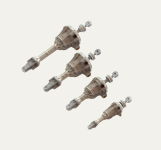

Isro to launch startup's satellite refuelling mission with PSLV-C62: What is it?
AayulSAT aims to extend satellite lifespans by enabling refueling and servicing in orbit, addressing space debris and sustainability challenges.