

Indian Space Industry : Updates & Discussions
- Thread starter Ashwin
- Start date
You are using an out of date browser. It may not display this or other websites correctly.
You should upgrade or use an alternative browser.
You should upgrade or use an alternative browser.


Dhruva Space ties up with Japan’s Infostellar
The collaboration is to explore integration of the Dhruva Space’s 3.8m S&X-band ground station antenna in Hyderabad into Infostellar’s StellarStation
March 31, 2025, 05:44 pm IST
HYDERABAD
The Hindu Bureau

Dhruva Space’s 3.8m S&X-band ground station antenna in Hyderabad | Photo Credit: BY ARRANGEMENT
Hyderabad-based Dhruva Space and Japan-based Infostellar on Monday (March 31, 2025) have announced a collaboration to explore integration of the Dhruva Space’s 3.8m S&X-band ground station antenna in Hyderabad into Infostellar’s StellarStation, expanding its global ground station network and enhancing satellite communications interoperability.
Infostellar plans to onboard Dhruva Space’s 3.8m S&X-band antenna onto its Cloud-based StellarStation platform, making it accessible to its global client base for enhanced satellite ground segment services, upon receiving necessary licenses from the Centre, as per an official release.
Dhruva Space, a full-stack space engineering solutions company, has positioned itself to service the needs of its customers by both building and providing ground stations as a service, in collaboration with the global ecosystem.
The firm is soon to establish ~ 7.4 m antennas with S, X and Ka Band capabilities, with plans to also explore establishment of larger antennas for supporting Lunar and Deep Space Missions in collaboration with global partners in the country.
Dhruva Space is India’s only commercial ground station solutions provider offering full hemispherical coverage with high reliability through X/Y mount systems. The geographical positioning of this 3.8m S- and X-band antenna in Hyderabad enhances its capability to support Low Earth Orbit (LEO) satellites in inclined planes, optimizing coverage and data downlink opportunities for mission-critical satellite operations.
India and Japan have already collaborated on missions like Chandrayaan series of lunar missions, the Sentinel Asia initiative and the upcoming LUPEX lunar endeavour. “Infostellar is excited to have signed this agreement with Dhruva Space, marking an important milestone in commercial Japan-India Space relationships. I am delighted to be able to make Dhruva Space’s antenna available to global satellite and spacecraft operators through StellarStation, Infostellar’s unique Cloud-based platform.” said CEO Naomi Kurahara.
Dhruva Space CEO Sanjay Nekkanti said: “This collaboration enhances our vertical integration strategy, allowing us to offer end-to-end satellite solutions, from space to ground, for global satellite operators.” This partnership was officially established in Tokyo, Japan, during the Third India-Japan Space Dialogue, jointly organized by the Indian National Space Promotion and Authorisation Center (IN-SPACe), Ministry of External Affairs, Government of India, and Cabinet Office of Japan.
Infostellar, headquartered in Tokyo, Japan, is a leading provider of Ground Segment as a Service (GSaaS) solutions, specializing in GSaaS, satellite antenna hosting and dedicated satellite antenna services in the Asia-Pacific region, the release added.
Dhruva Space ties up with Japan’s Infostellar
The collaboration is to explore integration of the Dhruva Space’s 3.8m S&X-band ground station antenna in Hyderabad into Infostellar’s StellarStation
March 31, 2025, 05:44 pm IST
HYDERABAD
The Hindu Bureau
Dhruva Space’s 3.8m S&X-band ground station antenna in Hyderabad | Photo Credit: BY ARRANGEMENT
Hyderabad-based Dhruva Space and Japan-based Infostellar on Monday (March 31, 2025) have announced a collaboration to explore integration of the Dhruva Space’s 3.8m S&X-band ground station antenna in Hyderabad into Infostellar’s StellarStation, expanding its global ground station network and enhancing satellite communications interoperability.
Infostellar plans to onboard Dhruva Space’s 3.8m S&X-band antenna onto its Cloud-based StellarStation platform, making it accessible to its global client base for enhanced satellite ground segment services, upon receiving necessary licenses from the Centre, as per an official release.
Dhruva Space, a full-stack space engineering solutions company, has positioned itself to service the needs of its customers by both building and providing ground stations as a service, in collaboration with the global ecosystem.
Dhruva to explore establishments of large antennas
The firm is soon to establish ~ 7.4 m antennas with S, X and Ka Band capabilities, with plans to also explore establishment of larger antennas for supporting Lunar and Deep Space Missions in collaboration with global partners in the country.
India’s only commercial ground station solutions provide
Dhruva Space is India’s only commercial ground station solutions provider offering full hemispherical coverage with high reliability through X/Y mount systems. The geographical positioning of this 3.8m S- and X-band antenna in Hyderabad enhances its capability to support Low Earth Orbit (LEO) satellites in inclined planes, optimizing coverage and data downlink opportunities for mission-critical satellite operations.
India and Japan’s collaborations
India and Japan have already collaborated on missions like Chandrayaan series of lunar missions, the Sentinel Asia initiative and the upcoming LUPEX lunar endeavour. “Infostellar is excited to have signed this agreement with Dhruva Space, marking an important milestone in commercial Japan-India Space relationships. I am delighted to be able to make Dhruva Space’s antenna available to global satellite and spacecraft operators through StellarStation, Infostellar’s unique Cloud-based platform.” said CEO Naomi Kurahara.
Dhruva Space CEO Sanjay Nekkanti said: “This collaboration enhances our vertical integration strategy, allowing us to offer end-to-end satellite solutions, from space to ground, for global satellite operators.” This partnership was officially established in Tokyo, Japan, during the Third India-Japan Space Dialogue, jointly organized by the Indian National Space Promotion and Authorisation Center (IN-SPACe), Ministry of External Affairs, Government of India, and Cabinet Office of Japan.
Infostellar, headquartered in Tokyo, Japan, is a leading provider of Ground Segment as a Service (GSaaS) solutions, specializing in GSaaS, satellite antenna hosting and dedicated satellite antenna services in the Asia-Pacific region, the release added.
Dhruva Space ties up with Japan’s Infostellar
Indian propulsion maker joins US expansion push
by Jason Rainbow
April 10, 2025

Rohan M Ganapathy, left, Bellatrix Aerospace’s co-founder and CEO, stands with Yashas Karanam, co-founder and chief operating officer. Credit: Bellatrix Aerospace.
TAMPA, Fla. — Indian satellite propulsion maker Bellatrix Aerospace announced plans April 10 to open a manufacturing facility in the United States in the coming months, joining a wave of foreign firms seeking a slice of the country’s vast space market.
Bellatrix hired Chris MacDonald, a former business development director at rocket developer Astra and satellite provider Terran Orbital, to lead its recently created U.S. subsidiary, headquartered in Delaware.
The manufacturing facility would support localized production, testing and delivery of propulsion systems to enable faster turnaround times and closer collaboration with U.S.-based customers, MacDonald said via email.
Founded in 2015, Bellatrix’s electric hall effect thruster has been used in a handful of missions for India’s space agency in recent years, along with a propulsion system that uses a less toxic alternative to hydrazine.
With technologies now proven on home turf, the company is turning its attention to international opportunities — particularly in the United States, where demand for space infrastructure continues to draw significant private investment.
According to research published April 9 by venture capital firm Space Capital, the U.S. attracted 72% of global investments in space infrastructure over the past three years.
In the first three months of 2025, U.S. companies accounted for the majority of the $1.7 billion invested in space infrastructure, referring to the hardware and software used to build, launch and operate satellites, rockets and other space-bound assets.
That marked a 31% drop from the previous quarter and the second-lowest quarterly total Space Capital has recorded over the past three years amid macroeconomic uncertainty and tightening financial conditions.

Bellatrix Aerospace's 50W Arka electric thruster.
Still, the report pointed to continued demand for propulsion, satellite manufacturing and launch services, particularly from defense-focused players aiming to seize opportunities created by the U.S. administration’s renewed emphasis on space as a national security priority.
International expansion
“We’re currently in advanced discussions with over six U.S.-based satellite manufacturers and operators, with several others in early-stage talks,” MacDonald said.
“We’ve also signed a Memorandum of Understanding (MoU) with a prominent U.S. satellite manufacturer to serve as their preferred propulsion partner. These partnerships are paving the way for a strong U.S. presence and product adoption.”
Bellatrix currently employs more than 90 people in India and expects to expand its team to around 115 by the end of the year to support increasing global demand and product development, including as many as six U.S.-based employees.
British satellite component maker Olsen announced similar expansion plans earlier this week targeting Florida, while GITAI, a space robotics specialist headquartered in California but majority-owned from Japan, recently set up a subsidiary under a U.S. voting trust to chase prime contractor roles in defense contracts.
Indian propulsion maker joins US expansion push
by Jason Rainbow
April 10, 2025
Rohan M Ganapathy, left, Bellatrix Aerospace’s co-founder and CEO, stands with Yashas Karanam, co-founder and chief operating officer. Credit: Bellatrix Aerospace.
TAMPA, Fla. — Indian satellite propulsion maker Bellatrix Aerospace announced plans April 10 to open a manufacturing facility in the United States in the coming months, joining a wave of foreign firms seeking a slice of the country’s vast space market.
Bellatrix hired Chris MacDonald, a former business development director at rocket developer Astra and satellite provider Terran Orbital, to lead its recently created U.S. subsidiary, headquartered in Delaware.
The manufacturing facility would support localized production, testing and delivery of propulsion systems to enable faster turnaround times and closer collaboration with U.S.-based customers, MacDonald said via email.
Founded in 2015, Bellatrix’s electric hall effect thruster has been used in a handful of missions for India’s space agency in recent years, along with a propulsion system that uses a less toxic alternative to hydrazine.
With technologies now proven on home turf, the company is turning its attention to international opportunities — particularly in the United States, where demand for space infrastructure continues to draw significant private investment.
According to research published April 9 by venture capital firm Space Capital, the U.S. attracted 72% of global investments in space infrastructure over the past three years.
In the first three months of 2025, U.S. companies accounted for the majority of the $1.7 billion invested in space infrastructure, referring to the hardware and software used to build, launch and operate satellites, rockets and other space-bound assets.
That marked a 31% drop from the previous quarter and the second-lowest quarterly total Space Capital has recorded over the past three years amid macroeconomic uncertainty and tightening financial conditions.
Bellatrix Aerospace's 50W Arka electric thruster.
Still, the report pointed to continued demand for propulsion, satellite manufacturing and launch services, particularly from defense-focused players aiming to seize opportunities created by the U.S. administration’s renewed emphasis on space as a national security priority.
International expansion
“We’re currently in advanced discussions with over six U.S.-based satellite manufacturers and operators, with several others in early-stage talks,” MacDonald said.
“We’ve also signed a Memorandum of Understanding (MoU) with a prominent U.S. satellite manufacturer to serve as their preferred propulsion partner. These partnerships are paving the way for a strong U.S. presence and product adoption.”
Bellatrix currently employs more than 90 people in India and expects to expand its team to around 115 by the end of the year to support increasing global demand and product development, including as many as six U.S.-based employees.
British satellite component maker Olsen announced similar expansion plans earlier this week targeting Florida, while GITAI, a space robotics specialist headquartered in California but majority-owned from Japan, recently set up a subsidiary under a U.S. voting trust to chase prime contractor roles in defense contracts.
Indian propulsion maker joins US expansion push
Indian space startup "EtherealX" is building a fully re-usable medium lift rocket. They are getting funded from Indo-US technology fund (INDUS-X):

The Stallion engine shown above will be a "closed gas generator cycle". I am not sure what that means. Gas generator cycles by their very nature are open cycles. As in fuel & oxidizer is used to turn the main turbopump & feed the combustion chamber. The propellant used in running the turbopump is dumped overboard. Since we are losing this propellant, it is called an open cycle. A closed gas generator cycle is called an expander cycle. Why not just call it that? We will have to wait for more updates on this.

Anyway, the Stallion is their lower stage engine. Thus, it is more powerful & more challenging. They are starting off their engine development with the smaller upper stage engine called "Pegasus".
They have 3D printed a prototype of the Thrust Chamber Assembly (TCA) of the "Pegasus" upper stage semi-cryogenic engine:


The spaces of the engine are as follows:
Propellant: RP-1/LOX
Thrust: 40 kN (sea level)
Isp: 293 sec (sea level)
Cooling: Regenerative
The engine feed cycle is rather interesting. The company describes it as "A proprietary, all-new, indigenously developed rocket engine feed cycle: the Full Flow Segregated Cooling Cycle (FSCC)". But also says this TCA is the "The world’s first RP-1/LOX engine TCA that can also run on an expander cycle".
It seems to me that this FSCC is a modified variant of the dual expander cycle. If it is genuinely an all-new engine cycle, this would be the 1st by any Indian organization/company. We will have to wait & see on that front.
They are getting ready to test the Pegasus TCA:
Video if the Pegasus TCA test rig:
View attachment EtherealX_Pegasus_test_rig.mp4
It going to be very very tough, but I hope they can make this work. Can you imagine having reusable rocket with payload similar to the LVM3. It will be a game changer for our military & civilian needs.
The Stallion engine shown above will be a "closed gas generator cycle". I am not sure what that means. Gas generator cycles by their very nature are open cycles. As in fuel & oxidizer is used to turn the main turbopump & feed the combustion chamber. The propellant used in running the turbopump is dumped overboard. Since we are losing this propellant, it is called an open cycle. A closed gas generator cycle is called an expander cycle. Why not just call it that? We will have to wait for more updates on this.
Anyway, the Stallion is their lower stage engine. Thus, it is more powerful & more challenging. They are starting off their engine development with the smaller upper stage engine called "Pegasus".
They have 3D printed a prototype of the Thrust Chamber Assembly (TCA) of the "Pegasus" upper stage semi-cryogenic engine:
The spaces of the engine are as follows:
Propellant: RP-1/LOX
Thrust: 40 kN (sea level)
Isp: 293 sec (sea level)
Cooling: Regenerative
The engine feed cycle is rather interesting. The company describes it as "A proprietary, all-new, indigenously developed rocket engine feed cycle: the Full Flow Segregated Cooling Cycle (FSCC)". But also says this TCA is the "The world’s first RP-1/LOX engine TCA that can also run on an expander cycle".
It seems to me that this FSCC is a modified variant of the dual expander cycle. If it is genuinely an all-new engine cycle, this would be the 1st by any Indian organization/company. We will have to wait & see on that front.
They are getting ready to test the Pegasus TCA:
Video if the Pegasus TCA test rig:
View attachment EtherealX_Pegasus_test_rig.mp4
It going to be very very tough, but I hope they can make this work. Can you imagine having reusable rocket with payload similar to the LVM3. It will be a game changer for our military & civilian needs.


Lot of updates from Skyroot recently:
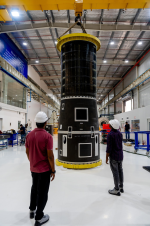
https://twitter.com/SkyrootA/status/1918211617726370018
Hardware in-loop Simulation of Vikram-1 Flight One
https://twitter.com/SkyrootA/status/1920347932118954396
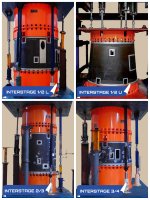
https://twitter.com/SkyrootA/status/1922606616098324940
Raman Mini Thruster Flight Qualification — Vikram-1 Pre-flight Update
https://twitter.com/SkyrootA/status/1918211617726370018
Hardware in-loop Simulation of Vikram-1 Flight One
https://twitter.com/SkyrootA/status/1920347932118954396
https://twitter.com/SkyrootA/status/1922606616098324940
Raman Mini Thruster Flight Qualification — Vikram-1 Pre-flight Update

Full Video
Exploring the final frontier!
It’s all rocket science in this episode of In The Spotlight with Mr. Arun Ramchandani, SVP – Precision Engineering & Systems, L&T, as he takes us through L&T’s aerospace journey. L&T is a proud partner to #ISRO, and has been associated with India’s Space Program for over five decades, contributing to critical missions such as ISRO’s moon mission #Chandrayaan and advancing India’s aerospace ambitions through indigenous innovation
Indian space startup "EtherealX" is building a fully re-usable medium lift rocket. They are getting funded from Indo-US technology fund (INDUS-X):
View attachment 42258
The Stallion engine shown above will be a "closed gas generator cycle". I am not sure what that means. Gas generator cycles by their very nature are open cycles. As in fuel & oxidizer is used to turn the main turbopump & feed the combustion chamber. The propellant used in running the turbopump is dumped overboard. Since we are losing this propellant, it is called an open cycle. A closed gas generator cycle is called an expander cycle. Why not just call it that? We will have to wait for more updates on this.
View attachment 42265
Anyway, the Stallion is their lower stage engine. Thus, it is more powerful & more challenging. They are starting off their engine development with the smaller upper stage engine called "Pegasus".
They have 3D printed a prototype of the Thrust Chamber Assembly (TCA) of the "Pegasus" upper stage semi-cryogenic engine:
View attachment 42260
View attachment 42261
The spaces of the engine are as follows:
Propellant: RP-1/LOX
Thrust: 40 kN (sea level)
Isp: 293 sec (sea level)
Cooling: Regenerative
The engine feed cycle is rather interesting. The company describes it as "A proprietary, all-new, indigenously developed rocket engine feed cycle: the Full Flow Segregated Cooling Cycle (FSCC)". But also says this TCA is the "The world’s first RP-1/LOX engine TCA that can also run on an expander cycle".
It seems to me that this FSCC is a modified variant of the dual expander cycle. If it is genuinely an all-new engine cycle, this would be the 1st by any Indian organization/company. We will have to wait & see on that front.
They are getting ready to test the Pegasus TCA:
Video if the Pegasus TCA test rig:
View attachment 42266
It going to be very very tough, but I hope they can make this work. Can you imagine having reusable rocket with payload similar to the LVM3. It will be a game changer for our military & civilian needs.
Can EtherealX Become India’s SpaceX with Its Fully Reusable Rocket?
09 Jun'25 | By Tapanjana Rudra

SUMMARY
- Spacetech startup EtherealX claims to have learned from the failures of SpaceX's Falcon launch and built its own technology to make medium-lift rockets fully reusable
- EtherealX has built its own re-entry algorithm, which is being tried out not only in its own test vehicles but also in test launches
- EtherealX has a $130Mn order book in place from satellite operators in the US, Japan, and some European countries
Late-winter frost was in full spell when a sleepy Polish town woke up to mysterious fireballs lighting up the obsidian sky on a February night.
Neither Helios was on an errand, nor a mythical dragon was on a recce of the Polish skies that night. Experts confirmed the next day that those were the wrecks of the upper stage of Falcon 9’s reusable launch vehicle that had failed to deorbit on time, malfunctioned, broke into pieces, and crashed down on earth like fireballs.
Elon Musk’s SpaceX grounded Falcon 9 rockets multiple times last year following anomalies in the recovery of their second stage or upper stage. From a liquid oxygen leak to a malfunction while grounding, the company has faced multiple failures while bringing the upper stage of its reusable rockets back to Earth.
"As California-headquartered SpaceX tries to comprehend the rocket science behind the failures, Bengaluru-based spacetech startup EtherealX claims to have learned from the Falcon fallacies. Lessons that the startup is using to build medium-lift fully reusable launch vehicles or rockets."
While deep-pocket giants like SpaceX, Blue Origin, and Rocket Lab have cracked the code of recovering the first stage or the booster stage of their medium-lift launch vehicles, but failed to make their satellite launch vehicles (SLVs) fully reusable for various tech constraints, EtherealX claims to be a pioneer in the Indian spacetech system to make rockets that can be reused fully.
EtherealX says it has built advanced hardware and software stacks, and worked around with the existing laws of physics to build its flagship Razor Crest Mk-1 that can be brought back to the launch pad after it docked a satellite into Low Earth Orbit (LEO), Geostationary Transfer Orbit (GTO), or following a trans-lunar injection (TLI).
With an eye on global markets, EtherealX plans its first commercial launch in 2027 to capture a major share of the Indian spacetech market that’s set to surpass $44 Bn by 2030.
The Making of EtherealX: From Vedas to Falcon Fallacies
As a child, Manu Nair was deeply inspired by the Vedas and was intrigued by celestial matters. He wanted to grow up to explore the mysteries of the cosmos. After his graduation in engineering from the BML Munjal University, he interned at the Human Space Flight Centre of the Indian Space Research Organisation (ISRO) in late 2019. He met Shubhayu Sardar there.
Before the ISRO assignment, Nair had the opportunity to work closely with commercial space flight planning as a part of NASA-supported Project PoSSUM (Polar Suborbital Science in the Upper Mesosphere). By late 2020, he joined Indian spacetech startup Manastu Space’s executive team and met Prashanth Sharma, who was heading propulsions in the company.
Nair introduced Sharma to Sardar at a dinner a year later. That’s where the entire game changed for the trio. Sharma turned down an offer from the US-based Rocket Lab, Sardar quit ISRO, and Nair called off his plans to join an American company.
The three space enthusiasts teamed up and the seed of EtherealX germinated in 2022.
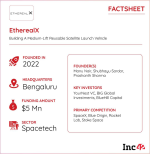
“That night at the dinner, the fundamental question we asked was why we still did not have resilient or multi-polar launch infrastructure. Even as launch costs had come down over the last few decades, mathematically, there should have been an oversupply of launch vehicles, but that was not the case. Launch was not a solved problem at all. It was an extremely polarised market where over 80% of all launches were being done by one vehicle, one company, and one demography,” Nair, the CEO of the spacetech startup, shared with Inc42.
They realised that most companies were not operating in the right segment of launch vehicles or did not follow the right approach, which was causing trouble for the satellite operators who had to wait long for launches. The idea was also to solve for unit economics.
"The answer was reusability. That was the core idea of the spacetech startup."
It wasn’t anything novel. The first reusable rocket, the Space Shuttle, was developed by NASA. Since 1981, the Space Shuttle fleet undertook 135 missions, inspiring generations of scientists.
The Space Shuttle comprised an external tank, two solid rocket boosters on the sides, and an orbiter. Only the external tank could not be recovered after launch. The solid rocket boosters landed in the ocean that NASA retrieved, inspected, refurbished, and reused, while the orbiter returned to Earth and landed like an airplane after completing its space mission.
"SpaceX created history in 2015 when it became the world’s first to bring back its Falcon 9 rocket in a soft touchdown during an orbital launch. “SpaceX too has had multiple failures. The company goes public stating the cause of the failure, but never discloses how they fixed it. We spotted the errors and framed our strategy based on what not to do. At EtherealX, we started off with the mitigation strategies for the issues SpaceX was facing,” Nair said."
It was almost impossible to replicate the SpaceX model, given that the company has a vertically integrated business. The EtherealX founders started building proprietary technology from the ground up that could recover both the booster stage and upper stage of the rockets – going one step ahead of what SpaceX has achieved so far, according to the CEO.
EtherealX has so far carried out a few private tests of its launch vehicle engine, while its fully reusable launch vehicle is still under testing and designing. It has recently signed an agreement with In-Space for facilitating the testing of its engines with ISRO. Its first hot fire will be done at its own facility in November, when the engine will be fired up and operated in a controlled environment for its performance and safety checks.
The company raised $5 Mn in a seed round last year from YourNest VC, BIG Global Investments, BlueHill Capital, and Golden Sparrow Ventures, to proceed with the final tests and qualification of the vehicle engine.
The Tech Edge: Spotting SpaceX Gaps
A two-stage-to-orbit (TSTO) launch vehicle has two main parts – the first or the booster stage and the upper or the second stage. Whether it’s SpaceX’s Falcon 9 or Blue Origin’s New Glenn or EtherealX’s Razon Crest – all medium-lift rockets have the same architecture.
After a rocket blasts off, there is the main engine cut off (MECO) stage, which SpaceX typically performs at an altitude of 80 km above the ground. It provides the initial acceleration and lift for the rocket. After MECO, the upper stage engine does the firing, and with enough velocity already built in it, the stage reaches the desired orbit for a satellite launch.
"Nair explained that the hardware capabilities can be reimagined in building these stages to achieve complete reusability. Technical challenges, however, stay on in bringing back the booster – a problem that lies in realigning the algorithm in flight software."
EtherealX has built its own re-entry algorithm, which is being tried out not only in its own test vehicles but also in test launches. “During every launch done by SpaceX, because it’s public information, we run our algorithm during relanding and predict before the launch when the booster is going to turn over, when it’s going to come back, when the boost back burn is going to happen,” Nair said.
He claimed that in the fourth run of its algorithm, its predictions reached a 100% perfection. The startup is collecting more data and polishing its existing algorithm each day.
Most vehicles face hardware issues due to the engine heat while re-entering the Earth’s atmosphere, often causing damage to the rockets. EtherealX has built a rocket engine feed cycle that would use the heat generated by the vehicles during their re-entry to the Earth’s atmosphere as the source to again run the engines.
The company will use a ‘source-sink mechanism’ to channel the re-entry heat for re-use. Nair did not elaborate on the mechanism further because the technology is proprietary and awaits patent approval.
"Most companies are still struggling with the technology that can recover the upper stage. EtherealX claims that it has solved that problem with a ballistic plus skip atmospheric re-entry. “For the upper stage to come back, it will be a free fall with some controlled direction till a certain altitude, and then we will power the engines to perform a cross range manoeuvre for the last bit,” Nair said, without explaining it further."
He, however, accepted that this was only in theory so far. While EtherealX is confident of the safe recovery of its booster stage, the credibility of its biggest value proposition, the upper stage recovery, remains dicey until a few flights are successful.
This USP is also directly linked to its business model, and hence, revenue and profitability. In case of a failure to recover the upper stage its margins will be hit. “But it won’t stop us from making money, and we’re confident that even if by the third or fourth launch we can achieve a full recovery level, it’s going to be a win-win for us and the end user.”
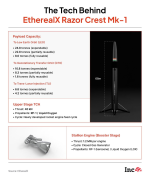
Razon Crest can carry 24.8 tonnes of payload in the non-reusable configuration. As a fully reusable vehicle, it can carry 8 tonnes in LEO and 1.6 tonnes in GTO. In a partially reusable configuration, the rocket can carry 22.8 tonnes in LEO, 8.3 tonnes in GTO, and 4.2 tonnes during trans-lunar injection.
Mapping The Skies: From Stargazing To A $130 Mn Order Book
EtherealX has a $130 Mn order book in place from satellite operators in the US, Japan, and some European countries.
"The startup plans to charge anywhere between $350 and $2,000 per kg, based on various configurations. If things pan out as planned, it is expected to see revenue coming in by early 2027 ahead of the planned launches."
From here on, the company is taking steady steps to reach its commercial launch target on time. To ensure the tests are done as planned, EtherealX is working towards the completion of its 16-acre test facility in Tamil Nadu within a few months. It is also aiming to carry out an upper stage cycle testing next year.
As the sky gets crowded with an increasing number of spacetech ventures vying for a slice of the $466.1 Bn global market, EtherealX is trying to stand out from US startup Stoke Space, which is also working on building fully reusable launch vehicles, or homegrown Agnikul, working in this broader domain of launch vehicles for small to medium satellite launches, with its technology edge that allows a much higher payload.
Dreaming it big – taking on giants like SpaceX and Blue Origin – EtherealX has reached a crucial point where its ability to raise more capital and succeed in on-ground tests will decide both the fate of the company as well as that of the country’s burgeoning spacetech ecosystem.
[Edited By Kumar Chatterjee]
Can EtherealX Become India’s SpaceX With Its Fully Reusable Rocket?
Surveillance satellites emerge as new revenue engine for India’s space sector
June 27, 2025
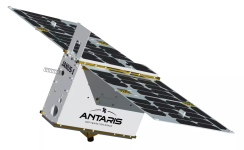
India’s private space firms may be getting the revenue boost they hoped for: Thanks to geopolitical tensions, several countries have tapped them to build satellites as demand for space-based surveillance grows.
Bengaluru-based Ananth Technologies, a long-time engineering partner for the Indian Space Research Organization (ISRO), has been executing an order from Australia for defence surveillance satellites over the past year. Peer Digantara is also part of this contract under the Mission for Australia-India’s Technology, Research and Innovation or Maitri programme.
Norway, Hungary and Poland, besides nations from West Asia and the global south, are also engaging with multiple Indian space firms, including Adani Defence and Aerospace-backed Alpha Design.
Most of these countries do not have their own satellite programmes, but changing geopolitical alignments and global tensions have amplified the need for space surveillance. And while revenue generated from such projects has still not reached hundreds of millions of dollars, India’s friendly relations are offering local space startups an opportunity to drive growth through such partnerships.
Moreover, surveillance satellite giants in the US, such as Boeing, Lockheed Martin and Northrop Grumman, focus mostly on large contracts, according to Chaitanya Giri, space fellow at global think-tank, Observer Research Foundation. Since most of the contracts coming India’s way range from $5-25 million per year, Giri said these “are too small for the American behemoths but cumulatively could add up to a significant boost for India”.
Satellite assembly line
Ananth Technologies and Digantara will offer end-to-end design and manufacturing of satellites and provide surveillance data to Australia. While neither divulged the exact size of the deals, both said the multi-year pacts are leading to monetization of their business models in India.
“We have three satellite manufacturing and design engineering centers across Hyderabad, Bengaluru and Thiruvananthapuram, where we build and design high-resolution surveillance, imaging and earth observation satellites based on requirements from clients,” Subba Rao Pavuluri, chairman and managing director of Ananth Technologies, told Mint.
The company has the reputation to back it, having manufactured surveillance satellites for India. These are in orbit and operated by ISRO.
In FY24, Ananth Technologies, incorporated in 1992, earned operating revenue of ₹270 crore, according to data from the ministry of corporate affairs.
Digantara, incorporated six years ago, earned ₹3.2 crore and projects its revenue to increase to ₹250 crore by FY27 on surveillance satellite data and manufacturing contracts. Over ₹100 crore of Digantara’s revenue growth is set to come from through its contract with India’s ministry of defence, Mint reported on 13 June.
Anirudh Sharma, chief executive of the Peak XV-backed startup, is also setting up the company’s own satellite assembly line. Mint visited the company’s headquarters in Bengaluru. The startup will offer satellite observation and data analytics services to paying customers.
“We’re currently working with other clients, too, including the government of India as well as interested parties from the European Union,” Sharma said. “There is an increasing demand for sovereign surveillance capabilities around the world, for which we are offering white-label services to various governments.”
Surveillance as a service
Beyond manufacturing for other nations, Indian space startups are looking to put their own surveillance satellites in orbit and offer high-resolution surveillance data to countries. GalaxEye Space, a four-year-old, Chennai-headquartered startup, announced earlier this month that it will place its first, owned surveillance satellite in orbit as part of its business expansion plan.
“…the current rise in interest for surveillance satellites is also boosting our case for innovation—where we are placing a high-resolution synthetic aperture radar (SAR) satellite that can observe the earth at up to 0.5 meters resolution,” said Suyash Singh, founder of GalaxEye. “We’re already having early-stage conversations with hundreds of clients, which is what spurred our decision to build this satellite. In the next six to eight months, we’ll offer a revenue projection for the coming years, launch the satellite in orbit, and raise funds for our next phase of operations.”
The company’s early-stage demand is largely coming from West Asia and the global south, Singh said.
One year ago, the government of Australia signed an $18-million contract with ISRO’s commercial business unit, NewSpace India Limited (NSIL), to use its satellite launch services.
Surveillance satellites emerge as new revenue engine for India’s space sector | Communications Today
June 27, 2025
India’s private space firms may be getting the revenue boost they hoped for: Thanks to geopolitical tensions, several countries have tapped them to build satellites as demand for space-based surveillance grows.
Bengaluru-based Ananth Technologies, a long-time engineering partner for the Indian Space Research Organization (ISRO), has been executing an order from Australia for defence surveillance satellites over the past year. Peer Digantara is also part of this contract under the Mission for Australia-India’s Technology, Research and Innovation or Maitri programme.
Norway, Hungary and Poland, besides nations from West Asia and the global south, are also engaging with multiple Indian space firms, including Adani Defence and Aerospace-backed Alpha Design.
Most of these countries do not have their own satellite programmes, but changing geopolitical alignments and global tensions have amplified the need for space surveillance. And while revenue generated from such projects has still not reached hundreds of millions of dollars, India’s friendly relations are offering local space startups an opportunity to drive growth through such partnerships.
Moreover, surveillance satellite giants in the US, such as Boeing, Lockheed Martin and Northrop Grumman, focus mostly on large contracts, according to Chaitanya Giri, space fellow at global think-tank, Observer Research Foundation. Since most of the contracts coming India’s way range from $5-25 million per year, Giri said these “are too small for the American behemoths but cumulatively could add up to a significant boost for India”.
Satellite assembly line
Ananth Technologies and Digantara will offer end-to-end design and manufacturing of satellites and provide surveillance data to Australia. While neither divulged the exact size of the deals, both said the multi-year pacts are leading to monetization of their business models in India.
“We have three satellite manufacturing and design engineering centers across Hyderabad, Bengaluru and Thiruvananthapuram, where we build and design high-resolution surveillance, imaging and earth observation satellites based on requirements from clients,” Subba Rao Pavuluri, chairman and managing director of Ananth Technologies, told Mint.
The company has the reputation to back it, having manufactured surveillance satellites for India. These are in orbit and operated by ISRO.
In FY24, Ananth Technologies, incorporated in 1992, earned operating revenue of ₹270 crore, according to data from the ministry of corporate affairs.
Digantara, incorporated six years ago, earned ₹3.2 crore and projects its revenue to increase to ₹250 crore by FY27 on surveillance satellite data and manufacturing contracts. Over ₹100 crore of Digantara’s revenue growth is set to come from through its contract with India’s ministry of defence, Mint reported on 13 June.
Anirudh Sharma, chief executive of the Peak XV-backed startup, is also setting up the company’s own satellite assembly line. Mint visited the company’s headquarters in Bengaluru. The startup will offer satellite observation and data analytics services to paying customers.
“We’re currently working with other clients, too, including the government of India as well as interested parties from the European Union,” Sharma said. “There is an increasing demand for sovereign surveillance capabilities around the world, for which we are offering white-label services to various governments.”
Surveillance as a service
Beyond manufacturing for other nations, Indian space startups are looking to put their own surveillance satellites in orbit and offer high-resolution surveillance data to countries. GalaxEye Space, a four-year-old, Chennai-headquartered startup, announced earlier this month that it will place its first, owned surveillance satellite in orbit as part of its business expansion plan.
“…the current rise in interest for surveillance satellites is also boosting our case for innovation—where we are placing a high-resolution synthetic aperture radar (SAR) satellite that can observe the earth at up to 0.5 meters resolution,” said Suyash Singh, founder of GalaxEye. “We’re already having early-stage conversations with hundreds of clients, which is what spurred our decision to build this satellite. In the next six to eight months, we’ll offer a revenue projection for the coming years, launch the satellite in orbit, and raise funds for our next phase of operations.”
The company’s early-stage demand is largely coming from West Asia and the global south, Singh said.
One year ago, the government of Australia signed an $18-million contract with ISRO’s commercial business unit, NewSpace India Limited (NSIL), to use its satellite launch services.
Surveillance satellites emerge as new revenue engine for India’s space sector | Communications Today
Axiom Space Partners with India-based Skyroot Aerospace to Advance Space Exploration
June 25, 2025
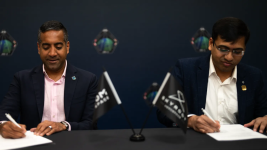
Axiom Space has signed a Memorandum of Understanding (MOU) with India-based Skyroot Aerospace to explore collaboration opportunities to advance space exploration and access to low-Earth orbit (LEO).
This collaboration further reinforces the growing cooperation between Axiom Space and the Indian space sector. Axiom Mission 4 (Ax-4), which launched June 25 at 2:31 a.m. ET, marks India’s return to human spaceflight and the nation’s first mission on board the International Space Station. This historic mission underscores how Axiom Space is redefining the pathway to LEO and fueling a vibrant space economy for the benefit of every human, everywhere.
With Ax-4, Axiom Space is laying the foundation for the construction and operation of Axiom Station, marking the U.S. company as a leader in LEO. As Axiom Space develops a diverse and global supply chain, the company is strategically partnering with pioneering organizations like Skyroot Aerospace.
Skyroot Aerospace is India’s leading private space launch service provider and the first private company to launch a rocket to space in South Asia. As the first private space-tech company to partner with the Indian Space Research Organisation (ISRO), Skyroot is on a mission to make access to space affordable, reliable, and on demand. In 2022, Skyroot successfully launched Vikram-S, and the team is now preparing to launch the Vikram-1 rocket, its maiden orbital-class launch vehicle.
“Enabling greater and equitable access to space, be it for research institutes, startups, or national agencies, is the guiding mantra at Skyroot,” said Pawan Kumar Chandana, co-founder and CEO, Skyroot Aerospace. “As we begin realizing this vision with the upcoming maiden launch of Vikram-1, the partnership with Axiom Space builds an opportunity to explore integrated launch and orbital solutions that will shape humanity’s future in space.”

Bhatia and Kumar discuss collaboration opportunities in India and international markets.
Tejpaul Bhatia, CEO of Axiom Space, added, “Since the day I visited Skyroot’s facility two years ago, I knew our companies had to work together to define humanity’s future in space. With our shared vision to transform access to space, we look forward to collaborating with Skyroot to serve the growing space ecosystem in India and globally.”
Axiom Space and Skyroot Aerospace are exploring opportunities to collaborate on era-defining space infrastructure. Axiom Space will explore utilizing Skyroot capabilities for groundbreaking research payloads, orbital data center nodes, and other missions to Axiom Station and independently in LEO. Together, the two organizations are excited to collaborate in serving India and international markets.
Axiom Space Partners with India-based Skyroot Aerospace to Advance Space Exploration
June 25, 2025
Tejpaul Bhatia, CEO of Axiom Space, and Pawan Kumar, CEO of Skyroot, sign a Memorandum of Understanding to advance access to low-Earth orbit.
Axiom Space has signed a Memorandum of Understanding (MOU) with India-based Skyroot Aerospace to explore collaboration opportunities to advance space exploration and access to low-Earth orbit (LEO).
This collaboration further reinforces the growing cooperation between Axiom Space and the Indian space sector. Axiom Mission 4 (Ax-4), which launched June 25 at 2:31 a.m. ET, marks India’s return to human spaceflight and the nation’s first mission on board the International Space Station. This historic mission underscores how Axiom Space is redefining the pathway to LEO and fueling a vibrant space economy for the benefit of every human, everywhere.
With Ax-4, Axiom Space is laying the foundation for the construction and operation of Axiom Station, marking the U.S. company as a leader in LEO. As Axiom Space develops a diverse and global supply chain, the company is strategically partnering with pioneering organizations like Skyroot Aerospace.
Skyroot Aerospace is India’s leading private space launch service provider and the first private company to launch a rocket to space in South Asia. As the first private space-tech company to partner with the Indian Space Research Organisation (ISRO), Skyroot is on a mission to make access to space affordable, reliable, and on demand. In 2022, Skyroot successfully launched Vikram-S, and the team is now preparing to launch the Vikram-1 rocket, its maiden orbital-class launch vehicle.
“Enabling greater and equitable access to space, be it for research institutes, startups, or national agencies, is the guiding mantra at Skyroot,” said Pawan Kumar Chandana, co-founder and CEO, Skyroot Aerospace. “As we begin realizing this vision with the upcoming maiden launch of Vikram-1, the partnership with Axiom Space builds an opportunity to explore integrated launch and orbital solutions that will shape humanity’s future in space.”
Bhatia and Kumar discuss collaboration opportunities in India and international markets.
Tejpaul Bhatia, CEO of Axiom Space, added, “Since the day I visited Skyroot’s facility two years ago, I knew our companies had to work together to define humanity’s future in space. With our shared vision to transform access to space, we look forward to collaborating with Skyroot to serve the growing space ecosystem in India and globally.”
Axiom Space and Skyroot Aerospace are exploring opportunities to collaborate on era-defining space infrastructure. Axiom Space will explore utilizing Skyroot capabilities for groundbreaking research payloads, orbital data center nodes, and other missions to Axiom Station and independently in LEO. Together, the two organizations are excited to collaborate in serving India and international markets.
Axiom Space Partners with India-based Skyroot Aerospace to Advance Space Exploration


EtherealX to Agnikul, Indian startups enter space defence domain. Op Sindoor was the pivot
From surveillance to reconnaissance to anti-satellite systems, the private sector is upping the ante as India plans to fast-track the launch of 52 dedicated satellites for the Armed Forces.
 theprint.in
