Indian Missiles and Munitions Discussion

Nibe signs tech collaboration with Elbit for artillery rocket system with 300 km range.

Nibe Limited has enteredinto a Technical Collaboration Agreement with Elbit Systems Land Limited, aleading global Israel based defence technology Company on July 26, 2025 for transfer oflicense and technology for Precise & Universal Launch System (PULS) including artilleryrocket system capable of engaging targets with precision over a range of up to 300 km.
 
Nibe signs tech collaboration with Elbit for artillery rocket system with 300 km range.

Nibe Limited has enteredinto a Technical Collaboration Agreement with Elbit Systems Land Limited, aleading global Israel based defence technology Company on July 26, 2025 for transfer oflicense and technology for Precise & Universal Launch System (PULS) including artilleryrocket system capable of engaging targets with precision over a range of up to 300 km.

This means that India is NOT going to wait for SMERCH long range MBRL development by DRDO
 
It's good to have competition no. High time DRDO feels the heat. With production in india, DRDO will lose its edge over "indigenous-ing" already deployed systems. While it is good but not enough for an organisation that is supposed to be the leading R&D org of worlds 4th largest economy.

If it results in better system good. If it results in drdo moving to more prioritised tech, good too. Amway tech transfer is taking place, not just license. So, the knowledge gets absorbed atleast.
 
It means Elbit wants to license produce PULS in india.

We need Long Range MBRLs

DRDO was going to replicate SMERCH in Pinaka Mk 3 and MK 4

But Army would have to wait for how long , nobody knows

But if the cost of licensed production Israeli version is similar to Indian made Pinaka and Smerch then we can induct it soon

300 KM range means SEAD missions can be done with a heavy Salvo of Rockets
 
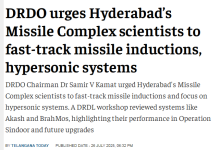
DRDO urges Hyderabad’s Missile Complex scientists to fast-track missile inductions, hypersonic systems

1753544305652.png

Hyderabad: DRDO Chairman Dr Samir V Kamat on Saturday urged the scientists at Missile Complex in Hyderabad to work towards quick induction of weapon systems, which were undergoing user trials.

Dr Kamat emphasised that Missile Complex should concentrate on the development of more agile, stealthier, and faster missiles, such as hypersonic missiles, to counter threats from advanced air defence systems.


The DRDL organised a one-day workshop on weapons systems, including Akash air defence, BrahMos, MRSAM and ULPGM developed at the Missile Complex that played a stellar role in Operation Sindoor, at DRDL here on Saturday.

The workshop, which had an exhibition displaying sub-systems of the various weapons used in Operation Sindoor, deliberated on the performance of these indigenous systems. It also discussed the ways and means to further enhance the system’s capabilities so that they remain unbeatable.

DRDL Director Dr GA Srinivasa Murthy, Akash Weapon System former project director Dr Prahlada, MSS DG U Raja Babu, and DRDO former Chairman Dr G Satheesh Reddy, and veterans involved in weapons system development also participated.


 
For the Indian Navy, AoN was accorded for the procurement of Compact Autonomous Surface Craft, BrahMos Fire Control System & Launchers and Upgradation of BARAK-1 Point Defence Missile System. The procurement of Compact Autonomous Surface Craft will provide the capability to the Indian Navy for detection, classification and neutralisation of threats in anti-submarine warfare missions.

Barak-1 upgrade? Could be life extension IMO.
 

As lesson from Op Sindoor, Indian Air Force to focus on inducting long-range missiles

August 12 (ANI): Following the extensive use of long-range stand-off weapons to target enemy military bases and assets during Operation Sindoor, the Indian Air Force (IAF) is now focusing on the induction of long-range air-to-ground, air-to-air, and surface-to-air missiles with strike ranges exceeding 200 kilometres.

During the operation, the IAF deployed missiles such as BrahMos, SCALP, Rampage and Crystal Maze, all of which have strike ranges well above 200 km. Defence officials told ANI that the Indian Air Force is prioritising the induction of missiles with over 200 km strike range across various categories, including air-to-ground, air-to-air, and surface-to-air weapons.

The Indian Air Force has also asked the Defence Research and Development Organisation (DRDO) to develop extended-range variants of the Astra air-to-air missile, capable of hitting targets beyond 200 km, officials stated.

Additionally, the Air Force is exploring the possibility of acquiring Russian R-37 missile variants, which have a range exceeding 200 km and could provide a significant edge against adversaries on both the western and northern fronts.Officials said that in the recent operation, long-range weapons enabled the IAF to strike targets from distances of 250-450 km, effectively neutralising threats without concern for Chinese HQ-9 air defence systems.

The IAF has also asked DRDO to fast-track the development of long-range air defence missile systems under Project Kusha.Furthermore, the Indian Air Force is planning to procure at least two or more squadrons of the S-400 Triumf air defence system, depending on the capacity of the equipment manufacturer.

The Indian Air Force also created a global record by shooting down a surveillance aircraft at a range of over 300 km.The deployment of the S-400 system compelled the Pakistan military to operate either deep within its territory or at low altitudes to avoid detection and targeting.The IAF has submitted a detailed presentation to the government outlining its operational requirements, which include Rafale fighter jets, fifth-generation fighter aircraft, and a wide array of long-range weapon systems across multiple domains. (ANI)