Indian Defense Industry General News and Updates

Taurus missile ?
Well Taurus is cheap than scalp, does the exact job, won't mind if they go for it,
Taurus KEPD will provide the longer range,
Also we don't have indian equivalent,
There's no sign of cats hunter,
Air lora is a ballistic missile,
Ice breaker is smaller missile,

Taurus KEPD cost roughly 1-2$ million per missile,
MIg 29, Tejas with Taurus KEPD will be awesome,
 
  • Like
Reactions: spice
There are a lot of individuals that go around saying 'not a single' org in India invests in R&D to improve its systems. I apologise. Seems to kind of fall flat when you do a basic search or even ask an AI chat bot.

I obtained the following results for 2023-24 (Stats provided by Gemini). I took HAL as an example and got this comparison done.

This is just a note presented to refute such blank statements.

Note: Currency conversions are approximate based on average exchange rates for the reporting period (1 USD ≈ 83 INR, 0.92 EUR, 10.5 SEK, 1300 KRW).

CompanyCountrySpending ($)Percentage of R&D (as per Revenue)Primary area of focus
HAL🇮🇳 India~$340 Million (₹2,826 Cr)10.0%LCA Tejas Mk1A/Mk2, AMCA, Helicopters (LUH/LCH), Engines
Dassault Aviation🇫🇷 France~$690 Million (€637 M)10.7%Rafale upgrades, Falcon business jets, Future Combat Air System (FCAS)
Saab AB🇸🇪 Sweden~$360 Million (3.8B SEK)7.3%Gripen E/F fighter, Radar systems (GlobalEye), Ground combat
KAI (Korea Aerospace)🇰🇷 South Korea~$165 Million (215B KRW)~5.7%KF-21 Fighter, FA-50 Light Combat Aircraft, Helicopters
Leonardo🇮🇹 Italy~$2.4 Billion (€2.2B)14.4%Helicopters, Defense Electronics, Cyber, Aircraft Division
Lockheed Martin🇺🇸 USA$3.2 Billion4.8%F-35, Missiles, Space, Skunk Works (Advanced Development)
 
Last edited:

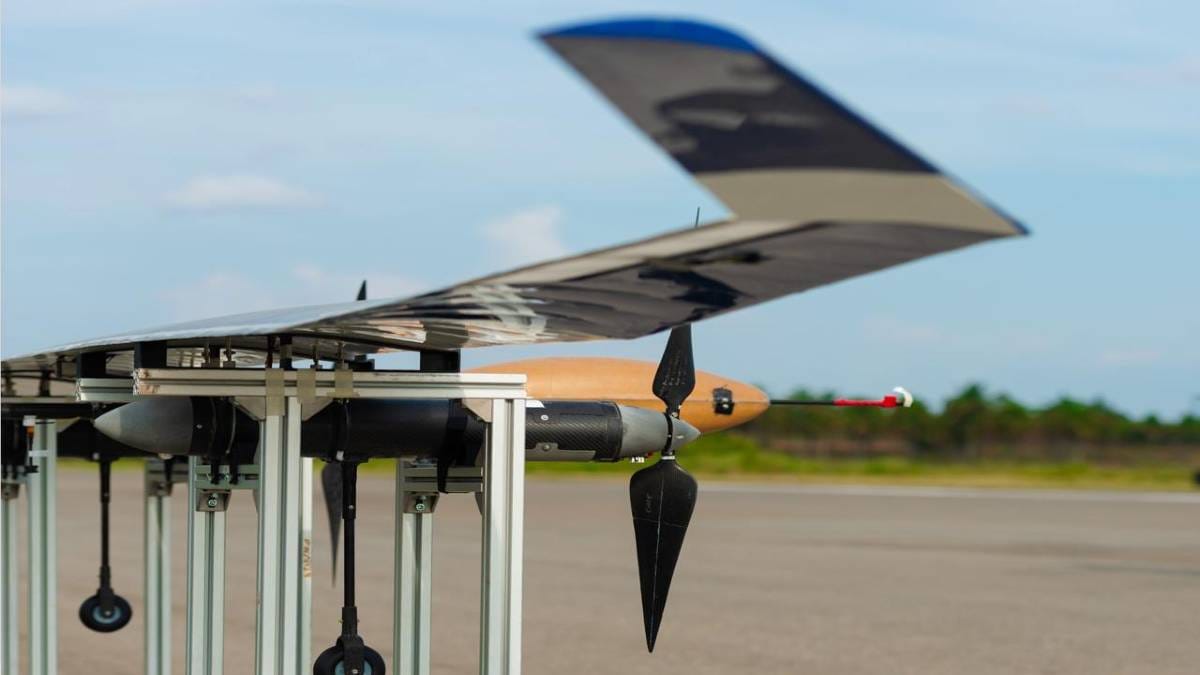
Indian Army has placed a Rs 168 crore order with Bengaluru-based startup NewSpace Research & Technologies (NRT) for its Medium Altitude Persistent Surveillance System (MAPSS), a fully electric, solar-powered unmanned aerial vehicle (UAV).
 
There are a lot of individuals that go around saying 'not a single' org in India invests in R&D to improve its systems. I apologise. Seems to kind of fall flat when you do a basic search or even ask an AI chat bot.

I obtained the following results for 2023-24 (Stats provided by Gemini). I took HAL as an example and got this comparison done.

This is just a note presented to refute such blank statements.

Note: Currency conversions are approximate based on average exchange rates for the reporting period (1 USD ≈ 83 INR, 0.92 EUR, 10.5 SEK, 1300 KRW).

CompanyCountrySpending ($)Percentage of R&D (as per Revenue)Primary area of focus
HAL🇮🇳 India~$340 Million (₹2,826 Cr)10.0%LCA Tejas Mk1A/Mk2, AMCA, Helicopters (LUH/LCH), Engines
Dassault Aviation🇫🇷 France~$690 Million (€637 M)10.7%Rafale upgrades, Falcon business jets, Future Combat Air System (FCAS)
Saab AB🇸🇪 Sweden~$360 Million (3.8B SEK)7.3%Gripen E/F fighter, Radar systems (GlobalEye), Ground combat
KAI (Korea Aerospace)🇰🇷 South Korea~$165 Million (215B KRW)~5.7%KF-21 Fighter, FA-50 Light Combat Aircraft, Helicopters
Leonardo🇮🇹 Italy~$2.4 Billion (€2.2B)14.4%Helicopters, Defense Electronics, Cyber, Aircraft Division
Lockheed Martin🇺🇸 USA$3.2 Billion4.8%F-35, Missiles, Space, Skunk Works (Advanced Development)
HAL just has toooo much on its table. It doesnt have the funding for all of it.
 
  • Haha
Reactions: Shan
HAL just has toooo much on its table. It doesnt have the funding for all of it.
I get where you're coming from. However, HAL will need to undergo certain reforms before most folks would agree to divert more funding towards R&D. I do get that they have a lot on their plate. In an ideal scenario most of us would be happy if the amount increases.

In case anyone is wondering that is the percentage that HAL spends on R&D as a share of the revenue that they make.

HAL structuring and reforms have been discussed and debated before. They seem to be scattered (do check Tejas thread).
 
Last edited:

The Indian Ministry of Defence (MoD) has awarded four contracts with a combined worth of INR1 billion (USD11.1 million) to Hyderabad-based defence company Indrajaal to procure its counter-unmanned aircraft systems (C-UASs) for the Indian Navy and the Indian Army, Janes has learnt.

An Indrajaal spokesperson told Janes on 9 January that the company will be supplying its Indrajaal Infra C-UASs under the four MoD contracts.

“While specific locations cannot be shared, the Indrajaal Infra will be deployed at naval ports on the western seaboard, protecting maritime assets and naval infrastructure. It will also be deployed along the eastern border by the Indian Army to protect strategic bases,” the spokesperson said.

The spokesperson added, “There is an urgency for these [Indrajaal Infra] systems. So we will be delivering 50% of the systems by the end of March, and complete the rest of the deliveries by the end of June.

The Indrajaal Infra C-UAS is powered by the company's artificial intelligence (AI)-enabled SkyOS command-and-control (C2) platform, the spokesperson said. SkyOS integrates sensors and countermeasures to enable system operation with minimal human input, the spokesperson added.

In addition to SkyOS, the key components of Indrajaal Infra are sensors including radars for long-range detection of aerial threats, radio frequency (RF) detectors for identifying unmanned aerial vehicle (UAV) communication signatures and command links, and direction finders; soft-kill capabilities including cyber takeover to seize control of a UAV and bring it down, RF jamming to break C2 links, and global navigation satellite services (GNSS) spoofers and jammers; and hard-kill capabilities including interceptor UAVs such as the company's Zombee UAV, the spokesperson said.
 
This is the state of certain sections of Indian Def. on X. People are cheering for systems based on imports/countries. I have seen people out right dismiss certain systems because they are DRDO/domestically created. More than amusing, it is saddening how things are distilled to just OEM based segregation.

BDs and Pakistanis come into the comments and try to get their engagements up by ragebaiting. Seeing it happen with Turks as well.

Spend less time combating trolls and blindly following/cheering for a system due to its origin. Reading articles and papers would serve you better. At the very least if the argument is genuine, you can present a coherent and meaningful counter. It is a shame that good defence analysts and reporters in India can be counted on two hands.


Note: Please move this to another thread if needed. I was unsure where to place this post. Thank you.
 

A good article.

Claude Key Points:

  • The Deal: In December 2025, Adani Group partnered with Brazil's Embraer to establish India's first commercial aircraft assembly line for regional jets.
  • The Contrast: Brazil, with half of India's GDP and one-sixth its population, built the world's third-largest commercial aircraft manufacturer (Embraer). India founded HAL nearly three decades before Embraer but never achieved similar success in commercial aviation.
  • Limited Role: India will only provide assembly facilities, while Brazil retains the critical elements—aircraft design, intellectual property, certification expertise, and global market credibility.
  • Underlying Question: The article questions what HAL could have become if India had pursued commercial aircraft manufacturing more aggressively, rather than now hosting foreign companies for assembly operations.
 

This is an important week for Indian diplomacy, not because of speeches or photo-ops, but because real negotiations are reaching a decision point.

New Delhi has become the centre of European strategic attention, and the reason is simple: India is one of the few major powers still willing to buy big-ticket defence systems—and it is now demanding technology in return.

The opening move comes from France. President Emmanuel Macron’s NSA, Emmanuel Bonne, will be in India on Tuesday ahead of Macron’s visit next month for the AI Impact Summit. Officially, the focus is on emerging technology. In reality, the more serious talks are about fighter aircraft and engines.

Bonne will confer with India’s NSA Ajit Doval on at least two major defence projects. At the heart of the discussions is the proposed jet engine partnership between Safran and DRDO for India’s future AMCA Mark II fighter. This deal matters because it goes beyond assembly.

For the first time, India is being offered full technology transfer and shared ownership of intellectual property for a high-thrust combat engine. Safran has agreed to design the engine jointly from scratch, rather than repackage an existing product. For India, this is a long-sought breakthrough.

Running alongside this is the Rafale story. Internal Indian consultations on buying a substantial number of Rafale combat jets (the numbers could range from 75 to 114) are likely to move to bilateral discussions, with a clear push to manufacture the majority of aircraft in India rather than import them. Indian industry is already producing components with Dassault Aviation, and the intent now is to turn Rafale into a domestic production line, not a one-off purchase.

Germany’s engagement this week is more immediate and wider. Chancellor Friedrich Merz’s visit has a strong economic focus, but an $8-billion submarine deal to build six boats at Mazgaon Docks with technology from Germany’s tKMS is in the final stages of price negotiations.

Berlin wants the contract, but New Delhi wants clarity on costs and responsibility if problems arise.

Russia, meanwhile, remains an option under quiet examination. The Indian Air Force is studying the Su-57 not for prestige, but for capability. Its interest lies in the aircraft’s ability to launch very long-range missiles like the R-37M and Kinzhal, which allow strikes from well outside enemy airspace.

There is a practical argument for this. India’s own fifth-generation fighter, the AMCA, is still years away. A small number of Su-57s could fill the gap in the interim, especially since the IAF already operates Russian aircraft. But any move carries political risk, with the possibility of US sanctions hanging over the decision.

As reported earlier, another major contest is taking shape in the airlift arena. India’s Medium Transport Aircraft requirement, covering aircraft in the 18–30 tonne range, has attracted global interest. Lockheed Martin is offering the C-130J, Embraer is pushing the C-390 with an Indian partner, and Airbus has entered with the A400M.

Put together, these negotiations show why Europe is suddenly so attentive. With global supply chains under strain and the US trade and defence policy unpredictable, India has become a critical partner.

For New Delhi, this attention is useful—but only if it delivers results. India is no longer satisfied with buying weapons. It wants the knowledge to build them, the rights to improve them, and the capacity to sustain them. That, more than any summit declaration, is what this week of diplomacy is really about.