Indian Defense Industry General News and Updates


From MR-SAM to Astra-2: Big Missile Decisions Expected at Dec 26 DAC Meet | EXCLUSIVE​


Missiles, of different kinds, will be the order of the day when the Defence Acquisition Council (DAC), headed by Rajnath Singh, the defence minister, meets on December 26. The DAC will decide on another round of Emergency Procurement(EP) for the armed forces. This way, weapons, though in smaller numbers, can reach the armed forces very quickly.

-The Navy wants the MR-SAM, or the medium-range surface-to-air missile. This is a big order: over 700 are required. Developed jointly by the Defence Research and Development Organisation (DRDO) and an Israeli firm, Bharat Dynamics (BDL) makes them. The MR-SAM has a range of about 70 km and can be used to counter enemy planes, missiles, drones, and helicopters. They have been fitted onto the Navy's larger warships for nearly a decade. The Army and the Air Force (IAF) have the MR-SAM.

-A significant weapon the DRDO is designing and developing is the Astra Mark-2, the Beyond Visual Range missiles for the IAF and the Navy. These will have a range of approximately 200 km, and the IAF plans to acquire over 600 of the Astras. With the Astra-2, the IAF can hit a Pakistan Air Force plane from well within India. in case a Sindoor-type operation is necessary.

-The Israeli-developed SPICE munition (though not a missile) is a precision-guided system that delivers bombs to their targets. The IAF used them during the Balakot air strike in 2019. They can strike hardened targets, and the IAF sees them as "proven." Again, after Operation Sindoor, there is a realisation that more of them are necessary, and over 300 may be ordered.

-New radars are also necessary, and the Army wants low-level, lightweight radars. The Army already has the 3D Aslesha and the 2D Bharani-- Bharat Electronics or BEL developed them.
More than two dozen of these radars are necessary, and they can be part of the comprehensive control and reporting system, the Akasheer, which performed creditably during the four days of fighting during Operation Sindoor.

Emergency Procurement

India's defence ministry allows Emergency Procurement, which ensures that a limited number of weapons can reach the forces very quickly. One round of EP ended on November 19, and several deals were incomplete. Once the DAC allows more time, as may happen on December 26, the ministry will have the opportunity to complete the negotiations.


Recent conflicts, whether it's the Russia-Ukraine war or the one between Armenia and Azerbaijan have shown the need for drones, for carrying munitions and also, for reconnaissance. So, drones with a range of about 100 km - "about 150 systems," according to highly-placed sources are on the anvil.

A large number of Indian firms are making drones and this approximately Rs 1800 crore deal will be important. Another focus area is counter drone systems, and here too, Indian manufacturers have achieved considerable success. These too are on the agenda.

The Army Air Defence (AAD), after Operation Sindoor--the counter-terrorism strikes in Pakistan and Pakistan Occupied Kashmir earlier this year--is keen to have more command posts. This is where basic data, video feeds and other information come in.

A command post can be at different levels, whether it is for a battalion or a brigade, for example, and in these posts, the battle can be orchestrated.
TIMES NOW has already spoken of the purchase of about 280 rockets for the S-400 air-defence systems from Russia before the visit by Russian

President Vladimir Putin. This Rs 10,000 crore deal is for rockets to make up for the ones used during Operation Sindoor and a few extra ones.
 
This is somewhat similar to SBIR to develop deep tech.

Yes, standard practice. Also somewhat bars any offered new innovative product being offered because no Govt authorised supervision was taken along the process. These NC-NC trials are way too recent to draw conclusion. Basically if some Anduril like org/firm tried to build a product on their own, they would neither find a taker nor would be allowed a biz opportunity (after scaling the tech into a product) without strict govt influenced inspection at every stage, and we all have experience of what that means, the cut-money to be paid for each sign off. Govt willingly erected barriers along the defence biz as a self-serving mechanism, even now there is very little openness because defence tech is highly sensitive.
 
Yes, standard practice. Also somewhat bars any offered new innovative product being offered because no Govt authorised supervision was taken along the process. These NC-NC trials are way too recent to draw conclusion. Basically if some Anduril like org/firm tried to build a product on their own, they would neither find a taker nor would be allowed a biz opportunity (after scaling the tech into a product) without strict govt influenced inspection at every stage, and we all have experience of what that means, the cut-money to be paid for each sign off. Govt willingly erected barriers along the defence biz as a self-serving mechanism, even now there is very little openness because defence tech is highly sensitive.

Obviously because these will be critical technologies. But this is a good initiative, because DRDO is already saturated with projects and they are under pressure. But if this can solve the two major problems that is engine technology and semiconductor designing then this will be the game changer. You can only hope that this doesn't turn out to be a dud due to delays in funds.
 
The Israeli-developed SPICE munition (though not a missile) is a precision-guided system that delivers bombs to their targets. The IAF used them during the Balakot air strike in 2019. They can strike hardened targets, and the IAF sees them as "proven." Again, after Operation Sindoor, there is a realisation that more of them are necessary, and over 300 may be ordered.

The French have put a dunce hat on the IAF. Before a Spice will ever be mated to the Rafales the IAF will be made to pay through the nose for that Hammer JV while a middle finger is raised to TARA.
 

Snehesh says the meeting was postponed at the last minute.
The Defence Acquisition Council of the Defence Ministry on Friday cleared a proposal to allow the defence forces to sign contracts under emergency procurement powers till January 15 next year.The clearance was given at a meeting of the DAC in the Defence Ministry today, defence sources said, while adding that the apex council is likely to meet again on Monday to take up major proposals for strengthening military capabilities with a long list of indigenous missiles and rocket programmes.The deadline for signing the contracts under emergency procurement powers was November 19.


Postponed to Monday.
 
One of companies, BEL probably, said the EPC itself would take anywhere between 8-18 months to finalise. So November deadline was for this fiscal ?
 

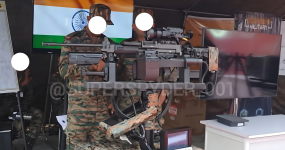
Nishan (ROWS) of Indian Army, based on Negev LMG supports 120-240-round box mag.

Technical Specs:
• Auto frequency hopping digital system
• Endurance – 10 to 12 hours
• Trigger operation – 12V solenoid
• Weapon operation – 8.5–12V motor
• Remote range – 500 m to 1 km
• Live feed – IP camera & TI sight

Roles:
• False depiction of platoon defended locality
• Anti-aircraft/UAV role
• Vehicle mounted convoy protection
• Ambush• Cover infiltration routes
• Company operating base security

1766857171479.png
 

Nishan (ROWS) of Indian Army, based on Negev LMG supports 120-240-round box mag.

Technical Specs:
• Auto frequency hopping digital system
• Endurance – 10 to 12 hours
• Trigger operation – 12V solenoid
• Weapon operation – 8.5–12V motor
• Remote range – 500 m to 1 km
• Live feed – IP camera & TI sight

Roles:
• False depiction of platoon defended locality
• Anti-aircraft/UAV role
• Vehicle mounted convoy protection
• Ambush• Cover infiltration routes
• Company operating base security

View attachment 48642

I have to say - the Negev NG7 (of which limited numbers exist, about ~16k IIRC) is wasted on such static applications.

Its lighter weight (compared to other similar MGs) and ergonomics are a godsend for soldiers that have to carry them. They are best kept for maneuvering elements only. There are scores of old FN MAG-derivatives made by OFB that fire the same 7.62x51mm round and are capable of putting up the same volume of fire. Their weight & lack of modern ergonomics would be less of an issue on such swivel/remote-operated mounts.

Just my 2 paise.
 

DAC clears proposals worth Rs 79,000 crore to enhance the capabilities of the Armed Forces​

The Defence Acquisition Council (DAC), chaired by Raksha Mantri Shri Rajnath Singh, has accorded Acceptance of Necessity (AoN) for various proposals of the three Services amounting to a total of about Rs 79,000 crore. During the meeting held on December 29, 2025, AoN was approved for the procurement of Loiter Munition System for Artillery Regiments, Low Level Light Weight Radars, Long Range Guided Rocket Ammunition for Pinaka Multiple Launch Rocket System (MRLS), and Integrated Drone Detection & Interdiction System Mk-II for the Indian Army.

Loiter Munition will be used for precision strike of tactical targets, whereas Low Level Light Weight Radars will detect and track small size, low flying Unmanned Aerial Systems. Long Range Guided Rockets will enhance the range and accuracy of Pinaka MRLS for effective engagement of high value targets. Integrated Drone Detection & Interdiction System Mk-II with enhanced range will protect the vital assets of the Indian Army in Tactical Battle Area and Hinterland.

For the Indian Navy, AoN was accorded for procurement of Bollard Pull (BP) Tugs, High Frequency Software Defined Radios (HF SDR) Manpack and for leasing High Altitude Long Range (HALE) Remotely Piloted Aircraft System (RPAS). Induction of BP Tugs will assist Naval ships and submarines in berthing, unberthing, and maneuvering in confined waters/harbor. The HF SDR will enhance long range secured communication during boarding and landing operations, whereas HALE RPAS will ensure continuous Intelligence, Surveillance and Reconnaissance and credible Maritime Domain Awareness over the Indian Ocean Region.

For the Indian Air Force, AoN was approved for procurement of Automatic Take-off Landing Recording System, Astra Mk-II Missiles, Full Mission Simulator and SPICE-1000 Long Range Guidance Kits etc. Induction of the Automatic Take-off Landing Recording System will fill the gaps in the aerospace safety environment by providing high definition all-weather automatic recording of landing and take-off. Astra Mk-II Missiles with enhanced range will increase the capability of the fighter aircraft to neutralise adversary aircraft from large standoff range. Full Mission Simulator for Light Combat Aircraft Tejas will augment pilots’ training in a cost effective and safe manner, while SPICE-1000 will enhance long range precision strike capability of the Indian Air Force.


Among the key approvals are proposals for the overhaul of T-90 main battle tanks and a mid-life upgrade of Mi-17 helicopters, aimed at enhancing operational readiness and extending the service life of critical assets.

In addition, changes have been approved to the Requests for Proposal (RFPs) for air-to-air refuellers and the Airborne Warning and Control System (AWACS). Both are considered vital force multipliers, enabling extended air operations, improved situational awareness, and greater operational reach.

Further strengthening India’s air and maritime defence capabilities, the Council cleared proposals to acquire Medium Range Surface-to-Air Missile (MRSAM) systems for the Indian Navy and the Indian Air Force, bolstering protection against aerial threats across multiple domains.

Major defence projects, including the acquisition of Javelin anti-tank guided missiles and Excalibur precision-guided artillery ammunition from the United States, are likely to be finalised by the Indian Army under the emergency procurement route, officials said.
 
I may be wrong but my hunch is that the BF 76mm will be largely identical to the Oto Melara SRGM (barrel, breech, turret, spent ammo ejection) with only some elements (ammo handling system, magazine) being developed by BF on its own.

The IN would ideally want maximum commonality with existing inventory to keep operating costs down. Let's see.
 
  • Like
Reactions: Sathya and Fatalis
I may be wrong but my hunch is that the BF 76mm will be largely identical to the Oto Melara SRGM (barrel, breech, turret, spent ammo ejection) with only some elements (ammo handling system, magazine) being developed by BF on its own.

The IN would ideally want maximum commonality with existing inventory to keep operating costs down. Let's see.

Its a Make-1 project so IN will be involved to large extent.
 
I may be wrong but my hunch is that the BF 76mm will be largely identical to the Oto Melara SRGM (barrel, breech, turret, spent ammo ejection) with only some elements (ammo handling system, magazine) being developed by BF on its own.

The IN would ideally want maximum commonality with existing inventory to keep operating costs down. Let's see.
What do you mean? are they partnering with Italians ?