Since folks cannot stop praising the SK defence deals and equipment. I would advise you to go through the paper. There are many who have stated that Indian DPSUs and pvt. enterprises need to take lessons. They operate under a vastly different set of conditions and policies. There are certain inspirations that can be taken. However, replication chances are negligible to none.
You are using an out of date browser. It may not display this or other websites correctly.
You should upgrade or use an alternative browser.
You should upgrade or use an alternative browser.

A much needed scheme that deserves attention. Can aid with multiple 'job creation' slogans if implemented well.


I think he left the Hindu.Did not clock that Dinakar Peri is part of Carnegie India
I was under impression of him still writing for them so kinda got surprised.I think he left the Hindu.
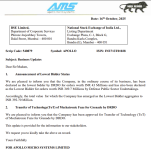
Apollo Microsystems has received orders from DRDO and Tech approvals
- Lowest Bidder for DRDO order worth Rs. 43 Mn
- Defense PSU declared lowest bidder for orders worth Rs. 392.70 Mn
- Received approval from DRDO for Transfer of Technology of Mechatronic Fuze for Grenade
- Lowest Bidder for DRDO order worth Rs. 43 Mn
- Defense PSU declared lowest bidder for orders worth Rs. 392.70 Mn
- Received approval from DRDO for Transfer of Technology of Mechatronic Fuze for Grenade
State-owned BEML has partnered with Kineco Ltd to work in the field of advanced composite manufacturing for defence and aerospace applications.
The Memorandum of Understanding (MoU) was exchanged in the presence of BEML CMD Shantanu Roy, and Shekhar Sardessai, Founder and CMD, Kineco Limited, along with senior officials from both organisations in the national capital.
As part of the collaboration, BEML and Kineco will jointly engage in the development and manufacturing of carbon fibre reinforced polymer (CFRP) structures, glass fibre reinforced polymer (GFRP) panels and components, honeycomb cores, foams, and bonding consumables for metallic detail parts.
These advanced materials are integral to next-generation aerospace and defence systems, offering lightweight strength, enhanced durability, and superior performance.
- In 2011, the Army’s tender demanded a rifle capable of firing both 5.56mm and 7.62mm cartridges just by swapping barrels—a requirement considered impossible by experts and compared to something from “Marvel comic movies.” This led to four wasted years and the tender’s cancellation in 2015, with zero rifles acquired.
- The Army has a pattern of issuing unrealistic and overly stringent requirements for equipment, resulting in 41 cancelled tenders.
- In 2019, after years of delay, the Army bought 72,000 SIG-716 rifles without night sights as a temporary measure, only placing an order for the missing equipment six years later—demonstrating a cycle of incomplete purchases leading to further costs and delays.
- A major deal with Russia to produce 671,000 AK-203 rifles was delayed by price disputes and the Ukraine war, with only 10,000 rifles delivered to troops by mid-2024, making progress extremely slow.
- Despite previous issues, the Army ordered over 70,000 more SIG-716 rifles in 2024, perpetuating the cycle of flawed procurement.
- The Army defends its “futuristic” requirements as preventing obsolescence, but this approach ignores how real militaries keep platforms current with upgrades, not impossible wish lists.
- There is no accountability for those responsible for the failures—no careers have suffered, and procurement officials remain in position while soldiers go without adequate rifles.
- This dysfunction discourages Indian manufacturers, hindering “Make in India” efforts, and signals to domestic companies that investing in small arms is risky.

The Army Killed Its Own Rifle Deal By Asking For The Impossible. Then Did It Again.
From multi-calibre fantasies to endless delays—every mistake was preventable.
 sharpbyswarajya.substack.com

"U.S. Defence Production Strain: The U.S. is struggling to replenish artillery shells after supplying Ukraine, able to produce only about 15,000 shells per month. "
"American companies are inviting Bharat Forge to help boost their ammunition manufacturing."
"Need for Product-Driven Approach: India is criticized for being process-driven, leading to delays. The call is for India to focus on being a product-driven nation—delivering results, not just sticking rigidly to processes."
"Major defense procurement is delayed by outdated systems like insistence on multiple tenders and FOPM (First of Production Model) tests, even after years of successful trials...7 years of trials in Leh, Sikkim, and Pokhran. We got an order of 180 ATAGS when they need 1000 guns."

Random insta editors and small time photographers do a better job of promoting products coming out of DPSUs than the group hired to do PR.
The factory floor maintenance and the aesthetics of factories is a long time ask. However, no one bothers with feedback. It is nitpicking but Jamwal is right to do so.
The factory floor maintenance and the aesthetics of factories is a long time ask. However, no one bothers with feedback. It is nitpicking but Jamwal is right to do so.

Astra Rafael JV won Rs.285.56 crore MoD order for IAF Special Forces communications, execution within 11 months.
Procurement of Communication Systems,with accessories, for Special Forces ofIndian Air Force (IAF).
Zen Technologies: Two MoD orders for Anti-Drone System upgrades totaling ₹289 crore (including GST), execution within one year.
Procurement of Communication Systems,with accessories, for Special Forces ofIndian Air Force (IAF).
Zen Technologies: Two MoD orders for Anti-Drone System upgrades totaling ₹289 crore (including GST), execution within one year.

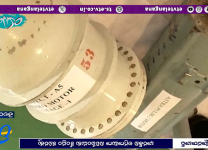
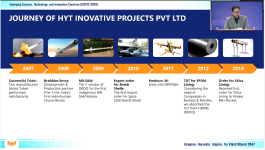
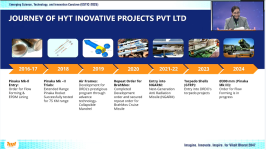
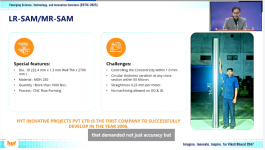
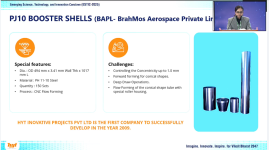
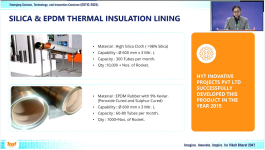
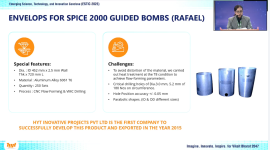
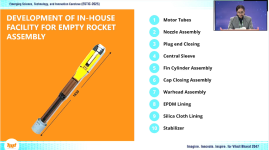
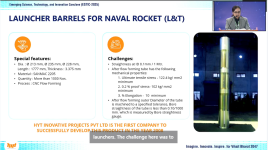
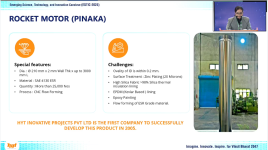
Some pics taken from the HYT inovative tech presentation from the fb stream