

Indian Defence Exports
- Thread starter R!cK
- Start date
You are using an out of date browser. It may not display this or other websites correctly.
You should upgrade or use an alternative browser.
You should upgrade or use an alternative browser.


MKU Wins Contract to Supply Ballistic Vests for Estonia’s Health Sector - Aeromag Asia
We are proud to announce that MKU Limited has been awarded a contract to supply NIJ Level IIIA ballistic vests to Estonia’s State Support Service Center. These vests will be deployed across 11 healthcare institutions, including the North Estonia Regional Hospital Foundation, Tallinn Children’s...
 www.aeromagasia.com
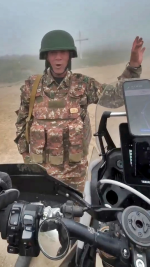


SSS Defence gets additional order from friendly nation for sniper rifles, $30 mn worth ammunition
Private firm had earlier bagged contracts to supply nearly $50 mn worth of ammunition from multiple friendly countries, the deliveries of which have been completed.
 theprint.in
SSS got into ammunition game?
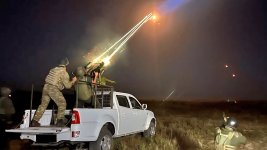
Ukrainian Army using Indian made TATA Xenon Pickup Truck as a Technical with Dual Pre World War I Era Maxim Heavy Machine Guns mounted for Counter Drone Role.
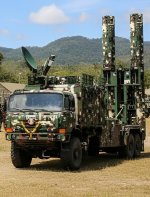
Philippine Marine Corps BrahMos

India to send last batch of BrahMos missiles to Philippines under defence deal
Shivani Sharma
New Delhi,UPDATED: Sep 12, 2025, 12:08 IST
Edited By: Karishma Saurabh Kalita
India is preparing to deliver the third and final consignment of BrahMos supersonic cruise missiles to the Philippines, completing a $375 million agreement signed in 2022. Earlier consignments were delivered in 2024 and earlier this year.
India to send last batch of BrahMos missiles to Philippines under defence deal

ToT of BM21 Grad motors from a US company?

What's the story here?
Royal Enfield proud to announce partnership with the British Army
superbike.co.uk
16 September 2025
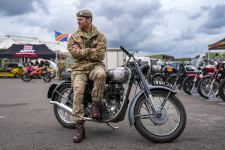

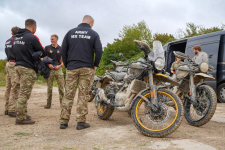
Milton Keynes, UK, Royal Enfield – Building on the heritage between Royal Enfield and the military, Royal Enfield is delighted to announce a new partnership with the British Army. This supports the Army Motorised Adventure group (AMA) with the supply of four new Royal Enfield Himalayan 450s. These will aid training and personnel development.
Not only that, but Royal Enfield will become an integral part of the British Army’s upcoming events calendar. Initially, they will support the AMA at the recent 2025 Army Motorsport Day at Thruxton Circuit. Subsequent events for Exercise Mudmaster and Exercise Roadmaster will also be supported.
British Army personnel will also be present at future Royal Enfield events. This includes MCL 2025 (Motorcycle Live at the NEC, 15-23 November) and other key events for 2026.
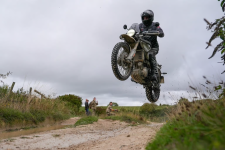
AMA Events with support from Royal Enfield
Kicking off this new partnership, the British Army Motorsport Association held an Army Motorsport Day at Thruxton Circuit on Wednesday, the 10th September. All 9 Army Motorsport disciplines were in attendance, including 5 motorcycle disciplines. Service personnel and veterans from across the Armed Forces were invited.
Following this initial event at Thruxton, the four Himalayan 450s will be used in further trials. Specifically, these will be the Mudmaster and Roadmaster off-road navigation exercises. Quarterly UK-based training weekends are planned in. These trials provide the perfect platform for serving military personnel to build on and master their skills. From technical riding, tactical planning and off-bike skills, to physical and psychological preparation.
In addition to these UK based navigation competitions, the AMA regularly participates in arduous overland expeditions.
April, a 4×4 AMA crew was the first British team to win the Santana trophy in Morocco. September, AMA delivered a Tri-Service expedition to Morocco. This encompassed 26 personnel on motorcycles and in 4x4s. They repeated this model in Namibia in November.
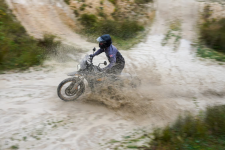
Lieutenant Colonel Nick Foulerton commented:
“We are delighted to partner with Royal Enfield. As part of the Army Motorised Adventure programme, this unique association with a fleet of Himalayan 450s offers serving personnel the opportunity to not only get on to two-wheels, but to learn off-road skills and ultimately go on to participate in some of the great expeditions we embark on both on home soil and abroad. The British Army has an association with Royal Enfield that dates back to World War 1, so we’re delighted to reignite this partnership and look forward to this developing over the coming years.”
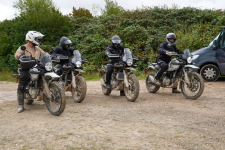
Himalayan 450
Built for all roads, built for no roads. The choice of the Himalayan 450 was natural for the British Army. It is for many owners around the world as well, as it’s the ultimate versatile off-road motorcycle. It is selected by the best for their own training expeditions.
The latest iteration of the Himalayan lineage is a motorcycle with strong adventure capabilities. Yet it remains true to our philosophy of pure motorcycling. The all-new Himalayan 450 retains the capability and versatility. It can go anywhere your adventure takes you.
Where the Flying Flea has established a rich history with the British Army, this new partnership allows the Himalayan 450 to take the reins. It is a durable, reliable all-terrain motorcycle. This builds on Royal Enfield’s uncomplicated and accessible nature. The Himalayan 450s in particular provide the perfect platform for adventure and exploration for the military personnel of Britain.

Royal Enfield’s military legacy
The British Army’s use of Royal Enfields can be traced back to 1914. By far the most prominent early development was the creation of the machine gun sidecar. Using the Maxim gun from their Made Like A Gun publicity display, the company produced a prototype in May 1914. They sent it to the Ministry of Munitions for testing.
Between 1939 and 1945, support for the British Army continued with Royal Enfield. They produced large quantities of military motorcycles, bicycles, generators and ant-aircraft gun predictors during the Second World War. The most iconic model is the world’s first ‘airborne’ motorcycle, the 60kg 125cc motorcycle known as the Flying Flea. It was loaded into specially fabricated parachute cradles and dropped in with paratroopers behind enemy lines. It supported the Allied Forces on D-Day and other military campaigns.
Building on the successes of the Long Range Desert Group during the North African campaign of World War II, the British military has promoted vehicle-mounted expeditions over the last 70 years. This is an activity closely aligned to operational requirements.
In 2018, in collaboration with the British Ministry of Defence, the Classic 500 Pegasus Edition was launched at the Imperial War Museum, Duxford. It pays homage to Flying Fleas used by the Parachute Regiment during WWII. The 750 limited edition machines were available in Olive Drab or Service Brown. They were badged with the Airborne Regiment’s Pegasus insignia and a unique stencilled serial number on their tanks. Each machine is a piece of history, a tribute to the resilience of the company, a salute to its long-standing partnership with the armed forces.
Thanks to their incredible utility and reliability, Royal Enfield bikes are used to this day around the world. They are used by law enforcement, armed forces, and adventure extraordinaires alike.
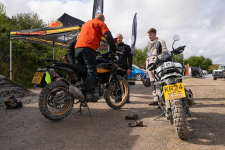
About AMA
The AMA are predominantly an Army-owned group, but they count a community of in excess of 450 tri-service members.
They aim to support service members in conducting their own on-duty expeditions. This is by providing the guidance, paperwork, funding, and administration support.
They also provide training and competitive opportunities to develop our team members’ riding, medical, mechanical, patrolling and other military skills.
In the last three years, they have assisted in the organisation of five on-duty expeditions:
About Royal Enfield
The oldest motorcycle brand in continuous production, Royal Enfield has created beautifully crafted motorcycles since 1901. From its British roots, a manufacturing plant was established in Madras in 1955.
It was a foothold from which Royal Enfield spearheaded the growth of India’s mid-sized two-wheeler segment. Royal Enfields are engaging, uncomplicated, accessible and fun to ride. A vehicle for exploration and self-expression. It’s an approach the brand calls Pure Motorcycling.
Royal Enfield’s premium line-up includes Bear 650, Classic 650, Guerrilla 450 modern roadster, Hunter 350, Meteor 350, and Super Meteor 650. It also includes Interceptor 650 and Continental GT 650 twins, the Shotgun 650, the new Himalayan adventure tourer, the Scram 440 ADV Crossover, the iconic Bullet 350, Classic 350, and Goan Classic 350.
The company recently unveiled its new city+ motorcycle brand – the Flying Flea. This is a fresh take on urban mobility, blending authentic design with advanced technology.
Riders and a passionate community are fostered with a rich profusion of events at a local, regional and international level. Most notable are Motoverse (previously Rider Mania). This is an annual gathering of thousands of Royal Enfield enthusiasts in Goa. There is also the Himalayan Odyssey, a yearly pilgrimage over some of the toughest terrain and highest mountain passes.
A division of Eicher Motors Limited, Royal Enfield operates through more than 2000 stores across all major cities and towns in India. They also operate through nearly 850 stores in more than 60 countries around the globe.
Royal Enfield also has two world-class technical centres, in Bruntingthorpe, UK, and in Chennai, India. The company’s two state-of-the-art production facilities are located at Oragadam and Vallam Vadagal, near Chennai.
Across the world, Royal Enfield has six modern CKD assembly facilities in Bangladesh, Nepal, Brazil, Thailand, Argentina and Colombia.
SuperBike Magazine - Royal Enfield proud to announce partnership with the British Army
superbike.co.uk
16 September 2025
- Royal Enfield is to collaborate with the British Army Motorised Adventure (AMA) group.
- Four Himalayan 450 motorcycles are to be provided to the AMA for training. This includes publicly attended AMA exercises such as EX Mudmaster and EX Roadmaster. It positions the Himalayan 450 as a premier off-road motorcycle.
- This initiative supports the training and development of soldiers. It helps them to fulfil their crucial role in serving the United Kingdom.
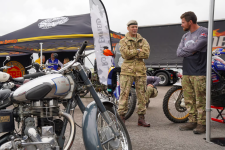
Milton Keynes, UK, Royal Enfield – Building on the heritage between Royal Enfield and the military, Royal Enfield is delighted to announce a new partnership with the British Army. This supports the Army Motorised Adventure group (AMA) with the supply of four new Royal Enfield Himalayan 450s. These will aid training and personnel development.
Not only that, but Royal Enfield will become an integral part of the British Army’s upcoming events calendar. Initially, they will support the AMA at the recent 2025 Army Motorsport Day at Thruxton Circuit. Subsequent events for Exercise Mudmaster and Exercise Roadmaster will also be supported.
British Army personnel will also be present at future Royal Enfield events. This includes MCL 2025 (Motorcycle Live at the NEC, 15-23 November) and other key events for 2026.
Royal Enfield’s George Cheeseman, commented:
“We are thrilled to provide support to the British Army’s Motorised Adventure initiative. With such a deep rooted history we felt compelled to support the programme which we believe is hugely important. With the Himalayan, we can provide a machine that is truly capable and versatile in the toughest of conditions, while we will also supply personnel with genuine Royal Enfield apparel and accessories too. We look forward to supporting military personnel even further as our partnership develops.”AMA Events with support from Royal Enfield
Kicking off this new partnership, the British Army Motorsport Association held an Army Motorsport Day at Thruxton Circuit on Wednesday, the 10th September. All 9 Army Motorsport disciplines were in attendance, including 5 motorcycle disciplines. Service personnel and veterans from across the Armed Forces were invited.
Following this initial event at Thruxton, the four Himalayan 450s will be used in further trials. Specifically, these will be the Mudmaster and Roadmaster off-road navigation exercises. Quarterly UK-based training weekends are planned in. These trials provide the perfect platform for serving military personnel to build on and master their skills. From technical riding, tactical planning and off-bike skills, to physical and psychological preparation.
In addition to these UK based navigation competitions, the AMA regularly participates in arduous overland expeditions.
April, a 4×4 AMA crew was the first British team to win the Santana trophy in Morocco. September, AMA delivered a Tri-Service expedition to Morocco. This encompassed 26 personnel on motorcycles and in 4x4s. They repeated this model in Namibia in November.
Lieutenant Colonel Nick Foulerton commented:
“We are delighted to partner with Royal Enfield. As part of the Army Motorised Adventure programme, this unique association with a fleet of Himalayan 450s offers serving personnel the opportunity to not only get on to two-wheels, but to learn off-road skills and ultimately go on to participate in some of the great expeditions we embark on both on home soil and abroad. The British Army has an association with Royal Enfield that dates back to World War 1, so we’re delighted to reignite this partnership and look forward to this developing over the coming years.”
Himalayan 450
Built for all roads, built for no roads. The choice of the Himalayan 450 was natural for the British Army. It is for many owners around the world as well, as it’s the ultimate versatile off-road motorcycle. It is selected by the best for their own training expeditions.
The latest iteration of the Himalayan lineage is a motorcycle with strong adventure capabilities. Yet it remains true to our philosophy of pure motorcycling. The all-new Himalayan 450 retains the capability and versatility. It can go anywhere your adventure takes you.
Where the Flying Flea has established a rich history with the British Army, this new partnership allows the Himalayan 450 to take the reins. It is a durable, reliable all-terrain motorcycle. This builds on Royal Enfield’s uncomplicated and accessible nature. The Himalayan 450s in particular provide the perfect platform for adventure and exploration for the military personnel of Britain.
Royal Enfield’s military legacy
The British Army’s use of Royal Enfields can be traced back to 1914. By far the most prominent early development was the creation of the machine gun sidecar. Using the Maxim gun from their Made Like A Gun publicity display, the company produced a prototype in May 1914. They sent it to the Ministry of Munitions for testing.
Between 1939 and 1945, support for the British Army continued with Royal Enfield. They produced large quantities of military motorcycles, bicycles, generators and ant-aircraft gun predictors during the Second World War. The most iconic model is the world’s first ‘airborne’ motorcycle, the 60kg 125cc motorcycle known as the Flying Flea. It was loaded into specially fabricated parachute cradles and dropped in with paratroopers behind enemy lines. It supported the Allied Forces on D-Day and other military campaigns.
Building on the successes of the Long Range Desert Group during the North African campaign of World War II, the British military has promoted vehicle-mounted expeditions over the last 70 years. This is an activity closely aligned to operational requirements.
In 2018, in collaboration with the British Ministry of Defence, the Classic 500 Pegasus Edition was launched at the Imperial War Museum, Duxford. It pays homage to Flying Fleas used by the Parachute Regiment during WWII. The 750 limited edition machines were available in Olive Drab or Service Brown. They were badged with the Airborne Regiment’s Pegasus insignia and a unique stencilled serial number on their tanks. Each machine is a piece of history, a tribute to the resilience of the company, a salute to its long-standing partnership with the armed forces.
Thanks to their incredible utility and reliability, Royal Enfield bikes are used to this day around the world. They are used by law enforcement, armed forces, and adventure extraordinaires alike.
About AMA
The AMA are predominantly an Army-owned group, but they count a community of in excess of 450 tri-service members.
They aim to support service members in conducting their own on-duty expeditions. This is by providing the guidance, paperwork, funding, and administration support.
They also provide training and competitive opportunities to develop our team members’ riding, medical, mechanical, patrolling and other military skills.
In the last three years, they have assisted in the organisation of five on-duty expeditions:
- Exercise Cornish Raider (UK)
- Exercise Welsh Raider (UK)
- Exercise Norther Raider (UK)
- Exercise Atlas Enduro – Morocco
- Exercise Eagles’ Endurance – Namibia
About Royal Enfield
The oldest motorcycle brand in continuous production, Royal Enfield has created beautifully crafted motorcycles since 1901. From its British roots, a manufacturing plant was established in Madras in 1955.
It was a foothold from which Royal Enfield spearheaded the growth of India’s mid-sized two-wheeler segment. Royal Enfields are engaging, uncomplicated, accessible and fun to ride. A vehicle for exploration and self-expression. It’s an approach the brand calls Pure Motorcycling.
Royal Enfield’s premium line-up includes Bear 650, Classic 650, Guerrilla 450 modern roadster, Hunter 350, Meteor 350, and Super Meteor 650. It also includes Interceptor 650 and Continental GT 650 twins, the Shotgun 650, the new Himalayan adventure tourer, the Scram 440 ADV Crossover, the iconic Bullet 350, Classic 350, and Goan Classic 350.
The company recently unveiled its new city+ motorcycle brand – the Flying Flea. This is a fresh take on urban mobility, blending authentic design with advanced technology.
Riders and a passionate community are fostered with a rich profusion of events at a local, regional and international level. Most notable are Motoverse (previously Rider Mania). This is an annual gathering of thousands of Royal Enfield enthusiasts in Goa. There is also the Himalayan Odyssey, a yearly pilgrimage over some of the toughest terrain and highest mountain passes.
A division of Eicher Motors Limited, Royal Enfield operates through more than 2000 stores across all major cities and towns in India. They also operate through nearly 850 stores in more than 60 countries around the globe.
Royal Enfield also has two world-class technical centres, in Bruntingthorpe, UK, and in Chennai, India. The company’s two state-of-the-art production facilities are located at Oragadam and Vallam Vadagal, near Chennai.
Across the world, Royal Enfield has six modern CKD assembly facilities in Bangladesh, Nepal, Brazil, Thailand, Argentina and Colombia.
SuperBike Magazine - Royal Enfield proud to announce partnership with the British Army
India's indigenous wheeled-APC "WhAP" to take nation's defence innovation to global stage: DRDO after Tata's defence manufacturing facility opens in Morocco.
New order ?
Got any non-paywalled version of the article?
You will have to wait for some other sources to report. This is site reliable from what I have seen.Got any non-paywalled version of the article?
Second export ?
A strangely worded report:
There is probably some negotiation going on between the two countries. We have been seeing similar reports from different sources for almost a year now:
This is also happening apparently:
India comes to Armenian defence; IAF’s Sukhoi Su-30MKI to counter Azerbaijan’s Pak-sold 40 JF-17C Block III Thunders
Azerbaijan's advancements in fighter jet procurements can't be left unchecked by Armenia, and the arrival of 40 JF-17C Block III Thunders needs to be countered immediately and the country chose India's Sukhoi Su-30MKI over French Rafales
By The Week News Desk Updated: October 27, 2025, 13:17 IST
IAF's Su-30MKI aircraft.
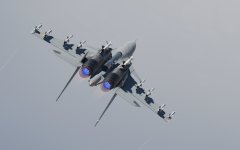
As expected by many, Armenia is reportedly preparing to counter Azerbaijan's defence deal with Pakistan by approaching New Delhi. Baku's $4.6 billion defence deal with Pakistan to acquire 40 JF-17C Block III Thunder fighters is a bolt to Armenia, which has quickly come to the conclusion that bringing home the Sukhoi Su-30MKI could avoid the balance in airpower from tilting.
Yerevan will certainly explore several options before settling on the fighter jet to counter the JF-17C Thunders, but given the price range of alternative options, Sukhoi Su-30MKIs hold an edge, reports said. India-built Su-30MKIs. With political alignments also to be factored in, both New Delhi and Yerevan are likely to pursue the 'enemy of my enemy's friend' line and boost the deal. The South Caucasus nation reportedly wants to get eight to twelve Su-30MKIs initially.
India's Akash-1S system is already part of Armenia's air defence since 2024 and a second batch expected to be delivered soon, Defence Security Asia said in a report. In March 2025, the nation's Foreign Minister visited India and the two countries signed MoUs for cooperation in regulating medical products and diplomatic training. The same month, Armenia’s Ambassador to India, Vahagn Afyan, met with Vishwesh Negi, the Joint Secretary of International Cooperation at the Indian Ministry of Defense.
It is said that Armenia was influenced by the rumours of IAF's Rafale jets failing to be flawless during 'Operation Sindoor', which ultimately resulted in the country choosing Su-30MKI over the French alternative, Defence Security Asia said.
Russian-made Su-30SMs, acquired in 2019, and Soviet-era Su-25s, guard Armenian skies as things stand, but they will struggle against the Sino-Pak JF-17Cs which are fourth generation jets.
IAF's Su-30MKIs
Sukhoi Su-30MKI is a two-seater, multi-role air superiority fighter developed by Russian aircraft maker Sukhoi and built by Hindustan Aeronautics Limited (HAL). Based on the Sukhoi Su-30 fighter aircraft, Su-30 MKI is equipped with thrust vectoring control, canards and is considered to be a cornerstone of the Indian Air Force (IAF) combat fleet. HAL has played a pivotal role in its licence production and integration of indigenous systems.
Developed through a collaboration between Sukhoi Design Bureau of Russia and HAL, Sukhoi Su-30MKI, a variant of the Russian-made Sukhoi Su-30, is specifically tailored to meet the demands of the IAF. The aircraft, which is now a major part of the Indian Navy's defence capabilities, can reach speeds up to Mach 2 and has a combat range of 3,000 km, extendable to 8,000 km with in-flight refueling.
Earlier reports had suggested that HAL is pushing for the proposal of the IAF to add as many as 72 Sukhoi Su-30MKI fighter jets to its fleet. The Nashik facility of the HAL, originally established as a dedicated hub for the Su-30MKI, is being tasked to meet the urgent production demands of this fighter aircraft.
Sino-Pak JF-17s
The JF-17Cs are developed jointly by the Pakistan Aeronautical Complex (PAC) and the Chengdu Aircraft Corporation (CAC) from China. Capable of gaining speeds of around 1,909 km/h, this versatile combat jet can typically carry a total payload of 3,400 kg. Originally intended to be a low-cost rival to the reputed Russian Su-30MKI and MiG-29, as well as the French Mirage-2000, Pakistan is said to have lost at least a couple of JF-17Cs to India's long-range missiles during Operation Sindoor.
India comes to Armenian defence; IAF’s Sukhoi Su-30MKI to counter Azerbaijan’s Pak-sold 40 JF-17C Block III Thunders
There is probably some negotiation going on between the two countries. We have been seeing similar reports from different sources for almost a year now:
Will Russia Lose… the Armenian Air Force?
Published on October 28, 2024
By Arnaud
View attachment 37570
Photo © Armenian Ministry of Defense
Is the Russian aeronautics industry starting to pay for its recurring shortcomings? At the end of October 2024, the Armenian Ministry of Defense announced that it had begun negotiations with the Indian aircraft manufacturer HAL in order to acquire a batch of locally produced Su-30MKI Flanker-H fighters as well as dedicated weapons. In doing so, it intends to cancel the order for eight additional Su-30SM Flanker-Cs that has been dragging on… for 5 years. This would be the first contract since India chose to export its own Su-30MKIs.
Currently, the Armenian fighter fleet consists of four Sukhoi Su-30SM Flanker-Cs received new in the spring of 2019 and around fifteen much older Su-25K Frogfoots. However, a few weeks after receiving its fighters, Armenia chose to order eight additional Su-30SMs. Although they have been partially paid for, at 70% of the contract, no aircraft have been delivered since. For one simple reason: Sukhoi has not produced any of them and the only Su-30s to date that have left its factories have been for the needs of Russia itself.
Five years later it seems that the patience of the Armenians has run out. Russia could well lose a customer but also an ally. Armenia has started discussions with HAL around the supply of eight to twelve Su-30MKI. In fact, Hindustan Aircraft Limited would take over the eight new aircraft, on condition that Sukhoi reimburses the advance, and would upgrade the four current Su-30SM to the Su-30MKI standard. This would include replacing the original passive electronically scanned array radar with an active Uttam antenna radar.
Known as the " Super 30 " program, the negotiations revolve around a batch of Astra 1 long-range air-to-air missiles, Rudram 1 anti-radar missiles, and SAAW guided bombs. All three are of Indian design and production. The size of the contract that is emerging between the two countries is currently unknown.
La Russie va t-elle perdre... la force aérienne arménienne ? — avionslegendaires.net
Armenia looks to India for Astra missiles, upgrade of its Sukhoi fleet
Four Su30s bought from Russia in 2019 did not take part in the 2020 Nagorno-Karabakh conflict with Azerbaijan as they lacked fire power, including guided air-to-surface munitions.
By Snehesh Alex Philip
14 September 2024 01:10 pm IST
View attachment 36255
The 'Astra' beyond-visual-range air-to-air missile developed by DRDO | Photo: Commons.
New Delhi: Armenia has reached out to India for possible procurement of Indian missiles including the indigenous beyond visual range Astra air-to-air missile and possible upgrade of their Sukhoi 30s, ThePrint has learnt.
Sources in the defence establishment said that the talks are on and still at a very initial stage.
Armenia is looking to upgrade its air force and is seeking help from India in terms of weaponry and maintainability of their assets, the sources added.
“The Su30s operated by Armenia are different from what we operate. So one will really have to see what all can be done. The talks are just in the initial stage,” a source told ThePrint. “They (Armenians) want to upgrade their Su30s and integrate our weapons.”
The weapons being sought by Armenia also include air-to-surface guided munitions. There was no confirmation on whether Armenia was also seeking the air launched BrahMos missiles.
The sources explained that there are multiple protocols when it comes to exports of missiles and multiple issues have to be tackled first.
Armenia had bought four Su30s from Russia in 2019 but those did not take part in the 2020 Nagorno-Karabakh conflict with Azerbaijan as the aircraft lacked fire power including guided air-to-surface munitions.
Interestingly, Azerbaijan has beefed up its Soviet era Su25s with help from Turkey.
Another area that Armenia is looking at is maintaining issues of the Su30s and also training of its pilots, the sources said.
India operates close to about 272 Su 30 MKIs and has managed to locally manufacture some of the components of the aircraft which helps in reducing the dependability on Russia for service and spares.
Incidentally, the four Su30s operated by Armenia are largely known as “white elephants” because of large investment without being of use. On the other hand, Azerbaijan invested in drones and loitering munitions, which were able to take out multiple air defence assets of Armenia and also pulverise its armoured columns.
Since the conflict, Armenia has become a big defence export destination for India and has, in the past, bought several systems, including artillery guns besides certain kinds of missiles, mortars, radars, small arms and sight systems.
(Edited by Tony Rai)
Armenia looks to India for Astra missiles, upgrade of its Sukhoi fleet
This is also happening apparently: