

India–United Kingdom relations : Updates
- Thread starter Gautam
- Start date
You are using an out of date browser. It may not display this or other websites correctly.
You should upgrade or use an alternative browser.
You should upgrade or use an alternative browser.




An article.fr on this topic:
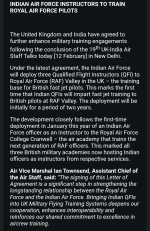
Indian instructors will contribute to the training of Royal Air Force fighter pilots
For several years now, the Royal Air Force has struggled to train new pilots, to the point that some trainees, nicknamed "holdies," sometimes have to wait months before moving on to the next stage of their training. As a result, they patiently wait by pursuing other training, such as air traffic control.
The result: according to Sky News, the average age of a newly qualified pilot was 29 in 2022… whereas it was previously 20-25.
The limited availability of Hawk T2 training aircraft, due in particular to repeated failures of the Adour Mk-951 engine, partly explains this problem. This is also why there are plans to replace it in the near future. Furthermore, the RAF is facing a shortage of instructors, as its most experienced pilots, when they are not lured away by private companies, are increasingly called upon to fulfill its operational commitments.
Therefore, to mitigate this problem, the RAF has reached an agreement with the Italian Air Force (Aeronautica Militare) to allow some of its student pilots to complete their training at the International Flight Training School (IFTS) based in Decimomannu, Sardinia. But this is apparently not enough.
Indeed, last week, during the 19th talks between the British and Indian Air Force general staffs, the RAF and the Indian Air Force agreed to strengthen their training cooperation. Three Indian qualified flight instructors will be seconded to RAF Valley [Wales], home to the BAe Hawks of No. 4 Flying Training School (4 FTS).
"This is the first time Indian instructors will provide jet training to British pilots at RAF Valley. The initial period will be two years," commented the UK Ministry of Defence (MoD).
As a reminder, the Indian Air Force (IAF) and the Indian Naval Air Arm also use BAe Hawks to train their student pilots.
"The signing of this agreement is an important step in strengthening the relationship between the Royal Air Force and the Indian Air Force." “The integration of qualified Indian flight instructors into British military training systems deepens our cooperation, improves interoperability and strengthens our shared commitment to excellence in aircrew training,” said RAF Deputy General Ian Townsend. /END

Yo, how's it hangin'?
I told ya Brexit will result in mass third world immigration into the UK. I just think it's stupid you chose Pakistanis over Indians, like AU, NZ, and Canada did. At least you would have gotten a whole bunch of domestic tax-paying tech support rather than wild animals.
Are you now feeling nostalgic for all the Polish immigrants now? Heard they are doing quite well being sensible and all.
Did it finally prove the Crown was in on it?
Welcome to communism. The powers that be are turning the UK and EU into Colonial India. We have been fighting this for more than 150 years now so we see clearly what's happening. You are new at this but you will learn to cope just like we did.
Welcome back.


