Hyperloop Transportation System Projects in India

Himanshu

Senior member
Dec 3, 2017
909
1,517
New Delhi
indopacfront.blogspot.com
HTT Proposes 700 km Hyperloop Transportation System in Southern India

The state government of Andhra Pradesh, which proposes to shift its current capital to the city of Amravati, had last year asked Hyperloop Transportation Technologies (HTT) for a pre-feasibility study for a high-speed transportation system.

New Delhi (Sputnik) — Banking on the Indian government's ambition to decongest the country's road and rail transport, Hyperloop Transportation Technologies (HTT) has come up with a pre-feasibility study, which aims to provide high-speed transportation in a 700-800 kilometer stretch along India's southern city of Andhra Pradesh.

The proposed system will connect the towns of Anantapur-Amaravathi-Vijayawada and Visakhapatnam as part of an integrated public transit system. HTT has also proposed setting up a manufacturing complex where it plans to build the tube, capsule and track and carry out 3D printing of some locomotive parts.

"Given the population of 3.5 million people, the total travel demand for the city is estimated to be around 4 million motorized trips by 2050. To support this requirement, there is a need for a sustainable high-quality robust mass transportation system," Ajay Jain, the principal secretary of the energy infrastructure and investment department, said in a statement.

We appreciate the pre-feasibility presentation made by Hyperloop Transportation Technologies and look forward to the feasibility study," J Krishna Kishore, the CEO of the Andhra Pradesh Economic Development Board, added.

In the last year, most of the firms engaged in hyperloop technology had entered into discussions with the Indian government to assess the feasibility of the technology, first mentioned by Elon Musk, CEO of Tesla and SpaceX, over five years ago.

On February this year, Richard Branson-backed Virgin Hyperloop One had signed a framework agreement with the Maharashtra government to connect Mumbai and Pune. This deal aims for a commercial hyperloop line operational by 2025. The company hopes to complete the feasibility study by September this year.

For the last five years, the revolutionary transportation system has constantly been discussed, but with little action. However, last month, Hyperloop Transportation Technologies (HTT) announced that it had begun constructing a test loop in France.
 
  • Informative
Reactions: Sumanta
Virgin Hyperloop One to invest Rs 3,000 crore in Pune-Mumbai Hyperloop track
Virgin Hyperloop One will be building a 15 km-long hyperloop demonstration track between Mumbai and Pune at an estimated cost of Rs 3,000 crore. The complete investment of making this demonstration track will be borne by Virgin Hyperloop One.

As per a report in Hindustan Times, the hyperloop route will link central Pune, Navi Mumbai International Airport, and Mumbai in 25 minutes. It will require at least two to three years to complete the demonstration track and the company will need to obtain various certificates for operationalising the project.

Kiran Gitte, Pune Metropolitan Region Development Authority (PMRDA) commissioner, said: "The track is intended to be a predecessor to the formidable Pune-Mumbai Hyperloop commute project." Gitte was a part of the chief minister’s delegation that visited the hyperloop test site in Nevada desert in US.

He further added that the land for the proposed project will be between Wakad and the Maharashtra Cricket Association’s Gahunje Stadium along the expressway. He said, “The company will make a 100 percent investment and the state government will provide the land for the project.” It is estimated that the cost for an effective demonstration of the track will be around Rs 3,000 crore. The route will be finalised soon after a team from Virgin Hyperloop One visits Pune.

According to PMRDA, three lakh commuters and 1.10 lakh vehicles including 80,000 buses and 6,000 cars, travel between the two cities daily. The futuristic hyperloop technology has pledged to cover the distance in 25 minutes with 5,000 commuters travelling in one direction per hour.
Hyperloop is the future of commuting across the globe. It is a pod-like vehicle which travels through a tube at a speed that is more than the usual airline speed.
Virgin Hyperloop One to invest Rs 3,000 crore in Pune-Mumbai Hyperloop track
 
  • Informative
Reactions: Himanshu
I don't believe in the Hyperloop. The concept relies on extremely long pressure tubes, it's too frail. Anything that damages the seal somewhere, air bursts in and you get downgraded to regular high speed rail, but much more expensive.

You can't partition the tube to contain leaks, because then the train would have to stop while the partition doors open, and that'd make it even worse than regular high-speed rail.

What can damage the seal? Vandalism (including terrorism), earthquakes, landslides, accidents... You can protect the tube by putting it deep underground so it'll be mostly safe from vandals, but it still won't be safe from earthquakes and it'll be even more ludicrously expensive to build.

The whole thing is really stupid. Build a TGV or a Shinkansen for a fraction of the cost of a Hyperloop, it'll be a lot more reliable and safe.
 
A major port operator is planning to launch its first hyperloop for cargo in India
DP World, one of the world's largest port operators, is launching its first hyperloop project in India, its chairman told CNBC Sunday. Last year, DP World, UAE's state-owned port operator, signed a partnership with Virgin Hyperloop One to develop a cargo transporter. Now it's revealed its first project destination will be in the world's largest democracy.


"The first project will be in India, we signed an agreement and we are looking at how to test the project," company Chairman Sultan Ahmed bin Sulayem told CNBC's Arjun Kharpal at the World Government Summit in Dubai. The company is "eager now today to go on the next step," bin Sulayem said, adding that "we are investing in something we believe is going to add value."


Source: Virgin Hyperloop

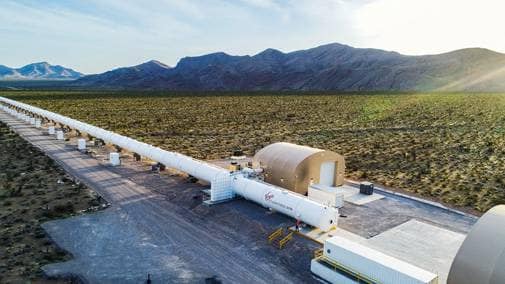
Virgin Hyperloop One built the world's first working, full-sized hyperloop test in Nevada. It ran last year for a little less than a third of a mile, and accelerated a 28-foot pod to 192 miles per hour in a few seconds. "We believe there is a need for it in India," the chairman continued. "One of the big problems in India is transportation, the congestion." He described hyperloop's technology as potentially providing a transformative solution for the country of 1.3 billion as it runs underground, out of public view.

Virgin Hyperloop One is one of a few companies racing to develop the technology that is hoped will revolutionize transportation of people and goods. First envisioned by Tesla founder Elon Musk in 2013, hyperloop transport promises to be faster than air travel but at a fraction of the cost. The concept is designed to propel pods through a large tube underground at speeds of 750 mph using magnets.

As for when the project will begin, bin Sulayem declined to offer a timeline but said an announcement would come soon. "We have a team in India that is working very hard, we're working with our office here and in Los Angeles, but we are not wasting our time. The technology we brought into the company has improved 10 times. Whenever I meet with them I see something new."

DP World is among the top four largest port operators on the planet by cargo tonnage.
A major port operator is planning to launch its first hyperloop for cargo in India
 
India closer to taking a lead, and leap with Hyperloop
India lags the world in many exponential technologies. The United States and China have taken a lead in work around Artificial Intelligence, for instance. Nevertheless, there is one technology where India could possibly be its earliest adopter - Hyperloop.

India is a bit ahead of both the United States and Europe in terms of regulation. The Office of the Principal Scientific Adviser to the Government of India has been designated as the relevant authority to develop Hyperloop standards. Late last year, a 'Consultative Group at the Office of Principal Scientific Adviser on Future Transportation' was constituted. And now, the Government of Maharashtra is expected to kick off the public procurement process for a Hyperloop project between Mumbai and Pune, soon. Over the next few months, when Maharashtra floats a tender, it could be the world's first.

For nearly a century, there hasn't been a new mode of transportation. Came Hyperloop, which now promises to take people in a pod direct to a destination at speeds above 1,000 kilometres an hour - the pods will travel via electric propulsion in a low-pressure tube. This sort of speed is nine-10 times faster than traditional rail. Vande Bharat Express, designed and built by India's Integral Coach Factory, reached speeds of 180 kilometres an hour during trial runs.

hyperloop-image-1-mos_072619051439.jpg
Virgin Hyperloop One, a company interested in building and operating the Mumbai-Pune route, writes on its website: "The vehicle floats above the track using magnetic levitation and glides at airline speeds for long distances due to ultra-low aerodynamic drag. Virgin Hyperloop One systems will be built on columns or tunnelled below ground to avoid dangerous grade crossings and wildlife. It's fully autonomous and enclosed, eliminating pilot error and weather hazards."
The Mumbai-Pune travel time, which currently takes over two hours by road, will effectively shrink to 25 minutes.
Business Today recently spoke to Harj Dhaliwal, Managing Director of Middle East and India, Virgin Hyperloop One, to understand company's plans in India. The company was founded in June 2014 and has thus far raised $295 million from DP World, Caspian VC Partners, Virgin Group, Sherpa Capital, Abu Dhabi Capital Group, SNCF, GE Ventures, Formation 8, 137 Ventures, WTI, among others.

While the company started engagements with many Indian states over the last two years, a strong business case emerged in Maharashtra.
"These projects cannot go forward without a champion, without somebody at the head of the government who leads the transformation," Dhaliwal says. "Devendra Fadnavis, the Chief Minister, saw the vision - how India can position herself," he adds.

Virgin Hyperloop One, part of an international consortium that also includes supply-chain company DP World, has proposed largely a privately financed project. The state government, though, will need to arrange the land for constructing the 117.5 kilometer corridor.

"When we started engaging with the government, it became clear that we will not get the land the way we want it. The state was very clear they would work with us in partnership to acquire the land that we need. Lot of the land is already in the state's ownership. We decided to adopt the route along the corridor of the Mumbai-Pune Expressway," Dhaliwal says.

The proposed alignment of the route, along the Mumbai-Pune Expressway, while reducing private land acquisition will increase the time taken for pods to reach its destination.

Initially, the company estimated a travel time of 14 minutes - that was if it got the land as needed to optimise speed. The speed was subsequently halved from over 1000 kilometers an hour and the journey time increased to 25 minutes. This, Dhaliwal says, wouldn't impact demand. There is a potential to connect 26 million people between two cities and support 150 million passenger trips annually. Pods, which resemble a bullet train coach, can be dispatched several times per minute - upto 16,000 passengers per hour per direction at peak capacity.

How much would a ticket cost? Dhaliwal wouldn't let it out since the public procurement process is around the corner. Nevertheless, he clarifies that fares will be competitive versus other modes of transport. "A mass transport system has to be available and accessible to all. It is not a transport system for the few. We also understand that there are other modes of transport in the corridor - trains, flights, the Expressway. We have to be competitive," he says.

Investments required for the project are staggering. The entire stretch of 117.5 kilometers has been proposed in two phases and commercialisation could take nearly a decade. The first phase is a stretch of 11.5 kilometers and will need half a billion dollars.

"We will raise the investment, build it, test it, and then work with the Government of India and Maharashtra to get it certified. Once certified, the consortium will raise the money for phase two. I think this is a very safe and pragmatic plan," the executive says.

The hyperloop system is expected to create a global manufacturing and supply-chain hub in India, and could potentially employ 1.8 million in Maharashtra.

"We did an analysis with KPMG. About 74 per cent of the component we require to build the Hyperloop system can be sourced in India. Of the 74 per cent, about 70 per cent of the component manufacturing can be done within Maharashtra," Dhaliwal says.

Importantly, early adoption of the technology would put India right at the forefront of the next revolution in transportation, for the next 100 years.
India closer to taking a lead, and leap with Hyperloop
 
  • Informative
Reactions: Gautam