High speed / Semi-High speed rail projects of Indian Railways
- Thread starter Ashwin
- Start date
You are using an out of date browser. It may not display this or other websites correctly.
You should upgrade or use an alternative browser.
You should upgrade or use an alternative browser.


And we're already developing a HSR trainset thru BEML. Wonder what're these talks all about then . Unless we're getting the French TGV trainsets to replace the Japanese Shinkasen in the Mum Ahm HSR network.
In which case why've we deputed drivers to Japan to be trained . Perhaps these talks are aimed at future projects given the slew of HSR projects announced. Or perhaps we're taking a leaf out of the Chinese playbook. Then again with the kind of experience the west has had with the Chinese I'm not sure what kind of ToT we can get out of them ?
I sincerely hope we aren't going to have a multi national HSR network the way we do in the IAF. For that's what it looks like from here.
its for signalling not the trainset. We will eventually have our own 350kmh trainset but signallign is a lot harder and frankly very very risky to do alone. Even china waited a decent amount of years and only implemented their own signalling after multiple years if not a decade of trials.And we're already developing a HSR trainset thru BEML. Wonder what're these talks all about then . Unless we're getting the French TGV trainsets to replace the Japanese Shinkasen in the Mum Ahm HSR network.
In which case why've we deputed drivers to Japan to be trained . Perhaps these talks are aimed at future projects given the slew of HSR projects announced. Or perhaps we're taking a leaf out of the Chinese playbook. Then again with the kind of experience the west has had with the Chinese I'm not sure what kind of ToT we can get out of them ?
I sincerely hope we aren't going to have a multi national HSR network the way we do in the IAF. For that's what it looks like from here.
Signalling systems for the Mum Ahmedabad HSR project has already been awarded to Siemens in spite of the incompatibility with Japanese Shinkansen trainsets whereas our drivers are in Japan to learn how to drive those Shinkansen trainsets. That's not all . There's also the indigenous project of 250 kmph HSR trainsets BEML is developing for the very same project.its for signalling not the trainset. We will eventually have our own 350kmh trainset but signallign is a lot harder and frankly very very risky to do alone. Even china waited a decent amount of years and only implemented their own signalling after multiple years if not a decade of trials.
wait siemens is not french... wth? what is going on?Signalling systems for the Mum Ahmedabad HSR project has already been awarded to Siemens in spite of the incompatibility with Japanese Shinkansen trainsets whereas our drivers are in Japan to learn how to drive those Shinkansen trainsets. That's not all . There's also the indigenous project of 250 kmph HSR trainsets BEML is developing for the very same project.

I never claimed Siemens is French. You suggested we were in talks with the French for signalling systems.wait siemens is not french...
It's called gxxndugiri masquerading as babooogiri. You should read up more on the issue going back a few pages on this very thread. Otherwise your comments here is akin to seeing a movie post interval.wth? what is going on?

India is planning a 40-km underground railway corridor through the strategically sensitive Siliguri Corridor, It will have 4 on ground and 2 underground rail lines for enhanced defence of area and connectivity with NE region. detail in link:
what about the MAHSR? Since that has to use japanese tech? @_Anonymous_ looks like theyre going to collab with the europeans for the HSR trains while using japanese trains on the mumbai ahmedabad line?
Wtf is this cluster *censored* man.

Attachments

Specs from the tender:
View attachment 48648
A zoomed in pic of the trainset:
View attachment 48647
The BEML tender doc is attached.
India To Acquire 16 More Indigenous Bullet Trainsets as BEML Secures Manufacturing Role for Mumbai–Ahmedabad High-Speed Rail Corridor
Swarajya Staff
Mar 01, 2026, | Updated 09:52 AM GMT+5:30
India is reportedly set to acquire 16 more domestically manufactured bullet trains, with state-owned BEML securing key manufacturing orders.
These trainsets will operate on the Mumbai-Ahmedabad High-Speed Rail corridor alongside two Japanese Shinkansen sets expected to arrive by 2029-30, marking a significant expansion of India's indigenous rolling stock capabilities.
The move represents India's strategic emphasis on domestic manufacturing for high-speed rail.
BEML is slated to deliver two initial trainsets capable of speeds up to 280 kmph by the end of 2026, with each coach carrying a significant price tag reflecting development and tooling costs.
The Public Sector Undertaking under the Ministry of Defence aims to capitalise on increasing capital expenditure in India's railway sector, which analysts project could reach Rs 50 lakh crore by 2030.
The Mumbai-Ahmedabad High-Speed Rail corridor project, funded significantly by JICA loans totaling nearly Rs 59,396 crore, continues to navigate land acquisition challenges and substantial costs estimated at Rs 1. 1-1. 25 lakh crores, with cost expected to rise further.
The ambitious project will primarily serve the Mumbai-Ahmedabad corridor, drastically reducing travel times and offering passengers an upgraded, efficient travel experience.
BEML's order bolsters India's indigenous rolling stock capabilities, aiming to capture a larger share of the global rail equipment market, which is projected to exceed $95 billion by 2032.
However, the company operates in a highly competitive environment where global giants like CRRC, Alstom, and Siemens dominate the international rolling stock market, controlling over 70 per cent of it.
In the Budget 2026-27, plans for seven additional bullet train corridors were announced, signalling India's commitment to expanding its high-speed rail network.
The project is also accelerating India's expertise in rail technology, including track construction, advanced signalling systems, and the manufacture of rolling stock.
The successful completion of the Mumbai-Ahmedabad corridor will provide a valuable blueprint for future high-speed rail developments across India.
India To Acquire 16 More Indigenous Bullet Trainsets As BEML Secures Manufacturing Role For Mumbai–Ahmedabad High-Speed Rail Corridor
this is all well and good but the TBMs for the 16km undersea tunnels are still stuck in china today. There have been high level diplomatic missions btw india and china and the chinese foreign minister has said it will be fast tracked and one machine did get fast tracked but 2 are still stuck in China today. The best we can hope for is both in India by late 2026 which means it will take 2 yrs from then to finish the tunnel and one for all inspections and track sand other stuff. late 2029 or 2030 seems like the date rn.
Thankfully we learnt our lessen and the Herrenknecht is setting up/has alr set up a large diameter TBM facility in T.N and BEML is also getting into TBM manufacturing so the future is looking decent
i have a feeling ahmedabad-thane will be opened first with mumbai coming a year or 2 later
Specs from the tender:
View attachment 48648
A zoomed in pic of the trainset:
View attachment 48647
The BEML tender doc is attached.
BEML-Medha set to bag 16-trainset order for Mumbai-Ahmedabad high-speed corridor
BEML–Medha has quoted around Rs 250 crore a train for 16 high-speed trainsets for Mumbai-Ahmedabad bullet train project, sources say
By Christin Mathew Philip
March 20, 2026 / 10:50 IST
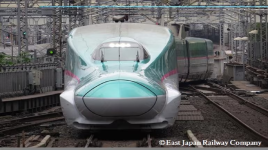
E5 Series Shinkansen Mumbai Ahmedabad Bullet train
BEML-Medha Servo Drives is set to supply 16 high-speed trainsets for the Mumbai–Ahmedabad bullet train project, sources told Moneycontrol.
The BEML-Medha consortium submitted its bid to the National High-Speed Rail Corporation (NHSRCL) on March 19 for the design and manufacture of 16 high-speed trainsets. The submission followed NHSRCL’s single-vendor bid invite in February to the state-run BEML for the Mumbai-Ahmedabad bullet train project.
In 2024, Integral Coach Factory awarded a contract worth Rs 866 crore to BEML-Medha for designing, manufacturing, and commissioning two eight-car high-speed trainsets. These trains are designed for a maximum speed of 280 kmph and an operational speed of 250 kmph.
Moneycontrol earlier reported that a follow-on order for 16 trainsets was expected.
Sources said BEML-Medha quoted around Rs 250 crore a train for the 16 new trainsets, including a seven-year maintenance contract. Of this, BEML’s share for car body and train interiors is about Rs 150 crore a train, while Medha’s share for propulsion systems, bogies, and Train Control and Management System (TCMS) is estimated at around Rs 100 crore a train. The final rates are likely to be lowered after negotiations.
“The additional 16 trainsets will retain the same design as the two currently on order, with minor enhancements introduced later. Poland-based design consultant EC Engineering is finalizing the designs, and manufacturing is expected to begin soon,” one of the sources said.
Indigenous content on the rise
The first two prototype trainsets are expected to have roughly 50 percent indigenous components, which is likely to increase as domestic supply-chains mature.
Knorr-Bremse, a German rail systems manufacturer supplying braking systems, train doors, HVAC units, and onboard sanitary systems, is setting up a manufacturing facility near Chennai. “This will enable local production of these systems and boost domestic value addition,” a source said.
BEML is also identifying Indian suppliers for passenger seats and interior panels, which could further increase indigenous content in the 16 trainsets.
Delays in Shinkansen procurement
Negotiations with Japan over Shinkansen trainsets remain unresolved due to pricing disputes. To ensure adequate rolling stock when operations begin, NHSRCL has moved ahead with the procurement of 16 indigenous trainsets.
The rollout of the first prototype is now expected in March 2027, delayed from December 2026, as manufacturing is yet to begin.
Phased commercial operations
Commercial services using the first two indigenous trainsets are likely to begin on the Surat–Bilimora section, subject to trial completion and statutory approvals.
Railways minister Ashwini Vaishnaw has said the Mumbai-Ahmedabad high-speed rail project will be commissioned in phases, starting in 2027. The Surat-Bilimora section is slated to open on August 15, 2027, followed by successive sections Vapi-Surat, Vapi-Ahmedabad, Thane-Ahmedabad, and Mumbai-Ahmedabad.
The 508-km Mumbai-Ahmedabad high-speed corridor will connect Maharashtra and Gujarat via 12 stations. While Japanese Shinkansen E5 trains, capable of speeds up to 350 kmph, were initially planned, high procurement costs prompted the government to pursue an indigenous high-speed train program.
BEML-Medha is a strategic partnership for manufacturing India's first indigenous high-speed trainsets for the Mumbai-Ahmedabad corridor. BEML handles fabrication and assembly in Bengaluru, while Hyderabad-based Medha Servo Drives specializes in electric traction motors, bogies and control systems.
https://www.moneycontrol.com/news/i...i-ahmedabad-high-speed-corridor-13865792.html
The much-awaited tunnel boring machines to build the country's first undersea rail tunnel for the Mumbai-Ahmedabad high-speed bullet train project are on their way and will be delivered at the Jawaharlal Nehru Port Trust in Mumbai on Monday, sources said.
The customised TBM was manufactured by the German company Herrenknecht in its unit based in China.
Officials said that these TBMs are among the largest and most expensive in the country, with a diameter of 13.1 meters, one of the biggest ever to be used in any rail project in India.
Usually, TBMs with cutter heads of 5 or 6 meter diameter are used for urban tunnels used in the MRTS Metro system.
The package C2 of the Mumbai-Ahmedabad High Speed Rail Project, under which the undersea tunnel comes, is being executed by Afcons Infrastructure Ltd. The whole package involves a 20.37 km-long tunnel.
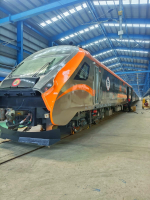
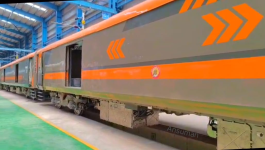
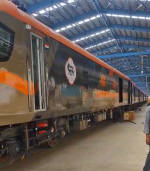

India’s first indigenous high-speed train set to enter manufacturing phase soon
Trainsets to be deployed on Mumbai-Ahmedabad high-speed rail corridor
By Christin Mathew Philip
January 05, 2026 / 16:27 IST
View attachment 48803
Interior renders of the proposed high-speed train.
Manufacturing activities for India’s first indigenous high-speed train are expected to begin soon, with the design phase nearing completion, sources familiar with the development told Moneycontrol.
The project is being executed by BEML-Medha, which received the contract from Integral Coach Factory (ICF) in 2024 to build two chair-car high-speed trainsets. Designed for an operational speed of 250 kmph and a maximum speed of 280 kmph, the trains will be deployed on Mumbai-Ahmedabad High-Speed Rail (HSR) corridor by 2027.
ICF general manager U Subba Rao told Moneycontrol, “The final design is nearing completion, and manufacturing will begin once it is frozen. We expect manufacturing to start between April and June. Component designs including carbody, bogies, suspension system, and doors are being developed in parallel and are in the final stages.”
View attachment 48802
Each trainset will consist of eight coaches, including seven chair cars and one executive class coach, with pantry and toilet facilities broadly aligned with those seen in chair-car Vande Bharat trains.
Design phase nearing completion
Sources said the design phase of the project is nearing completion, with Poland-based EC Engineering- design consultant for the project-having submitted detailed design for review and approval. EC Engineering had earlier worked with BEML and Medha on the design of the Vande Bharat sleeper train.
Officials involved in the project said global vendors with a proven track record of supplying European high-speed rail systems have been engaged to ensure compliance with international performance and safety benchmarks. “We are also enabling localisation and the gradual development of domestic manufacturing capabilities” an official said.
Moneycontrol has also accessed interior renders of the proposed high-speed train, which will be deployed on Mumbai-Ahmedabad HSR corridor.
Parallel work on systems and bogies
Manufacturing activities are expected to commence with the fabrication of car body shells at BEML’s Bengaluru plant, while Medha will begin production of bogies at its Hyderabad facility. In parallel, Medha is also developing the Train Control and Management System (TCMS) software and working on the integration of Siemens’ signaling system with the train systems.
Prototype rollout targeted for December 2026
The first prototype of the indigenous high-speed train is expected to roll out by December 2026. “Following this, the train will undergo a comprehensive testing and certification program lasting about seven to eight months, covering static and dynamic trials, safety validations, and high-speed test runs, including trials mandated by the Research Designs and Standards Organization (RDSO),” a source said.
Follow-on order for 16 trainsets likely
Industry sources said the BEML-Medha consortium is likely to receive a follow-on order for 16 additional high-speed trainsets.
Phased start to commercial operations
Commercial services using the first two indigenous trainsets likely to begin on Surat–Bilimora section of the corridor, subject to the successful completion of trials and statutory approvals.
Railways Minister Ashwini Vaishnaw has recently said that the Mumbai-Ahmedabad high-speed rail project will be commissioned in phases starting in 2027. He said the Surat-Bilimora section will be opened on August 15, 2027, followed by successive sections-Vapi-Surat, Vapi-Ahmedabad, Thane-Ahmedabad, and Mumbai-Ahmedabad.
Project background
The 508-km Mumbai-Ahmedabad High-Speed Rail corridor will connect Maharashtra and Gujarat through 12 stations. While Japanese Shinkansen E5 trains, capable of speeds of up to 350 kmph, were originally planned for the corridor, high procurement costs led the Union government to pursue an indigenous high-speed train program.
https://www.moneycontrol.com/news/i...-enter-manufacturing-phase-soon-13756924.html