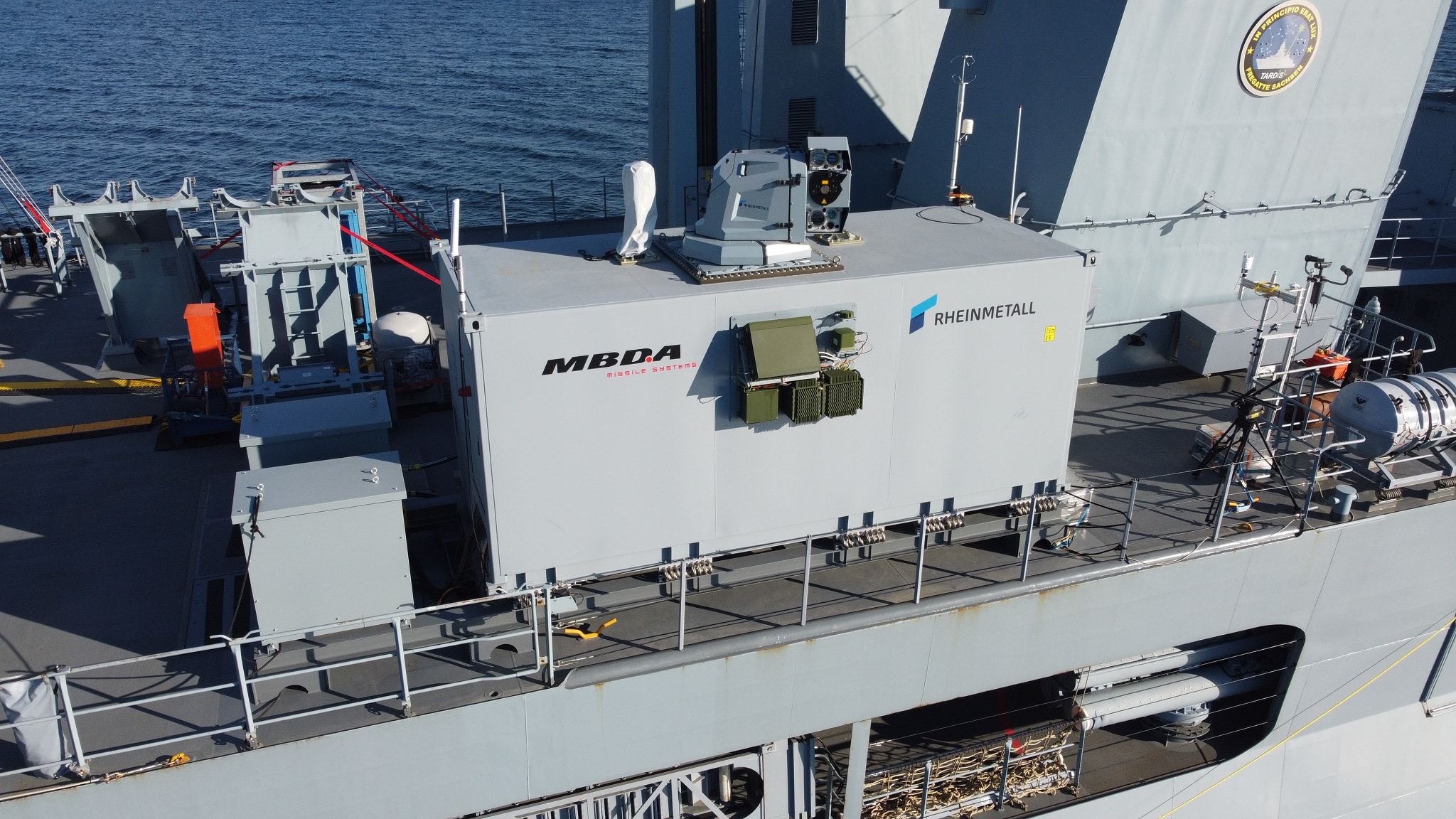
Rheinmetall and MBDA Germany have transferred a laser demonstrator for the German Navy to the Laser Competence Centre at the Technical Centre for Weapons and Ammunition (WTD 91) in Meppen for further testing

www.navalnews.com
Following the successful completion of a one-year trial phase at sea, defence contractors Rheinmetall and MBDA Germany have transferred a laser demonstrator for the German Navy to the Laser Competence Centre at the Technical Centre for Weapons and Ammunition (WTD 91) in Meppen for further testing. This marks a major step in the development of a high-energy laser weapon system for maritime use, and highlights the strong partnership between the two German technology companies.
Based on this, an operational laser weapon system could be available to the German Navy as of 2029, providing a powerful and cost-effective addition to conventional guided missiles.
Thanks to WTD 91’s support during the acceptance process, the demonstrator was successfully commissioned at the Laser Competence Centre in Meppen. This represents an important step towards achieving rapid market and operational readiness for a future laser system for the Navy.
The containerised demonstrator has already been successfully tested several times over the course of a year under real operational conditions at sea on board the frigate SACHSEN, proving the system’s robustness and performance. With the support of WTD 91 in Meppen, the laser container has now been put into operation for further land-based drone defence testing.
The laser weapon system offers new possibilities for counter-operations against non-cooperative targets. With its ability to precisely and effectively neutralise drones and other small, fast-moving targets, it addresses one of the most pressing challenges of our time. An operational laser weapon system complements cannons and guided missiles, particularly for the defence against drones and drone swarms, as well as for attacking speedboats and, if necessary, guided missiles in the closer and immediate vicinity. In the future, it could also be equipped with greater capabilities and be used to destroy supersonic guided missiles and rockets, as well as mortar and artillery shells. Unique technologies ‘designed and made in Germany’ ensure precise target detection and tracking, based on years of expertise in optics and sensor technology.


 www.diehl.com