

Are there any other sources to verify this news? Such a massive development could not have gone unannounced by the IN or the affiliated development agency

Are there any other sources to verify this news? Such a massive development could not have gone unannounced by the IN or the affiliated development agency
Nothing production ready can come out of this with a funding of Rs 250 cr (70% from MoD) upper limit of MAKE-1. But it's a good initial step in the right direction.
I am intersted in the figure of 40 Gas turbines. This is enough for like 20 warships.Nothing production ready can come out of this with a funding of Rs 250 cr (70% from MoD) upper limit of MAKE-1. But it's a good initial step in the right direction.
Sensible. Manpad launcher is a low cost way to add air defence capability to OPVs and corvettes.
Nothing production ready can come out of this with a funding of Rs 250 cr (70% from MoD) upper limit of MAKE-1. But it's a good initial step in the right direction.
| Ship Type | Current Strength | Details |
|---|---|---|
| Aircraft Carriers | 2 | INS Vikrant, INS Vikramaditya , |
| Destroyers | 11-13 | Various classes including Kolkata and Visakhapatnam class , |
| Frigates | 12-14 | Including new Nilgiri class frigates , |
| Corvettes | 18-20 | Various corvette and missile boat classes , |
| Submarines | 16-19 | Including conventional and nuclear submarines |
| Amphibious Ships | 9+ | 1 Amphibious Transport Dock + 8 Tank Landing Ships , |
| Support Vessels | 40+ | Various auxiliary and support craft , |
| Category | Total Numbers |
|---|---|
| Total Active Warships | 135+ warships |
| Total Fleet Units | 100-150 units |
| Aircraft & Helicopters | 300+ aircraft |
| Active Personnel | 67,252 active + 75,000 reserve |


What this glosses over is the parts.View attachment 46485
View attachment 46486
View attachment 46487
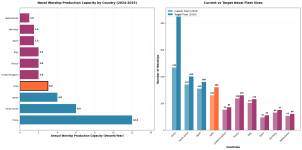
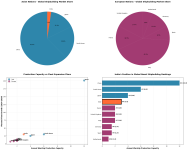
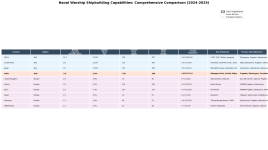
A comprehensive analysis of naval warship shipbuilding capabilities among the top 10 Asian and European nations, with India prominently highlighted for comparison:
India's Position in Global Naval Shipbuilding:
- Rank: #4 globally in annual warship production capacity
- Annual Capacity: 3 warships per year
- Current Fleet: 130 vessels (2024)
- Growth Target: 160 vessels by 2030 (+30 vessels, 23.1% increase)
- Key Shipyards: Mazagon Dock (MDL), Cochin Shipyard (CSL), GRSE
- Specializations: Frigates, Destroyers, Corvettes, Submarines
Regional Dominance:
- Asian Nations: Control 85% of global shipbuilding market
- European Nations: Hold 17.3% of global market share
- Top 3 Producers: China (12 vessels/year), South Korea (6/year), Japan (4/year)
China's Overwhelming Lead:
- Produces 12 warships annually - more than any other nation
- 200x greater shipbuilding capacity than the United States
- Fleet expanding from 234 to 435 warships by 2030 (as per BBC News)
- Controls 53% of global shipbuilding market share
Comparison with Major Players:
Asian Powers:
European Leaders:
- South Korea: 6 vessels/year, specializes in Aegis destroyers and advanced systems
- Japan: 4 vessels/year, focuses on high-tech submarines and advanced technologies
- India: 3 vessels/year, developing multi-role capabilities across all vessel types
- United Kingdom: 2 vessels/year, focuses on aircraft carriers and Type 26 frigates
- France: 2 vessels/year, Naval Group produces FREMM frigates and submarines
- Italy: 2 vessels/year, Fincantieri leads EU with €7.29 billion in shipbuilding value
Fleet Expansion Race (2024-2030):
- China: +201 vessels (85.9% growth)
- India & South Korea: +30 vessels each (23.1% and 17.6% growth respectively)
- Japan: +25 vessels (16.1% growth)
Sources: BBC Analysis, CSIS Reports, Marine Insight, Naval Industry Reports (2024-2025)
This is an analysis of assembly and overall capacity to launch naval ships. You're correct - this does not factor in the origins of parts (if they are being imported or domestically built). It presents an overall view of the naval shipyards and has less to do with the component manufacturing.What this glosses over is the parts.
Like Germany is big in ship building.
But they don't build ships they build parts, like marines engines( which compromises 30%+ of a ship's total cost).
China, Japan, SK's share shown here is of "complete assembled ships".
It does not show individual parts origin, which lot will be chinese/korean/Japanese but also american, European etc.
Indeed.This is an analysis of assembly and overall capacity to launch naval ships. You're correct - this does not factor in the origins of parts (if they are being imported or domestically built). It presents an overall view of the naval shipyards and has less to do with the component manufacturing.
This is just an overview and is inherently simple.Indeed.
But the "share of shipbuilding" market, skews the picture in this oversimplification.
Europe and US still has quite significant share in high end components that goes into commercial ships.

On the other hand, why should MoD and IN deal with the mess that comes with smaller shipyards? The troubles in bharathi, pipavav, Alcock and ABG set IN/ICG back by 10 years is not more.Now that GoI is coming up with a national shipbuilding plan, it should also look at reviving dysfunctional yards like ABG and Alcock Ashdown which were once building ships for the ICG. Also, those partially built Sachi class NOPVs at Pipavav could be towed to another yard for completion, imo. Why let them rust away into oblivion?
At the same time, we need to reward those private shipyards that have consistently delivered(like L&T) by giving them more contracts and expanding what they can bid on(like Frigates/Corvettes)On the other hand, why should MoD and IN deal with the mess that comes with smaller shipyards? The troubles in bharathi, pipavav, Alcock and ABG set IN/ICG back by 10 years is not more.
We desperately needed sachi for dealing with pirates
We greatly missed the CTS that ABG was to deliver
Till date we dont have the survey vessels that Alcock was to deliver
Best give all orders to main shipyards and keep them busy
For Pipavav, it was just plain bad luck. When they finally settled on a design and started construction, they ran out of funds. Reliance bailed out again because of financial problems and the Sachi class ships which were in an advanced stage of construction (already fitted with 76mm SRGM) had to be abandoned. Last time I checked, they are going to be scrapped. Sad, if true.On the other hand, why should MoD and IN deal with the mess that comes with smaller shipyards? The troubles in bharathi, pipavav, Alcock and ABG set IN/ICG back by 10 years is not more.
We desperately needed sachi for dealing with pirates
We greatly missed the CTS that ABG was to deliver
Till date we dont have the survey vessels that Alcock was to deliver
Best give all orders to main shipyards and keep them busy
And how is it not a good idea if we also collab with on aerospace?
The opposite will also happen.But an AC with Emals, nuclear propulsion etc.. is another huge project in strategic value. Choosing France might give them unwanted strategic leverage over our security apparatus.
Three carrier requirements still exists, subs are important but can't bring airpower, and Vikramaditya will reach retirement age in another decades.And recent trends shows govts interest in enhancing underwater capabilities and limiting money flow towards an AC in near future. Thus, my rationale behind skepticism.
Neither has any experience in developing nuclear powered carrier, or even nuclear powered submarine.Meanwhile japan, SK have good expertise which we need and also with evolving US' posture, they are in market for such collabs for long term security goals. Fits right into our needs to increase Cooperation with them too.

We do need collab with Korea or Japan but to learn how to build ships much faster than we do now namely by using modular ship building methods etc. This can be especially beneficial not only to our military warships but also to our commercial shipping industry.The opposite will also happen.
Along with next gen engine collab, whose developed tech will also be used by France.
France will also partially depend on india on its future aircraft carrier project.
So I don't see the problem.
Infact it will actually further incentivize the French to not sour relations with India.
Three carrier requirements still exists, subs are important but can't bring airpower, and Vikramaditya will reach retirement age in another decades.
Collaboration with france reduces "monetary" pressure.
Neither has any experience in developing nuclear powered carrier, or even nuclear powered submarine.
Neither any experience in operating catobar carrier.
Neither are actively pursuing attempt to build a catobar carrier( in SK's case all those carrier models are from private companie).
Your points, if i'm being honest are retarded.


