France is planning for its next aircraft carrier to be substantially larger than its existing flattop, Charles de Gaulle.
BY
JOSEPH TREVITHICKDECEMBER 8, 2020
French President Emmanuel Macron has officially announced that a program is underway to develop a new nuclear-powered aircraft carrier to replace the country's existing flattop,
Charles de Gaulle. French shipbuilder Naval Group, which is partially state-owned, subsequently released new concept art of what is presently known as the
Porte Avion Nouvelle Generation, or PANG, which translates to New Generation Aircraft Carrier.
Macron
made the announcement on Dec. 8, 2020, during a visit to Framatome, a French company that builds nuclear reactors, and associated equipment, and is set to provide the powerplants for the PANG. The French government also has a controlling stake in this firm, which built the reactor plants for the
Charles de Gaulle, via the electric utility company Électricité de France.
"
Charles de Gaulle, as you know, will come to the end of its life in 2038. This is why I have decided that the future aircraft carrier that will equip our country and our navy will be nuclear-powered like the
Charles de Gaulle,"
Macron said. “Your plant in Le Creusot, which has been producing parts essential to our navy for a long time, will produce, among others, several major parts of the nuclear boiler [reactor] of the future aircraft carrier by forging and machining them right here. … By these choices, we confirm France’s desire to preserve its strategic autonomy."
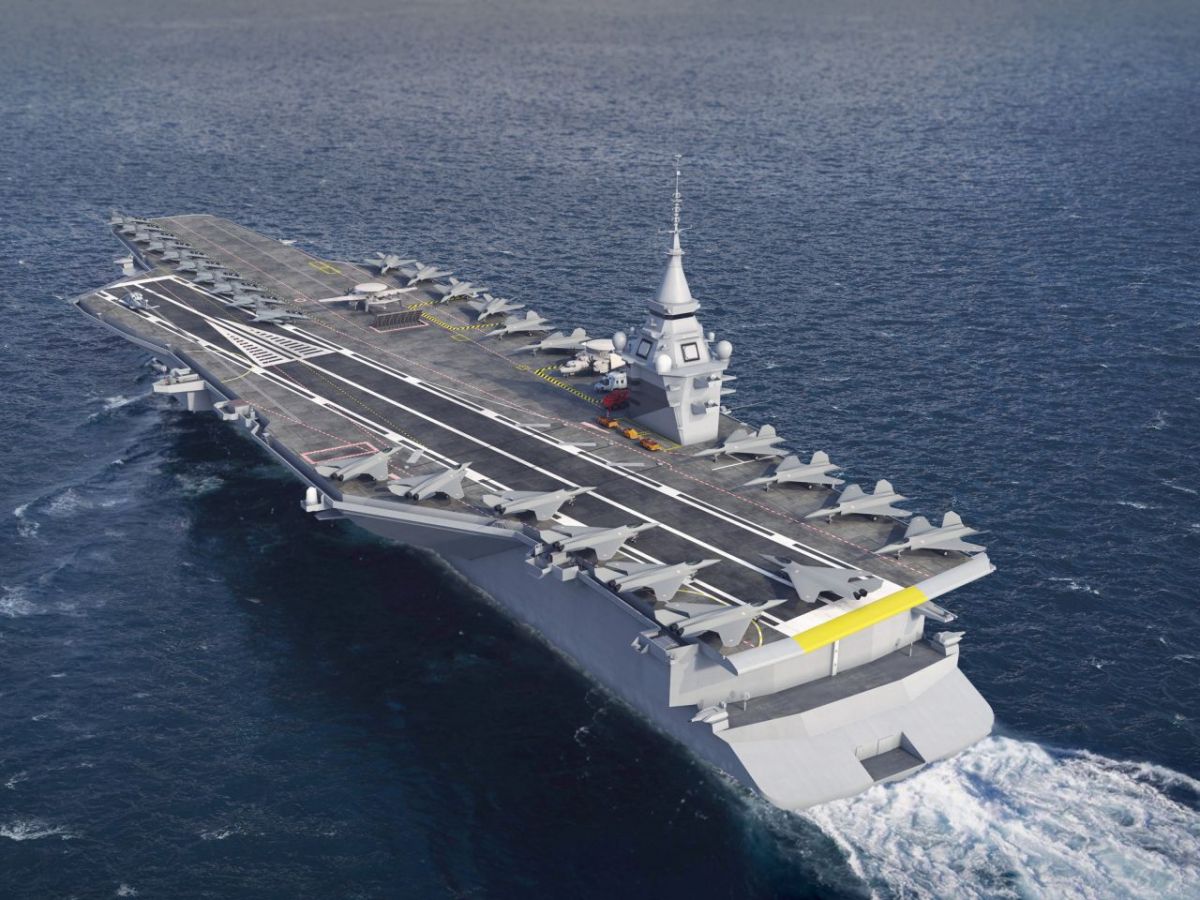
The concept art that Naval Group and the French Ministry of Armed Forces have now released online shows a Catapult Assisted Take-Off Barrier Arrested Recovery (CATOBAR) type design with an angled deck and a relatively small main island toward the rear right end of the flight deck. The
Charles de Gaulle is also has a CATOBAR configuration and, at present, France is only just two countries to operate aircraft carriers of this type, the other being the United States. China is now in the process of building
a CATOBAR-configured carrier and India has expressed interest in acquiring
a ship of this type, as well.
On Twitter, Florence Parly, France's Minister for the Armed Forces, provided some detail about the planned specifications and capabilities of the PANG. The future aircraft carrier will be just over 984 feet long and displace approximately 75,000 metric tons. The
Charles de Gaulle is around 858 feet long and displaces just 42,500 metric tons.
"The expression '42,000 tonnes of diplomacy' will therefore have to change to '75,000 tonnes...,'" Parly wrote on Twitter.
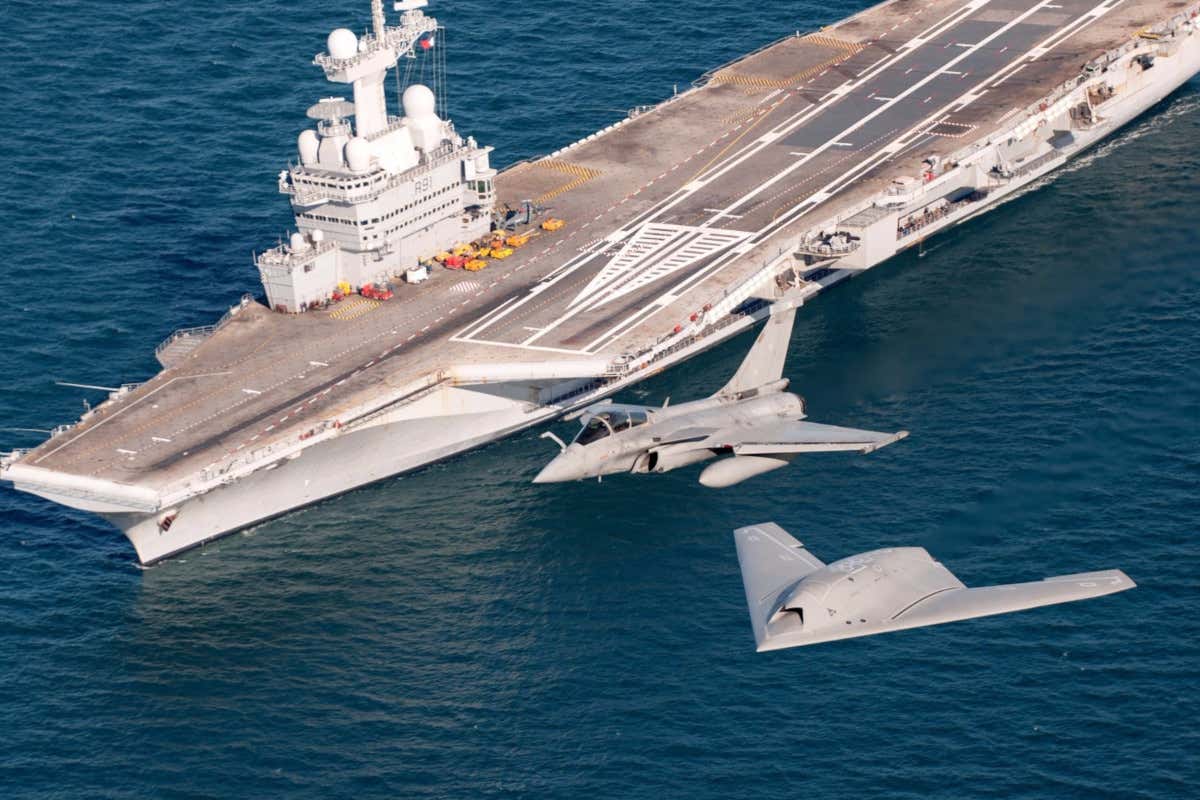
France's existing aircraft carrier, the Charles de Gaulle.
Parly also said that the decision to again go with a nuclear-powered aircraft carrier was twofold. Firstly, it will give the ship virtually unlimited range and, secondly, it will help France maintain its nuclear industrial base. She did note that fuel would still be required for the carrier's air wing. The ship will still need to maintain stocks of food and water for the personnel on board, as well.
Two K22 nuclear reactors will drive the ship's propulsion system and propel the vessel to speeds of up to 27 knots, as well as supply electrical power for the ship's various systems. This will include electromagnetic catapults
from General Atomics, the same company that designed and built the
Electromagnetic Aircraft Launch System (EMALS) for the U.S. Navy's
Ford class carriers. It's not clear whether the PANG will also have an electronically-controlled arresting system, such as the
Advanced Arresting Gear (AAG) found on the
Fords, another General Atomics product.
In principle, electromagnetic aircraft launching and electronically-controlled recovery systems can also be more finely tuned to
specific aircraft and loadouts, ranging from very heavy to very light types. This would help reduce the physical strain on their airframes as they go flying off the deck and when they come back to land, reducing maintenance and logistics demands. The U.S. Navy has also said that its EMALS, when it
is working as intended, will help increase sortie generation rates.
Parly said that the PANG is expected to have a crew of 2,000, but it's not clear if that includes aviators that will be assigned to the ship's air wing. Given that the typical combined size of
Charles de Gaulle's crew plus its air wing
is around 2,000 personnel, it could indicate that the French Minister's estimated PANG crew size accounts for both elements. If true, it's interesting that the PANG would have an identical crew size to the
Charles de Gaulle given how much larger the proposed ship is, which could point to plans for the design to incorporate features and technology to reduce various workloads.
The carrier will be able to accommodate around 30 fighter jets, according to Parly. These could initially be Dassault
Rafale-M fighters, but the ultimate goal is for the ship to carry a version of the stealthy
New Generation Fighter (NGF) that now in development as part of the
Future Air Combat System (FCAS) program.
France and Germany
initiated the FCAS program together in 2017 and Spain
announced its intention to join the effort the following year. Dassault is set to be the primary contractor for the NGF. European aviation consortium Airbus is leading the development of "loyal wingman" type drones, also known as "
remote carriers," for the FCAS program.
Naval Group's concept art, as seen below, shows NGFs on the flight deck. It also shows
E-2 Hawkeye carrier-borne airborne warning and control aircraft and an
NH90 helicopter, both of which the French Navy operates now.
Remote carriers, or a fully autonomous unmanned combat air vehicle (UCAV), such as a derivative of the
Dassault nEUROn, which took part in a demonstration
together with Charles de Gaulle in 2016, could also be added to the PANG's air wing in the future. The ship's electromagnetic catapults would be a major boon for any future carrier-borne drones, as they are much better suited to launching smaller, lighter aircraft than traditional steam catapults.
Of course, it's important to remember that the PANG project is still very clearly in the early stages of development. Much about the ship, including what sensors, such as radars and defensive systems, it will have, still appears to need to be finalized.
With the key schedule requirement being the need to have the ship in service by 2038, when the French Navy expects to decommission
Charles de Gaulle, there is significant time for the exact design and expected capabilities of the ship to further evolve.
It's also worth noting that France has been exploring possible new carrier concepts since the early 2000s, shortly after
Charles de Gaulle entered service. The initial construction of that carrier was finished in 1994, but it required significant additional work, including the need to lengthen the flight deck, and was only commissioned in 2001.
Various designs were considered for a potential
Porte Avions 2 (PA2), or Aircraft Carrier 2, including a CATOBAR design derived from the U.K. Royal Navy's
Queen Elizabeth class hullform from DCNS, which was subsequently renamed Naval Group, and Thales Naval France. In 2013, a French Armed Forces white paper was published that
included an announcement that the PA2 project had been canceled.
French authorities seem very committed now to the PANG program, which, based on what we know now, looks set to provide the country's navy with a new carrier with significantly improved capabilities over
Charles de Gaulle within the next few decades.



 www.challenges.fr