European Union - News and Updates

A new package has been requested from EU leaders for the defence of Ukr.


Speaking at an EU summit in Brussels, Zelensky called on European partners to provide more funding for defence, weapons and the country’s resilience.

“The war will cost 155 billion euros next year. And we need at least 70 billion euros more from you - for defence, for weapons, and for our resilience. This is a realistic amount. And I ask you to find this support,” he said.
While EU economy is going down the drain manifested in the various riots across France Belgium etc we're witnessing , trust the EU to ignore that & focus on funding never ending wars instead of focusing on ending it, shoring up their economy, boosting industry, welfare spending even & so on.

French members here are notoriously touchy when one brings this up to highlight their decline , that of Europe & the west in general while Paddy outrightly denies this is due to terminal stage Paddyitis . @BMD
Thank you for your concern about our economy, but your concern stems mainly from a lack of understanding of our situation. The protests – sometimes violent – that we are experiencing have always been a part of our history; every generation has its own. We are a grumbling people, never satisfied. It’s a luxury we can afford because our wealth – which stems from our productivity at work – is at a level you cannot even imagine. For example, France’s total debt is as follows:
  • Central Government: 2,942.1 billion euros (81.8 per cent of GDP)
  • Social security bodies: 309.4 billion euros (8.6 per cent of GDP)
  • Local authorities: €274.9 billion (7.6 per cent of GDP)
  • Various central government bodies (ODAC): €69.2 billion (2.0 per cent of GDP)
By way of comparison, the ‘great transfer’ refers to the transfer of historical wealth that the baby-boomer generation will effect by 2040: a cumulative total of approximately 9,000 billion euros will change hands in France.

If the government were to launch a ‘patriotic’ loan, as was the case to pay the indemnity demanded by Bismarck to release the territories he occupied during the 1870 war, it would be fully subscribed in a matter of days.

Bismarck had calculated the indemnity so that France would never recover from it.
  • The amount and conditions: Initially set at 6 billion, the indemnity was reduced to 5 billion gold francs (equivalent to around 25 billion francs at the time, or 15 per cent of France’s GDP).
  • Military occupation as security: The German army remained stationed in several departments in eastern and northern France as a guarantee of payment, which was normally to be spread over three years.
  • The first loan (June 1871): Launched on 20–28 June 1871 by Adolphe Thiers, an initial public loan of 2 billion francs at 5 per cent was subscribed to by French savers with such enthusiasm that it was oversubscribed by 2.5 times.
  • The second loan (July 1872): A further massive international loan of 3 billion francs was launched on 15 July 1872 to settle the remainder of the debt.
  • Early repayment: Thanks to the strength of French public savings and the support of major banking networks, the entire sum was repaid ahead of schedule. The last German soldier left French territory on 16 September 1873, well ahead of the originally scheduled deadline.
 
Thank you for your concern about our economy, but your concern stems mainly from a lack of understanding of our situation.
Yup. Yet the protests never dies down. It keeps getting inflamed every time the fires are going down.

The protests – sometimes violent – that we are experiencing have always been a part of our history; every generation has its own. We are a grumbling people, never satisfied.
Yup. The French Revolution certainly set a bad precedent. In the past 200+ years since, the French have been staging protests / revolution every 2-3 decades for the first century followed by a major protest every year, 6 decades ago to what it is now where not a day goes by without a protest in France.

As you can see there's been a lot of improvement!
It’s a luxury we can afford because our wealth – which stems from our productivity at work – is at a level you cannot even imagine. For example, France’s total debt is as follows:
  • Central Government: 2,942.1 billion euros (81.8 per cent of GDP)
  • Social security bodies: 309.4 billion euros (8.6 per cent of GDP)
  • Local authorities: €274.9 billion (7.6 per cent of GDP)
  • Various central government bodies (ODAC): €69.2 billion (2.0 per cent of GDP)
By way of comparison, the ‘great transfer’ refers to the transfer of historical wealth that the baby-boomer generation will effect by 2040: a cumulative total of approximately 9,000 billion euros will change hands in France.
I posed this question to Gemini AI & it came up with the opposite of the rosy scenario you're attempting to convey . 👇


If the government were to launch a ‘patriotic’ loan, as was the case to pay the indemnity demanded by Bismarck to release the territories he occupied during the 1870 war, it would be fully subscribed in a matter of days.

Bismarck had calculated the indemnity so that France would never recover from it.
  • The amount and conditions: Initially set at 6 billion, the indemnity was reduced to 5 billion gold francs (equivalent to around 25 billion francs at the time, or 15 per cent of France’s GDP).
  • Military occupation as security: The German army remained stationed in several departments in eastern and northern France as a guarantee of payment, which was normally to be spread over three years.
  • The first loan (June 1871): Launched on 20–28 June 1871 by Adolphe Thiers, an initial public loan of 2 billion francs at 5 per cent was subscribed to by French savers with such enthusiasm that it was oversubscribed by 2.5 times.
  • The second loan (July 1872): A further massive international loan of 3 billion francs was launched on 15 July 1872 to settle the remainder of the debt.
  • Early repayment: Thanks to the strength of French public savings and the support of major banking networks, the entire sum was repaid ahead of schedule. The last German soldier left French territory on 16 September 1873, well ahead of the originally scheduled deadline.
I don't see why did you have to reach so far back in history to make a point but now that you have how come the French aren't coming up with such solutions as of the present?

Or do such solutions await a disaster for it's only a disaster which galvanizes public opinion & spurs intense feelings of patriotism in the French people. Otherwise it's a free for all.
 

The European Union is working toward fast-track antitrust approval for a satellite joint venture between Leonardo SpA, Airbus SE, and Thales SA, which is positioned as Europe's response to SpaceX, Bloomberg reported on Thursday.

Over the past year, discussions have focused on identifying and resolving potential competition concerns before the project receives formal notification for approval, according to the person who requested anonymity. The companies have not yet filed their application, but EU officials anticipate a submission in the coming weeks, the report said.

The initiative, called Project Bromo, has received praise from European Commission President Ursula von der Leyen as a potential European champion worthy of high-level support. Competition Commissioner Teresa Ribera, who serves as von der Leyen's second-in-command, cautioned that the project would not receive automatic approval from regulators.

The venture seeks to establish a company that would reduce Europe's dependence on American satellite providers, including Elon Musk's SpaceX. The project has faced opposition from unions and suppliers concerned about employment and competition issues. Project Bromo will also serve as one of the first tests of a revised EU merger approach designed to be more supportive of creating regional companies capable of competing with US and Chinese competitors.
 

Washington’s envoy to the European Union has put Brussels on notice that European businesses could pay a heavy price in the American market if the bloc moves to shut US satellite operators out of part of its airwaves, sharpening a transatlantic dispute over who controls Europe’s critical technology.

The flashpoint is a European Commission proposal, tabled this year, to set aside a slice of the spectrum used for direct satellite-to-smartphone connections for European operators. That would shrink the frequencies available to American and Chinese providers, including SpaceX and its Starlink network.

Andrew Puzder, the US ambassador to the EU, told the Financial Times that European firms should be alert to the possibility of retaliation, and suggested the consequences would be severe given how much those companies depend on access to the large US market.

He accepted that Europe has a legitimate interest in safeguarding sensitive government data, but argued that rules designed to weaken American competitors in order to lift domestic ones would not make European industry stronger. US products in the sector were reliable and trusted, he said, adding that Europe did not need what he called “synchronised mediocrity”.
 
Thank you for your concern about our economy, but your concern stems mainly from a lack of understanding of our situation.,, It’s a luxury we can afford because our wealth – which stems from our productivity at work – is at a level you cannot even imagine. For example, France’s total debt is as follows:
  • Central Government: 2,942.1 billion euros (81.8 per cent of GDP)
  • Social security bodies: 309.4 billion euros (8.6 per cent of GDP)
  • Local authorities: €274.9 billion (7.6 per cent of GDP)
  • Various central government bodies (ODAC): €69.2 billion (2.0 per cent of GDP)
By way of comparison, the ‘great transfer’ refers to the transfer of historical wealth that the baby-boomer generation will effect by 2040: a cumulative total of approximately 9,000 billion euros will change hands in France.

If the government were to launch a ‘patriotic’ loan, as was the case to pay the indemnity demanded by Bismarck to release the territories he occupied during the 1870 war, it would be fully subscribed in a matter of days.

Bismarck had calculated the indemnity so that France would never recover from it.
  • The amount and conditions: Initially set at 6 billion, the indemnity was reduced to 5 billion gold francs (equivalent to around 25 billion francs at the time, or 15 per cent of France’s GDP).
  • Military occupation as security: The German army remained stationed in several departments in eastern and northern France as a guarantee of payment, which was normally to be spread over three years.
  • The first loan (June 1871): Launched on 20–28 June 1871 by Adolphe Thiers, an initial public loan of 2 billion francs at 5 per cent was subscribed to by French savers with such enthusiasm that it was oversubscribed by 2.5 times.
  • The second loan (July 1872): A further massive international loan of 3 billion francs was launched on 15 July 1872 to settle the remainder of the debt.
  • Early repayment: Thanks to the strength of French public savings and the support of major banking networks, the entire sum was repaid ahead of schedule. The last German soldier left French territory on 16 September 1873, well ahead of the originally scheduled deadline.

And I thought I was an optimist, Your review of the French economy is only exceeded by your Rafale talk

The word is that the IMF are about to step in, as your minister previously warned over a year ago

PARIS, June 10 2025
(Reuters) - France must put its finances into order or face the risk of being placed under the supervision of the International Monetary Fund (IMF) or of European institutions, Budget Minister Amelie de Montchalin said on Tuesday.
"Today, we need to seize the budgetary weapon again, get our house in order, and put it back in order, because if we don't, others will decide for us," Montchalin told RTL radio.
"There is a risk of supervision by international institutions, European institutions, our creditors," she added when asked if France faced a risk of supervision by the IMF.

French Prime Minister Francois Bayrou plans to unveil proposals in July to get public finances under control, hoping to push through a 40-billion-euro ($45.62 billion) budget squeeze in 2026.
France has a long history of flouting EU overspending rules and is currently running the biggest public sector deficit in the euro zone, at an estimated 5.4% of economic output this year.
 
Last edited:
And I thought I was an optimist, Your review of the French economy is only exceeded by your Rafale talk

The word is that the IMF are about to step in, as your minister previously warned over a year ago

PARIS, June 10 2025
(Reuters) - France must put its finances into order or face the risk of being placed under the supervision of the International Monetary Fund (IMF) or of European institutions, Budget Minister Amelie de Montchalin said on Tuesday.
"Today, we need to seize the budgetary weapon again, get our house in order, and put it back in order, because if we don't, others will decide for us," Montchalin told RTL radio.
"There is a risk of supervision by international institutions, European institutions, our creditors," she added when asked if France faced a risk of supervision by the IMF.

French Prime Minister Francois Bayrou plans to unveil proposals in July to get public finances under control, hoping to push through a 40-billion-euro ($45.62 billion) budget squeeze in 2026.
France has a long history of flouting EU overspending rules and is currently running the biggest public sector deficit in the euro zone, at an estimated 5.4% of economic output this year.
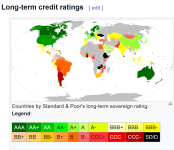
These are statements made by politicians to further their own agendas, but it is very rare for the IMF to take up the case of a country that has received this rating from the agencies:
Standard & Poor's (S&P) A+ Stable 29 mai 2026
 
You realise that France was downgraded to A+, With A-1 in the near term

It isn't just Politicians, As I said, I heard the IMF was going to step in, I googled for the story to confirm, Which is where I found your Minister


They have already issued a warning


The International Monetary Fund (IMF) has warned France to urgently reduce its budget deficit below 5% and lower its debt. In its October 2026 World Economic Outlook, the IMF slashed France's real GDP growth forecast to just 0.4% for 2026 and 0.7% for 2027 amid political deadlock and rising bond yields. [1, 2, 3]

-----------------------

It is enough to have your minister spooked and calling a warning,

French budget minister warns of IMF, EU oversight risk​

Budget Minister Amelie de Montchalin said
"France must put its finances into order or face the risk of being placed under the supervision of the International Monetary Fund (IMF) or of European institutions"

"Today, we need to seize the budgetary weapon again, get our house in order, and put it back in order, because if we don't, others will decide for us,"

"There is a risk of supervision by international institutions, European institutions, our creditors,"

---------------------------


It seems it isn't the S&P that triggers it

"How the IMF Evaluates Intervention

Rather than tracking credit ratings, the IMF utilizes its own internal Debt Sustainability Framework (DSF) to measure risk. [1, 2]
  • The IMF Focus: S&P focuses strictly on a government's willingness and capacity to pay back private commercial creditors. The IMF assesses broader systemic "sovereign stress"—meaning whether a country has enough foreign currency reserves to pay for essential imports and service its total external debts. [1, 2, 3]
  • The IMF Scale: Instead of a multi-tier letter grade, the IMF uses a simple three-level mechanical risk signal: Low, Moderate, or High risk of debt distress. A "High" classification serves as the internal prompt for the IMF to urge policy changes or prepare a financing package. [1]"
---------------

Australia, Canada and the Nordics seem to be going well

1792585812067.png
 
Last edited:

Police clashed with anti-far-right protesters in A Coruña on October 21st following a rally by Vox party leader Santiago Abascal.
 

Thousands of stores were looted during last weekend's unrest. As new demonstrations approach, Paris shop owners explain why they fear the violence could return.
 

From France to Italy, and from Spain to Portugal, young people have hit the streets in large numbers against their government in Europe. What explains this growing rebellion in one of the richest parts of the world? Palki Sharma brings you the four main reasons.