Corvettes of Indian Navy : News and Discussions

IMO, the follow on orders for ASWSWC is not required. These 16 ships along with 12 MCMV will be more than enough to deter and counter any submarine threat along both the coasts.
Nope. You need the additional 6 P8I from US and 9 C295 MRMR to increase coverage.

So in essence 12+6 P8I MPA and 9 C295 MRMR working in tandem with 4 Kamorta Class corvettes and 16 ASW SWC (8 Arnala Class and 8 Mahe Class) will provide adequate coverage against diesel electric and nuclear attack submarines.

There will also be Dornier 228-201 aircraft for signal intelligence and spotter roles.

I'm not sure about the nature and role of the MCMVs given that they may even be unmanned extensions of the Kamorta Class and ASW SWC vessels.
 
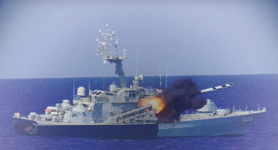
Tbh a decent size corvette is a very good platform for this sort of quick swing role involving Brahmos.
Old original version contains a lot of clutter, the more modern NG would prove to be ideal if the ramjet works fine.
This is something IN could have built more , only a handful of NGMV here & there.
 
Tbh a decent size corvette is a very good platform for this sort of quick swing role involving Brahmos.
Old original version contains a lot of clutter, the more modern NG would prove to be ideal if the ramjet works fine.
This is something IN could have built more , only a handful of NGMV here & there.

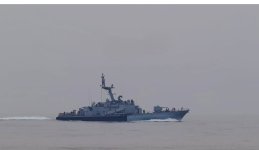
NGMV is much bigger than the Veer class at over 1500t. About the same size as the Kora class 'pocket destroyer' which will also need replacement in the near future.

Ideally, NGMV should replace both classes (Veer and Kora) with 16 × Brahmos NG fitted.

Also, L&T should be tasked to develop a compact, fully enclosed version of their inclined quad-tube Brahmos launcher to reduce rcs and improve loading flexibility.
 
G_NyOIFXYAA4CEj


G_NyPd6XsAAxyKr


Source
 

INDIAN NAVY TO COMMISSION ANJADIP​

Posted On: 23 FEB 2026 3:52PM by PIB Delhi

The Indian Navy is set to enhance its Anti-Submarine Warfare (ASW) capabilities with the commissioning of Anjadip, the third vessel of the eight-ship Anti-Submarine Warfare Shallow Water Craft (ASW-SWC) project. The warship will be formally commissioned into the Eastern Naval Command at Chennai Port on 27 Feb 2026.

The ceremony will be presided over by Admiral Dinesh K Tripathi, Chief of the Naval Staff.

The commissioning ceremony highlights the nation’s accelerated progress towards achieving ‘Aatmanirbhar Bharat’ in defence, as the ASW-SWC project exemplifies the triumph of indigenous warship design and construction. Built by Garden Reach Shipbuilders & Engineers (GRSE), Kolkata, Anjadip is a state-of-the-art vessel specifically designed to address the challenges of the littoral combat environment—the coastal and shallow waters vital for the nation’s security.

The vessel is engineered to act as a 'Dolphin Hunter', focused on the detection, tracking, and neutralisation of enemy submarines in coastal areas. The ship is packed with an indigenous, cutting-edge Anti-Submarine Warfare weapons and sensor package, including the Hull Mounted Sonar Abhay, and armed with Lightweight Torpedoes and ASW Rockets. In addition to its primary ASW role, the agile and highly manoeuvrable warship is also equipped to undertake Coastal Surveillance, Low-Intensity Maritime Operations (LIMO) and Search & Rescue operations. The 77 meter-long ship, features a high-speed Water-Jet Propulsion system, enabling it to achieve a top speed of 25 knots for rapid response and sustained operations.

The induction of Anjadip, named after the historically significant island off the coast of Karwar, significantly bolsters the Navy’s capacity to safeguard India’s vast maritime interests and coastal approaches including Tamil Nadu and Puducherry Area, marking another key step in transforming the Indian Navy into a formidable 'Builder's Navy'.

 

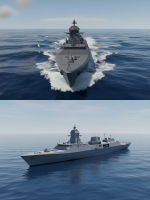
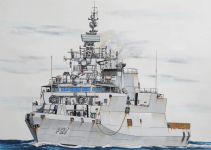
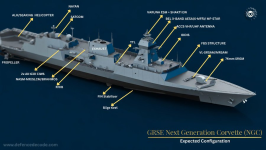
It is a Rs 40,000 crore deal, and on the verge of clearance as it is before the Cabinet Committee on Security (CCS), headed by Prime Minister Narendra Modi. This is about the building of eight NGCs or New Generation Corvettes for the Indian Navy, to be made in India by the Garden Reach shipyards in Kolkata, West Bengal and then, the Goa Shipyard.

Corvettes are small warships, smaller than frigates and of course, destroyers, they being about 3,000 tons at best, but they are nimble and speedy at about 30 knots roughly, and can be effective for anti-submarine warfare as well as other operational work. A corvette can have guns/surface-to-surface missiles and air-defence weaponry. Keeping in mind India's atmanirbharata (or self reliance) plan, an overwhelming large part of the corvettes will be indigenous.

With the CCS likely to clear the project soon, the shipbuilding process can begin this year and the first of the eight will probably join the Navy by 2030, with perhaps, one every year. Currently, the Navy has Veer, Khukri and Kora class corvettes that are over 20 years old, and some of them are getting to be 30 years old and will be on their way out in less than a decade. The New Generation Corvettes could be a replacement particularly for Khukris and the Koras. That leaves the Navy with four Kamorta class corvettes, and similar warships of the Mahe (1) and the Arnala (3) class. The NGCs will be bigger than the Khukris and Koras going out with more "capability." In the past, the Navy had relied on Soviet/Russian corvettes, but increasingly, they are being made indigenously.

The NGCs will be much needed as the Pakistan Navy has already acquired four MILGEM-class corvettes from Turkey and are called the Babur-class. Two were made in Turkey and the other two, in Karachi. At roughly 3,000 tons, they are heavy corvettes and can be used for air-defence and against surface ships and submarines.
 

INS Agray, an anti-submarine warfare shallow watercraft, is tailored for coastal defence operations. With about 88% indigenous content, it is equipped with lightweight torpedoes, ASW rockets, and a 30 mm naval gun. Its shallow draught and waterjet propulsion system enhance manoeuvrability in littoral waters.