

Climate Change : News, Updates, Discussions & Remedies.
- Thread starter _Anonymous_
- Start date
You are using an out of date browser. It may not display this or other websites correctly.
You should upgrade or use an alternative browser.
You should upgrade or use an alternative browser.


Proposal to decarbonise the world economy
This plan is clearly based on nuclear energy, I will need several posts to explain all the arguments, but the very possibility of decarbonising the world economy is debatable, I consider that it is with nuclear energy that the constraints are the least strong, and yet we will see that we will have to make decisions that are really difficult to accept, retirement at 64 years old is nothing compared to that. So we can look at other plans and discuss their relative merits, but the factual presentation of a plan is a way of becoming aware of the effort required.
My plan aims at not decreasing the world GDP too much because this would be a difficult constraint to accept, and as there is a very clear relationship between the world GDP and the world consumption of energy, and even clearer between the world GDP and the world consumption of oil, which is the energy that allows mobility and therefore the exchange of goods and people, nuclear energy will be used as much as possible because it is decarbonised, including to produce synthetic fuels, even though this production has a poor energy yield.
In fact, to a first approximation, it will take 5 kwh of electricity to produce 1 kwh of fuel, which will then produce the same mechanical energy as 0.3 kwh of electricity.... This being said, except for charging stations, 1 kWh of electricity is much cheaper than 1 kWh of fuel and this is normal because a kWh of fuel is a much more compact energy reservoir than a kWh of electricity, which explains why it is used for mobility.
To put a figure on the proposals I am making in this plan, I would draw on the French experience because this experience is somewhat similar to the effort that should be made with a duration in line with the urgency of the situation. For example, we will see that for the world the equivalent of 4000 EPRs should be built and that France's share of this effort should be 100 EPRs. However, we have the experience of building 54 reactors in about twenty years, which is close to the new challenge. So I would give global figures, but the example of France will be very useful for judging feasibility, because we are not used to global figures: the world is big, which means that there are many projects that can be launched in parallel, even China or India have a dimension that we are not used to: in China a large coal-fired power station is built every week....
I used Chat GPT to do research and from time to time I would copy my dialogue with it to justify the result.
Price of a nuclear kwh in France
What is the cost of sale imposed by the State on EDF for its historical nuclear electricity?
In France, the State imposes a regulated sales tariff (TRV) on EDF for historical nuclear electricity. This tariff is set by the public authorities and is intended to cover the production costs of nuclear electricity and to allow EDF to make a profit margin.
The TRV is currently set at €42/MWh for nuclear electricity produced by EDF's nuclear plants in France. This tariff is set for a period of four years and is revised every year to take account of inflation and changes in production costs.
[...]
But the state cannot impose the sale at a loss to a private company, it would be unconstitutional, so this price must take into account the costs of construction, operation and maintenance of nuclear power plants, as well as the costs of processing nuclear waste.
You are absolutely right. Indeed, the State cannot impose the sale at a loss to a private company, and the regulated sales tariff (TRV) imposed on EDF for its historical nuclear electricity takes into account the production costs of nuclear electricity, including the costs of construction, operation and maintenance of nuclear power plants, as well as the costs of treatment of nuclear waste.
The calculation of the TRV is based on a full cost method which takes into account all the costs incurred by EDF
[...]
What is the share of the distribution cost in the cost of nuclear electricity in France?
[...]
In general, the distribution cost represents a relatively small part of the total cost of nuclear electricity in France. Indeed, according to figures published by the Commission de régulation de l'énergie (CRE) for the year 2020, the cost of electricity distribution represents about 10% of the regulated sales tariff (TRV) of nuclear electricity.
[...]
What is RTE's turnover?
According to data published by RTE in its 2020 annual report, RTE's turnover amounted to €5.98 billion in 2020, up 1.5% on the previous year.
What was EDF's production in France in 2020?
According to data published by EDF in its 2020 annual report, EDF's electricity generation in France amounted to 385.9 terawatt hours (TWh) in 2020. This represents a decrease of 3.3% compared to the previous year, mainly due to a reduction in nuclear production.
Dividing RTE's turnover by EDF's production (which RTE distributes) I find a distribution cost of €15.5 per Mwh
[...]
However, if we divide the turnover of RTE in 2020 (5.98 billion euros) by the electricity production of EDF in France in 2020 (385.9 TWh), we obtain an average distribution cost of about 15.5 euros/MWh. This figure may give an indication of the cost of transporting nuclear electricity in France, but it should not be taken as a precise figure for all cases, as it may vary according to many parameters.
But it is much more than 10%, compared to the regulated sales tariff (TRV) of nuclear electricity, it represents 37%, where is the mistake?
You are right, I apologise for the confusion. Dividing RTE's turnover in 2020 (5.98 billion euros) by EDF's electricity production in France in 2020 (385.9 TWh), we get an average transmission cost of about 15.5 euros/MWh, which corresponds to about 37% of the Regulated Tariff of Sale (TRV) of nuclear electricity in France in 2020.
This means that the transmission cost of nuclear electricity represents a significant part of the total cost of nuclear electricity in France.
[...]
My conclusion
I have removed all the off-topic arguments that Chatgpt adds when he comes to a conclusion that contradicts the general feeling.
My conclusion is that if we have a massive construction plan for nuclear power plants, such as 4 or 5 per year (with the Mesmer plan, we went up to 7) and if some of these plants are dedicated to the production of synthetic fuel, which avoids distribution costs, we can arrive at an electricity cost of 30 € per Mwh.
Chemical reactions to produce synthetic fuel
To produce synthetic fuel, a Fischer-Tropsch type of installation is used, but instead of starting the reaction with the classical equation :
(2n+1)H2 + nCO ---> CnH2n+2 +nH2O (équation 1)
Instead we have :
(3n+1)H2 + nCO2 ---> CnH2n+2 +2nH2O (equation 2)
It is obvious that for the reaction to take place energy must be added, but the aim of the exercise is to store nuclear energy in the form of fuel while avoiding adding carbon dioxide to the atmosphere.
Normally, a Fischer-Tropsch type installation that naturally handles equation (1) should be able to handle equation (2) with a few adjustments, a fact that seems to be demonstrated by a pilot experiment reported in the document "Panorama des voies de valorisation du CO2" of ADME § 2.1.4 of its CO2 hydrogenation section.
One could also return to equation 1 by the following steps:
With a nickel oxide catalyst, the classic methanisation is carried out:
CO2 + 4H2 ---> CH4 +2H2O (equation 3) (Sabatier process)
With common catalysts such as iron and cobalt :
CH4 + 1/2O2 ----> 2H2+CO (equation 4)
This reaction is easy to carry out because the electrolysis of water provides us with pure oxygen.
We can then implement equation 1 of the classic Fischer-Tropsch process.
For one tonne of CO2, i.e. for 273 kg of carbon, 45.5 kg of hydrogen will be needed to produce 318.5 kg of fuel, plus 91 kg of H2 to eliminate the oxygen from the CO2. But CEA Liten is developing a high-pressure, high-temperature electrolyser that saves 30% of energy.
"The CEA electrolysis technology that Genvia will use to produce hydrogen is 99% efficient," says Julie Mougin of CEA-Liten.
We will therefore need 4675 kwh to produce 319 kg of fuel, i.e. 400 l from one tonne of CO2.
The energy required to reach a temperature of 150° at the inlet to the electrolyser results from the use of steam which is at 7-800° at the inlet to the turbine that produces electricity in the nuclear power station and which leaves the turbine at 280°. Similarly, the energy needed for the chemical reactions to occur (which is thermal) is obtained by cogeneration and costs nothing in terms of electricity consumption.
ChatGPT tells me:
In general, the steam that comes out of the turbine of a nuclear power plant has a temperature of about 280°C and a pressure of about 6.5 MPa. This steam is then directed to a heat exchanger where it is cooled and condensed into liquid water, which is returned to the cooling circuit to be reused in the electricity generation process.
We can see that even if the statement "it takes 5 kwh of energy to produce 1 kwh of fuel" is probably true, it is 5 kwh of thermal energy and not electrical energy because the 400 l of fuel can generate about 4000 kwh of thermal energy which compares to the 4675 kwh of electrical energy consumed for their production. The additional energy needed comes from cogeneration, which is possible with a nuclear power plant because it wastes 2/3 of the heat produced by the nuclear reaction.
On the other hand, if we compare the mechanical energy that can be extracted from these values, we will have great differences because we will have a yield of 90% with electrical energy and only 30% with fuel, i.e. 4207 mechanical kwh and 1200 mechanical kwh, so we lose 71.5% of the mechanical energy that electricity could generate.
To go further I need to explain where I am going to find the carbon dioxide needed for my reactions, to do this, I'll give you an extract from a document:
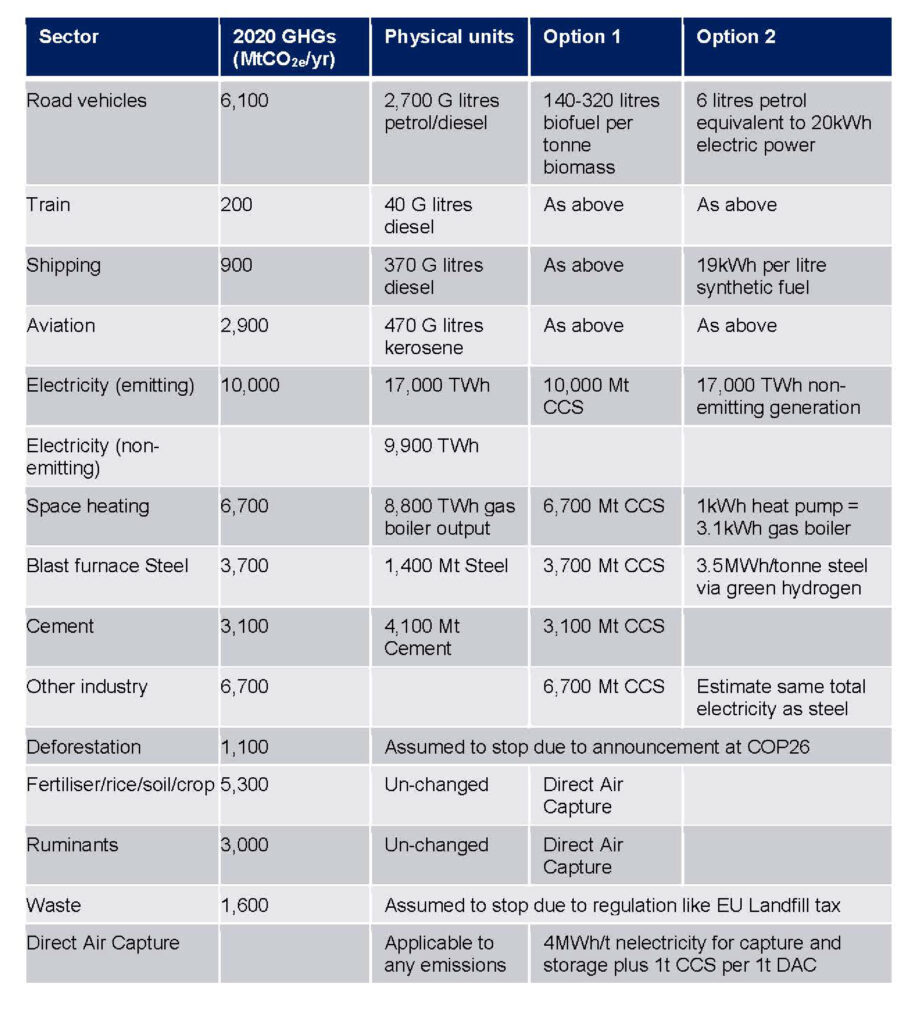
Table 1: The main technical options for mitigation discussed at COP26
This table shows that there are many sources of carbon dioxide where it is more concentrated than in the atmosphere and therefore more economical to capture, the idea is to add up the liquid fuels we need, add up the carbon dioxide emissions released by industrial installations and use them as a priority to produce synthetic fuels, but we have to see whether we cover our fuel needs and how much carbon dioxide we can avoid releasing.
First of all, the total of all CO2 emissions is 51300 Mt or 51.3 Gt. What can be avoided is 10 Gt by replacing fossil electricity with nuclear electricity and 13.5 Gt of CO2 from recovery, i.e. 23.5 Gt in total.
The fuel requirement is 3580 Gt of fuel.
As 1 t of carbon dioxide can produce 400 l of fuel, 13.5 Gt can produce 5400 Gl of fuel, so we have almost 2000 G l surplus. This means that some of the recovered CO2 will have to be stored deep underground!
There is indeed an impact on the CO2 released into the atmosphere because we are leaving in the ground natural oil that would have been consumed if we had not produced synthetic fuel.
It takes 4675 kwh to produce 400l of fuel, so for 3580 G l it takes 41841.250 Twh and as an EPR produces 12.8 Twh per year it takes 3269 Twh. To replace fossil electricity, 17000 Twh must be produced, i.e. 1328 EPRs. The total is therefore 4600 EPRs.
The solution space discussed at COP26 is unrealisable:
Anticipated demand for nelectricity, CCS and biomass
The table below lists the main sources of global emissions today, translates them into physical units, and reveals the resources required by the main options discussed at COP26 for replacing them. The data used to populate this table is discussed below, and I would welcome any suggestions for additional credible data.
Table 1: The main technical options for mitigation discussed at COP26
This table shows that there are many sources of carbon dioxide where it is more concentrated than in the atmosphere and therefore more economical to capture, the idea is to add up the liquid fuels we need, add up the carbon dioxide emissions released by industrial installations and use them as a priority to produce synthetic fuels, but we have to see whether we cover our fuel needs and how much carbon dioxide we can avoid releasing.
First of all, the total of all CO2 emissions is 51300 Mt or 51.3 Gt. What can be avoided is 10 Gt by replacing fossil electricity with nuclear electricity and 13.5 Gt of CO2 from recovery, i.e. 23.5 Gt in total.
The fuel requirement is 3580 Gt of fuel.
As 1 t of carbon dioxide can produce 400 l of fuel, 13.5 Gt can produce 5400 Gl of fuel, so we have almost 2000 G l surplus. This means that some of the recovered CO2 will have to be stored deep underground!
There is indeed an impact on the CO2 released into the atmosphere because we are leaving in the ground natural oil that would have been consumed if we had not produced synthetic fuel.
It takes 4675 kwh to produce 400l of fuel, so for 3580 G l it takes 41841.250 Twh and as an EPR produces 12.8 Twh per year it takes 3269 Twh. To replace fossil electricity, 17000 Twh must be produced, i.e. 1328 EPRs. The total is therefore 4600 EPRs.
Now we need to see the result of all this, which means using a model of the Earth's atmosphere that takes into account human emissions of carbon dioxide to calculate the concentration of carbon dioxide in the atmosphere. I propose a simple model which is described here:

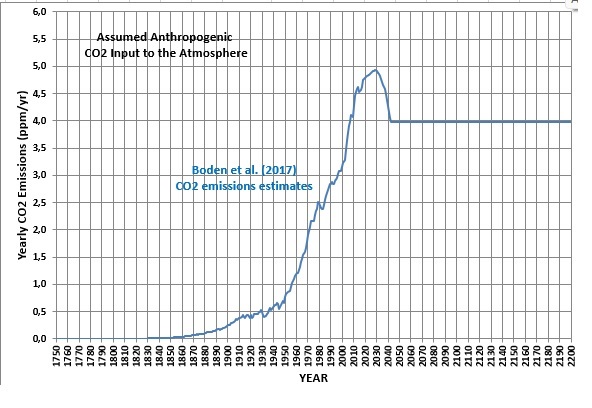
If we simply build nuclear power plants to replace fossil electricity and manage to limit other emissions to the current level, we have an emissions graph that looks like this:
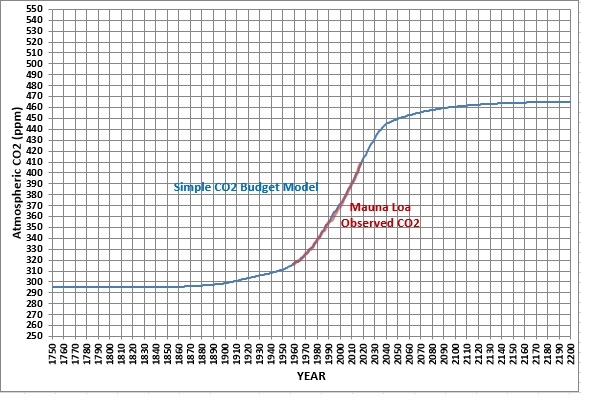
 And the result in the atmosphere will be this:
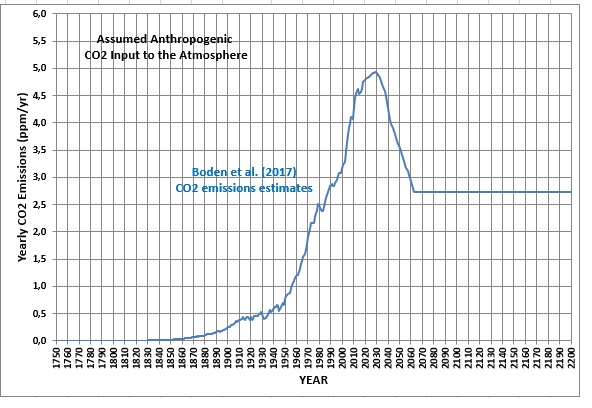
 Whereas if we also build power plants to produce synthetic fuels and manage to limit other emissions to the current level, we have an emissions graph that looks like this:
 With a resultant for the CO2 rate in the atmosphere that becomes this:
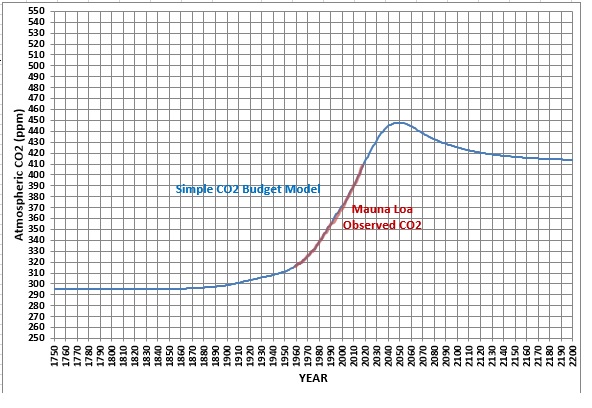
A Simple Model of the Atmospheric CO2 Budget
If we do nothing else but not increase our emissions we will have this result
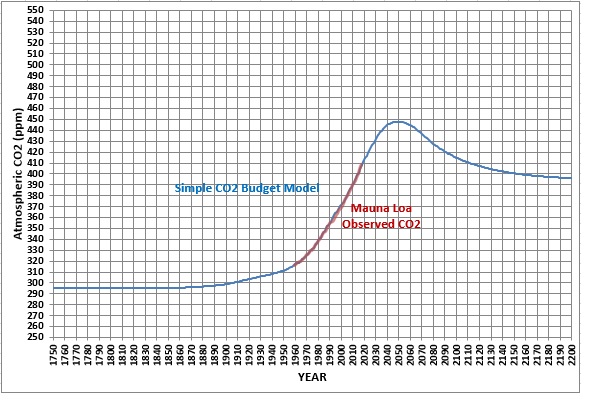
So the good news is that we have removed 10 Gt of CO2 corresponding to fossil electricity, and 2/3 of the 13.5 Gt that could be removed by equipping industry with CO2 capture systems, there is still the last third that can be captured but that has not been used because the need for synthetic fuel did not justify it. Our plan stops around 2062 and we can assume that by then we will have realised that we also need to remove this last third either by burying it in deep structures or by modifying the processes so that they emit less CO2 (for example by using hydrogen). I'm not making any assumptions in the long term, but we could see what happens:
For emissions
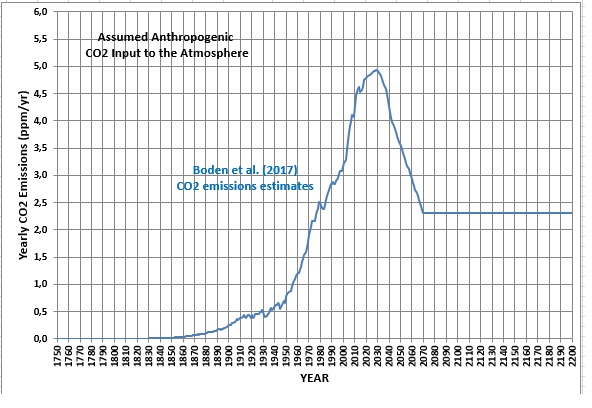 And for the CO2 in the atmosphere:
 The other good news is that all these plants are financed:
Synthetic fuel price
It takes 4675 kwh to produce 400l of fuel and we have seen that dedicated power stations allow us to have a cost per Mwh of 30€, the electricity contained in a barrel of synthetic fuel is therefore worth 55.75€, we must add the construction of the specific plant and its operation, but we do not need refining, so we can see that we will arrive at a reasonable price and that we will even be able to tax it as we do natural fuel.
Carbon dioxide has a price because of the cost of its capture and transport, but it is negligible compared to the cost of hydrogen, which has been taken into account.
The problem is the social acceptability of all these plants. Hence the importance of improving safety.
For emissions
- Those that replace fossil electricity are financed by the sale of the electricity
- Those that produce synthetic fuel are financed by the sale of the fuel
Synthetic fuel price
It takes 4675 kwh to produce 400l of fuel and we have seen that dedicated power stations allow us to have a cost per Mwh of 30€, the electricity contained in a barrel of synthetic fuel is therefore worth 55.75€, we must add the construction of the specific plant and its operation, but we do not need refining, so we can see that we will arrive at a reasonable price and that we will even be able to tax it as we do natural fuel.
Carbon dioxide has a price because of the cost of its capture and transport, but it is negligible compared to the cost of hydrogen, which has been taken into account.
The problem is the social acceptability of all these plants. Hence the importance of improving safety.
There is a problem, however, which is the availability of resources. As long as there were 400 nuclear power plants in the world, the problem of resources was remote, but with 4600 plants, it is worth looking at.
The baseline scenarios for world energy consumption predict around 16.5 GTEP in 2030, which will allow comparisons with the known reserves of different energy sources.
Most of the figures are taken from the BP Statistical Review of World Energy June 2011, so they are rather lower today because consumption has been higher than discoveries.
We can see that the energy accessible via uranium 235 is of the order of half that of the oil that remained in 2011. We can say to ourselves that this is always a good thing, but no, it's not much because I remind you that we use electricity, which is an energy that allows good yields, to make fuel, which is an energy that will be used with a yield of 30%, and that we lose 71.5% of the energy of the ore in the process, and so the 80 Gtoe represents only 22.8 Gtoe!
For the plan to be viable, we need to move on to fast breeder reactors fairly quickly. And not just any old way.
When used in breeder reactors, the available energy is multiplied by 140. If we also use thorium in breeder reactors, we multiply the available energy by 4 (3 for thorium and 1 for uranium), which is 280 times 22.8 Gtoe, i.e. 6384 Gtoe.
But it is obvious that if breeder reactors were used, it would become profitable to process ores poorer than 1kg per tonne. For example, if one were to limit oneself to 50g per tonne, the energy equivalent of one tonne of such an ore would still be 150t of coal or 650 barrels of oil (as opposed to 20t of coal for the uranium 235 contained in ores at 1kg per tonne). This consideration would multiply by a factor of about 1000 the amount of nuclear fuel available due to the exploitation, made possible, of poorer ores.
By comparison, for fusion, the deuterium contained in one cubic metre of water is equivalent to 433 tonnes of coal or 1870 barrels of oil and the volume of the oceans is 1.37 109 km3.
So if we move to fast breeder reactors we can breathe a little easier, but it is not enough, we have to do it well, because to start a fast breeder reactor we need an inventory of fissile material and therefore a deployment strategy that combines EPRs, fast breeder reactors and Molten Salt Reactors (MSRs) that use the Thorium 232/Uranium 233 cycle. In conclusion, the problem of the amount of nuclear energy available is not a trivial one, but neither is it without solutions.
The baseline scenarios for world energy consumption predict around 16.5 GTEP in 2030, which will allow comparisons with the known reserves of different energy sources.
Most of the figures are taken from the BP Statistical Review of World Energy June 2011, so they are rather lower today because consumption has been higher than discoveries.
Sources | Reserves in Gtoe |
| Uranium in water reactor | 80 |
| Gas | 168.4 |
| Oil | 169 |
| Lignite and sub-bituminous | 290 |
| Coal | 257 |
| Oil shale + tar sands | ≈ 500 |
| Methane hydrates | > 1000 |
| Uranium in fast breeder reactor | 11200 |
| Thorium in fast breeder reactor | 33600 |
| Thorium and Low grade uranium | More than 40000000 |
| Deuterium seawater | 407588000000 |
We can see that the energy accessible via uranium 235 is of the order of half that of the oil that remained in 2011. We can say to ourselves that this is always a good thing, but no, it's not much because I remind you that we use electricity, which is an energy that allows good yields, to make fuel, which is an energy that will be used with a yield of 30%, and that we lose 71.5% of the energy of the ore in the process, and so the 80 Gtoe represents only 22.8 Gtoe!
For the plan to be viable, we need to move on to fast breeder reactors fairly quickly. And not just any old way.
When used in breeder reactors, the available energy is multiplied by 140. If we also use thorium in breeder reactors, we multiply the available energy by 4 (3 for thorium and 1 for uranium), which is 280 times 22.8 Gtoe, i.e. 6384 Gtoe.
But it is obvious that if breeder reactors were used, it would become profitable to process ores poorer than 1kg per tonne. For example, if one were to limit oneself to 50g per tonne, the energy equivalent of one tonne of such an ore would still be 150t of coal or 650 barrels of oil (as opposed to 20t of coal for the uranium 235 contained in ores at 1kg per tonne). This consideration would multiply by a factor of about 1000 the amount of nuclear fuel available due to the exploitation, made possible, of poorer ores.
By comparison, for fusion, the deuterium contained in one cubic metre of water is equivalent to 433 tonnes of coal or 1870 barrels of oil and the volume of the oceans is 1.37 109 km3.
So if we move to fast breeder reactors we can breathe a little easier, but it is not enough, we have to do it well, because to start a fast breeder reactor we need an inventory of fissile material and therefore a deployment strategy that combines EPRs, fast breeder reactors and Molten Salt Reactors (MSRs) that use the Thorium 232/Uranium 233 cycle. In conclusion, the problem of the amount of nuclear energy available is not a trivial one, but neither is it without solutions.
Last edited: