Chinese Economy : Updates and Discussions

Evergrande has defaulted on its debt, Fitch Ratings says​

Hong Kong (CNN Business)Evergrande, the embattled Chinese property developer, has defaulted on its debt, according to Fitch Ratings.

The credit ratings agency on Thursday downgraded the company and its subsidiaries to "restricted default," meaning that the firm has failed to meet its financial obligations.

Fitch said the downgrade reflects the company's inability to pay interest due earlier this week on two dollar-denominated bonds. The payments were due a month ago, and grace periods lapsed Monday.

Fitch noted that Evergrande made no announcement about the payments, nor did it respond to inquiries from the ratings agency. "We are therefore assuming they were not paid," Fitch said.

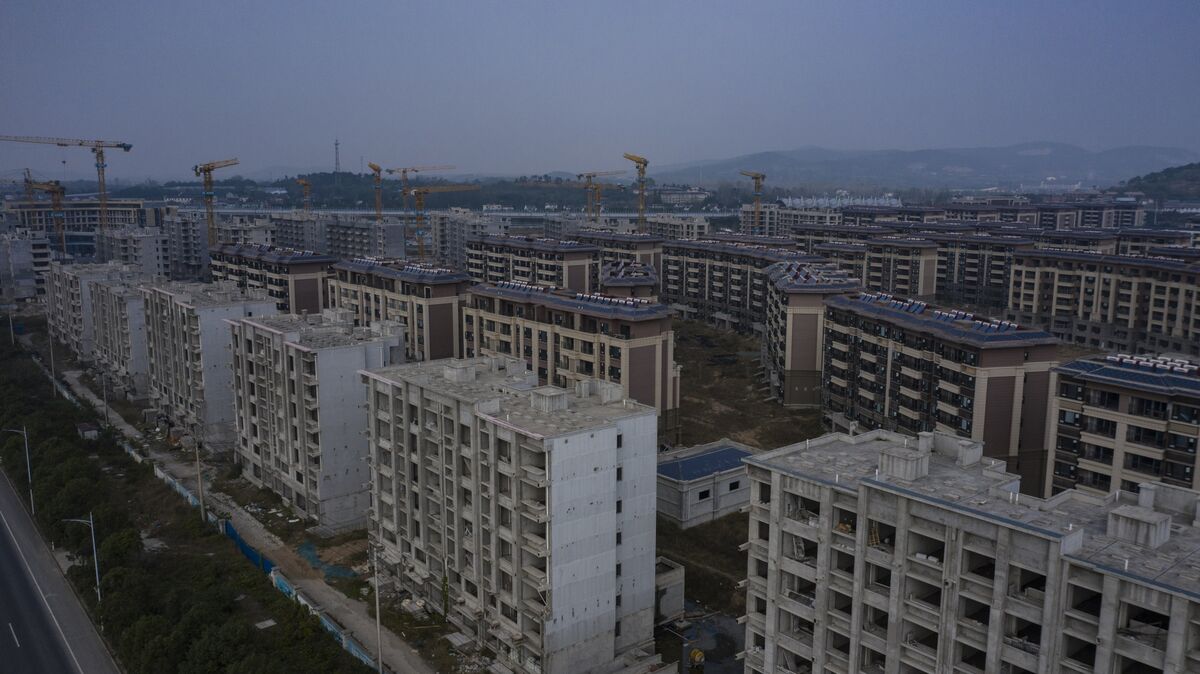
Evergrande has about $300 billion in total liabilities, and analysts have worried for months about whether a default could trigger a wider crisis in China's property market, hurting homeowners and the broader financial system. The US Federal Reserve warned last month that trouble in Chinese real estate could damage the global economy.

Evergrande did not immediately respond to a request from CNN Business for comment. However, the company had warned this may be coming. In a stock exchange filing last Friday, it said it might not have enough funds to meet its financial obligations. At that time, it said it was planning to "actively engage" with offshore creditors on a restructuring plan.

In another filing Monday, the company said it would set up a risk management committee that would be headed by Evergrande's chairman and founder Xu Jiayin to focus on "mitigating and eliminating" future risks.

Fears of default sent shares of Evergrande plummeting 20% on Monday. So far this year, the stock has lost 87%.

The company had been scrambling for months to raise cash to repay lenders, and Xu has even been selling off personal assets to prop up its finances. It previously appeared to avoid default on any of its offshore bonds by paying overdue interest before their grace periods expired. Now, though, that streak has ended.

Another credit ratings agency, S&P, said earlier this week that "default looks inevitable for Evergrande" with repayments of $3.5 billion on US-dollar denominated bonds due in the coming months.

"The issuer [Evergrande] does not seem to be making much progress in resuming construction, given its difficulties in raising new financing," S&P Global analysts wrote in a note published Monday.

Chinese authorities have been trying to contain the fallout. Last Friday, the local government in Guangdong province, where Evergrande is based, said it would send a working group to Evergrande to oversee risk management, strengthen internal controls and maintain normal operations, at the request of the company.

The People's Bank of China and other top financial regulators have tried to reassure the public that Evergrande's problems can be contained. The central bank on Monday also announced that it would pump $188 billion into the economy, apparently to counter the real estate slump.

"The rights of shareholders and creditors of Evergrande will be fully respected in accordance to their legal seniority," PBOC governor Yi Gang said Thursday in a video speech to a Hong Kong forum, according to the central bank.

But other Chinese developers are also in trouble. On Thursday, Fitch downgraded the Kaisa Group to "restricted default."
 

Evergrande slides into default while some ratings agencies keep quiet​

Late Thursday, Fitch Ratings said Evergrande had not confirmed payment of its latest debt obligation, triggering a default.
  • S&P Global Ratings did not have a statement as of Friday afternoon, and referred CNBC to its report Tuesday that said “default looks inevitable for Evergrande.” Moody’s, another ratings agency, did not respond to a request for comment.
  • “We should have been calling this a technical default for a long time already, but nobody dared,” Alicia Garcia-Herrero, Natixis’ chief economist for Asia-Pacific, said Friday.
BEIJING — Indebted property developer China Evergrande defaulted this week with hardly a ripple in markets as most institutions remained silent.


Late Thursday, Fitch Ratings said Evergrande had not confirmed payment of its latest debt obligation, triggering a default. The developer’s shares traded 1% lower Friday. The Shanghai composite dropped 0.2%.

Evergrande’s problems came to light over the summer amid tight regulation on real estate as investors worried about spillover to China’s economy. The company has a total $300 billion in liabilities, with $19 billion in offshore U.S. dollar-denominated bonds — the most of any Chinese developer.

“We should have been calling this a technical default for a long time already, but nobody dared,” Alicia Garcia-Herrero, Natixis’ chief economist for Asia-Pacific, said Friday.

“China is not making it clear because there’s no pressure to make it clear,” she said. “Ratings [agencies] should be pushing. Some investors did push. Nobody wants to label this because they don’t want to bear the consequences. Everybody’s trying to increase what they can get out of it.”

Not putting the official “default” label on Evergrande allows the company to restructure its debt at a lower cost, she said.

S&P Global Ratings did not have a statement as of Friday afternoon, and referred CNBC to its report Tuesday that said “default looks inevitable for Evergrande.” Moody’s, another ratings agency, did not respond to a request for comment.

Evergrande did not respond to a CNBC request for comment.

Fitch’s proclamation of default is based on the firm’s assumption that two interest payments were not paid before the grace period ended Monday, the ratings agency said. It downgraded Evergrande’s rating to “restricted default,” which means the developer has not yet ceased operations, or even begun formal procedures such as filing for bankruptcy.

No other mentions of ‘default’​

The overall silence around Evergrande’s default comes as Chinese authorities have made public statements in the last week about efforts to manage the developer’s situation.

On Dec. 3, Hong Kong-listed Evergrande warned in a filing it could not guarantee it could meet its financial obligations and planned to “actively engage with offshore creditors” about debt restructuring. The company said it received a demand from creditors to pay about $260 million.

China’s Evergrande and Kaisa are ‘idiosyncratic risks,’ says Matthews Asia

Later that day, the local government in Guangdong province, where the developer is headquartered, said it met with Evergrande founder Xu Jiayin. The province added it sent a working group to the company for supervising risk management.

People’s Bank of China head Yi Gang said in a speech Thursday that Evergrande’s situation is a “market event,” to be handled according to market principles and law.

“Our view on the Evergrande situation is that ultimately, that’s an extremely healthy development, because there needs to be a ... [worked-out] precedent for companies to restructure their liabilities for it to be a truly functioning credit market,” Jason Brady, president and CEO of Thornburg Investment Management, said on a media call Wednesday.

Read more about China from CNBC Pro​

Real estate is closely watched since it and related industries account for about a quarter of China’s economy, according to Moody’s.
What’s more important for China’s economy is Evergrande’s ability to complete apartments that it’s already sold to consumers, Natixis’ Garcia-Herrero said. She expects that with Beijing’s help, there will be a long, drawn-out impact on growth rather than a sharp shock from property developers’ problems.

On the side of financial markets, she said spillover is limited because Evergrande’s debt is mostly held by “high net worth individuals, [who] are holding Evergrande to the maturity, to the restructuring point.”
 

The Made in China plan is back, and it’s better​

manufacturing-plant-istock.jpg

STORY OUTLINE​

  • The latest blueprint has the potential to help Beijing become the factory floor of the future.
  • Beijing intends to create small companies that are focused on specific sectors essential to industrial technology.
  • It wants to reduce dependence on foreign companies.


Beijing intends to create small and medium companies that are focused on very specific sectors what it calls “little giants”, that are globally competitive and essential to industrial technology.
As the world headed into 2022 grappling with the latest virus variant, Chinaunveiled a sharpened version of the Made in China 2025 industrial policy blueprint. Previous iterations may have had nations like the U.S. on edge, but this is the one to keep an eye on.

State planners released a five-year smart manufacturing development plan in late December that aims to digitize 70% of the country’s large enterprises. China will now focus on building and owning industrial robots, as well as upgrading equipment and processes used in the manufacturing sector.

These may not have the same buzz as nanotechnology, new materials or human job-stealing robots — sectors targeted in the last Made in China plan. However, the latest blueprint has the potential to help Beijing become the factory floor of the future, with uber-efficient and precise machinery, at a time when the U.S.’s biggest hurdle to competitiveness is just that. With global supply chains in a state of disarray, China’s intent to upgrade its vast industrial production sector and the ecosystem around it to bolster its role as the world’s supplier is shrewd and prescient: Beijing will do better what it already does well.

Core to the latest intelligent manufacturing plan is growing the country’s industrial robotics sector revenue at an annual rate of 20% over the next three years and doubling the density of robots — a proxy for automation adoption. These aren’t just in factories, but also in warehouses, logistical functions and other related areas that make the entire sector operate in a way that raises productivity, including better and more electric cars, batteries and electronics.
382522297

Bloomberg

In addition, Beijing intends to create small and medium companies that are focused on very specific sectors — what it calls “little giants” — that are globally competitive and essential to industrial technology. In doing so, it also wants to reduce dependence on foreign companies. China’s Ministry of Industry and Information Technology called for improvements in areas like high-precision speed reducers, servo systems, robot controllers and integrated intelligent joints, according to analysts from Daiwa Capital Markets Hong Kong Ltd. These are all key components used in equipment for industrial automation that help with motion control and other machine functions.

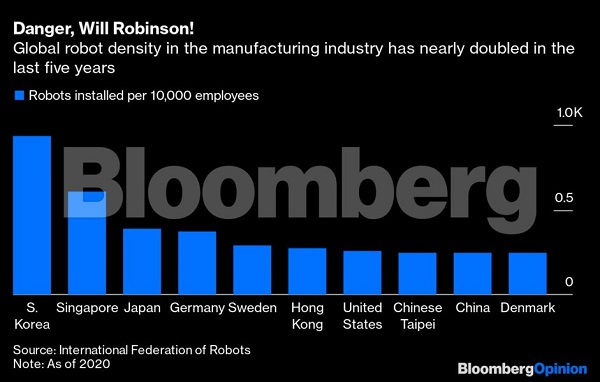
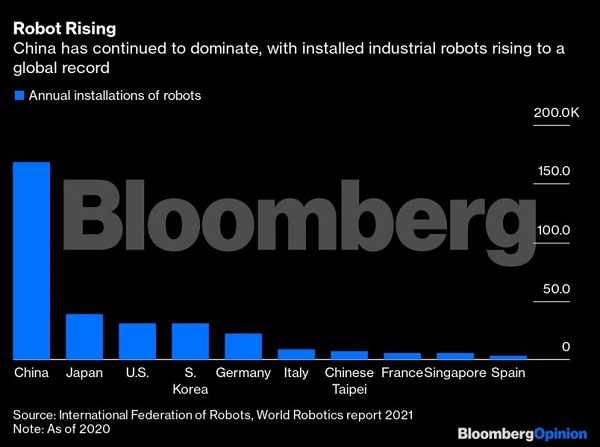
While these targets seem ambitious, they are in line with a global trend toward automated factories: In 2021, there were 126 robots per 10,000 employees across the world, up from 66 five years ago. China is by far the largest market — it has 44% of robot installations and ranks 9th in terms of density globally, up from 25th place just five years ago, according to the International Federation of Robots. Meanwhile, the U.S., with an 8% share, comes in 7th.
382522116

Bloomberg

Still, just because there’s a plan doesn’t mean it’s a sure-shot. Companies like Estun Automation Co., China’s largest industrial robot manufacturer, have grown through acquisition of foreign companies rather than with leaps in technology. Those businesses have then been expanded to create supply chains around them. Government subsidies, too, loom large in the company’s earnings. Officials recently said they will encourage merger and acquisition activity in the sector.

It would be remiss to say this is just another attempt by Chinese policy makers to move toward technological innovation, or to develop a blueprint like several other Soviet-style plans the nation has churned out since the 1950s. Instead, Beijing has acknowledged that to stay ahead and maintain its leading role as a global manufacturing hub, it’ll need to upgrade. A ministry official recently said that “there are still gaps and a weak industrial foundation, and the quality, stability and reliability of key components cannot meet the needs of high-performance complete machines,” state media reported.

The U.S. and other nations have been talking up advanced manufacturing, too. Yet limited progress has been made. The global supply chain snarls that have left companies across the world scrambling to produce goods with all the right parts in a timely fashion makes that clear. It’s also put a spotlight on the otherwise mundane role of factories and their workers, shipping, logistics and warehouses, exposing deficiencies in the U.S. industrial complex.

Viewed through that lens, Beijing’s plan is on point: Keeping the world reliant on China for as long as possible.


Chinese are so bullish on Automation, Precision Engineering, Nanotechnology.

Some of Indian: We had loads and loads of Cheap labour. We tha Beest
 

Chinese Maal Chala To Chaand Tak Nahi To Shaam Tak. In this case Zameen Par....🤗😆😆😆
we need to look at overall failure rate not one offs. If one structure fails out of a million structures, failure rate is still less. chinese model is more of a build fast , fail fast approach for a developing cntry its worth it instead of taking 20 years to complete a project.
 
Chinese are so bullish on Automation, Precision Engineering, Nanotechnology.

Some of Indian: We had loads and loads of Cheap labour. We tha Beest
They are moving pretty fast despite having some glaring gaps. Thats what makes the westerners nervous while India is oblivious to the threat.
China will become like japan in another decade, while we are still focusing on fixing society issues.

Cheap labor does no good unless it is harnessed effectively. On the contrary we are bleeding out talent to MNC's whose products we end up buying at a higher cost. We are neither creating an environment for entrepreneurs or providing support for them. We are just driving our own talent out. Sadly our investment in high tech industry is not just lagging but totally missing. Its the private sector's responsibility is misplaced thinking.
 
  • Agree
Reactions: AbRaj
They are moving pretty fast despite having some glaring gaps. Thats what makes the westerners nervous while India is oblivious to the threat.
China will become like japan in another decade, while we are still focusing on fixing society issues.

Cheap labor does no good unless it is harnessed effectively. On the contrary we are bleeding out talent to MNC's whose products we end up buying at a higher cost. We are neither creating an environment for entrepreneurs or providing support for them. We are just driving our own talent out. Sadly our investment in high tech industry is not just lagging but totally missing. Its the private sector's responsibility is misplaced thinking.
Giant Japan with North Korea society and Soviet Union like expansionist policies.
Its a perfect mix of all terrible ingredients to create a Giant geopolitical upheaval
 
China will become like japan in another decade, while we are still focusing on fixing society issues.

Absolutely. Now look at bureaucracy or diplomacy in India, the DMK Periyar affiliates harassing the forward caste people in subordinate service in central government as if it is their personal enmity. You think, under such circumstances India will ever formulate any robust policy to protect it's across the globe economic interest?
 

Interesting take on the Chinese quest for sovereignty in semi conductor mfg as well as it's projected market size & emerging competition from Japan for EUV SC Lithographic machine hegemon ASML of Netherlands .