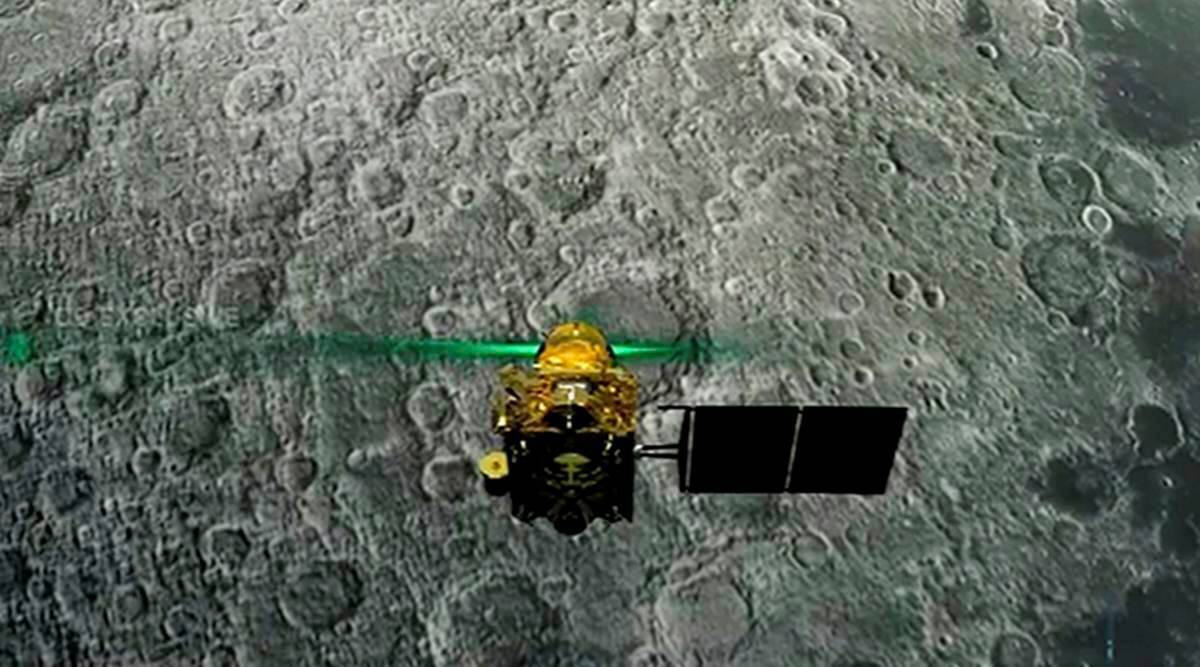
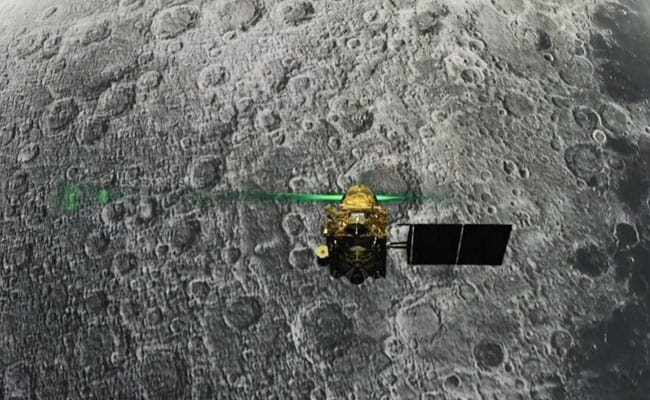
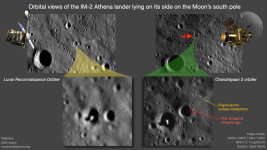
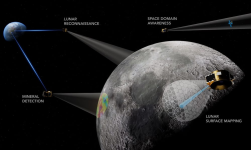
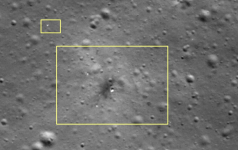
Chandrayaan-2 : Updates

ISRO is creating unnecessary confusion, They should confirm it's failed

We should soon find some car mechanic who can tell us in unequivocal terms that the rover is a write off and cannot be repaired. Then we can auction the rover to the car mechanic to salvage it for parts.
 

Scientists reveal ‘unambiguous presence of water ice’ at permanently shadowed regions of Moon​

One of the eight payloads of India’s second Moon mission, Chandrayaan-2, developed at Space Applications Centre (SAC) at Ahmedabad, has detected an unambiguous presence of water ice at the permanently shadowed regions of the Moon, revealed scientists of the Indian Space Research Organisation (ISRO) on Tuesday, the second day of a two-day lunar science workshop.

Permanently shadowed regions (PSR) have largely remained inaccessible as no sunlight reaches these regions, making it difficult to get images.
The Dual Frequency Synthetic Aperture Radar (DFSAR), one of the eight payloads on board Chandrayaan-2, is the only full polarimetric radar sent on a planetary mission in the world so far and its capability to combine radar images from two wavelengths, allows it to differentiate surface roughness properties from water ice properties.

Earlier studies using hybrid-polarimetric SAR data led to ambiguous detection of water ice regions as it had similar sensitivity to surface roughness and water ice. However, full polarimetric DFSAR, which uses measurements of electrical properties of materials, can decouple the effect of water ice and surface roughness, “leading to encouraging results on unambiguous detection of water ice in some PSRs”, as stated in the public documents released by ISRO chairperson K Sivan on Monday.

Potential patches of “dirty ice” within the Cabeaus crater on the lunar south pole, were also detected by the radar instrument. Patchy dirty ice involves ice crystals mixed with the lunar regolith, unlike continuous sheets of ice. Regolith is the top surface of the moon extending upto three to four metres, consisting of loose deposits.

The ability to combine polarimetric radar images from two wavelengths has also brought forth subsurface features and the polarimetric data helps in identifying the distribution of impact melts.

“This is very very essential to get information on what kind of impact cratering took place and how the impact melts distributed around the craters,” said Anup Das of Ahmedabad’s SAC and part of the DFSAR science team, during his presentation.

“One benefit (of DFSAR) is, we are seeing better resolution so we are seeing more number of smaller craters and scattering mechanism is more prominent here… this data gets finer details of smaller craters compared to Mini-RF (miniature radio frequency on the lunar reconnaissance orbiter launched by NASA in 2009),” added Das.

Freshness of a crater indicates that it has not been exposed enough to space weathering and in the polar regions of the moon, the findings can be expanded to further estimate the age and impact processes that the craters or boulders or other subsurface structures underwent over the years.

The discussions also promised a better imaging of the PSRs by combining data and image results from orbiter high resolution camera (OHRC), one of the payloads designed for imaging in very low Sun illumination conditions, along with DFSAR results.

Presenting the science results from OHRC, scientist at SAC, Ahmedabad, Aditya Kumar Dagar said that while OHRC imaging has “high constraints”, the data can be used to understand boulder distributions around a fresh crater. Boulder is important to understand regolith formation and also to determine future landing sites so that the lander is not jeopardised.

Chandrayaan-2 mission director Ritu Karidhal said that after two years of operation, “the propellant is enough to support more than four (more) years of life”.
 

Chandrayaan-2 orbiter payloads made discovery-class findings, says ISRO​

The observations of the Chandrayaan-2 orbiter payloads have yielded discovery-class findings, according to the Indian Space Research Organisation (ISRO).

There were eight scientific payloads hosted on the orbiter craft.

They are: Chandrayaan-2 Large Area Soft X-ray Spectrometer (CLASS), Solar X-ray Monitor (XSM), CHandra's Atmospheric Compositional Explorer 2 (CHACE 2), Dual Frequency Synthetic Aperture Radar (DFSAR), Imaging Infra-Red Spectrometer (IIRS), Terrain Mapping Camera (TMC 2), Orbiter High Resolution Camera (OHRC), and Dual Frequency Radio Science (DFRS) experiment.

Earlier this week, ISRO opened up its scientific discussions on Lunar Science to "the people of the country, to engage the Indian academia, institutes, students, and people from all disciplines and walks of life", in the form of a two-day "Lunar Science Workshop & Release of Chandrayaan-2 Data".

The workshop commemorated the completion of two years of the Chandrayaan-2 orbiter in the lunar orbit. The events were conducted in virtual mode.

ISRO Chairman and Secretary in the Department of Space (DoS) K Sivan inaugurated the workshop and released the documents on Chandrayaan-2 science results and data products for utilisation by the scientific community.

"The lunar workshop delivered the big news of bunch of discovery-class of findings by Chandrayaan-2", the Bengaluru headquartered India's national space agency said.

The mass spectrometer CHACE-2, in its pursuit to conduct first-ever in-situ study of the composition of the lunar neutral exosphere from a polar orbital platform, detected and studied the variability of the Argon-40 at the middle and higher latitudes of the Moon, depicting the radiogenic activities in the mid and higher latitudes of the Lunar interior, it said.

The discovery of Chromium and Manganese on the lunar surface, which are available in trace quantities, by the CLASS payload was announced.

The observations of microflares of the Sun, during the quiet-Sun period, which provide important clues on the coronal heating problem of the Sun, were made by the XSM payload.

The first-ever unambiguous detection of the hydration features of the Moon was achieved by Chandrayaan-2 with its infra-red spectrometer payload IIRS, which captured clear signatures of Hydroxyl and water-ice on the lunar surface, ISRO said.

The DFSAR instrument could study the subsurface features of the Moon, detected signatures of the sub-surface water-ice, and achieved high resolution mapping of the lunar morphological features in the polar regions, it was stated.

"The observations (of Chandrayaan-2 orbiter payloads) have been yielding intriguing scientific results, which are being published in peer-reviewed journals and presented in international meetings," Sivan said.

Chandrayaan-2, ISRO said, has the feat of imaging the Moon from 100 km lunar orbit with "best-ever" achieved resolution of 25 cm with its OHRC.

The TMC 2 of Chandrayaan-2, which is conducting imaging of the Moon at a global scale, has found interesting geologic signatures of lunar crustal shortening, and identification of volcanic domes, the ISRO said.

The DFRS experiment onboard Chandrayaan-2 has studied the ionosphere of the Moon, which is generated by the solar photo-ionisation of the neutral species of the lunar tenuous exosphere, it was noted.

The science data archived in Indian Space Science Data Centre (ISSDC) at Byalalu, near here, are being disseminated to public through its "PRADAN" portal.

The questions received from the academia, institutes and students were addressed by the ISRO scientists during the two-day deliberations.

A panel discussion provided the opportunity to academia, institutes and students to interact with the ISRO scientists on lunar science and Chandrayaan-2, ISRO said.

Chandrayaan-2 is the second spacecraft in the Indian series of Lunar exploration satellites. It comprised an orbiter, lander named Vikram and rover named Pragyan to explore the unexplored South Polar region of the Moon.

It was launched on July 22, 2019 from the Sriharikota spaceport by GSLV Mk-III. It was inserted into a lunar orbit on August 20, 2019, with firing of thrusters on the orbiter.

The orbiter and lander modules were separated as two independent satellites on September 2, 2019.

Later, Vikram lander's descent was as planned and normal performance was observed up to an altitude of 2.1 km from Lunar surface on September seven, 2019. Subsequently, communication from the lander (with the six-wheeled Pragyan rover accommodated inside it) was lost and the lander had a hard landing on the lunar surface.

A successful soft-landing would have made India the fourth country after the erstwhile Soviet Union, the United States, and China to do so, according to ISRO officials.

The orbiter, placed in its intended orbit around the Moon, will enrich our understanding of the Moon's evolution and mapping of minerals and water molecules in polar regions, using its eight advanced scientific instruments, according to ISRO.

The precise launch and optimised mission management have ensured a long life of almost seven years for the orbiter instead of the planned one year, it said.
 

Chandrayaan-2 Detects Solar Proton Events, Says ISRO, Explains Phenomenon​

Most of these are high energy protons that impact space systems and significantly increase radiation exposure to humans in space. They can cause ionisation on large scales in the earth's middle atmosphere, the space agency said.​


Chandrayaan-2 Detects Solar Proton Events, Says ISRO, Explains Phenomenon

Chandrayaan-2 Orbiter has detected solar proton events, Indian Space Agency ISRO said.


Mumbai:
A Large Area Soft X-ray Spectrometer (CLASS), a payload on-board Chandrayaan-2 Orbiter, has detected solar proton events which significantly increase the radiation exposure to humans in space, the Indian Space Research Organisation has said.

The instrument on January 18 also recorded coronal mass ejections (CMEs), a powerful stream of ionised material and magnetic fields, which reach the Earth a few days later, leading to geomagnetic storms and lighting up the polar sky with auroras, the ISRO said on Wednesday.

"Such multi-point observations help us understand the propagation and its impact on different planetary systems," it said.

When the sun is active, spectacular eruptions called solar flares occur that sometimes also spew out energetic particles (called solar proton events or SPEs) into interplanetary space.

Most of these are high energy protons that impact space systems and significantly increase radiation exposure to humans in space. They can cause ionisation on large scales in the earth's middle atmosphere, the space agency said.

Many intense solar flares are accompanied by CMEs, a powerful stream of ionised material and magnetic fields, which reach the earth a few days later, leading to geomagnetic storms and lighting up the polar sky with auroras.

Solar flares are classified according to their strength. The smallest ones are A-class, followed by B, C, M and X. Each letter represents a 10-fold increase in energy output. This means that an M class flare is 10 times more intense than C-class flare and 100 times intense than B-class flare, the ISRO said.

Within each letter class there is a finer scale from 1 to 9 - a M2 flare is twice the strength of M1 flare.

"Recently, there were two M-class solar flares. One flare (M5.5) spewed out energetic particles into interplanetary space and the other flare (M1.5) was accompanied by a CME," the space agency said.

The SPE event was seen by NASA's Geostationary Operational Environmental Satellite (GOES) orbiting around the Earth. However, the CME event was not detected by GOES.

"Chandrayaan-2 Large Area Soft X-ray Spectrometer (CLASS) on-board Chandrayaan-2 Orbiter detected SPE due to an M5.5 class solar flare that occurred on January 20, 2022," the ISRO said.

"The CLASS instrument also detected a CME event as it passed through the moon due to an M1.5 class solar flare that occurred on January 18," it added.

The CME travels at a speed of about 1,000 km/s and it takes about two-three days to reach the Earth.

"The signature of this event is missed by the GOES satellite, as the earth's magnetic field provides shielding from such events. However, the event was recorded by Chandrayaan-2," the ISRO said.

"The CLASS payload on Chandrayaan-2 saw both the SPE and CME events pass by from two intense flares on the Sun," it added.

Planned to land on the moon's south pole, Chandrayaan-2 was launched on July 22, 2019. However, the lander Vikram hard-landed on September 7, 2019, crashing India's dream to become the first nation to successfully land on the lunar surface in its maiden attempt.

The ISRO had then said the mission achieved 98 per cent success as the orbiter continues to share data with the ground station.
 
Chandrayaan-2 unveils the effect of the Earth’s geomagnetic tail on the Lunar ionosphere plasma

March 07, 2025
1741363635091.png
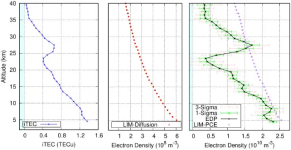
Figure: The left panel displays the altitude profile of integrated total electron content (iTEC) observed on November 8, 2022 at ~ 18:00 UTC, near the north pole at 740 latitude and 840 W longitude, and the corresponding electron density profile (EDP) is shown in the right panel (black curve). The error bars in green and pink colors indicate the σ and 3σ variations in electron density respectively with σ representing the standard deviation. The area shaded in cyan has negative electron density which stands for noise. The purple-colored profile represents the Lunar Ionospheric Model (LIM) output, and PCE stands for Photo Chemical Equilibrium. The middle panel of the figure shows the simulated electron density profile at the observation site when the Moon is inside the Geo-tail in the absence of a crustal magnetic field.

New study reveals surprisingly high electron densities in the Lunar environment, hinting at the potential role of lunar crustal magnetic fields in shaping plasma dynamics.

In a major finding, scientists from Space Physics Laboratory, VSSC, analyzing radio signals from India’s Chandrayaan-2 (CH-2) orbiter – which is in good health and providing data - have revealed that the Moon’s ionosphere exhibits unexpectedly high electron densities when it enters the Earth’s geomagnetic tail. These finding sheds new light on how plasma behaves in the lunar environment and suggests a stronger influence of the Moon’s remnant magnetic fields than previously thought.

The scientists have used an innovative method to study the plasma distribution around moon. In this method they conducted experiments using the S-band Telemetry and Telecommand (TTC) radio signals in a two-way radio occultation experiment, tracking CH-2’s radio transmissions through the Moon’s plasma layer. These signals were received at the Indian Deep Space Network (IDSN), Byallalu, Bangalore. The results revealed a surprisingly high electron density of approximately 23,000 electrons per cubic centimeter in the lunar environment, comparable to densities observed in the Moon’s wake region (previously discovered by the same team) and nearly 100 times higher than those on the sunlit side of the Moon.

The Moon passes through Earth’s extended magnetic field, or "geotail," for nearly 4 days in each orbit. During this period, the moon is shielded from direct solar wind and was thought to have lower plasma densities due to free diffusion along Earth's magnetic field lines. However, the Chandrayaan-2 observations challenge this assumption. Scientists have proposed that the presence of remnant lunar crustal magnetic fields could be trapping plasma, preventing its diffusion, and leading to localized enhancements in electron density. To confirm this, they used in-house Three-Dimensional Lunar Ionospheric Model (3D-LIM) developed at SPL/VSSC, which simulated plasma dynamics under different conditions. The simulations showed that to sustain such high plasma densities, the ionosphere must be in photochemical equilibrium, a condition only achievable in the geotail when crustal magnetic fields are present. The model also suggested a localized reduction in neutral Argon (Ar) and Neon (Ne) densities near the Moon’s poles, aligning with previous spacecraft observations.

High plasma densities can influence radio communications, surface charging effects, and interactions with lunar dust, all of which are important for the upcoming robotic and crewed missions near lunar orbital magnetic field region. Understanding how the lunar ionosphere behaves in different space environments will also improve planning for lunar habitats, particularly in regions influenced by crustal magnetic fields.

The study marks a significant step in unravelling the complex plasma environment around the Moon and highlights the continued impact of Chandrayaan-2’s science mission in advancing lunar research. As more nations gear up for Moon exploration, findings like these will play a crucial role in shaping the future of lunar science and technology.

Reference: "Lunar Ionosphere in the Geotail Region as Observed by Chandrayaan-2 Orbiter Using Two-way Radio Occultation Measurements”, Keshav R. Tripathi, R. K. Choudhary, and K. M. Ambili, The Astrophysical Journal - Letters (DOI: 10.3847/2041-8213/adb3a7).

Chandrayaan-2 unveils the effect of the Earth’s geomagnetic tail on the Lunar ionosphere plasma
 
Shining light on solar activity and the Moon’s exosphere—a Diwali gift from Chandrayaan 2

Moon Monday #247 and Indian Space Progress #32

By Jatan Mehta
20 Oct 2025 — 8 min read
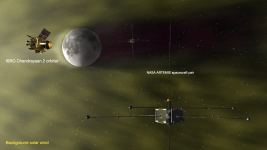
1761502030584.png
Illustration visualizing the Sun’s radiation wind bombarding the Moon, and various spacecraft observing its activity and effects. Background image: E. Masongsong / UCLA EPSS | Derivative graphic and annotations: Jatan Mehta

Theoretical and computational models of highly energetic solar storms have predicted for more than a decade that the density of the Moon’s nearside exosphere increases by at least ten times during such events. Between our Moon having no global magnetic field to shield its surface and the charged, energetic solar wind particles bombarding the ground like a machine gun, solar storms release a greater number of atoms to the exosphere than during normal solar activity. But until now there have been no confirmed measurements to know the real rate increase.

Last year’s heightened solar activity which caused widespread auroras on Earth provided an opportunity to Indian researchers for utilizing the Chandrayaan 2 orbiter to confirm or deny these predictions as well as refine them. A newly published paper based on data from the orbiter’s neutral gas mass spectrometer (named CHACE-2) taken during the time of the heightened solar activity now confirm that the nearside lunar exosphere became at least tenfold denser. Said solar storms were also observed by the Chandrayaan 2 orbiter’s X-ray solar monitor.

You probably wouldn’t get a clear enough picture of this if you read ISRO’s only-jargon-filled release about the discovery on its website, which also needs multiple typo fixes. The release meant for science popularization does not even attempt to capture the unique importance of studying our Sun from the vantage point of our Moon as opposed to elsewhere. That ISRO does not even consider leveraging any of the fairly large number of science writers in the country for such releases, much less think about actively supporting the growing talent, is inefficient. In any case, with the aforementioned discovery explained in brief above, here’s my attempt at capturing its broader picture: why the Chandrayaan 2 orbiter studies the Sun from the Moon, what scientists have found through it, and why the endeavor is unique and relevant to future exploration.

The Sun watcher

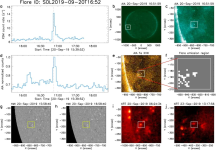
By now it’s clear that the Chandrayaan 2 orbiter doesn’t just study the Moon’s surface and aid its exploration but observes the Sun too. Specifically, scientists use the orbiter’s high-resolution Solar X-ray Monitor (XSM) to study solar flares. In turn, XSM provides a reference for the orbiter’s Chandrayaan-2 Large Area Soft X-ray Spectrometer (CLASS) instrument so it can map elements on the lunar surface. Scientists have published multiple results in international journals based on XSM’s unique observations of the Sun’s surface and atmospheric activities. These include results from statistical measurements of micro-flares and nano-flares crucial to understanding our Sun’s dynamic nature.
1761502082379.png
Panel (a) shows a micro-flare on the Sun detected by India’s Chandrayaan 2 orbiter. Panels (b) and (c) show its locations in images captured by NASA’s SDO spacecraft. Image: Santosh Vadawale, et al.

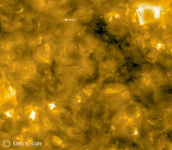
XSM studies of micro-flares and nano-flares are especially important because scientists think they’re relevant to unlocking a fundamental mystery about our Sun: why is its extended atmosphere, the corona, much hotter than its surface? Scientists have been debating since the 1940s how the Sun’s atmosphere is heated to a million degrees Celsius while the surface barely crosses 6,000. Recent close-up observations of many tiny eruptions across the Sun’s surface by ESA’s Solar Orbiter mission coupled with coronal measurements made by NASA’s Parker Solar Probe have helped scientists almost solve the coronal heating mystery.

In that context, having abundant micro-flare and nano-flare observations over time from other spacecraft at different vantage points, like the Chandrayaan 2 orbiter, has helped scientists contextualize and refine these results to improve our understanding of the Sun. Furthermore, through high-resolution measurements of the Sun’s background X-ray emissions, the Chandrayaan 2 orbiter’s XSM data has provided the first elemental abundances of magnesium, aluminum, and silicon in the Sun’s corona during quiet times, refining our understanding.
1761502108797.png
A high-resolution image of the Sun from ESA’s Solar Orbiter spacecraft, captured on May 30, 2020. The lower left circle indicates Earth’s size for scale. The arrow points to one of the many nano-flares. Image: ESA

Protecting future lunar explorers

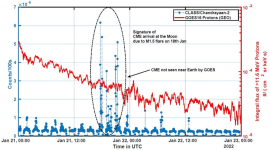
Other than XSM, the Chandrayaan 2 orbiter’s aforementioned CLASS instrument can detect some solar events too. In January 2022, CLASS detected two highly energetic proton emission events in the solar wind. NASA’s GOES-16 satellite couldn’t detect one of these two events because Earth’s magnetic field shielded it from said particles. The Chandrayaan 2 orbiter being at the Moon though could detect them, as could other Sun-studying spacecraft lying outside Earth’s magnetic field.
1761502124530.png
The rate of protons recorded by India’s Chandrayaan 2 lunar orbiter (blue) and NASA’s GOES-16 Earth orbiter (red) circa January 20, 2022. Image: ISRO / NASA

During August 4-7 in 1972, the Sun released several bursts of flares and associated energetic particles. This places its time between the Apollo 16 and 17 missions to the Moon in the same year. Had any of the astronauts been in lunar orbit or on the surface during the solar event, they could’ve faced damaging levels of radiation with the potential to cause cancer. As we prepare to send astronauts on much longer Moon missions and beyond, we’ll need to protect our explorers from such solar storms whose particles reach the Earth-Moon space in a matter of hours.

NASA’s Artemis I mission in 2022 studied solar radiation effects inside the Orion spacecraft that will host crew on future missions. The agency’s upcoming Artemis II flight will advance these studies further. India’s Chandrayaan 2 orbiter is aiding these safety efforts by improving our understanding of solar flares themselves as well as by helping scientists model how solar events affect the Moon, its exosphere, and the surrounding radiation environment as an overall place which will host future astronauts. Dedicated efforts from India for studying solar weather itself obviously include data from the recently launched Aditya-L1 solar observatory and its ongoing contributions but also specific institutional research such as the CESSI lab in IISER Kolkata, which focuses on the fundamental physics of stellar dynamics and modeling solar weather.

Chandrayaan’s Moon-based solar observations are helping extend all solar weather studies to an environment that future astronauts will be exposed to during long-duration missions as well as at Moonbases.
1761502148158.png
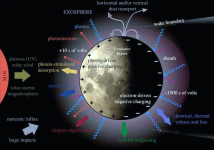
The Moon's environment illustrated to show the complex interactions between solar wind radiation, space plasma, flux of impacting meteorites, and the Moon’s surface, dust, and exosphere. Image: Jasper Halekas

Lunar water and exosphere

With the above context, let’s come back to the discovery we started with up top about the Sun’s wind affecting the lunar ionosphere. It affects water on the Moon too.
1761502213583.png
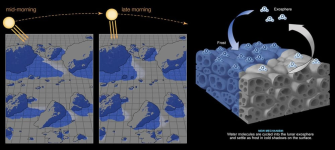
Shadows on the Moon due to terrain can enable water ice to survive on the sunlit lunar surface. Instead of being trapped within lunar soil and rocks, where water is largely immobile, a new study suggests that water molecules remain as frost on the surface in cold shadows and move to other cold locations via the Moon’s thin exosphere. Image: NASA / JPL-Caltech

The Sun’s wind of charged particles is one of the key sources of lunar water, and so understanding how the solar wind shapes the lunar exosphere simultaneously helps us understand processes fundamental to it, which includes mechanisms of how water is altered and moves across the Moon, and how it’s lost. Lunar missions wanting to map and analyze surface water, like the upcoming joint ISRO-JAXA LUPEX rover, will be best served when accounting for all of these factors. The overall work also enables planetary scientists to make better water cycle models on other airless bodies across the Solar System like Mercury, gas giant moons, Ceres, etc.

Instead of explaining such interconnected aspects of the solar wind, the lunar exosphere, and human lunar exploration, ISRO’s aforementioned jargon-filled release about the importance of the discovery only states the following with no specifics or elaboration:

Apart from pushing the edge of our scientific understanding about the Moon and the lunar space weather (effect of the Sun’s emissions on the Moon), this observation also indicates the challenges of building scientific bases on the Moon. Lunar base architects need to account for such extreme events, which would temporarily alter the lunar environment, before the effects subside.

More lunar exosphere studies by Chandrayaan 2
1761502245728.png
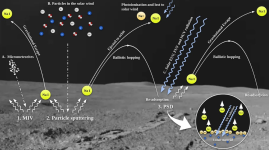
Illustration showing source, sink, and release processes for sodium on the Moon’s surface and in its exosphere. See full caption | Image: A. Devaraj et al.
Shining light on solar activity and the Moon’s exosphere—a Diwali gift from Chandrayaan 2

 

ISRO Offers Advanced Data Products for Deeper Understanding of the Lunar Polar Region

November 08, 2025
1762619775420.png
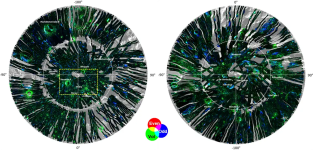
Figure: Radar Polarimetric Decomposition Maps of Lunar North (left) and South (right) Pole.

The Chandrayaan-2 Orbiter is in orbit around the Moon since 2019 and has been providing high quality data. One of the payloads, the Dual Frequency Synthetic Aperture Radar (DFSAR) is the first instrument that has mapped the Moon using L-band in full-polarimetric mode and in highest resolution (25m/pixel). This advanced radar mode sends and receives signals in both vertical and horizontal directions, making it ideal for studying surface properties.

Since launch, about 1400 radar datasets were collected and processed to create polarimetric mosaics of north and south polar region (80 to 90 deg latitude) of the Moon. Using the datasets, the scientists from Space Applications Centre (SAC), Ahmedabad have developed advanced data products, on potential presence of water-ice, surface roughness, as well as an important electrical property, namely dielectric constant which describes features like density and porosity of the Moon’s surface. The algorithm for analysing the full-polarimetric data is developed and data products are generated indigenously by ISRO.

1762619809405.png
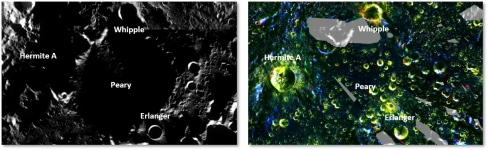
Figure: (Left) Optical and (Right) DFSAR Image of Peary Crater region in Lunar North Pole, from a section marked on the mosaic.

These advanced data products are significant in view of gathering a first-order information about Moon’s polar regions. Such regions are expected to have preserved the early chemical conditions of the solar system, which are important clues to explain several facets of evolution of the planetary bodies. This kind of ready-to-use data products on lunar polar regions has always been sought after, because it will provide holistic information to characterise the polar regions for future lunar exploration. These products complement hyperspectral data in studying the distribution of minerals on the Moon.

The polar mosaics include key radar parameters that reveal the physical and electrical (dielectric) characteristics of the Moon’s surface and subsurface.

The parameters include:
  • Circular Polarization Ratio (CPR): Indicator of possible presence of water ice.
  • Single bounce Eigenvalue Relative Difference (SERD): Represents surface roughness.
  • T-Ratio: Related to the material's dielectric constant.
  • Polarimetric decomposition components: Show different types of radar scattering (Odd, Even, Volume, Helix).
The derived Polar Mosaic products (Level 3C) are released for the users and freely available in Indian Space Science Data Centre (ISSDC) PRADAN website: Sign in to Indian Space Science Data Center

The products can be visualized in CH2 MapBrowse: Sign in to Indian Space Science Data Center

ISRO encourages the scientific community to explore these data products.

ISRO Offers Advanced Data Products for Deeper Understanding of the Lunar Polar Region
 
A giant leap in orbital imagery is what we need to realize advanced Moon missions

Jatan Mehta
07 Nov 2025 — 6 min read
1762620242963.png
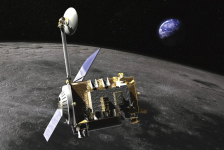
Illustration of the LRO spacecraft orbiting our Moon. Image: NASA / GSFC / Chris Meaney

At over 1.6 petabytes, NASA’s Lunar Reconnaissance Orbiter (LRO) mission hosts by far the largest dataset from any planetary science spacecraft ever launched. LRO’s high-resolution lunar imagery and topographic data has been the bedrock for selecting landing sites of most Moon missions launched this century from around the world. Many of these landers though were planned as short or mid duration missions at best, whereas the next generation of landers and rovers will explore unknown ground truths about water ice and other resources amid unfavorable lighting conditions at the Moon’s south pole. These will not only need more granular orbital imagery to plan precision landings but comprehensive environmental datasets that allow missions to last long enough.

But NASA’s 2009-launched LRO has gracefully aged now. It’s due for its final mission extension evaluation this year and has limited capabilities left. LRO’s inertial measurement unit has degraded, and it can no longer maintain an orbit that can study the lunar poles from directly above them; its orbit is now inclined. Recognizing these constraints, a specialized team of US scientists released a report called CLOC-SAT in 2022 urging NASA to plan replacing the LRO with an enhanced approach so as to support the increasingly complex and diverse upcoming robotic CLPS and crewed Artemis Moon missions.

Three years since, NASA has not approved any LRO successor despite the LExSO mission being proposed by members from the LRO team itself. NASA’s FY2026 Presidential budget request does not ask for any funding for the same.

What will stand on the shoulders of the giant ?

On the US’ side, there is NASA’s ShadowCam imager, which launched aboard South Korea’s KPLO lunar orbiter in 2022. It images polar craters that are permanently shadowed. However, it has found no reflectance differences that can be uniquely attributed to surface water ice in most of the areas it has mapped so far. To be clear, this isn’t a failure of ShadowCam, the instrument. But given that KPLO’s mission will likely end this year, the dull outcome highlights the pressing need for higher-resolution studies from orbit and the surface, neither of which are taking place substantially.

India’s Chandrayaan 2 orbiter, a full-fledged reconnaissance spacecraft like LRO, has fulfilled a few advanced needs. Having launched a decade later, it’s also more capable in certain areas, such as having a better radar as well as a better imaging resolution of up to 0.25 meters/pixel—twice LRO’s finest. Scientists who authored the aforementioned report for NASA recognized the Chandrayaan 2 orbiter’s capability in mission planning:

Additional imaging of the lunar surface at sub-meter scales (e.g., 30 cm) is highly desirable to facilitate identification of roughly m-scale hazards that are often relevant to finding safe landing sites. As an example, the Chandrayaan-2 Orbiter High Resolution Camera (OHRC) has a nominal pixel scale of 30 cm from a 62 km altitude orbit.

1762620326297.png
Images: NASA / GSFC / ASU / LROC / ISRO / C. Tungathurthi | Graphic: Jatan Mehta

Through its instruments, the ISRO orbiter has been producing a trickle of this next layer of lunar water results. The orbiter also helped JAXA’s SLIM spacecraft achieve the most precise Moon landing ever for a robotic vehicle, touching down only 55 meters from its targeted point. ISRO shared Chandrayaan 2 data with JAXA for final landing site selection as well as for SLIM’s onboard last-mile navigation maps. Without the world’s sharpest lunar imager, it wouldn’t be possible for SLIM to spot and navigate to a safe touchdown point without compromising on the landing accuracy—the primary mission goal. The two agencies are now collaborating on the joint LUPEX rover mission to study water ice on the Moon’s south pole.

Similarly, NASA has been collaborating with ISRO to have the Chandrayaan 2 orbiter aid Artemis landing site selections by prospecting for lunar polar water, classifying hazards, and gaining better topographic data about polar sites. But NASA’s leveraging and ISRO’s promoting of the orbiter’s optical and radar capabilities have been limited in scope. Moreover, the orbiter is likely to end its nominal operations by the end of the decade if not before that with no immediate replacement planned or announced by ISRO.

Commercial services coming up

Seeing the opportunity to fill gaps in the apt planning of future, more complex Moon missions, especially in the case of NASA, commercial companies are entering the landscape of orbital imagery and mapping.

US-based Firefly announced a commercial lunar imaging and mineral detection service called Ocula to hope to carry forward a part of LRO’s foundational role. The service will commence with the first Elytra Dark orbiter next year from low lunar orbit. The orbiter will do so after completing its services for Firefly’s upcoming second Moon lander mission part of NASA’s CLPS program. Firefly says Ocula’s best case optical imagery will tout a then-best resolution of 20 cm/pixel.

Blue Origin has announced that it will send an “ultra-low” polar orbiter called Oasis-1 to the Moon to “create the most detailed high-resolution maps to date of lunar water ice, Helium-3, radionuclides, rare earth elements, precious metals, and other materials”. The mission will be in partnership with the Luxembourg Space Agency, ESA’s space-resources-focused ESRIC institute, and GOMspace. The company has not yet specified when Oasis-1 will launch or what its altitude range will be to enable the required outcomes.

On the other side of the world, ispace has been selected as part of Japan’s 1-trillion yen “Space Strategy Fund” initiative to develop, launch, and operate a lunar orbiter which will use a terahertz wave sensor system to locate and map water ice deposits on the Moon’s poles. Data from this orbiter will be analyzed in tandem with direct surface and subsurface measurements made by the upcoming joint Indo-Japanese LUPEX rover mission.

Coordinate to catalyze

1762621098830.png
Illustration of the Ocula lunar imaging service. Image: Firefly

All of these commercially driven orbiters, while welcome, are specialized and have relatively limited use cases. The expansive scope of future missions leading up to Moonbases still requires having the whole spectrum of orbital datasets, especially for helping locate and explore swaths of water ice and permanently shadowed regions on lunar poles—something the US has been failing at despite it being central to Artemis.

To that end, scientists have formally recommended NASA through the aforementioned CLOC-SAT report as well as other means to coordinate future lunar orbital measurements and capabilities. This, the report has argued, necessitates having a slew of interconnected lunar orbiters—both long-lived ones like LRO & Chandrayaan 2 as well as specialized ones—instead of a single successor.

Meeting these [future mission] goals will require multiple approaches involving several orbits and/or orbiters, but there are a large number of stakeholders in our return to the Moon, including commercial and international partners, whose resources can be shared and leveraged to meet diverse goals while minimizing cost.
[…]
NASA should establish a single office tasked with coordinating across space agencies and within NASA for sharing resources, such as communications networks and orbital strategies. For example, a spacecraft’s orbit altitude and orbit plane could be chosen partially based on the requirements of other orbiters.

The Lunar Ledger project by the Open Lunar Foundation (a Moon Monday sponsor) aims to help catalyze acting on this advice by allowing more commercial and national mission operators to reliably share technical data at mutual discretion. Six companies have signed up for the Ledger at launch with an eye towards mission data sharing: ispace, Firefly, Astrolab (a Moon Monday sponsor), JAOPS, Dymon, and SpaceData. Similar to how NASA, ESA, and ISRO have been planning to perform coordinated imaging and scientific observations of Venus with their respective upcoming missions, lunar orbiters from across the world could coordinate and build atop their respective observations to accelerate progress and improve output for all while saving costs. Christine Tiballi, the Lunar Ledger’s Lead, is particularly excited about the possibilities of orbital data enabling better rover missions, which in turn enhance quality of orbital datasets that later missions can leverage:

We've included market signals like data sharing and available payload space, so that any mission can communicate their interest as a provider or a consumer of these assets. So say an upcoming rover is to traverse projected operational coordinates of another future mission, capturing data at unprecedented resolutions. Tapping into it will not only improve calibration of public orbital datasets and significantly increase the chances of future mission successes but also signal operational orbiters to enable planning for that rover traverse in the first place.

This way you have the opportunity to be the supplier and enabler as well as the customer while reducing building costs. “Suddenly competition can become very lucrative cooperation,” adds Tiballi.

A giant leap in orbital imagery is what we need to realize advanced Moon missions