

You are using an out of date browser. It may not display this or other websites correctly.
You should upgrade or use an alternative browser.
You should upgrade or use an alternative browser.


Rajnath, Iranian counterpart review progress of key INSTC freight corridor involving Russia
Russia, Iran & India had in 2002 signed agreement to develop International North South Transport Corridor (INSTC) project.
 theprint.in

#Chabahar 
A vital Indian asset in the Middle East is in trouble
A vital Indian asset in the Middle East is in trouble
The media believe that the port of Chabahar is India's answer to China in the Indian Ocean.
They say it will unlock Central Asia and Europe for India
BUT, Chabahar is stuck
I visited the port last week
Thread about what's wrong with Chabahar :
So what is the hype around Chabahar really about?
Three things are fuelling the hype around the port:
1. Economy
Chabahar is located in south-eastern Iran, close to the country's border with Pakistan.
India's aim was to develop the port as a major trading hub
The idea was that goods would leave India by ship, reach Chabahar and continue on to Central Asia via Afghanistan.
This would allow India to bypass Pakistan and build an independent trade artery to key Central Asian markets.
It would also allow India to import minerals and raw materials
2. Location
Chabahar lies beyond the Strait of Hormuz, a strategic chokepoint in the Indian Ocean.
Experts believed that these straits would be blocked in the event of conflict in the Middle East.
Unlike many other ports, Chabahar was located beyond the Strait.
As a result, experts said that trade via Chabahar would be safe from disruption in the event of a conflict closing the Strait of Hormuz.
3. China and Pakistan
Chabahar is just 72 km from the port of Gwadar, developed by CHN & PAK.
Over the years, fears of an increasing Chinese naval presence in the Indian Ocean have led to calls to develop Chabahar as a strategic asset to counter China
The media have speculated that Chabahar could be used by India in case China tries to use Gwadar as a naval base in a conflict
So that's the hype
The reality is disappointing
That's because the Chabahar project has stalled
Some would say it has been stuck for 20 years
The saga began in 2002 when India showed an interest in the port
In 2003, India signed a memorandum of understanding with Iran promising to develop Chabahar
After that, nothing happened for years
In 2004, an Indian consortium including Ashok Leyland, backed by the Hinduja group, signed a memorandum of understanding to develop Chabahar.
However, things never got off the ground
Even as China completed the port of Gwadar in 2006, the IND and Iran had years of meetings about getting Chabahar off the ground
@KabirTaneja writes that in 2013, India's NSA called the MEA to "drag its feet" on Chabahar
2013 saw some movement as India committed $100m to port development
Analysts speculated that this was a move to counter China and Pakistan's presence in Afghanistan
Things started after the 2015 nuclear deal between Iran and the P5 countries
Sanctions were partially lifted and there was increased interest in investing in Iran
In 2016, the governments of India, Iran and Afghanistan signed a memorandum of understanding to develop Chabahar
India committed $85 million to develop the Shahid Behesti terminal (one of the port's two terminals)
The government set up India Ports Global Limited, a government company, to take charge of development
In 2018, the Trump administration of USA withdrew from the 2015 nuclear deal
It also imposed sanctions on Iran, which deterred a number of Indian companies from doing business.
In 2019, India cut Chabahar's development budget from 150 crore to 45 crore
In 2023, India has spent around $25 million to develop Chabahar (promised amount $85 million)
India has supplied 6 cranes to Chabahar so far
But Iranian officials complain that development work at Chabahar has been too slow
During my visit to Chabahar, many officials said that India could lose the port to China
Although this is largely just tactical pressure...
...tactics, Iran has expressed its displeasure with India before.
India has been excluded from the Farzad B gas field project due to development delays
India was dropped from the development of the Zahedan rail line, which would have strengthened connectivity to Chabahar
China has launched a direct shipping line to Chabahar, while Gwadar has signed a twinning agreement with Chabahar.
So the idea that Iran will allow India to use Chabahar as an asset against China may be far-fetched
The fall of Afghanistan in 2021 has also complicated Indian plans
Indian companies are also unlikely to invest in the Chabahar Free Trade Zone
While Indian companies were initially interested in investing in petrochemicals and other sectors, the imposition of US sanctions has reduced interest.
During my visit, I saw little foreign investment in the port
This is not intended to undermine the efforts of Indian diplomats
While bureaucracy has slowed Chabahar's development, sanctions have been the main culprit
For example, sanctions and procedural difficulties have made it difficult for India to supply cranes to develop Chabahar
Similarly, the development of the railway line to Zahedan was also affected because Indian companies did not want to breach the sanctions
So with all this, what is Chabahar really worth?
The port remains an asset
If US sanctions were lifted, the port could become a key centre for trade
The disruption of global supply chains means that India is looking to build new trade routes and new partners outside the West
It now wants to make Chabahar a...
...key element of the INSTC project, which will enable India to develop a new trade artery to Central Asia and Eastern Europe via Azerbaijan/Armenia
This could lead to a wider conversation about using Chabahar for strategic purposes
But these conversations have not yet taken place
Thank you for reading this!
Last edited:
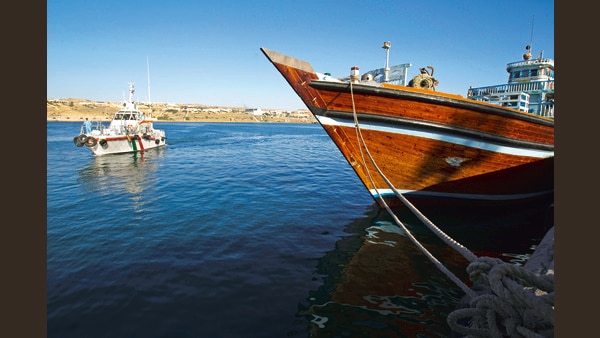
India, Iran drop arbitration clause for Chabahar port
The move paves the way for the two sides to sign a long-term deal for the development of the strategic port, two persons aware of the development said.
www.livemint.com
Envoy: Taliban Invest $35mn In Iran’s Chabahar - Iran Front Page
Afghans want to be less dependent on Karachi and the Afghanistan-Pakistan border crossings, which the Pakistanis have closed several times in recent months to protest against TTP attacks. And also against smuggling.
Afghans want to be less dependent on Karachi and the Afghanistan-Pakistan border crossings, which the Pakistanis have closed several times in recent months to protest against TTP attacks. And also against smuggling.


until now, the Chabahar project was exempted fron US sanctions…
 bad news.
Flip-flop seen over US stance on Chabahar port
The United States shifting stance on Chabahar Port in light of India-Iran's decade-long contract has raised eyebrows, with a U-turn seen in the policy. On Monday (May 13), in response to the impact on Indian firms dealing with Chabahar port, the US State Department pointed out that "any entity...
www.wionews.com

MEA has put out a statement denying any exit from the project.
Even in the article, it's clearly stated that only the money is being transferred, to bypass sanctions. India haven't opted out of the project.
Chabahar was never about Iran's economy. Its about connectivity and bypassing pakistan which is still very important for India.Iran's economy is in a very bad shape and Chahbahar is of little use now to India
16.02.26_Reuters
India seizes three Iran-linked US-sanctioned tankers, source says
NEW DELHI, Feb 16 (Reuters) - India has seized three U.S.-sanctioned oil tankers linked to Iran this month and stepped up surveillance in its maritime zone to curb illicit trade, a source said on Monday, confirming a post on X by Indian authorities earlier in February that had been deleted.India aims to prevent its waters from being used for ship-to-ship transfers that obscure the origin of oil cargoes, the source with direct knowledge of the matter told Reuters.
The seizures and heightened surveillance follow an improvement in U.S.-India relations. Washington earlier this month announced it will cut import tariffs on Indian goods to 18% from 50%, after New Delhi agreed to stop Russian oil imports.
The three sanctioned vessels - Stellar Ruby, Asphalt Star and Al Jafzia - frequently changed their identities to evade law enforcement by coastal states, the source said, adding that their owners were based overseas.
VESSELS SEIZED OFFSHORE MUMBAI
Iranian state media cited the National Iranian Oil Company as saying that the three tankers seized by India had no connection to the company. It said that neither the cargoes nor the vessels were linked to the company.
Indian authorities had said in a post on X on February 6 that they intercepted three vessels about 100 nautical miles west of Mumbai after detecting suspicious activity involving a tanker in India's exclusive economic zone.
The post was later deleted, but the source confirmed that the vessels had been escorted to Mumbai for further investigation.
The Indian Coast Guard has since deployed about 55 ships and between 10 and 12 aircraft for round-the-clock surveillance in its maritime zones, according to the source.
The U.S. Office of Foreign Assets Control said last year it had sanctioned three vessels, called Global Peace, Chil 1, and Glory Star 1, with IMO numbers identical to the ships lately captured by India.
Two of the three tankers are linked to Iran, with Al Jafzia having carried fuel oil from Iran to Djibouti in 2025 and Stellar Ruby flagged in Iran, according to LSEG data.
The Asphalt Star mostly operated on voyages around China, the data show.
Sanctioned oil and fuel are often sold at deep discounts due to the risks involved, with intermediaries moving cargo through complex ownership structures, false documentation and mid-sea transfers that complicate enforcement. /END