British Army Discussions & Updates

UK RFDEW radio frequency weapons to combat UAVs. Britain has introduced radio frequency energy weapons to combat UAVs and jam enemy electronics. The new weapon is being developed by the Defense Science and Technology Laboratory "Dstl". A universal system called RFDEW (Radio Frequency Directed Energy Weapon), is a radio frequency directed energy weapon. The complex emits radio waves and disables important electronic components of enemy vehicles and UAVs. The RFDEW system can be installed on a variety of vehicles and uses a mobile power source to generate pulses of radio frequency energy in the form of a beam. This beam can strike individual targets or expand the area of effect to all threats within its range. The RFDEW system is automated, operated by one person and is capable of hitting targets at a distance of up to 1 km, and work is currently underway to increase the operating range. An RFDEW beam costs just 10p to fire, making it significantly more cost effective than using traditional air defense systems.

 
  • Like
Reactions: BMD
In Britain, the RFDEW microwave weapon was successfully tested against a group of drones. Earlier, we talked about the RFDEW radio frequency energy weapon. It is worth noting that the microwave weapon was tested on hovering drones. One of the problems with FPV drones is the difficulty of detecting them, especially when moving at low altitude. Despite this, according to the test results, we can say that the microwave weapon against drones really works. Considering that drones are beginning to be used with fiber optic control, microwave weapons are becoming more relevant to combat them than electronic warfare systems.


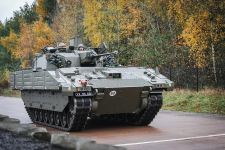
The Ajax armoured fighting vehicle has reached Initial Operating Capability (IOC), confirming it is ready to deploy a squadron on operations. Developed through collaboration between the Army, Defence Equipment & Support (DE&S), and General Dynamics, Ajax is the most advanced medium weight armoured vehicle of its kind.

Built in Merthyr Tydfil, Wales, the Ajax programme supports over 4,100 jobs and more than 230 companies across the UK. It marks the first new armoured fighting vehicle to enter British Army service in nearly 30 years.

Trials included firing over 20,000 rounds from the 40mm cannon, overseas training in extreme temperatures, and more than 42,000 kilometres of battlefield driving. Ajax will serve at the core of the British Army’s Armoured and Deep Recce Strike Brigades.

Minister for Defence Readiness and Industry, Luke Pollard MP, said: “Defence is an engine for growth. Ajax is contributing not only to the economy in South Wales but also UK-wide in the supply chain. We’re exploring the potential to export Ajax. Ajax boasts world-class capabilities and it is a hugely important milestone that the UK-wide suppliers have delivered a vehicle that is safe, effective and truly cutting-edge which will be recognised by allies and adversaries alike.”

1762496487940.png
 
  • Like
Reactions: spice

Britain is facing a military crisis driven by a combination of underfunding, delayed modernization programs, and an inability to fight a modern war, according to recent reports from a UK Parliament Defence Committee and the UK Defence Review. Key issues include a lack of a modern layered air defense system, vulnerabilities to missile and cyber attacks, and a military design that lacks the depth for a long conflict.
 
  • Like
Reactions: spice

The Ajax is on the naughty step, again, pending a review being conducted by the programme stakeholders following the humiliation of a Labour defence minister after being forced to suspend its use in late-2025, mere days the Ministry of Defence publicly crowed the platform had reached initial operating capability.

Service personnel continue to report injury and illness after operating the Ajax for prolonged periods, the platform still suffering from apparent shaking and noise issues, years after the problem was apparently fixed.

However, Army Technology learned that the programme is still apparently considered central to the future of the British Army, along with the Boxer mechanised infantry vehicle – which has its own problems – and a Challenger 3 programme still years away from delivery.

As of 21 January, 170 Ajax platforms have been delivered up to and including 1 December 2025, including: 87 Ajax, 33 Ares, 25 Athena, three Argus, 13 Apollo, and nine Atlas variants.
 
  • Like
Reactions: spice

For first time, 155mm TRBM 155HG Sceptre Shell with ramjet liquid rocket engine that can run even on diesel for range up to 150km flew on its own engine during tests

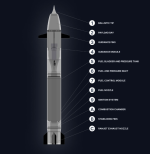
Tiberius Aerospace company reported that its 155mm TRBM 155HG Sceptre shell with ramjet liquid rocket engine launched its engine in flight during recent live-fire tests. Most likely, tests conducted since late 2025 tested only the design, without functioning engine.

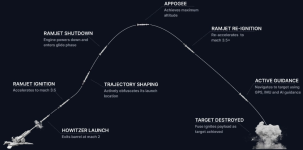
Along with this announcement, the company published video from this test. One can notice the shell flying horizontally, in other words, the ability of the engine to work after initial overload of 18,000g during firing was tested.

The video also shows a certain sabot flying immediately behind the shell, which pushes the TRBM 155HG Sceptre out of the barrel under powder charge action. Interestingly, the ramjet liquid rocket engine turns on already several meters after exiting the gun barrel.

Development of TRBM 155HG Sceptre first became known only in May 2025. Regarding characteristics, maximum range of 140-160 km is announced, as well as speed in initial stage up to Mach 3.5 (4,290 km/h).

As noted above, this shell's caliber is 155mm, while its length is 1.55 meters, which is indeed quite a lot.

This ramjet liquid rocket engine can use three fuel types at once for operation: diesel, as well as JP-4 and JP-8 aviation fuel. Shell weight when firing is 47.5 kg, but despite this, only 5.2 kg may fall on the warhead.
1777103490562.png
1777103548545.png
1777103570802.png