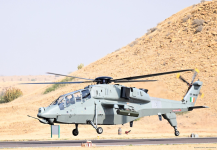
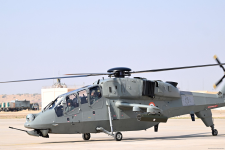
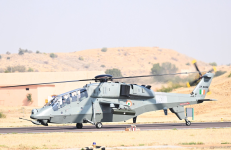
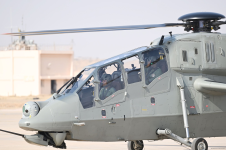
Attack Helicopters of IAF - LCH Prachand, AH-64E Apache : Updates & Discussions

AH-64 Apaches Make Mysterious Return To U.S. On Their Delivery Flight To India​


Thomas Newdick

6–7 minutes


The planned delivery of three AH-64E Apache Guardian attack helicopters to the Indian Army has taken an unusual turn. The Antonov Airlines An-124 cargo aircraft carrying the rotorcraft to India returned to the United States with the Apaches still onboard, after a long stopover in the United Kingdom. A Boeing spokesperson told TWZ that the company was looking into “logistical issues” that they said had interrupted the transportation.


The unexpected movements were tracked by plane spotter @KiwaSpotter, who noted the heavy-lift An-124 serial UR-82008 arriving at Mesa Gateway Airport, also known as Phoenix–Mesa Airport, in Arizona, on October 30, after a flight from its operating base in Leipzig, Germany.

One of three Indian Army AH-64Es is readied for loading onto the An-124 at Mesa, Arizona, on October 30. <em>@KiwaSpotter</em>

One of three Indian Army AH-64Es is readied for loading onto the An-124 at Mesa, Arizona, on October 30. @KiwaSpotter


After being moved from the nearby Boeing facility in Mesa, the Apaches were loaded aboard the An-124, which then departed the United States on November 1 and flew to East Midlands Airport in England. When loaded, the helicopters were already painted in their distinctive Indian Army desert camouflage scheme. At least one of the Apaches could be identified in the photos, as serial IA-7105.


The An-124 and its Apache cargo then remained on the ground at the British airport for eight days before the aircraft departed, not headed toward India but returning over the Atlantic to its original point of departure at Mesa Gateway Airport, where they touched down on November 8.

The Apaches were later seen after being unloaded, now under tow, with their rotors removed.


The Indian Army has already received its first three AH-64Es in July this year, part of a six-aircraft deal worth $796 million that was signed back in February 2020, during U.S. President Donald Trump’s visit to New Delhi.

The first trio of rotorcraft was flown by Antonov Airlines An-124 to Air Force Station Hindon.

“These … helicopters will enhance the Army Aviation wing’s operational effectiveness, especially in challenging terrains,” Indian Minister of Defense Rajnath Singh said at the time.


These AH-64s are currently being used to train crews at Nashik, in Maharashtra state, western India, home of the Indian Army Aviation Training School. Ultimately, the Indian Army Apaches are expected to be stationed at Nagtalao Army Aviation Base, north of Jodhpur, in northwestern India.

The latest batch of three helicopters would have completed the Indian Army deliveries… had they arrived.

TWZ approached Boeing for more information, and a company spokesperson provided the following statement:

We are currently addressing logistical issues caused by external factors to complete the delivery process for the remaining aircraft. We remain closely engaged with the U.S. government and Indian Army and continue working to execute our contract as expeditiously as possible to meet India’s needs and fleet requirements.”

The second batch of three Indian Army AH-64Es are loaded onto the An-124 at Mesa, Arizona, on October 30. <em>@KiwaSpotter</em>

The second batch of three Indian Army AH-64Es are loaded onto the An-124 at Mesa, Arizona, on October 30. @KiwaSpotter

It remains unclear what the exact nature of the problem was, and whether it was related to the Apaches, the An-124 carrying them, or some other factor in their long aerial transport to India. Potentially, “logistical issues” could involve something technical, relating to any of the aircraft involved, but they might also involve something more mundane, perhaps related to customs or other paperwork. There’s even the potential for some kind of diplomatic or political interference in the transport process, although it would be a little surprising if this wasn’t signaled in advance.

Unusually, New Delhi has ordered AH-64Es for two different armed services.

Previously, 22 Apaches were ordered by the Indian Air Force, and all have been successfully delivered.

The lead of this pair of AH-64E Apaches fires an AGM-114 Hellfire anti-tank missile during a live-fire demonstration. <em>Angad Singh</em>

The lead of this pair of AH-64E Apaches fires an AGM-114 Hellfire anti-tank missile during a live-fire demonstration. Angad Singh

The current delay in delivery comes amid New Delhi’s increasing willingness to buy new military aircraft from the United States. Other aircraft acquisitions in this category include the C-130J Hercules transport aircraft, the CH-47F Chinook heavy-lift helicopter, and the P-8I Neptune maritime patrol aircraft (as the Poseidon is locally known).

At the same time, there have been increasing strains in U.S.-India politics of late. Within India, there have been growing questions about the reliability of the United States as a strategic partner. Tensions worsened after the terrorist attack in India in April and the ensuing India-Pakistan military clashes, after which the Trump administration imposed a 50 percent tariff against India. These penalties also reflected U.S. displeasure about continued Indian purchases of Russian oil.


More in World​


9cff960ea7eca54a49b184eed4b4fd42.cf.webp

1a92a6fb4f3b831f22a77fe96673b928.cf.webp

26f5e39a294781f102e7612b4e500e38.cf.webp

What is clear is the Indian Armed Forces’ urgent need to bolster its attack helicopter capabilities, especially as it seeks to better counter its increasingly high-tech adversaries — chiefly China and Pakistan.

The same Boeing spokesperson told TWZ that the company plans to complete the delivery of the remaining Apaches on order for the Indian Army as soon as possible. We will continue to track this story and the eventual fate of the three AH-64s that the service is still waiting for.

20 Confirmed Dead as Military Cargo Plane Crashes to the Ground After Going into a Tailspin
What's funny is that the basic airframe would've been assembled in Hyd before being shipped back after outfitting and flight tests at Boeing. At this rate, it would have probably been easier to import the avionics, engines, rotors, gearboxes, sensors etc and do the whole thing in India.

Overall, the Apaches have not lived up to the hype with frequent emergency landings ( not just at high altitudes but also in the plains). Perhaps the Mi-28NE would have been a better bet.
 
  • Like
Reactions: Shan and Aniruddha


Navies do have a role for dedicated attack helis in amphibious ops to provide low altitude fire support to marine forces making beach landings.


Operational envelope can be further increased with addition of anti ship, anti surface anti sub payload etc, though main helis for these jobs will still be something like sea king , sea hawk.

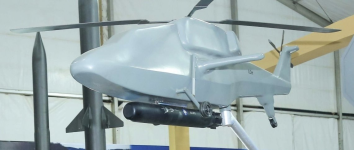
I got that. I was talking about the scale of the torpedo model w. r. t. the helo.


Navies do have a role for dedicated attack helis in amphibious ops to provide low altitude fire support to marine forces making beach landings.


Operational envelope can be further increased with addition of anti ship, anti surface anti sub payload etc, though main helis for these jobs will still be something like sea king , sea hawk.
Shipborne close air support, yes. But tandem two seat attack helos are not suited for ASW roles- not with their narrow airframes carrying underbelly stores. LCH was certainly not designed for that.

NRUAV would have been perfect for the role. sadly still MIA. Doubt whether those Schiebel Camcopters in IN service are ASW capable, either.
 
I got that. I was talking about the scale of the torpedo model w. r. t. the helo.
Mu90 torpedo, 2.85m long ,.

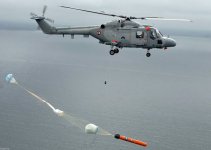
sea lynx ~15mlong,
prachand ~16m long.
images (19).jpeg


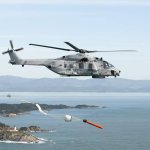
Nh90 ~20m long.
images (18).jpeg
Shipborne close air support, yes. But tandem two seat attack helos are not suited for ASW roles- not with their narrow airframes carrying underbelly stores. LCH was certainly not designed for that.

NRUAV would have been perfect for the role. sadly still MIA. Doubt whether those Schiebel Camcopters in IN service are ASW capable, either.
Prachand by virtue of its design is less suited to for these roles, but still can be modified to perform them if needed.

Though If navy ever buys naval prachand it will be primary to support group troops doing beach landings.
 
Mu90 torpedo, 2.85m long ,.

sea lynx ~15mlong,
prachand ~16m long.
View attachment 47821


Nh90 ~20m long.
View attachment 47820

Prachand by virtue of its design is less suited to for these roles, but still can be modified to perform them if needed.

Though If navy ever buys naval prachand it will be primary to support group troops doing beach landings.
The stub wing (individual) hardpoints on Prachand are probably not rated for 300kg+ loads. Underbelly hardpoints for LWT would likely be suboptimal.

In any case, we're going to need a marinized Mk2 variant with corrosion protection, better endurance and payload capability for the ship-based cas role.
 
The stub wing (individual) hardpoints on Prachand are probably not rated for 300kg+ loads. Underbelly hardpoints for LWT would likely be suboptimal.

In any case, we're going to need a marinized Mk2 variant with corrosion protection, better endurance and payload capability for the ship-based cas role.
The 70mm rocket pods prachand and other attack helis carry on their inner pylon, can exceed 250+kg weight when fully loaded with all their rockets

Apache's hydra70:-
The most common launcher is the M261 19-tube lightweight launcher. When fully loaded, its weight is approximately 596 pounds (270 kg)

Prachand's 70mm rocket pod, carries 12 rockets instead of 19 of hydra 70.
Which means it will still be ~200kg.


Plus prachand can carry 2, 250kg bombs, each on its each inner wing pylon


So a more strengthened inner wing pylon for 300+kg loads for navalised parachand is possible to make.

Can also increase ground clearance of belly for naval varient.
 
A light helo should not be more than support & light attack option. You want torp delivered via a helo, use the naval imrh. Yes using a light heli would be unsuspecting for the enemy, but light helo needs to be very robust, not first of the line product.

That model is also a concept model for this reason.
 
The stub wing (individual) hardpoints on Prachand are probably not rated for 300kg+ loads. Underbelly hardpoints for LWT would likely be suboptimal.

In any case, we're going to need a marinized Mk2 variant with corrosion protection, better endurance and payload capability for the ship-based cas role.
The 70mm rocket pods prachand and other attack helis carry on their inner pylon, can exceed 250+kg weight when fully loaded with all their rockets

Apache's hydra70:-
The most common launcher is the M261 19-tube lightweight launcher. When fully loaded, its weight is approximately 596 pounds (270 kg)

Prachand's 70mm rocket pod, carries 12 rockets instead of 19 of hydra 70.
Which means it will still be ~200kg.


Plus prachand can carry 2, 250kg bombs, each on its each inner wing pylon


So a more strengthened inner wing pylon for 300+kg loads for navalised parachand is possible to make.

Can you increase ground clearance of belly for naval vari
A light helo should not be more than support & light attack option. You want torp delivered via a helo, use the naval imrh. Yes using a light heli would be unsuspecting for the enemy, but light helo needs to be very robust, not first of the line product.

That model is also a concept model for this reason.
Prachand is more of a medium attack helo by international standards.
With 5.8tons mtow.


Payload, range endurance
All roughly similar to eurocopter tiger.


Can also use that concept in coastal anti sub warfare or even somewhat modify airforce and army prachand hero's, taking off from land for coastal anti sub warfare.
 
The 70mm rocket pods prachand and other attack helis carry on their inner pylon, can exceed 250+kg weight when fully loaded with all their rockets

Apache's hydra70:-
The most common launcher is the M261 19-tube lightweight launcher. When fully loaded, its weight is approximately 596 pounds (270 kg)

Prachand's 70mm rocket pod, carries 12 rockets instead of 19 of hydra 70.
Which means it will still be ~200kg.


Plus prachand can carry 2, 250kg bombs, each on its each inner wing pylon


So a more strengthened inner wing pylon for 300+kg loads for navalised parachand is possible to make.

Can you increase ground clearance of belly for naval vari

Prachand is more of a medium attack helo by international standards.
With 5.8tons mtow.


Payload, range endurance
All roughly similar to eurocopter tiger.


Can also use that concept in coastal anti sub warfare or even somewhat modify airforce and army prachand hero's, taking off from land for coastal anti sub warfare.

Prachand can theoretically carry LWT given it has a 1.5t payload capacity. But without onboard dipping sonar, it's role would be rather limited. It would need to be cued by dedicated MPA/ASW helos to the target area.

Putting a dipping sonar onboard would mean adding a winch/ventral port to the airframe. A ventral opening in particular would make it hard to accommodate the LWT station.
 
  • Like
Reactions: PhotonVish
Prachand can theoretically carry LWT given it has a 1.5t payload capacity. But without onboard dipping sonar, it's role would be rather limited. It would need to be cued by dedicated MPA/ASW helos to the target area.

Putting a dipping sonar onboard would mean adding a winch/ventral port to the airframe. A ventral opening in particular would make it hard to accommodate the LWT station.
As I said before navalised version's inner stub wing pylon can be strengthened to carry 300+kg or even ~400kg payload.

So 220 kg Light weight torpedo will be a non issue weight wise even for current prachand's inner stub wing pylons.

Dipping sonar can be added on its belly, on the later half of its front fuselage.