Agni & Prithvi Ballistic Missiles : News & Discussions

India to develop lighter intercontinental missile capable of beating THAAD, S-500 air defence systems: Report

India is developing its next generation of intercontinental missiles, which is reportedly a significant step up from the Agni-5 in terms of range and effect. The project is reportedly being kept top secret, as its objective is to ensure it can evade the world's best missile defence systems, such as Russia's S-500, America's THAAD, and China's HQ-19.

The project aims to develop a missile that is not only powerful but also lighter than the Agni-5—the nuclear-capable, intermediate-range ballistic missile (IRBM) developed by the Defence Research and Development Organisation (DRDO). The platform is expected to carry 10 to 12 warheads and have a range exceeding 10,000 kilometres. The Agni-5's range is said to be between 5,000 and 5,500 km.

The use of Manoeuvrable Re-entry Vehicles (MaRVs), advanced decoys to deceive radars, and radar-absorbing coatings will be key to beating the S-500, THAAD, and similar systems. A Manoeuvrable Re-entry Vehicle (MaRV) is a type of ballistic missile payload designed to change its flight path after re-entering the Earth's atmosphere. A MaRV's capability to change its trajectory makes it possible to evade enemy missile defence systems.

Earlier reports indicated that the design of the new missile was completed in 2025, Mathrubhumi said in a report. The technology of the K-5 and K-6 Submarine-Launched Ballistic Missiles (SLBMs), launched from under the sea, is being used for the development of the new missile, the daily claimed. As K-5 missiles are designed to be stored in submarine launch tubes, making use of the same technology will help the new, undisclosed weapon operate faster and more efficiently.

It is expected to carry warheads weighing up to three tonnes. To reduce its own weight, "advanced composite materials" will be used in place of steel parts, the Mathrubhumi report said. This will help reduce the missile's weight by more than 20 per cent, as using these components in the missile's engine casings and other parts will increase fuel efficiency and range.

Direct mention of THAAD and S500 is interesting. Ignoring than the range component, can THAAD intercept A5 RV/RVs ? They are having tough time intercepting the higher tier Iranian BMs.

As for S-500, I really don’t know — will be an interesting match up.
 
  • Like
Reactions: Rajput Lion
Direct mention of THAAD and S500 is interesting. Ignoring than the range component, can THAAD intercept A5 RV/RVs ? They are having tough time intercepting the higher tier Iranian BMs.

As for S-500, I really don’t know — will be an interesting match up.
We need something like the khoramshahr, oreshniks and df-26 in mass production.
Agni Prime covers but we need longer ranged systems.
 
We need something like the khoramshahr, oreshniks and df-26 in mass production.
Agni Prime covers but we need longer ranged systems.

BMs (heavy systems, also classified as strategic weapons) have long been considered only for nuclear delivery! Iran (largely) and also Russia have shown that these systems have a lot of use and utility with conventional payloads! I am sure every country is scrambling to add this capability !! There was a rumour that A5 is being fitted with a massive 5T/7T penetration payload to strike underground bunkers and tunnels — this was after the “Operation Midnight Hammer” where US dropped those massive MOPs on Iranian nuclear facilities, I guess we are taking this new approach seriously given it is clear to the world now that there is a scope for conventional war fare with all kinds of weapons below the nuclear threshold!
 
We need something like the khoramshahr, oreshniks and df-26 in mass production.
Agni Prime covers but we need longer ranged systems.
You mean the missile mounted Bazookas or missile mounted mortar rounds iran had been firing ?
They don't do much damage.
 
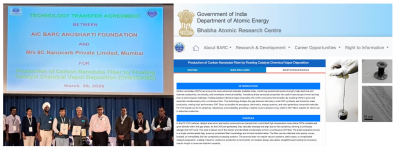
Multi-Walled Carbon Nanotube (MW-CNT) fiber manufacturing tech developed by BARC is getting commercialized:


Another one! This time a BARC/AIC ToT—for MW CNT fibre manufacturing (FC-CVD based) to Bhukhanvala Inc (6C NanoCarb); BK has a history of absorbing BARC tech.

Carbon fibre is a critical product used across aero/def, NG electronics, energy storage/supercapacitors, ballistics, etc., but dominated by US/JP/Ch.

ToT should cover entire stack: CNT synthesis (CVD), alignment & fibre spinning. CNT fibres have semis-like issues—yield & process control are the real challenge. This time ToT ≠ guaranteed scalable production, unlike ceramics. Despite ToT, BK will need to focus on yield, efficient production & higher tensile strength.

Hopefully, ~3 GPa initially, targeting ~5 GPa with process maturity.
1775451867612.png
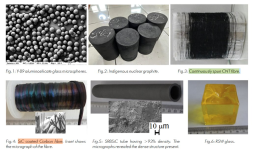
BARC has also developed process technology for SiC coated carbon fiber production:


Maybe ToT SiC Carbon Fibre next?
1775452036341.png
 
@randomradio

Seeing the usefulness of Iranian Ballistic Missiles , I wonder why don't we Deploy AGNI 1 missiles with Conventional Warheads
Thats an expensive way of delivering less than a ton of explosives.
Fighter jets do that much cheaper.

Iean is trying to bomb an area with the world's most sophisticated and most concentrated air defences.
Plus they got no Air force .
 
Thats an expensive way of delivering less than a ton of explosives.
Fighter jets do that much cheaper.

Iean is trying to bomb an area with the world's most sophisticated and most concentrated air defences.
Plus they got no Air force .

Fighter planes are very expensive

They take a lot of time to be procured

I mean Ballistic Missiles have much bigger warheads and overall weight ie Missile weight plus Warhead weight is also much higher than cruise missile

So the Kinetic energy would be definitely much higher
 
  • Like
Reactions: Aniruddha