
You are using an out of date browser. It may not display this or other websites correctly.
You should upgrade or use an alternative browser.
You should upgrade or use an alternative browser.


Are those powerlines in the Noida picture?
Ex-ISRO guys are killing it in the SAR field. Sirsir radar achieved 0.85m in L-band, that's insane.
The purple bit is below tree cover (from Sisir radar) -
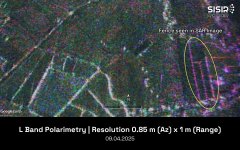
Ex-ISRO guys are killing it in the SAR field. Sirsir radar achieved 0.85m in L-band, that's insane.
The purple bit is below tree cover (from Sisir radar) -

SARLA AVIATION
We're developing India's most sophisticated eVTOL, driving innovation for widespread adoption in urban air mobility. Our focus is on creating an affordable, clean, and safe aerial travel experience, revolutionizing the way urban India moves.
 www.sarla-aviation.com


Extreme cold is where most systems fail. Ours didn't.
Our SWITCH and NETRAV4PRO UAVs were recently put through rigorous flight testing and demonstrations in Fairbanks, Alaska, in collaboration with the Arctic Drone Integration Cell, 11th Airborne Division’s 1st Infantry Brigade Combat Team (1st IBCT), with temperatures reaching -30°F.
In one of the world's most extreme operational environments, our platforms delivered full flight endurance without compromise, a true test of what #BuiltDifferent means in practice. Personnel were also able to independently operate the systems after a short orientation, reflecting the intuitive design and field-readiness engineered into every ideaForge platform.
Extreme conditions are where design assumptions get tested and validated. These trials mark another milestone in ensuring our systems are mission-ready, anywhere operators need to deploy.
I saw that the Australian Ghost Bat is being offered to India
Last edited:

I saw that the Australian Ghost Bat is being offered to India
Yea, the offer has been known for a while now. Ghost Bat, along with the MQ-25 carrier refueler:


It's surprising that American companies always offer those only whose tech is fully present in india.I saw that the Australian Ghost Bat is being offered to India
Why not B-21 ? Or F-47 ? These are things we can not build in at least next 2 decade.
But ghostbat ? We already have one which is smaller version of ghost bat.
And larger(9 tonnes) can too be made. But IAF is not much interested in these type of loyal wing man(which is surprising).
LMAO no the IAF is interested, just doesn't have any confidence in HAL. We first need the CATS warrior to fly(HAl says 2027 but who fking knows what the actual date is).And larger(9 tonnes) can too be made. But IAF is not much interested in these type of loyal wing man(which is surprising).
Still this is a strategic system compared to the CATS warrior which will be the low expendable version. The CATS warrior mk2 with the 2 HTFE engines is what will compete with this system. Once again the HTFE 25KN engine hasn't been certified yet. And thats only going to fly around 2030.
Then why no fund for project ?LMAO no the IAF is interested, just doesn't have any confidence in HAL. We first need the CATS warrior to fly(HAl says 2027 but who fking knows what the actual date is).
Still this is a strategic system compared to the CATS warrior which will be the low expendable version. The CATS warrior mk2 with the 2 HTFE engines is what will compete with this system. Once again the HTFE 25KN engine hasn't been certified yet. And thats only going to fly around 2030.
HAL don't have funds like boeing, nor it has talent pool, nor its authorised to behave and act like a private entity.
HAL can not go and bring the top aerospace engineers around the world( lol, not even from india) with very high packages.
HAL is alr doing the CATS warrior with internal funding. the IAF is more focused on the ghatak and its a-a variant. HAL does have good talent, they're just abysmal at managing projects.Then why no fund for project ?
HAL don't have funds like boeing, nor it has talent pool, nor its authorised to behave and act like a private entity.
HAL can not go and bring the top aerospace engineers around the world( lol, not even from india) with very high packages.
If CATS warrior can be used for a2a, then it's hundred times better than ghostbat.HAL is alr doing the CATS warrior with internal funding. the IAF is more focused on the ghatak and its a-a variant. HAL does have good talent, they're just abysmal at managing projects.
A flying wing will be far stealthy, with easily 4 bvr missile, it will be good to even agaisnt 6th gen.
Assuming your talking about the ghatak instead of the CATS warrior then yes practically a flying wing is vastly better but the issue with that is that theyre also more expensive. A single ghatak is nearly 1/2 the price of the flyaway cost of the tejas. The CATS warrior mk1 cannot have internally carrier A-A missiles. its too small. its going to be the expendable low end CCA for the IAF.
The mk2 is envisioned to be the internal bay version but that will also take some time to mature.
The mk2 is envisioned to be the internal bay version but that will also take some time to mature.
If CATS warrior can be used for a2a, then it's hundred times better than ghostbat.
A flying wing will be far stealthy, with easily 4 bvr missile, it will be good to even agaisnt 6th gen.
They say India is looking at it as a gap filler, till your domestic stuff comesIf CATS warrior can be used for a2a, then it's hundred times better than ghostbat.
A flying wing will be far stealthy, with easily 4 bvr missile, it will be good to even agaisnt 6th gen.
It will get a2a

MQ-28 Ghost Bat With Aerial Refueling Capability Hinted At By Boeing
The ability to refuel in mid-air would give the MQ-28 an attractive boost in range and persistence.
 www.twz.com
Zen Technologies has achieved complete self-reliance in drone propulsion tech in both BLDC and ICE systems across all platform categories from small drones to eVTOLs.
Vector Technics Emerges as India's Largest Fully Integrated Drone Propulsion Manufacturer, Expands Manufacturing Capacity to 300,000 Units Annually
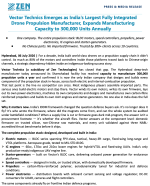
Vector Technics Emerges as India's Largest Fully Integrated Drone Propulsion Manufacturer, Expands Manufacturing Capacity to 300,000 Units Annually

Army eyes one-way desi drones with 1,000-km strike envelope
The Indian Army is initiating a process to acquire indigenous long-range attack drones.New Delhi: Army has initiated a process to acquire indigenous long-range, one-way attack drones, with the industry being invited to offer systems that can accurately hit targets at a range of 1,000 km, operate in GPS-denied environments and possess AI-enabled targeting.
The process to acquire the drones under the Long Range Loiter Munition (LRLM) project has taken off under the Make II clause of the acquisition policy, which requires the industry to fund its own research and development and Army undertaking to acquire them if all technical specifications are met.
While numbers are yet to be specified, India has a requirement of thousands of one-way attack drones of different ranges. In the current process, Army is looking for a system that can carry a 25 kg warhead for a 50-metre killing radius, has the ability to fly at above 5,000 m and can achieve speeds of at least 400 km per hour.
The desired system needs to be designed for operations in plains, deserts, jungles and hilly terrain and ruggedised to military standards. The acquisition has been initiated by the Regiment of Artillery, which is also acquiring shorter range one-way attack drones. As reported by ET, Tata Advanced Systems Limited and Nibe Defence were recently shortlisted for the procurement of 850 drones, which will have the ability to hit targets at over 100 km.
Under the LRLM programme, Army is seeking to create an entire ecosystem for operation of long-range, one-way attack drones. Army will require a whole set that will consist of a launch vehicle, ground control station, a simulator and 15 aerial vehicles.
The drones will be required to strike on steep, slant and nape-of-earth profiles, similar to systems that are currently being deployed in the Russia-Ukraine war. They will also be required to carry different warheads, including thermobaric and deep penetration types.
Army is also surveying whether the engine, electro optic payload, avionics, mainframe, warhead, and subcomponents are indigenous or imported, and whether imported items will be indigenised over time. The idea is to ensure that an independent ecosystem for manufacturing such drones is created in India, with the ability to surge production as and when needed by the armed forces.
Bid Number: GEM/2026/B/7618098
Custom Bid for Services - Wind Tunnel Model Design, Fabrication And Testing Of UAV Airfoils And Configuration
Contract Period - 1 Year 5 Months
Bid Number: GEM/2026/B/7656452
Custom Bid for Services - Digital mock up generation for Experimental High Altitude Long Endurance UAV Airframe Structure
Contract Period - 2 Years
STR-UAV division is working on experimental High altitude long endurance UAV airframe structure technology development task to meet the futuristic requirements for ADE projects.
Custom Bid for Services - Wind Tunnel Model Design, Fabrication And Testing Of UAV Airfoils And Configuration
Contract Period - 1 Year 5 Months
ADE is designing an UAV configuration. Aerodynamic analysis of the configuration has been carried out and its adequacy to meet the requirements has been established by preliminary aero data generation and performance estimation. This is a completely new category of UAV which has been taken up, hence, preliminary data has to be substantiated with wind tunnel data. In this regard, it is proposed to test the configuration and its airfoils at closed circuit wind tunnel at IIT Kanpur.
The following tasks has to be carried out.
- Wind tunnel model design, fabrication, inspection, and integration of following
- 1:10 scale model for generating entire aerodynamic dataset except for payload and landing gear
- 1:5 scale model with stub wing for generating aero data for payloads and landing gear
- Two airfoil models for high Reynolds number tests
- Two airfoil models for low Reynolds number tests
- Wind tunnel test runs as per provided test matrix
Bid Number: GEM/2026/B/7656452
Custom Bid for Services - Digital mock up generation for Experimental High Altitude Long Endurance UAV Airframe Structure
Contract Period - 2 Years
STR-UAV division is working on experimental High altitude long endurance UAV airframe structure technology development task to meet the futuristic requirements for ADE projects.

Apollyon Dynamics Nightshade ADX-1 Jet powered LM:

Range: 150+ km
Endurance: 45 mins
Speed: 600 km/hr
MTOW: 70kg
Payload: Modular (ISR/Anti-radiation/Anti-personnel etc.)
German company "FESTO" is offering their micro-UAV ornithopter to the military:

Currently some spec ops units use the Black hornet in this role:

Range: 150+ km
Endurance: 45 mins
Speed: 600 km/hr
MTOW: 70kg
Payload: Modular (ISR/Anti-radiation/Anti-personnel etc.)
German company "FESTO" is offering their micro-UAV ornithopter to the military:
Currently some spec ops units use the Black hornet in this role:
Apollyon Dynamics Nightshade ADX-1 Jet powered LM:
View attachment 53311
Range: 150+ km
Endurance: 45 mins
Speed: 600 km/hr
MTOW: 70kg
Payload: Modular (ISR/Anti-radiation/Anti-personnel etc.)
View attachment MnS7nyOPU6pwKXUv.mp4


