How modern war will be fought - Lessons from Ukraine

Status
Not open for further replies.
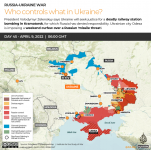
Ukraine has lost literally a quarter of it's country's territory , has experienced immeasurable infrastructure damage , has suffered untold thousands in casualties & you're busy selling us your snake oil here.
 
  • Haha
Reactions: Innominate
The atgm's have won the race between armour. Like firearms made metal based armour irrelevant. Atgm's have made heavy armour irrelevant. The transition will take place with high speed lightly armoured vehicles with low IR signature, jammers and aps. That's the future... High speed warfare something like the Mongols but with atgm's. Something the French have done with the ebrc jaguar.
These words start from the Fourth Middle East War,
ATGM gives infantry the ability to fight tanks
But it will never replace the tank as a long-range assault weapon
 
These words start from the Fourth Middle East War,
ATGM gives infantry the ability to fight tanks
But it will never replace the tank as a long-range assault weapon
Drones will become the new long range assault weapons. As they become more cheaper
 
Ukraine has lost literally a quarter of it's country's territory , has experienced immeasurable infrastructure damage , has suffered untold thousands in casualties & you're busy selling us your snake oil here.
That is not surprising - difference in sheer resources between Russia and Ukraine is significant. Still, fact is that Russia did not achieve its goals, and that Ukraine had performed far better than expected even in the West:
 
That is not surprising - difference in sheer resources between Russia and Ukraine is significant. Still, fact is that Russia did not achieve its goals, and that Ukraine had performed far better than expected even in the West:
Yes I agree. The entire campaign has been a really rude wake up call for the Russians but in their spite now they may well tear up all of Ukraine once they sanitise the whole of the east & South of Ukraine which they've occupied. I for one don't believe all this is Ukranian doing as I believe there's enough Western presence on the ground in Ukraine co ordinating the war on Ukraine's behalf & also fighting it on their behalf.


Having said that , the Ukrainians have given a good account of themselves.
 

A Key Reason for Russia’s Colossal Electronic Warfare Failure in Ukraine​

As modern Russian EW/EA systems get towed into barns by Ukrainian farm tractors, it could not be clearer how epically Russia failed in the EMS battlespace.​


As a 30-year US Air Force Electronic Warfare Officer, I spent a significant portion of my career learning and understanding how to fight in the electromagnetic spectrum (EMS) domain, including Russian Electronic Warfare/Electronic Attack (EW/EA) systems.

Without delving into classified details, Russian systems were formidable, well made, and incorporated modern technology. For decades, it was believed any US/Russia war would be a slugfest, much of it executed in a denied or degraded EMS.

On February 24, the initial thrust of Russia’s illegal invasion of Ukraine, the media parroted that “Electronic warfare and cyber attacks have started” repeatedly. Most of these reports were based on what their analysts assessed to be the “first wave” of strikes.

It’s known that the EW/EA hardware, such as vehicles, jammers, and antennas, were in Ukraine, but six weeks into the war, it’s clear that Russian EW/EA systems have been largely ineffective.

This failure has been excellent for Ukraine but raises the crucial question: “Why did Russia’s formidable EW/EA systems fail?” Did intelligence assessments get it wrong?

Maybe partly, but after a closer look, there is significant evidence that Russia’s EW/EA failure wasn’t hardware-related — it was humanware-related.

Foundational Background​

Electronic Attack (EA) simply refers to offensive combat efforts in the electromagnetic spectrum. In most cases, it is considered a harassing fire.

For the victim, it’s an annoyance. There likely isn’t a human alive who has used a cell phone and hasn’t experienced a “dropped” signal. It’s frustrating, but after a few reattempts, the call is reconnected, or the caller simply gives up.

By and large, it is the same situation in combat. In some cases, it’s the targeting of communication devices, while in others, it’s a jammed and washed-out radar scope. Both are the result of intentional action to deny communication or effective use of an enemy radar system.

Good militaries train their personnel to operate in a degraded EMS, such as taking measures to regain communications or fix their radar screens to mitigate the jamming’s impacts.

This means that while EA has a decaying value, the initial and short time of attack can buy time to protect friendly forces.

In the example of a fighter strike package that flies at 500 miles an hour, five minutes of effective jamming means nearly 50 miles of protection. Ten minutes is 100 miles.

The US learned the value of EA long ago, building numerous ground-based and airborne jamming platforms, some of which I flew in combat. But long before my first combat hour, there were hundreds of flight hours of training.

US Training: Building the Humanware​

In both the EC-130H Compass Call and the EA-6B Prowler, training was based on a “Crawl, walk, run” construct. Aircrew first learns the systems’ academics, then gets taught how to fly it safely, and finally learns to operate the weapon system. But it went farther than that.

Once aircrew learned to operate the weapons system, they would join other platforms, such as a large strike group of aircraft. A critical piece of this training evolution was to ensure the jamming system could target enemy signals while ensuring friendly forces could use the EMS unhindered.
Although this sounds simple enough, it is not. As Prussian general and military theorist Carl von Clausewitz said: “In war, while everything is simple, even the simplest thing is difficult.”

Once a force structure of integrated arms can operate together, the next training step is for that force to operate in an enemy-jammed environment where now an opposition force also gets to compete in the EMS.

Such training exercises are challenging, and some events are unsuccessful. Additionally, the mission debriefs of “Who shot who” as well as “Who jammed who” could be chippy. Egos were checked, but the aircrew learned to operate as a cohesive fighting force in the end.

Armed Forces-Wide Training​

Such training isn’t unique to the Air Force. The Navy trains surface ships, subsurface ships, and airborne assets. The Army prepares its soldiers at some world-class training ranges, and so do the Marines.

Being able to operate in a degraded or denied EMS environment is something our military trains for constantly. Through realistic training scenarios, airmen, sailors, soldiers, marines, and guardians all learn the tactics, techniques, and procedures to fight through EA challenges (but are often a pain in the rear end to employ).

Denied or degraded EMS usage is often infuriating and always seems to surface at the most crucial moments. In fact, EA is arguably one of the best examples of the phrase “Fog of War.”

So, what about Russian EMS training?

Obviously, I have never trained with Russian EW/EA units, but I can extrapolate Russia’s likely training based on its effect in Ukraine and from drawing on my own experiences.

It appears highly likely that Russia’s EW/EA training only progressed to a combined arms level with no real opposition forces. Lacking an opposition force, there was no real training for Russian forces to learn how to “fight through” the jamming.

There are at least four reasons for this assessment, which are outlined below.

Russia Abandoned EA Effort Early​

From all media reports, Russia abandoned its EA effort early on in the conflict. There are two likely reasons for this.

First, in many cases, weapons systems that employ EA provide little feedback on the success of their efforts. There’s no explosion, and unless friendly intelligence assets are relaying the enemy their frustrations about jamming, operators are often “going on faith” that their tactics are working.


A quick side note, good EA training is invaluable when it comes to being able to demonstrate the impact of jamming during a post-mission debrief. It gives the operator confidence their systems are effective.

Second, one of the most common problems of EA in an undisciplined and/or undertrained force is the possibility of fratricide jamming. When the Russian forces activated their jammers during the initial invasion, Ukraine likely did the same thing.

All this jamming would have been agonizing to military leaders on both sides, but which side does this hurt more? The offensive force that’s trying to move and attack. Defensive and prepositioned forces are not immune to jamming, but the effect is far less detrimental to their efforts.

Arguably, Russian commanders at some point ordered their jammers to “Cease Buzzer” (the NATO codeword for “stop jamming”). The implications of this order are significant because it effectively means that Russia was going to, in part, surrender some of the EMS to Ukraine.

This order also made it clear that Russian forces had little (if any) combined force training in a dense jamming environment.

Cellular Communications​

Media reports also suggest that Russian forces often rely on cellular communications, in some cases more than on their military-issued radios. The simple reason for this? “You fight like you train.”

It is highly likely that Russian soldiers have grown far more comfortable talking on these devices (which provide greater clarity) than the cumbersome, noisy, staticky, and logistically difficult-to-use military-designed communication systems.

Should these reports be accurate about Russian cell phones and Chinese open wireless communications, it would serve as a gold mine for Ukrainian intelligence collection, another part of the greater EW battle called “Electronic Surveillance.”

Implementation​

While I have received many briefings about new Russian EW systems during my career, most of those briefings focused on assessed capability. I cannot recall a single briefing regarding how well Russia implemented its systems in a greater conflict or in a combined arms exercise.

In fairness to the intelligence community, I don’t think I ever asked that question either — nor did anyone I know.

Perhaps unwise, but most of us assumed Russia trained its forces in EW/EA systems similar to the US. Clearly, that’s not the case.

Problem With Russia’s Military Doctrine​

Russia’s military execution is doctrinally challenged. Their long known “Centralized Execution” doctrine means that no one or nothing in the battlespace can do anything until the commanding general gives the go-ahead.

Given recent technological advances, the sheer complexity of today’s combined operations cannot be managed by a single person. Therefore, the West has doctrinally preached “Decentralized Execution” and trained forces to carry out this approach, allowing young officers and non-commissioned officers (NCOs) the freedom to make local decisions on how to achieve the orders handed down by the leadership.

Young NCOs and officers will make mistakes, but they will learn to mitigate most of those through training and more training.

Russia’s Centralized Execution approach creates the problem of proximity to conflict in which leaders must operate. This is why Russia has lost more than a handful of generals in just a month of fighting. Centralized control demands generals are up close and personal to the battlespace, which comes with increased risk.

Russian doctrine demands leaders continually pass orders and directives down the chain of command or their forces won’t act.
I’ve often said, a well-trained Russian soldier will allow the enemy to climb into his foxhole before fighting if there’s no order to engage. The reason is the soldier has far greater fear of Russian military leadership than they do of the enemy.

Epic Failure​

So, as modern Russian EW/EA systems get towed into barns by Ukrainian farm tractors, it could not be clearer how epically Russia failed in the EMS battlespace.

Just like every other form of warfare, combined arms training truly requires all assets on the battlefield and in the battlespace to cooperate, coordinate, and compete.

I’m grateful to the US military for forcing me to train in this area, even when I was sick of it.

Now, if I could just get an apology from every F-16 and F-15 pilot who cursed my name at the Nellis Officer’s Club bar when they were certain my jamming was the cause of their mission failure. A fighter pilot apology? Ha. Well, one can dream.
 
  • Haha
Reactions: _Anonymous_

A Key Reason for Russia’s Colossal Electronic Warfare Failure in Ukraine​

As modern Russian EW/EA systems get towed into barns by Ukrainian farm tractors, it could not be clearer how epically Russia failed in the EMS battlespace.​


As a 30-year US Air Force Electronic Warfare Officer, I spent a significant portion of my career learning and understanding how to fight in the electromagnetic spectrum (EMS) domain, including Russian Electronic Warfare/Electronic Attack (EW/EA) systems.

Without delving into classified details, Russian systems were formidable, well made, and incorporated modern technology. For decades, it was believed any US/Russia war would be a slugfest, much of it executed in a denied or degraded EMS.

On February 24, the initial thrust of Russia’s illegal invasion of Ukraine, the media parroted that “Electronic warfare and cyber attacks have started” repeatedly. Most of these reports were based on what their analysts assessed to be the “first wave” of strikes.

It’s known that the EW/EA hardware, such as vehicles, jammers, and antennas, were in Ukraine, but six weeks into the war, it’s clear that Russian EW/EA systems have been largely ineffective.

This failure has been excellent for Ukraine but raises the crucial question: “Why did Russia’s formidable EW/EA systems fail?” Did intelligence assessments get it wrong?

Maybe partly, but after a closer look, there is significant evidence that Russia’s EW/EA failure wasn’t hardware-related — it was humanware-related.

Foundational Background​

Electronic Attack (EA) simply refers to offensive combat efforts in the electromagnetic spectrum. In most cases, it is considered a harassing fire.

For the victim, it’s an annoyance. There likely isn’t a human alive who has used a cell phone and hasn’t experienced a “dropped” signal. It’s frustrating, but after a few reattempts, the call is reconnected, or the caller simply gives up.

By and large, it is the same situation in combat. In some cases, it’s the targeting of communication devices, while in others, it’s a jammed and washed-out radar scope. Both are the result of intentional action to deny communication or effective use of an enemy radar system.

Good militaries train their personnel to operate in a degraded EMS, such as taking measures to regain communications or fix their radar screens to mitigate the jamming’s impacts.

This means that while EA has a decaying value, the initial and short time of attack can buy time to protect friendly forces.

In the example of a fighter strike package that flies at 500 miles an hour, five minutes of effective jamming means nearly 50 miles of protection. Ten minutes is 100 miles.

The US learned the value of EA long ago, building numerous ground-based and airborne jamming platforms, some of which I flew in combat. But long before my first combat hour, there were hundreds of flight hours of training.

US Training: Building the Humanware​

In both the EC-130H Compass Call and the EA-6B Prowler, training was based on a “Crawl, walk, run” construct. Aircrew first learns the systems’ academics, then gets taught how to fly it safely, and finally learns to operate the weapon system. But it went farther than that.

Once aircrew learned to operate the weapons system, they would join other platforms, such as a large strike group of aircraft. A critical piece of this training evolution was to ensure the jamming system could target enemy signals while ensuring friendly forces could use the EMS unhindered.
Although this sounds simple enough, it is not. As Prussian general and military theorist Carl von Clausewitz said: “In war, while everything is simple, even the simplest thing is difficult.”

Once a force structure of integrated arms can operate together, the next training step is for that force to operate in an enemy-jammed environment where now an opposition force also gets to compete in the EMS.

Such training exercises are challenging, and some events are unsuccessful. Additionally, the mission debriefs of “Who shot who” as well as “Who jammed who” could be chippy. Egos were checked, but the aircrew learned to operate as a cohesive fighting force in the end.

Armed Forces-Wide Training​

Such training isn’t unique to the Air Force. The Navy trains surface ships, subsurface ships, and airborne assets. The Army prepares its soldiers at some world-class training ranges, and so do the Marines.

Being able to operate in a degraded or denied EMS environment is something our military trains for constantly. Through realistic training scenarios, airmen, sailors, soldiers, marines, and guardians all learn the tactics, techniques, and procedures to fight through EA challenges (but are often a pain in the rear end to employ).

Denied or degraded EMS usage is often infuriating and always seems to surface at the most crucial moments. In fact, EA is arguably one of the best examples of the phrase “Fog of War.”

So, what about Russian EMS training?

Obviously, I have never trained with Russian EW/EA units, but I can extrapolate Russia’s likely training based on its effect in Ukraine and from drawing on my own experiences.

It appears highly likely that Russia’s EW/EA training only progressed to a combined arms level with no real opposition forces. Lacking an opposition force, there was no real training for Russian forces to learn how to “fight through” the jamming.

There are at least four reasons for this assessment, which are outlined below.

Russia Abandoned EA Effort Early​

From all media reports, Russia abandoned its EA effort early on in the conflict. There are two likely reasons for this.

First, in many cases, weapons systems that employ EA provide little feedback on the success of their efforts. There’s no explosion, and unless friendly intelligence assets are relaying the enemy their frustrations about jamming, operators are often “going on faith” that their tactics are working.


A quick side note, good EA training is invaluable when it comes to being able to demonstrate the impact of jamming during a post-mission debrief. It gives the operator confidence their systems are effective.

Second, one of the most common problems of EA in an undisciplined and/or undertrained force is the possibility of fratricide jamming. When the Russian forces activated their jammers during the initial invasion, Ukraine likely did the same thing.

All this jamming would have been agonizing to military leaders on both sides, but which side does this hurt more? The offensive force that’s trying to move and attack. Defensive and prepositioned forces are not immune to jamming, but the effect is far less detrimental to their efforts.

Arguably, Russian commanders at some point ordered their jammers to “Cease Buzzer” (the NATO codeword for “stop jamming”). The implications of this order are significant because it effectively means that Russia was going to, in part, surrender some of the EMS to Ukraine.

This order also made it clear that Russian forces had little (if any) combined force training in a dense jamming environment.

Cellular Communications​

Media reports also suggest that Russian forces often rely on cellular communications, in some cases more than on their military-issued radios. The simple reason for this? “You fight like you train.”

It is highly likely that Russian soldiers have grown far more comfortable talking on these devices (which provide greater clarity) than the cumbersome, noisy, staticky, and logistically difficult-to-use military-designed communication systems.

Should these reports be accurate about Russian cell phones and Chinese open wireless communications, it would serve as a gold mine for Ukrainian intelligence collection, another part of the greater EW battle called “Electronic Surveillance.”

Implementation​

While I have received many briefings about new Russian EW systems during my career, most of those briefings focused on assessed capability. I cannot recall a single briefing regarding how well Russia implemented its systems in a greater conflict or in a combined arms exercise.

In fairness to the intelligence community, I don’t think I ever asked that question either — nor did anyone I know.

Perhaps unwise, but most of us assumed Russia trained its forces in EW/EA systems similar to the US. Clearly, that’s not the case.

Problem With Russia’s Military Doctrine​

Russia’s military execution is doctrinally challenged. Their long known “Centralized Execution” doctrine means that no one or nothing in the battlespace can do anything until the commanding general gives the go-ahead.

Given recent technological advances, the sheer complexity of today’s combined operations cannot be managed by a single person. Therefore, the West has doctrinally preached “Decentralized Execution” and trained forces to carry out this approach, allowing young officers and non-commissioned officers (NCOs) the freedom to make local decisions on how to achieve the orders handed down by the leadership.

Young NCOs and officers will make mistakes, but they will learn to mitigate most of those through training and more training.

Russia’s Centralized Execution approach creates the problem of proximity to conflict in which leaders must operate. This is why Russia has lost more than a handful of generals in just a month of fighting. Centralized control demands generals are up close and personal to the battlespace, which comes with increased risk.

Russian doctrine demands leaders continually pass orders and directives down the chain of command or their forces won’t act.
I’ve often said, a well-trained Russian soldier will allow the enemy to climb into his foxhole before fighting if there’s no order to engage. The reason is the soldier has far greater fear of Russian military leadership than they do of the enemy.

Epic Failure​

So, as modern Russian EW/EA systems get towed into barns by Ukrainian farm tractors, it could not be clearer how epically Russia failed in the EMS battlespace.

Just like every other form of warfare, combined arms training truly requires all assets on the battlefield and in the battlespace to cooperate, coordinate, and compete.

I’m grateful to the US military for forcing me to train in this area, even when I was sick of it.

Now, if I could just get an apology from every F-16 and F-15 pilot who cursed my name at the Nellis Officer’s Club bar when they were certain my jamming was the cause of their mission failure. A fighter pilot apology? Ha. Well, one can dream.
What exactly were the Russians supposed to jam sweetie ? Didn't it occur to dyslexic , autistic , ADHD afflicted in transition miserable pimply teen like you that Ukraine has no Air Force or Navy worth the name .

So let me ask you again , what exactly were they supposed to jam except ground communications ? All other ISR activities are being conducted & inputs fed by NATO .
 
  • Haha
Reactions: Innominate
Status
Not open for further replies.