Independence Day speech: Modi announces Chief of Defence Staff post

lcafanboy

Senior member
Dec 22, 2017
3,146
3,760
Bangalore
PM Narendra Modi's mega announcement: India will now have Chief of Defence Staff
PM Narendra Modi Independence Day speech: The three armed forces of India will now have a post of Chief of Defence Staff that will integrate the operations of the three forces-the Army, Navy and Air Force.
PM Narendra Modi's mega announcement: India will now have Chief of Defence Staff
 
After 2 Decades Twiddling Thumbs, India Announces Apex Chief Of Defence Staff

By Shiv Aroor
Aug 15 2019
11 : 22 am
1565851289873.png
PHOTO / WIKIMEDIA COMMONS

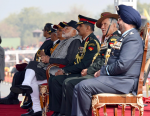
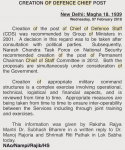
In a move that flings aside nearly two decades of agonising indecision, India’s Prime Minister Narendra Modi today formally announced that the country’s first ever Chief of Defence Staff (CDS) would be appointed. Modi used the occasion of India’s 73rd Independence Day to make the announcement from Delhi’s Red Fort, a podium that has come to represent a platform for significant policy guidances and future-focused decisions.

“To further sharpen coordination between the forces, I want to announce a major decision from the Red Fort: India will have a Chief of Defence Staff- CDS. This is going to make the forces even more effective,” the PM said as part of a 93-minute speech.

It was in 2001 that a Group of Ministers (GoM) recommended that India create a position for a Chief of Defence Staff. The recommendation was borne from troubling lessons gleaned from the 1999 Kargil conflict between India and Pakistan, a skirmish that India finally won, but not without significant cost. One of the many trouble areas identified was the lack of cohesive interoperability between the three armed forces, and the inability to coordinate fast and effectively. The post-Kargil years resulted instead in the creation of an Integrated Defence Staff (IDS) and the position of Chairman, Chiefs of Staff Committee — the latter a largely ceremonial position that befell the seniormost of the three chiefs.

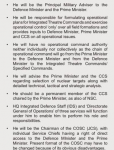
It is not clear at this time who the country’s first Chief of Defence Staff will be, or whether the new appointment will follow the terms of reference and powers recommended by the original Group of Ministers, as well as successive committees. Whether the appointment will be a ‘4.5-star’ post is also unclear at the moment, though the MoD is likely to lay out the details in the coming days.

1565851342518.png
From a CENJOWS paper on defence reforms

While the current Chairman of the Chiefs of Staff Committee is IAF chief Air Chief Marshal B.S. Dhanoa, he will be succeeded to the appointment at the end of next month by Army chief General Bipin Rawat. Rawat retires at the end of the year.

“The crucial question is where will the Chief of Defence Staff figure in the Indian warrant of precedence. I’m guessing Cabinet Secretary equivalent or MoS equivalent,” says Ashok Malik, who recently completed a term as Press Secretary to the Indian President.

Today’s decision by the Indian PM, coming shortly after the historic move to abrogate Article 370 and bifurcate the erstwhile state of Jammu & Kashmir into two fresh Union Territories, has been in the works for months, with defence reforms a stated priority.

1565851362203.png

Lt Gen Satish Dua, Corps Commander in the Kashmir Valley during the decisive 2016 trans-LoC strikes in Pakistan-occupied Kashmir welcomed the announcement today, saying, “One single step that will be a game changer, a great force multiplier.”

Te original idea for the post of Chief of Defence Staff — the idea that fructified into the recommendation in 2001 — came from the Kargil Review Committee headed by K. Subrahmanyam, whose son S. Jaishankar is now India’s External Affairs Minister.


https://www.livefistdefence.com/201...ia-announces-apex-chief-of-defence-staff.html
 
HaHa, I also just got a report feedback. This one was peddling fake news about Kashmir and India using old Rani Mukerji videos

View attachment 9379
What a happy moment. It is our independence day. Government has announced CDS post. Our army is killing the adversaries on loc. And we are winning the propaganda war on twitter. And last but l not least today is Rakshabandhan!!!!! I am not sure I can contain myself now.
 
  • Like
Reactions: Volcano
What a happy moment. It is our independence day. Government has announced CDS post. Our army is killing the adversaries on loc. And we are winning the propaganda war on twitter. And last but l not least today is Rakshabandhan!!!!! I am not sure I can contain myself now.
Most likely Lt. Gen Ranbir Singh will be the first CDS of India even though he is junior to many.
 
Most likely Lt. Gen Ranbir Singh will be the first CDS of India even though he is junior to many.
if this happen it will be the best ,lately they are showing too much love for the sikhs ,let sardarji call them for the audition of bangbros.then we will see their reaction
 
  • Agree
Reactions: Sulla84
GOI will never have a serving and operational five star General. The bureacracy will see to it that they have no equals and remain supreme.
 
CDS is PM’s ‘yes’ to hybrid warfare, theatre commands, military reforms

Sanjib Kr Baruah @sanjibkrbaruah
Last Updated : Aug 15, 2019 01:58 PM IST | Source: Moneycontrol.com

The CDS will take charge of the military’s modernisation, ‘jointness’ and ‘integration’ effort, essential in today’s world of hybrid warfare or wars where the lines blur between war, politics, diplomacy and legalities
1565979379919.png

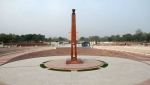
The Indian military architecture has a new dimension, albeit a painfully longstanding one, till Thursday morning that is. Announced from the Mughal era Red Fort in his own signature style during his Independence Day address, Prime Minister Narendra Modi said his government has taken the crucial decision to set up the post of the Chief of Defence Staff (CDS).

The implications of this move are immense.

For one, the CDS will take charge of the military’s modernization, ‘jointness’ and ‘integration’ effort that is essentially in the realm of lip-service now. But is most essential in today’s world of hybrid warfare or wars where the lines blur between war, politics, diplomacy, legalities, and even between the combatant and civilians. Such wars are a blend of the conventional with the psychological, are fought in cyber-world, on the economic front and in the media. It is widely-accepted that future wars will be hybrid in nature and scope.

He will also have to wisely supervise the planned ‘downsizing’ (right-sizing?) of the 15 lakh strong military and yet rationally pan out the present pyramid structure of the forces. It is often cited that the Indian armed forces suffer a deficit of about 9,000 officers. And significantly at the lower rungs which affects the operational effectiveness of the forces.

The CDS will be the pivotal link between the PM-led political executive and the military. Which means he will have the ears of the PM and detailed attention of the defence minister and the National Security Adviser (NSA). The present practice is that the defence minister is briefed by the army, navy and air force chiefs separately.

The Indian military architecture comprising different arms each with distinct operational and tactical priorities was at a distinct disadvantage because it had to endure a political executive that lacked a nitty-gritty understanding of the way armed forces function, and yet had the final say on all matters.

The move will also away with the excess bureaucratic control of the military. Babudom, but more its excesses, as most military officers would admit sotto voce, has been the bane of military administration in the country.

An important possibility of the setting up of the CDS is the formation of theatre commands or joint commands where all the various arms of the military participate in a single cohesive format during wars and conflicts. A single commander in a designated zone commands all the resources of all forces be it from the army, the navy or the air force stationed in that zone.

Powerful militaries like that of US or China are organised along theatre command lines. In fact, China has recently restructured its seven military regions into five geographical-operational theatre commands while the US’ six Unified Theater Commands control the global operations.

In contrast, India has 17 commands. The Indian Army has six operational commands—Eastern (headquartered at Kolkata), Western (Chandimandir), Northern (Udhampur), Southern (Pune), Central (Lucknow) and South-Western (Jaipur). These are besides the Shimla-based Army Training Command.

The Navy has three commands—Eastern (Vishakapatnam), Western (Mumbai), and Southern (Cochin), while the Air Force has five operational commands--Eastern (Shillong), Western (Delhi), Southern (Thiruvananthapuram), Central (Allahabad), and South-Western (Gandhinagar), besides the Training Command (Bengaluru) and the Maintenance Command (Nagpur).

The total of 17 commands also includes the tri-services command located at the Andaman and Nicobar islands and the SFC (Strategic Forces Command).

But yet, obvious initial hiccups will have to be overcome. For instance, what kind of interface will the CDS have with the NSA? Or with the defence minister and the defence secretary? It is believed that the Army has been rooting for the CDS while the IAF and the Navy have had certain reservations about it possibly because of the belief that the Army—due to its overwhelming size and scale of operations—is likely dominate the other services.

CDS is PM’s ‘yes’ to hybrid warfare, theatre commands, military reforms

 
CDS to Bring Doctrinal Coherence in the Indian Military

August 16, 2019
By: Nitin A. Gokhale


Prime Minister Narendra Modi took everyone—or let me say at least the strategic community—by surprise by announcing the appointment of a Chief of Defence Staff from the ramparts of the Red Fort on 15 August.

“Our forces are India’s pride. To further sharpen coordination between the forces, I want to announce a major decision from the Red Fort. India will have a Chief of Defence Staff (CDS). This is going to make the forces even more effective,” the Prime Minister said in his Independence Day speech, ushering in one of the most significant defence reforms in the past two decades.

The need for creating the post of CDS was first clearly articulated by the Kargil Review Committee (KRC) in 1999, although the demand for a single point military adviser has existed since 1971. The Group of Ministers (GoM) appointed in the wake of the KRC report recommended several measures to improve synergy and coordination among the three armed forces. The biggest recommendation was to create the post of CDS. However, traditional bickering amongst military leaders, resistance from the civil bureaucracy and lack of political will combined to delay the appointment of CDS so far.

On Thursday however, Modi, politically stronger than any other Prime Minister since 1984, bit the bullet, taking the first step in what is likely to be a long road towards truly integrating India’s armed forces.

So what is the likely road map of this journey? And what would constitute the job profile of India’s first CDS? Details are still hazy but from whatever little information one could gather from multiple sources, it is clearly going to be a calibrated approach to achieve full inter-services jointness and integration of the three services with the Ministry of Defence (MoD) in coming years.

First up, it needs to be noted that India’s first CDS will be a four-star officer, equal in rank to the three service chiefs but a notch higher in status. He will most likely also have functional parity with the defence secretary although the top civil servant in the MoD will continue to be below the CDS and the three service chiefs in the Warrant of Precedence. This arrangement will probably disappoint many military veterans but in its wisdom, the government has decided to be cautious and not go the whole hog in giving a 5-star rank to the CDS—at least for the moment.

To begin with, the CDS is to be entrusted with full charge of the recently created three tri-services agencies—for space, cyber and special operations. The Andaman and Nicobar Command, headquartered at Port Blair will also be under the CDS while there will be no change in the status of the Strategic Forces Command (SFC), the functional arm of the country’s Nuclear Command Authority (NCA). Any future tri-service organisation, let’s say an Indian Ocean Region (IOR) Command, can also become the direct responsibility of the CDS.

All available inputs suggest that the main tasks assigned to the CDS will include integrating training infrastructure and courses spread across the three services, prioritisation of inter-service allocation of resources and avoiding duplication in acquisition and procurement in consultation with the service headquarters. Going forward, the CDS will plan and execute tri-service exercises—both small and large—over the next two-three years to evolve true jointness across the military.

In a way, CDS will replace the current Chiefs of Staff Committee (CoSC), a compromise arrangement where service chiefs become chairman by rotation. The CISC (Chief of Integrated Defence Staff to the CoSC), a three-star officer, currently heading the HQ Integrated Defence Staff (IDS), created after the GoM report in 2001, will become the Vice Chief of Defence Staff. The IDS organisation—and its expanded scope and numbers–will therefore automatically come under the CDS as his secretariat.

Eventually, HQ IDS may have to be integrated with the MoD, instead of remaining outside its functional structure, necessitating changes in allocation of business rules. The CDS will thus report to the Raksha Mantri (defence minister) and the Cabinet Committee on Security (CCS). Some current practices will however remain unchanged. The defence secretary will be directly responsible to the Parliament for the functioning of the MoD and will be in-charge of budget and its disbursement in the ministry.

The Prime Minister’s announcement may appear to have been made out of the blue, but it now transpires that the Prime Minister’s Office (PMO), the National Security Council Secretariat (NSCS), the MoD have been working in tandem to not just create the post of CDS but also evolve a defence strategy for the country. In fact, the national defence strategy (which looks at the country’s internal, external and non-traditional security threats in a comprehensive manner) has been derived from the National Security Strategy (NSS) that has been finalised in the past six months by the NSCS. The CDS is now expected to write a joint military doctrine flowing out of the national defence strategy and the Raksha Mantri’s periodic operational directive issued to the Indian military. There is also a clear understanding at the highest decision-making level that in the Indian context there is no need or scope to create joint or theatre commands given that the country also has complex internal security challenges to deal with.

The CDS is expected to work with all the three service headquarters and the civilian bureaucracy to bring doctrinal coherence in the Indian military’s future roadmap. There is however no plan to give any operational role to the CDS in the near future. That will remain the primary responsibility of the respective service chief. Overall, this move is aimed not only at improving inter-services synergy but also to create a balance in the civil-military relations. While keeping the primacy of civilian control over the military, the creation of the post CDS should be seen as the first step towards bringing the pendulum of civil-military relations to the middle instead of heavily leaning towards the civilian segment of the nation-state.

Nitin A. Gokhale

CDS to Bring Doctrinal Coherence in the Indian Military | Bharat Shakti