Espionage: The secret battlefield
Bollywood blockbuster Raazi and a controversial new book by former RAW and ISI chiefs have brought the focus back on the deadly espionage game between India and Pakistan, the sacrifices of agents who prized patriotism over their own lives and the political interests that crippled Indian intelligence capabilities
The spy thriller Raazi, which has just swept into the `100-crore club, is not just a true story. It is also an allegory of the chessboard of intrigue on which Pakistan and India compete to capture military and strategic superiority over the subcontinent. In the high voltage standoff scene between RAW spy Sehmet played by Alia Bhatt and her Pakistani Army officer husband Iqbal played by Vicky Kaushal, Sehmet says tearfully, “Watan ke aage kuchh nahi… khud bhi nahi (Nothing matters more than the country, not even oneself).”
Her words sum up the essence of espionage—patriotism is worthy of the ultimate sacrifice. Little is known of what happens behind the black curtain of spycraft— Research and Analysis Wing (RAW) spies abducted or killed and Inter-Services Intelligence (ISI) targets identified and executed in war zones like Kashmir and Balochistan. Additional players in the subcontinental espionage milling pond are the CIA, Mossad, MI6, China’s MSS, Russia’s FSB and a host of agencies from smaller nations. Deception is the name of the game, as the motto of the world’s most feared spy agency Mossad sums up the Old Testament spirit, ‘By deception, thou shall wage war.’
Shadow Players
A controversial book released last month The Spy Chronicles: RAW, ISI and the Illusion of Peace involving former RAW boss Amarjit Singh Dulat and ISI chief Lt Gen (retd) Asad Durrani has the intelligence community in a flap. The Pak Army has charged Durrani with violating its Military Code of Conduct and has forbidden him to leave the country. The book contains an embarrassing revelation that Kulbhushan Yadav’s arrest was an attempt by the ISI to deflect world attention from Pakistan’s Balochistan problem and the connection between the Pathankot terror attack and the ISI.
The spy game between India and Pakistan has many ramifications. In mid-May, former diplomat Madhuri Gupta was jailed for spying for ISI. On 28 March 2017, Minister of State for Home Affairs, Hansraj Ahir, told Rajya Sabha that India had arrested 33 Pakistani spies in 2016. India, however, does not execute Pakistani spies. But Jadhav has been sentenced to death in a Field General Court Marshal. Sarabjit Singh was murdered in a Lahore jail in 2013.
Sheikh Shamim was hanged in 1999. A very few like Kashmir Singh were lucky; he spent 35 years on death row and was pardoned by Pak President Pervez Musharraf in 2008. “I was a spy and did my duty,” declared Kashmir Singh, who had pretended to be deranged while in prison. “Even Pakistan authorities failed to get information from me,” he said proudly. Of such stories, Ravindra Kaushik’s stands out as a unique example of courage and patriotism. Identified as a potential asset for his theatrical abilities by RAW after being spotted acting in a play, Kaushik was trained as a spy, who then infiltrated Pakistan, enrolled in Karachi University under the alias Nabi Ahmad Shakir and joined the Pakistan Army where he was promoted to Major.
For nearly 30 years, he kept feeding sensitive information to his handlers, including the plans for a Pakistan invasion across the Rajasthan border until he was caught and executed. A former RAW official said his inputs helped India win many confrontations against Pakistan, including the Kargil War. Pakistani spy Mohammed Kalam aka Ejaz’s story is similar to Kaushik’s, though not as tragic. Chosen for his interest in photography, ISI trained him in codes and military formation signs and smuggled him into India via Dhaka, helped by the Pakistan High Commission in Bangladesh.
He opened a photo studio with ISI funds and began spying on Indian Army and Air Force movements which had bases there. The ISI network in India is so well entrenched that Kalam was able to get an Aadhaar card, Voter’s ID and driving licence. He also sent video recordings of the landing of a Mirage 2000 on the Yamuna Expressway in May 2015. There is no dearth of traitors on both sides. The Intelligence Bureau (IB) says many Indians who travel to Pakistan to visit relatives legally are trapped with either money or sexual blackmail. In October 2016, Pak spy Bodh Raj was arrested in Jammu with SIM cards and Indian troop deployment maps in Kashmir. Spooks don’t always use high tech; Raj’s arrest revealed the ISI uses carrier pigeons to take messages to and fro between Pakistan and India.
The Doval Factor
The Current National Security The current National Security Advisor (NSA), Ajit Doval, spent around seven years as an Indian spy in Pakistan. During a function at Vidarbha, he related how he would attend a dargah regularly to keep his cover as a Muslim. One day, he was spotted by a bearded old man who called him a Hindu. Though he denied it, the man pointed out a hole in Doval’s ear for an earring. The present NSA replied that he was born a Hindu who had later converted to Islam. The old man took him home and showed idols of Durga and Shiva hidden in a cupboard.
He was a Hindu, living in disguise in Pakistan. Doval does not reveal anything further, though the old man would have made an excellent intelligence asset for RAW. Veterans also say Pakistan gets away with espionage transgressions more than India, simply because India is an accountable democracy while the military controls Islamabad and funds terror activity worldwide. The Spy Chronicles speculates that Prime Minister Narendra Modi and Doval are literally a single entity when it comes to deciding India’s Pak policy.
Durrani said Pakistan believes Doval would love to come to Pakistan if invited, but Islamabad would lose face if he cancels at the last minute. There are times when the Ministry of External Affairs or RAW miscalculate. There exists between India and Pakistan an unwritten 13-year code of conduct that any ‘outed’ diplomat is allowed to leave for home with bag and baggage unhindered.
In November 2016, in an unprecedented exhibition of bravado, Indian agencies broke this rule and ambushed, detained, interrogated and expelled Pakistan High Commission staffer Mehmood Akhtar. Pakistan immediately expelled an Indian employee in the Islamabad mission. India retaliated by ordering Pakistan to unilaterally withdraw six of its diplomats, saying Akhtar had ‘confessed’ they were spies. Infuriated, Pakistan named eight Indian diplomats and mission staffers in Islamabad as spies, burning their alleged cover, thereby rendering them useless to operate in any country. “There was some courtesy between agents, especially those working under diplomatic cover. It’s less now,” says an IB officer.
THE AFGHAN BLUNDER
Senior officials in the Cabinet Secretariat suggest that the intelligence agencies of India, the US, the UK, Israel, France and other terrorism-affected countries are closely working together to monitor ISI activities. Says a senior Israeli diplomat, now retired, who was posted in Delhi in the late 2000s, “Indian intelligence agencies are among the five best in the world. Their information has helped prevent many terror attacks in major Western cities.”
The late 1980s and 1990s were crucial years for RAW. Another former Israeli diplomat who worked in Delhi in the eighties and now serves at a training facility in Tel Aviv says even in the ’70s when India and Israel had no diplomatic relations, cooperation between agencies was unhindered since both had a common enemy in Pakistan. He says, “Geopolitics then was a complex affair. Foreign policy depends a lot on intelligence inputs. Everyone was paranoid. Delhi was a nest of spy activity, with CIA and KGB at each other’s throats. The State Department hated India.” Afghanistan was occupied by Soviet forces and India was pro-USSR. The Americans supported Pakistan, through which it was arming the Mujahideen. Everyone wanted to know what India was thinking because Afghanistan is the most strategic country in the region. In 2001, after the Soviets withdrew and the Mujahideen executed Afghan President Najibullah, it was suddenly free for all.
India faced an intelligence crisis since its only contacts were the Pashtuns and no information was available on other tribal warlords. Indian intelligence opened clandestine ties with mujahideen leader Ahmad Shah Masood in 1994. Masood was fighting on two fronts—against the Saudi-US-Pakistan-supported Ittehad group and Hezb-e-Islami led by Gulbuddin Hekmatyar. According to former diplomat MK Bhadrakumar, Pakistan Interior Minister Nasirullah Babar, known as the father of the Taliban, gave his fighters the necessary support to fill the power vacuum in Kabul. In late 1992, India botched a chance to establish a working relationship with Taliban president Burhanuddin Rabbani of Afghanistan who had asked to refuel his plane in Delhi on his way to Jakarta to attend the Non-Aligned Movement Summit meeting in September. AfPak experts presume he wished to use India as a counter-force against Pakistan. But Prime Minister PV Narasimha Rao procrastinated and the opportunity was lost, says Bhadrakumar. In the end, all espionage comes down to one thing—business.
Afghanistan is everyone’s business. The US is still a partner in Pakistan’s “war on terror” albeit a tentative one in the Trump era. South Block sources estimate America gives Pakistan about $1 billion a year in the form of Coalition Support Funds (CSF). Pakistan’s State Bank announced CSF has even reduced Pak’s current account deficit. India on its part has promised $1 billion in assistance to Afghanistan, which provides a route to energy-sufficient Central Asia, since the transit of Indian products through Pakistani territory is prohibited.
COVERT POWER
While diplomacy is the promotion of national interest through well-established norms, espionage works for the same purpose through undercover action that includes kidnappings, assassinations and sabotage. Security expert Jaydev Ranade recalls that RAW was so effective in Pakistan in the 1970s that the-then ISI chief called his Indian counterpart to talk truce in unprecedented move. Establishment support is crucial to any intelligence agency. Many books have been written by retired intelligence officers on operations conducted by IB and RAW. The Kaoboys of R&AW: Down Memory Lane by former operative B Raman, who worked in Intelligence for 26 years, describes how RAW developed its covert capabilities in Pakistan within two years, thanks to Prime Minister Indira Gandhi’s backing.
Writes Raman, “Covert action capability is an indispensable tool for any State having external adversaries. Any intelligence agency worth its salt will have a covert action capability ready to use, when necessary.” Meanwhile, The Spy Chronicles recalls the cordiality that once prevailed between senior intelligence officers of both countries, who belong to the Partition generation and share a modicum of emotional attachment. Dulat recounts chatting with Durrani in Islamabad over glasses of Black Label whiskey—unimaginable today owing to the almost total Islamic radicalisation of the top ranks of the Pakistan Army. RAW agents have reportedly conducted successive anti-terrorist operations on foreign soil. In 2009, RAW and IB launched a joint operation to conduct 400 snatch operations in Nepal, Bhutan and Bangladesh to catch and bring to India escaped militants, including Sheikh Abdul Khwaja, conspirator in the 26/11 Mumbai attacks. More recently, Pakistan news reports said a retired Pakistani Army officer, who had participated in Jadhav’s kidnapping and incarceration, was taken by Indian intelligence agencies near the Nepal border in retaliation.
POLITICAL SABOTEURS
Over the past few decades, Indian intelligence capabilities have been eroded by political ambitions. It started in 1977, when Morarji Desai cut the RAW budget by 30 percent and shared details of the agency’s network in Pakistan with Zia-ul-Haq and information gathered on the Kahuta nuclear facility. A RAW agent had procured a hair sample from a saloon in Kahuta where Pak scientists went for haircuts. Tests revealed the hair had signs of high radiation and bomb-grade uranium. The agent also obtained a copy of the blueprint of the nuclear plant.
Morarji refused permission to RAW to sabotage Pak’s nuclear plans. He then refused permission to Israeli warplanes to refuel in India on a mission to bomb the Kahuta facility. In retrospect, Morarji is singularly responsible for the nuclear threat in the region. The next fatal blow to RAW came from 10-month Prime Minister IK Gujral, who banned all covert operations in 1997. He also gave out details of all RAW agents in Pakistan, who were promptly tortured and executed on the directions of Gen Ziauddin, then DG, ISI.
The last blow was the dismantling of the Technical Services Division in 2012 and the persecution of its chief Major Hunny Bakshi as a result of inter-service rivalry between factions of the Indian Army. “Then the Pakistanis were so scared of RAW that if they hit us once in India, we would hit back ten times,” says a Military Intelligence (MI) officer in the know. Another spy film released this year, Aiyaary shows vested interests trying to sabotage a similar intelligence outfit. In a dramatic scene, a Kashmiri double agent is killed for treachery. The Indian spymaster and the traitor have a final cordial drinking session, followed by a last request by the doomed man to have noodles. After the meal, he is executed with a single shot to the head. An MI officer serving in Kashmir suggests it could well be a true story.
Loyalty is the ultimate test in spycraft—loyalty to the nation and the mysterious brotherhood of spooks. In the treacherous terrain of the secret war fought in the shadows, unnamed men and women continue to adhere to a code that has been in operation since the beginning of nations, “Watan ke aage kuchh nahi… khud bhi nahi.”
The Great Game
Afghanistan has always been the theatre of geopolitical control, espionage and wars. The Great Game that started in January 1830 was meant to map and control the vast tract of land that included Afghanistan, India, Pakistan and Persia, Turkey, Tibet and the Himalayan route into Central Asia. It was a grim game of death and war that involved the British Empire, Russia and Germany. Its echoes still determine the violent politics and policy of the region.
A short history of esponage
Egyptian hieroglyphs record spies in the royal court, military and among slaves. Egyptian spies were also the first to use poison to kill. Spies of Egypt, Greece and Rome used codes, disguised writing, invisible ink and hidden pockets. Ancient Greeks used complex signals to secretly communicate among outposts and towers. In the Middle East and Byzantium, civilian intelligence agents gathered information about foreign armies and economies from traders, merchants, sailors, and businessmen. Fifth-century records mention the use of spies in the Indus Valley civilisation.
Sun Tzu’s The Art of War and Kautilya’s Arthasatra have extensive details on their use in times of both war and peace. Records show Rome’s intelligence agency warned Julius Caesar of the plot against his life, which he fatally ignored. Roman military intelligence was used to conquer hostile and alien lands. Political espionage was common.
The feared Roman secret police, the Frumentarii, spied on politicians and commoners alike. The Middle Ages necessitated the use of couriers, translators, and royal messengers acting as spies who used cryptography and steganography. The Catholic Church created a massive spy network as it expanded control over Europe. Elizabethan Intelligence chiefs hired linguists, scholars, authors, engineers and scientists to procure and analyse information. Telescopes, magnifying glasses, camera obscura, and clocks were used for remote surveillance. In the 19th century, colonial powers employed secret agents to gather information about unrest in their holdings. As the industrial age dawned, government spies infiltrated labour organisations, which had spies of their own.
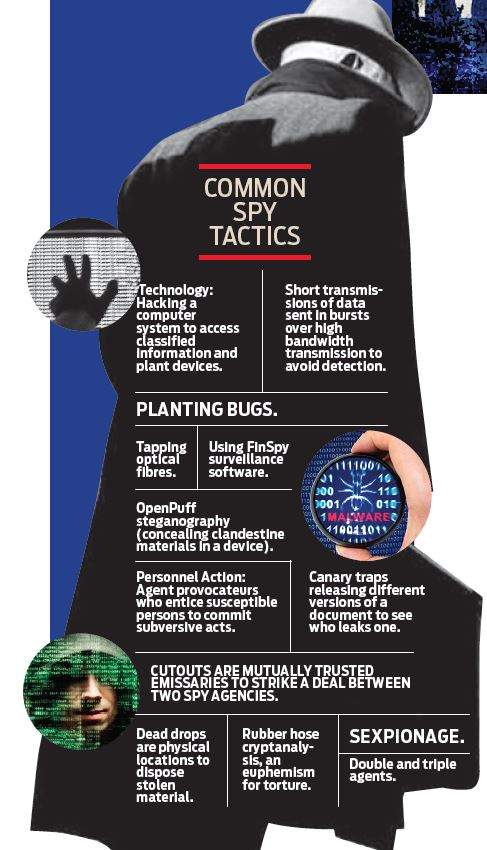
Technology progressed rapidly, and the invention of the daguerreotype in 1837 and the Morse Code were game changers until the electronic era dawned with telegraph, radio, computers, hacking and satellites as intelligence-gathering aids. Today espionage comparatively involves more technical sophistication and research and analysis than in-field operations.
Espionage: The secret battlefield – Sri Lanka Guardian
Bollywood blockbuster Raazi and a controversial new book by former RAW and ISI chiefs have brought the focus back on the deadly espionage game between India and Pakistan, the sacrifices of agents who prized patriotism over their own lives and the political interests that crippled Indian intelligence capabilities
The spy thriller Raazi, which has just swept into the `100-crore club, is not just a true story. It is also an allegory of the chessboard of intrigue on which Pakistan and India compete to capture military and strategic superiority over the subcontinent. In the high voltage standoff scene between RAW spy Sehmet played by Alia Bhatt and her Pakistani Army officer husband Iqbal played by Vicky Kaushal, Sehmet says tearfully, “Watan ke aage kuchh nahi… khud bhi nahi (Nothing matters more than the country, not even oneself).”
Her words sum up the essence of espionage—patriotism is worthy of the ultimate sacrifice. Little is known of what happens behind the black curtain of spycraft— Research and Analysis Wing (RAW) spies abducted or killed and Inter-Services Intelligence (ISI) targets identified and executed in war zones like Kashmir and Balochistan. Additional players in the subcontinental espionage milling pond are the CIA, Mossad, MI6, China’s MSS, Russia’s FSB and a host of agencies from smaller nations. Deception is the name of the game, as the motto of the world’s most feared spy agency Mossad sums up the Old Testament spirit, ‘By deception, thou shall wage war.’
Shadow Players

A controversial book released last month The Spy Chronicles: RAW, ISI and the Illusion of Peace involving former RAW boss Amarjit Singh Dulat and ISI chief Lt Gen (retd) Asad Durrani has the intelligence community in a flap. The Pak Army has charged Durrani with violating its Military Code of Conduct and has forbidden him to leave the country. The book contains an embarrassing revelation that Kulbhushan Yadav’s arrest was an attempt by the ISI to deflect world attention from Pakistan’s Balochistan problem and the connection between the Pathankot terror attack and the ISI.
The spy game between India and Pakistan has many ramifications. In mid-May, former diplomat Madhuri Gupta was jailed for spying for ISI. On 28 March 2017, Minister of State for Home Affairs, Hansraj Ahir, told Rajya Sabha that India had arrested 33 Pakistani spies in 2016. India, however, does not execute Pakistani spies. But Jadhav has been sentenced to death in a Field General Court Marshal. Sarabjit Singh was murdered in a Lahore jail in 2013.
Sheikh Shamim was hanged in 1999. A very few like Kashmir Singh were lucky; he spent 35 years on death row and was pardoned by Pak President Pervez Musharraf in 2008. “I was a spy and did my duty,” declared Kashmir Singh, who had pretended to be deranged while in prison. “Even Pakistan authorities failed to get information from me,” he said proudly. Of such stories, Ravindra Kaushik’s stands out as a unique example of courage and patriotism. Identified as a potential asset for his theatrical abilities by RAW after being spotted acting in a play, Kaushik was trained as a spy, who then infiltrated Pakistan, enrolled in Karachi University under the alias Nabi Ahmad Shakir and joined the Pakistan Army where he was promoted to Major.
For nearly 30 years, he kept feeding sensitive information to his handlers, including the plans for a Pakistan invasion across the Rajasthan border until he was caught and executed. A former RAW official said his inputs helped India win many confrontations against Pakistan, including the Kargil War. Pakistani spy Mohammed Kalam aka Ejaz’s story is similar to Kaushik’s, though not as tragic. Chosen for his interest in photography, ISI trained him in codes and military formation signs and smuggled him into India via Dhaka, helped by the Pakistan High Commission in Bangladesh.
He opened a photo studio with ISI funds and began spying on Indian Army and Air Force movements which had bases there. The ISI network in India is so well entrenched that Kalam was able to get an Aadhaar card, Voter’s ID and driving licence. He also sent video recordings of the landing of a Mirage 2000 on the Yamuna Expressway in May 2015. There is no dearth of traitors on both sides. The Intelligence Bureau (IB) says many Indians who travel to Pakistan to visit relatives legally are trapped with either money or sexual blackmail. In October 2016, Pak spy Bodh Raj was arrested in Jammu with SIM cards and Indian troop deployment maps in Kashmir. Spooks don’t always use high tech; Raj’s arrest revealed the ISI uses carrier pigeons to take messages to and fro between Pakistan and India.
The Doval Factor
The Current National Security The current National Security Advisor (NSA), Ajit Doval, spent around seven years as an Indian spy in Pakistan. During a function at Vidarbha, he related how he would attend a dargah regularly to keep his cover as a Muslim. One day, he was spotted by a bearded old man who called him a Hindu. Though he denied it, the man pointed out a hole in Doval’s ear for an earring. The present NSA replied that he was born a Hindu who had later converted to Islam. The old man took him home and showed idols of Durga and Shiva hidden in a cupboard.
He was a Hindu, living in disguise in Pakistan. Doval does not reveal anything further, though the old man would have made an excellent intelligence asset for RAW. Veterans also say Pakistan gets away with espionage transgressions more than India, simply because India is an accountable democracy while the military controls Islamabad and funds terror activity worldwide. The Spy Chronicles speculates that Prime Minister Narendra Modi and Doval are literally a single entity when it comes to deciding India’s Pak policy.
Durrani said Pakistan believes Doval would love to come to Pakistan if invited, but Islamabad would lose face if he cancels at the last minute. There are times when the Ministry of External Affairs or RAW miscalculate. There exists between India and Pakistan an unwritten 13-year code of conduct that any ‘outed’ diplomat is allowed to leave for home with bag and baggage unhindered.
In November 2016, in an unprecedented exhibition of bravado, Indian agencies broke this rule and ambushed, detained, interrogated and expelled Pakistan High Commission staffer Mehmood Akhtar. Pakistan immediately expelled an Indian employee in the Islamabad mission. India retaliated by ordering Pakistan to unilaterally withdraw six of its diplomats, saying Akhtar had ‘confessed’ they were spies. Infuriated, Pakistan named eight Indian diplomats and mission staffers in Islamabad as spies, burning their alleged cover, thereby rendering them useless to operate in any country. “There was some courtesy between agents, especially those working under diplomatic cover. It’s less now,” says an IB officer.
THE AFGHAN BLUNDER
Senior officials in the Cabinet Secretariat suggest that the intelligence agencies of India, the US, the UK, Israel, France and other terrorism-affected countries are closely working together to monitor ISI activities. Says a senior Israeli diplomat, now retired, who was posted in Delhi in the late 2000s, “Indian intelligence agencies are among the five best in the world. Their information has helped prevent many terror attacks in major Western cities.”
The late 1980s and 1990s were crucial years for RAW. Another former Israeli diplomat who worked in Delhi in the eighties and now serves at a training facility in Tel Aviv says even in the ’70s when India and Israel had no diplomatic relations, cooperation between agencies was unhindered since both had a common enemy in Pakistan. He says, “Geopolitics then was a complex affair. Foreign policy depends a lot on intelligence inputs. Everyone was paranoid. Delhi was a nest of spy activity, with CIA and KGB at each other’s throats. The State Department hated India.” Afghanistan was occupied by Soviet forces and India was pro-USSR. The Americans supported Pakistan, through which it was arming the Mujahideen. Everyone wanted to know what India was thinking because Afghanistan is the most strategic country in the region. In 2001, after the Soviets withdrew and the Mujahideen executed Afghan President Najibullah, it was suddenly free for all.
India faced an intelligence crisis since its only contacts were the Pashtuns and no information was available on other tribal warlords. Indian intelligence opened clandestine ties with mujahideen leader Ahmad Shah Masood in 1994. Masood was fighting on two fronts—against the Saudi-US-Pakistan-supported Ittehad group and Hezb-e-Islami led by Gulbuddin Hekmatyar. According to former diplomat MK Bhadrakumar, Pakistan Interior Minister Nasirullah Babar, known as the father of the Taliban, gave his fighters the necessary support to fill the power vacuum in Kabul. In late 1992, India botched a chance to establish a working relationship with Taliban president Burhanuddin Rabbani of Afghanistan who had asked to refuel his plane in Delhi on his way to Jakarta to attend the Non-Aligned Movement Summit meeting in September. AfPak experts presume he wished to use India as a counter-force against Pakistan. But Prime Minister PV Narasimha Rao procrastinated and the opportunity was lost, says Bhadrakumar. In the end, all espionage comes down to one thing—business.
Afghanistan is everyone’s business. The US is still a partner in Pakistan’s “war on terror” albeit a tentative one in the Trump era. South Block sources estimate America gives Pakistan about $1 billion a year in the form of Coalition Support Funds (CSF). Pakistan’s State Bank announced CSF has even reduced Pak’s current account deficit. India on its part has promised $1 billion in assistance to Afghanistan, which provides a route to energy-sufficient Central Asia, since the transit of Indian products through Pakistani territory is prohibited.
COVERT POWER
While diplomacy is the promotion of national interest through well-established norms, espionage works for the same purpose through undercover action that includes kidnappings, assassinations and sabotage. Security expert Jaydev Ranade recalls that RAW was so effective in Pakistan in the 1970s that the-then ISI chief called his Indian counterpart to talk truce in unprecedented move. Establishment support is crucial to any intelligence agency. Many books have been written by retired intelligence officers on operations conducted by IB and RAW. The Kaoboys of R&AW: Down Memory Lane by former operative B Raman, who worked in Intelligence for 26 years, describes how RAW developed its covert capabilities in Pakistan within two years, thanks to Prime Minister Indira Gandhi’s backing.
Writes Raman, “Covert action capability is an indispensable tool for any State having external adversaries. Any intelligence agency worth its salt will have a covert action capability ready to use, when necessary.” Meanwhile, The Spy Chronicles recalls the cordiality that once prevailed between senior intelligence officers of both countries, who belong to the Partition generation and share a modicum of emotional attachment. Dulat recounts chatting with Durrani in Islamabad over glasses of Black Label whiskey—unimaginable today owing to the almost total Islamic radicalisation of the top ranks of the Pakistan Army. RAW agents have reportedly conducted successive anti-terrorist operations on foreign soil. In 2009, RAW and IB launched a joint operation to conduct 400 snatch operations in Nepal, Bhutan and Bangladesh to catch and bring to India escaped militants, including Sheikh Abdul Khwaja, conspirator in the 26/11 Mumbai attacks. More recently, Pakistan news reports said a retired Pakistani Army officer, who had participated in Jadhav’s kidnapping and incarceration, was taken by Indian intelligence agencies near the Nepal border in retaliation.
POLITICAL SABOTEURS
Over the past few decades, Indian intelligence capabilities have been eroded by political ambitions. It started in 1977, when Morarji Desai cut the RAW budget by 30 percent and shared details of the agency’s network in Pakistan with Zia-ul-Haq and information gathered on the Kahuta nuclear facility. A RAW agent had procured a hair sample from a saloon in Kahuta where Pak scientists went for haircuts. Tests revealed the hair had signs of high radiation and bomb-grade uranium. The agent also obtained a copy of the blueprint of the nuclear plant.
Morarji refused permission to RAW to sabotage Pak’s nuclear plans. He then refused permission to Israeli warplanes to refuel in India on a mission to bomb the Kahuta facility. In retrospect, Morarji is singularly responsible for the nuclear threat in the region. The next fatal blow to RAW came from 10-month Prime Minister IK Gujral, who banned all covert operations in 1997. He also gave out details of all RAW agents in Pakistan, who were promptly tortured and executed on the directions of Gen Ziauddin, then DG, ISI.
The last blow was the dismantling of the Technical Services Division in 2012 and the persecution of its chief Major Hunny Bakshi as a result of inter-service rivalry between factions of the Indian Army. “Then the Pakistanis were so scared of RAW that if they hit us once in India, we would hit back ten times,” says a Military Intelligence (MI) officer in the know. Another spy film released this year, Aiyaary shows vested interests trying to sabotage a similar intelligence outfit. In a dramatic scene, a Kashmiri double agent is killed for treachery. The Indian spymaster and the traitor have a final cordial drinking session, followed by a last request by the doomed man to have noodles. After the meal, he is executed with a single shot to the head. An MI officer serving in Kashmir suggests it could well be a true story.
Loyalty is the ultimate test in spycraft—loyalty to the nation and the mysterious brotherhood of spooks. In the treacherous terrain of the secret war fought in the shadows, unnamed men and women continue to adhere to a code that has been in operation since the beginning of nations, “Watan ke aage kuchh nahi… khud bhi nahi.”
The Great Game
Afghanistan has always been the theatre of geopolitical control, espionage and wars. The Great Game that started in January 1830 was meant to map and control the vast tract of land that included Afghanistan, India, Pakistan and Persia, Turkey, Tibet and the Himalayan route into Central Asia. It was a grim game of death and war that involved the British Empire, Russia and Germany. Its echoes still determine the violent politics and policy of the region.
A short history of esponage
Egyptian hieroglyphs record spies in the royal court, military and among slaves. Egyptian spies were also the first to use poison to kill. Spies of Egypt, Greece and Rome used codes, disguised writing, invisible ink and hidden pockets. Ancient Greeks used complex signals to secretly communicate among outposts and towers. In the Middle East and Byzantium, civilian intelligence agents gathered information about foreign armies and economies from traders, merchants, sailors, and businessmen. Fifth-century records mention the use of spies in the Indus Valley civilisation.
Sun Tzu’s The Art of War and Kautilya’s Arthasatra have extensive details on their use in times of both war and peace. Records show Rome’s intelligence agency warned Julius Caesar of the plot against his life, which he fatally ignored. Roman military intelligence was used to conquer hostile and alien lands. Political espionage was common.
The feared Roman secret police, the Frumentarii, spied on politicians and commoners alike. The Middle Ages necessitated the use of couriers, translators, and royal messengers acting as spies who used cryptography and steganography. The Catholic Church created a massive spy network as it expanded control over Europe. Elizabethan Intelligence chiefs hired linguists, scholars, authors, engineers and scientists to procure and analyse information. Telescopes, magnifying glasses, camera obscura, and clocks were used for remote surveillance. In the 19th century, colonial powers employed secret agents to gather information about unrest in their holdings. As the industrial age dawned, government spies infiltrated labour organisations, which had spies of their own.
Technology progressed rapidly, and the invention of the daguerreotype in 1837 and the Morse Code were game changers until the electronic era dawned with telegraph, radio, computers, hacking and satellites as intelligence-gathering aids. Today espionage comparatively involves more technical sophistication and research and analysis than in-field operations.
Espionage: The secret battlefield – Sri Lanka Guardian