

Indian Unmanned Naval Vessel Developments
- Thread starter Levina
- Start date
You are using an out of date browser. It may not display this or other websites correctly.
You should upgrade or use an alternative browser.
You should upgrade or use an alternative browser.


A list of large & extra-large UUV programs of the IN:
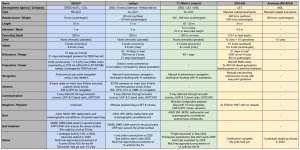
The 2 columns marked in blue have moved past documents to hardware production/testing phase. The column marked in green is still in paper. This Make-1 program addresses the largest & heaviest class of XLUUVs. The primary contenders bidding are MDL & L&T Shipyard. Both of these vendors have experience in designing midget subs which are close to the XLUUV in terms of size & displacement. The columns in yellow show the known parameters of their midget/coastal submarine design. This design experience should help with the XLUUV program.
Navy is leaning more towards unmanned systems like XLUUVs. But it doesn't completely eliminate the need for midget/coastal submarines. In any case we can expect the DND to be heavily involved with the design of this XLUUV, just like they were with the "Jalkapi". We can also expect the usual suppliers to be involved in providing components for this program.
AIP/Fuel cell powerpack, Propeller design & hydrodynamic design/testing by NSTL. Sonars, radars & electronics by BEL.

Building armed unmanned boats for the Navy: How Sagar Defence is chasing a $2 billion-plus valuation
Founded in 2015 by former merchant navy officer Nikunj Parashar, Sagar Defence has grown into a maker of armed unmanned boats for the Navy. The IPO will fund a new shipyard, research & development.
By Bhaswar Kumar
21 November, 2026 11:31 am IST
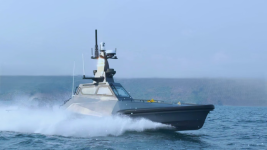
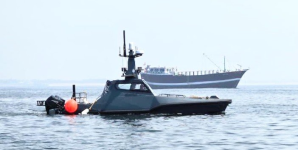
Sagar Defence Engineering's 'Matangi' armed unmanned boat | Sagar Defence Engineering
New Delhi: Sagar Defence Engineering, which began life in 2015 in what was reportedly a cramped Mumbai office of barely 150 square feet and is today delivering armed unmanned boats to the Indian Navy, filed updated papers with the Securities and Exchange Board of India (SEBI) Thursday for a Rs 3,412-crore initial public offering (IPO).
The issue is made up of fresh shares worth Rs 1,200 crore and an offer for sale of Rs 2,212 crore, according to the company’s updated draft red herring prospectus. Before filing the updated papers, the company raised Rs 300 crore through a pre-IPO placement priced at Rs 97.27 a share, reducing the size of the fresh issue accordingly.
If the IPO is priced at the Rs 97.27 a share paid in the pre-IPO placement, Sagar Defence would be valued at about Rs 21,500 crore after the issue, according to ThePrint’s calculations based on its updated draft red herring prospectus.
The company’s registered office is in Mumbai, while its corporate office and both manufacturing facilities are in Chakan, Pune. It cites a CAREEdge report in the prospectus to describe itself as “the only company in India specialising in unmanned, integrated and multi-domain systems across the maritime surface, maritime sub-surface, aerial and land domains”.
Nikunj Parashar, the company’s founder, chairman and managing director, is a former merchant navy officer. His co-founders are Mridul Babbar, Lakshay Dang, Saurabh Patil and Ankit Kumar.
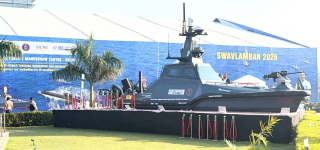
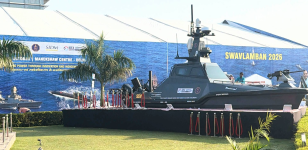
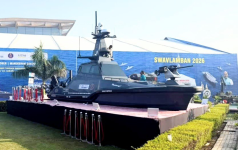
Addressing the Indian Navy’s ‘Swavlamban’ seminar last month, Parashar reportedly spoke of the setbacks he faced while building the company, including two heart attacks and a paralytic stroke.
At the core of Sagar Defence Engineering’s offering is ‘GENISYS’, its in-house autonomy and command-and-control system, which it markets as a combined hardware and software package that can turn existing vehicles into autonomous ones.
The company’s flagship offering is the ‘Matangi’ unmanned surface vessel, which in November 2024 reportedly made an uncrewed coast-to-coast passage of about 1,600 km from Mumbai in Maharashtra, on the west coast, to Thoothukudi in Tamil Nadu, on the south-eastern coast.
The Navy is reported to be taking delivery of 12 of the company’s armed unmanned surface vessels, ‘Matangi’ among them, under a contract awarded within the Innovations for Defence Excellence (iDEX) framework, with the boats said to carry 12.7 mm stabilised remote-controlled guns.
Sagar Defence also builds drones and has reportedly partnered with Israel Aerospace Industries on the ‘Point Blank’ loitering munition.
The company’s financials point to rapid growth. Revenue from operations climbed from Rs 39.50 crore in 2023-24 to Rs 254.59 crore in 2025-26, and the first six months of the current financial year, to 30 September, alone brought in Rs 222.24 crore. A loss of Rs 6.26 crore in 2023-24 turned into a profit of Rs 87.90 crore in 2025-26, and the company earned Rs 101.61 crore in profit in the first half of 2026-27.
The prospectus is also clear about the risks. “We derive almost all of our revenue from our top customer, i.e., the Government of India,” it states. The company also cautions that the drivers of its recent growth “may not be sustainable at historical rates”.
Most of the fresh capital, Rs 724.78 crore, is meant for a manufacturing and technology campus at Juvvaladinne Fishing Harbour in Andhra Pradesh’s Nellore district, pitched by the company as the country’s first autonomous maritime shipyard. Construction is yet to start, and the company concedes it has never run a coastal facility before. A further Rs 170 crore will go to research and development.
(Edited by Viny Mishra)
Building armed unmanned boats for the Navy: How Sagar Defence is chasing a $2 billion-plus valuation
Founded in 2015 by former merchant navy officer Nikunj Parashar, Sagar Defence has grown into a maker of armed unmanned boats for the Navy. The IPO will fund a new shipyard, research & development.
By Bhaswar Kumar
21 November, 2026 11:31 am IST
Sagar Defence Engineering's 'Matangi' armed unmanned boat | Sagar Defence Engineering
New Delhi: Sagar Defence Engineering, which began life in 2015 in what was reportedly a cramped Mumbai office of barely 150 square feet and is today delivering armed unmanned boats to the Indian Navy, filed updated papers with the Securities and Exchange Board of India (SEBI) Thursday for a Rs 3,412-crore initial public offering (IPO).
The issue is made up of fresh shares worth Rs 1,200 crore and an offer for sale of Rs 2,212 crore, according to the company’s updated draft red herring prospectus. Before filing the updated papers, the company raised Rs 300 crore through a pre-IPO placement priced at Rs 97.27 a share, reducing the size of the fresh issue accordingly.
If the IPO is priced at the Rs 97.27 a share paid in the pre-IPO placement, Sagar Defence would be valued at about Rs 21,500 crore after the issue, according to ThePrint’s calculations based on its updated draft red herring prospectus.
The company’s registered office is in Mumbai, while its corporate office and both manufacturing facilities are in Chakan, Pune. It cites a CAREEdge report in the prospectus to describe itself as “the only company in India specialising in unmanned, integrated and multi-domain systems across the maritime surface, maritime sub-surface, aerial and land domains”.
Nikunj Parashar, the company’s founder, chairman and managing director, is a former merchant navy officer. His co-founders are Mridul Babbar, Lakshay Dang, Saurabh Patil and Ankit Kumar.
Addressing the Indian Navy’s ‘Swavlamban’ seminar last month, Parashar reportedly spoke of the setbacks he faced while building the company, including two heart attacks and a paralytic stroke.
At the core of Sagar Defence Engineering’s offering is ‘GENISYS’, its in-house autonomy and command-and-control system, which it markets as a combined hardware and software package that can turn existing vehicles into autonomous ones.
The company’s flagship offering is the ‘Matangi’ unmanned surface vessel, which in November 2024 reportedly made an uncrewed coast-to-coast passage of about 1,600 km from Mumbai in Maharashtra, on the west coast, to Thoothukudi in Tamil Nadu, on the south-eastern coast.
The Navy is reported to be taking delivery of 12 of the company’s armed unmanned surface vessels, ‘Matangi’ among them, under a contract awarded within the Innovations for Defence Excellence (iDEX) framework, with the boats said to carry 12.7 mm stabilised remote-controlled guns.
Sagar Defence also builds drones and has reportedly partnered with Israel Aerospace Industries on the ‘Point Blank’ loitering munition.
The company’s financials point to rapid growth. Revenue from operations climbed from Rs 39.50 crore in 2023-24 to Rs 254.59 crore in 2025-26, and the first six months of the current financial year, to 30 September, alone brought in Rs 222.24 crore. A loss of Rs 6.26 crore in 2023-24 turned into a profit of Rs 87.90 crore in 2025-26, and the company earned Rs 101.61 crore in profit in the first half of 2026-27.
The prospectus is also clear about the risks. “We derive almost all of our revenue from our top customer, i.e., the Government of India,” it states. The company also cautions that the drivers of its recent growth “may not be sustainable at historical rates”.
Most of the fresh capital, Rs 724.78 crore, is meant for a manufacturing and technology campus at Juvvaladinne Fishing Harbour in Andhra Pradesh’s Nellore district, pitched by the company as the country’s first autonomous maritime shipyard. Construction is yet to start, and the company concedes it has never run a coastal facility before. A further Rs 170 crore will go to research and development.
(Edited by Viny Mishra)
Building armed unmanned boats for the Navy: How Sagar Defence is chasing a $2 billion-plus valuation
last one is like the containerized command center sort of thing?
last one is like the containerized command center sort of thing?
Yep.
