Pakistan Defence Industries - Updates

MR SAM is costly, you cannot keep that system every corner.

Ramjet missiles like HD-1 aren't cheap either.

And as such they are used for addressing certain kinds of high-value targets, not every single field comms station or FARP point.

And it's those higher-value targets (air bases, major logistics hubs etc) that systems like Barak-8 defend.
 
MR SAM is costly, you cannot keep that system every corner.
But we (can) produce them in-house in decent numbers.
1795084011685.png


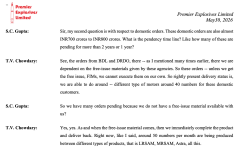
LRSAM and MRSAM are different designations of the same thing. ~30/month is current peacetime production of MR-SAM.
Now how many HD-1s can China supply them? That isn't to say it is not a threat to be taken lightly, it is a serious one.
 
how many HD-1s can China supply them?
Current number is less than 200. To put that in perspective, India has test fired 100+ BrahMos missiles till date.

I'm assuming, the targets that will warrant their top of the line weapons would already be protected by a multilayer defense.

Another point to keep in mind is the trajectory limitation, it's a solid fuel design and they state maximum range to be 290km that is likely to be a Hi-Lo trajectory. S400 or 2084 will see it coming a long way off, similar to what went down with the so called hypersonic CM401. I mean, what air force downgrades from a "hypersonic" missile to a lowly supersonic missile.

A Lo-Lo trajectory will see that range slashed even more, less than 150km if air launched, far worse in ground launched. Liquid fuel ramjets have far greater ecomomy at low level flight. At low altitudes the airflow is more compressed necessitating a higher solid fuel burn rate to prevent a blowout.

At least BrahMos has huge lifting fins and the liquid ramjet has a greater range of throttling.
My guess with the video released is that it goes up into thin atmosphere, cruises at high altitude and descends in a somewhat top-down ballistic trajectory without any waypoint navigation of sorts, maybe? I don't know if i am right calling it an air-breathing quasi-ballistic missile.

BrahMos on the other hand is quite crazy. Flies low and can perform pop-up terminal dives at low altitudes. Basically nearly all the advantages of a sub-sonic cruise missile with supersonic speeds. HD-1 is faster but i don't think it cruises at low altitude or performs evasive manoeuvres and that's fine. It is made by a literal civilian mining company afterall as a side gig.
 
Pak had been working on a supersonic cm for a while as per their MoDP (def prodn). Looks like the local effort went nowhere and they've finally acquired the HD-1 off the shelf.

I doubt this Hd1 is a true super sonic CM. May be flying in some particular trajectory where it touches lower line of super sonic speeds. I have a feeling that Chinese have fooled them to make some bucks just like their crap Jhamoora 17 and PL crap missile found dud in the fields.

They will test it via Pakistan against India to market it like their Jhamoora 17 on social media.
 
I doubt this Hd1 is a true super sonic CM. May be flying in some particular trajectory where it touches lower line of super sonic speeds. I have a feeling that Chinese have fooled them to make some bucks just like their crap Jhamoora 17 and PL crap missile found dud in the fields .
It has a top speed of Mach 4 afair .
I dont even wanna talk about what you wrote about JF17 & PL15s , its like taking to a wall .
 
It has a top speed of Mach 4 afair
Booster burnout will take you there, but that's unsustainable. Kinda like how they made up random high Mach numbers for CM401 while in terminal phase, it was barely supersonic.

We have SFDR speed for comparison which btw flies in a rarified atmosphere, Mach 2 sustained, still significantly faster than any dual-pulse AAM.
 
  • Like
Reactions: Kimjongun
I doubt this Hd1 is a true super sonic CM. May be flying in some particular trajectory where it touches lower line of super sonic speeds. I have a feeling that Chinese have fooled them to make some bucks just like their crap Jhamoora 17 and PL crap missile found dud in the fields.

They will test it via Pakistan against India to market it like their Jhamoora 17 on social media.

Well the general airframe design is similar to the French ASMP which is said to be capable of speeds of upto Mach 3. This likely has similar performance, if we take Pakistani claims with a pinch of salt.

The PLA has reportedly opted for a lighter version of the YJ-12 to eventually replace the Kh-31/YJ-91 in the AL role. They are also working on hypersonic CMs for aircraft. So, they would've had no need for it.

And the Chinese mfgr of HD-1 might have been looking at the export market to recover dev costs. Pak just happened to be the test case/guinea pig to try it out with.
 
  • Like
Reactions: screambowl
I doubt this Hd1 is a true super sonic CM. May be flying in some particular trajectory where it touches lower line of super sonic speeds. I have a feeling that Chinese have fooled them to make some bucks just like their crap Jhamoora 17 and PL crap missile found dud in the fields.

They will test it via Pakistan against India to market it like their Jhamoora 17 on social media.
If it uses ramjet, then it is at mach 2. No point deluding ourselves.

Anyways Pakistanis have tested it. So they know its true speed as well
 
  • Like
Reactions: Photon Vish
It has a top speed of Mach 4 afair .

Definitely supersonic but at lower super sonic speeds. Mach 4 is wet dreams for Pakistanis.

If it uses ramjet, then it is at mach 2. No point deluding ourselves.

depends on the trajectory and flight path, secondly India is prepared for China thinking such scenarios have systems placed for high hypersonic speeds as well. No one is deluded.
Well the general airframe design is similar to the French ASMP which is said to be capable of speeds of upto Mach 3. This likely has similar performance, if we take Pakistani claims with a pinch of salt.

The PLA has reportedly opted for a lighter version of the YJ-12 to eventually replace the Kh-31/YJ-91 in the AL role. They are also working on hypersonic CMs for aircraft. So, they would've had no need for it.

And the Chinese mfgr of HD-1 might have been looking at the export market to recover dev costs. Pak just happened to be the test case/guinea pig to try it out with.

True, and Indian AD is preparing for that bold part. Supersonic is the talk of past.
 
depends on the trajectory and flight path, secondly India is prepared for China thinking such scenarios have systems placed for high hypersonic speeds as well. No one is deluded.
How does it depend on trajectory and flight path? In which trajectory or flight path csn a ramjet propelled missile have speed less than mach 2?
 
How does it depend on trajectory and flight path? In which trajectory or flight path csn a ramjet propelled missile have speed less than mach 2?

at high alt mach 2 and above at low alt low super sonic or just touching Mach 2 to increase range in dense atmosphere trade off.

More over this is a solid fuel ramjet engine what HD1 carries.
 
Booster burnout will take you there, but that's unsustainable. Kinda like how they made up random high Mach numbers for CM401 while in terminal phase, it was barely supersonic.

We have SFDR speed for comparison which btw flies in a rarified atmosphere, Mach 2 sustained, still significantly faster than any dual-pulse AAM.

You think PL-15 has less speed than mach 2 at the end game engagement? Then it would not score any kill to begin with. (Against fighters)
 
general airframe design is similar to the French ASMP which is said to be capable of speeds of upto Mach 3. This likely has similar performance,
ASMP has a liquid (kerosene) ramjet, vastly different from a solid-fuel ramjet that powers HD-1
You think PL-15 has less speed than mach 2 at the end game engagement
Depends on the range. However, how do you think we ended up with nearly intact PL15s from Punjab and Himachal fields?
 
  • Informative
Reactions: Speedster1
Agreed.


I mean, everything runs out of energy at somepoint.

There was a leaked chart showing PL-15's effective range at 100km in tail chase mode.
I mean, we have a powered missile sustaining Mach 2, how fast do you think an unpowered projectile can go, especially after travelling tens of kilometres through atmosphere since the last burnout?

Terminal effectiveness is a function of how good the guidance is, not so much of speed. There's is no go around if the projectile missed the first time.
 
@screambowl

Indeed. Apart from the current crop of sam and cuas, work on next gen systems based on rotating detonation 'rocket' engine tech is underway at D-Propulse et all.

S Jha has specifically talked about a point defence/cuas anti-missile application of this tech. He even says this tech is easier to do than RDE ramjet. Then there are microwave/DEW like Tonbo Wavestrike. Should be effective in the terminal phase when most supersonic cm's slow down a notch to acquire targets.
 
I mean, we have a powered missile sustaining Mach 2, how fast do you think an unpowered projectile can go, especially after travelling tens of kilometres through atmosphere since the last burnout?

As a rule for thumb, the time it takes for a missile to lose 25% of its velocity after burn out at supersonic speeds.

Never @ > 100,000 m (~300,000 ft) ; in space
~150 seconds @ 24,000 m (~80,000 ft)
~70 seconds @ 18,000 m (~ 60,000 ft)
~25 seconds @ 12,000 m (~ 40,000 ft)
~10 seconds @ 6,000 m (~20,000 ft)
~5 seconds @ Sea Level.

Obviously exact kinematic specs of PL-15 is classified. It is estimated to reach Mach 5 when launched at supersonic speed. (You can get similar results with standard simulations)

So, let's say it is launched at an altitude of 15,000 m in a standard lofted trajectory at supersonic speed and it immediately start climbing. Usually goes up to 25,000 m/27,000 m. As it approaches closer to target, it starts to decent.

We can roughly guess, by the time PL-15 at 120km it is still flying at around Mach 3, (accounting for the velocity loss due to air resistance and minor course corrections all the way) Then the second pulse might kick in and gives it another 40%/50% boost in speed. So by the time it engages the target at roughly 150km, it still has Mach 3 Terminal speed with roughly 25%/30g Maneuverability. (That is of course assuming, the target is unaware of the incoming threat until last few seconds.)

 
From my understanding of HD1, and based on why PLA don't use them, its just speculation from my part.

1) hardware is just one part, second part is software and ECCM capabilities.
-> PLA might not have found them accurate enough in high EW environment.

2) might not be very menurable, SFDR theoretically gives higher G limits than liquid fuel ramjet but precision is much lower and may be that company is not able to make it good enough specially for mountains.

3) lo-lo-lo profiles favors liquid fuel alot, and an SFDR can give just a fraction of range in such trajectory specially if not made well enough

4) fuel may be corrosive and maintainance demanding which negate the single biggest advantage of solid fuel.

5) range, obviously significantly lower than liquid fuel in any trajectory.

6) based on 3rd & 5th point, an SFDR practically can not be used to attack deeper target without eliminating shallower air defence system, as range is lower specially in lo-lo-lo profile while a liquid fuel still offer a usable range in lo-lo-lo profile.


Again, these all are just speculations, but likelihood of bad ECCM, bad precision menurabality and corrosive/high maintenance fuel is high.

But still, it will be a hard to hard kill and atleast a visible damage on ground even if it misses target by 20-30 meters which will be deadly in larger targets like airfields, refinaries, dams(specially).
 
  • Like
Reactions: screambowl
But still, it will be a hard to hard kill and atleast a visible damage on ground even if it misses target by 20-30 meters which will be deadly in larger targets like airfields, refinaries, dams(specially).

With supersonic missiles, range is usually cut by half when flying a lo-lo trajectory, when flying hi-hi, they light up like a Christmas tree because of their massive IR signatures. (For context, the massive Brahmos can manage just 120km lo-lo) This means they can be spotted from miles away even with rcs reduction and/or onboard C/F countermeasures.

The IAF will have sized up Pak employment strategy for HD-1 based on it's experience with Brahmos and prepared adequate countermeasures before long.
 
  • Like
Reactions: screambowl