Brahmos Supersonic Cruise Missile : News, Updates and Discussions

Looks like Brahmos is being exported to one of these countries: Philippines, Vietnam, UAE or Russia. Philippines' first order was completed last year. Text from their tender:

HMV 12 x 12 Chassis for MAL & MRV 8 Nos LHD + 8 Nos RHD 16 Nos
HMV 8 x 8 Chassis for MCP (2 Nos LHD + 2 Nos RHD) 04 Nos
HMV 8 x 8 Chassis for WV (1 Nos LHD + 1 Nos RHD) 02 No
HMV 8 x 8 Chassis for VMR (2 Nos LHD + 2 Nos RHD) 04 Nos
SATs, Maintenance & Shipment support at Project locations 01 No
Training (O & M level) at Project locations and Documentation Charges 01 Set
ESP Package for maintenance of 12 x 12 vehicles 16 Sets
ESP package for maintenance of 8 x 8 Vehicles 10 Sets


Support during shipment from Indian Port 04 working days (Excluding Journey period)
Support during unloading of shipment at project locations 14 working days (Excluding Journey period)
Support for Maintenance and followed by SATs with end user at project locations 21 working days (Excluding Journey period)

Although delivery will start 17-21 months after contract is signed.
 

India and Indonesia are likely to discuss sale of additional BrahMos supersonic missile systems during Prime Minister Narendra Modi’s three-day visit to Indonesia starting July 6.

Sources told the Tribune that Indonesia has expressed its keenness on going beyond the lone BrahMos missile battery it had sought under a preliminary procurement framework finalised in March this year.

A BrahMos battery includes launchers, radars and missiles.

India and Indonesia had first discussed the sale during the Defence Cooperation Dialogue in New Delhi in November last year, when Defence Minister Rajnath Singh hosted his Indonesian counterpart, Sjafrie Sjamsoedd.

In March, Indonesian Defence Ministry spokesperson Rico Ricardo Sirait had said the agreement with India on getting the missile system was a “part of the modernisation of military hardware and defence capabilities, especially ⁠in the maritime sector.”

Sources said the two sides are working on a phased procurement plan that would include the Brahmos missile that can fire at targets 290 km away. Missile Technology Control Regime (MTCR) restrictions on range, cap missile at 290 km.

Vietnam is also looking at the missile systems and the contract is reportedly valued at approximately $620 million. It includes the supply of mobile coastal defence missile batteries, operator training and long-term logistics and maintenance support.
 

A missile with no foreign buyer until 2022 now has two contracted customers, a third in the pipeline and at least half a dozen countries in the queue.

The BrahMos, the only supersonic cruise missile available for export anywhere in the world, has emerged as the flagship of India’s defence export push, with the Memorandum of Understanding (MoU) inked with Indonesia on Tuesday marking the latest step in a rapidly expanding footprint.

The Philippines opened the account with a $375-million contract for shore-based anti-ship missile batteries in 2022 and has since taken deliveries. Vietnam came next, with Defence Secretary Rajesh Kumar Singh confirming at the Shangri-La Dialogue in Singapore earlier this year that the deal, estimated at around $629 million, had “already been signed, probably not publicly announced”.

Indonesia is now set to become the third customer. The newly signed MoU between BrahMos Aerospace and the Indonesian defence ministry provides the overarching framework for phased procurement of two batteries estimated at around $200 million, with formal contracts to follow, sources in the defence establishment said.

India is now negotiating with the United Arab Emirates (UAE) for both BrahMos and the Akashteer air defence command and control system, with Abu Dhabi keen to cut dependence on Western suppliers after the recent Iran conflict, even as the Saudi-Pakistan mutual defence pact reshapes strategic equations in the Gulf. In a telling turn, Russia, its missile stocks depleted by the Ukraine war, is also learnt to be considering induction of BrahMos on its own naval platforms.
The Russian factor
Moscow’s concurrence is required for every third-country sale, which Russian Defence Minister Andrey Belousov conveyed for the Vietnam and Indonesia deals during talks with Defence Minister Rajnath Singh in Dec 2024.
BrahMos Aerospace, in turn, is working to cut costs by nearly 20 per cent over the next two years, while developing the lighter 1.2-tonne BrahMos-NG (Next Generation) for integration on a wider range of platforms.
 
  • Like
Reactions: _Anonymous_

BrahMos to adapt missile to new customer’s requirements — Co-Director​


BrahMos Aerospace Russian-Indian joint venture will upgrade the BrahMos-NG lightweight air-launched cruise missile to new requirements of the customer in 2027, Managing Co-Director Alexander Maksichev told TASS on the sidelines of the International Maritime Defense Show Fleet 2026.

"Flight tests of the new generation BrahMos-NG missile have not yet begun due to the fact that the customer has slightly changed its requirements. Therefore, we still have to make some improvements. In other words, the requirements for the missile have become stricter and higher, so we will need some time to upgrade this missile and meet the new requirements. So we are still acting according to plan," Maksichev said.

Brahmos-NG missile finalizing may take about a year, he noted. The item will undergo traditional ground adaptation, and then the missile will be flight-tested.

 

BrahMos to adapt missile to new customer’s requirements — Co-Director​


BrahMos Aerospace Russian-Indian joint venture will upgrade the BrahMos-NG lightweight air-launched cruise missile to new requirements of the customer in 2027, Managing Co-Director Alexander Maksichev told TASS on the sidelines of the International Maritime Defense Show Fleet 2026.

"Flight tests of the new generation BrahMos-NG missile have not yet begun due to the fact that the customer has slightly changed its requirements. Therefore, we still have to make some improvements. In other words, the requirements for the missile have become stricter and higher, so we will need some time to upgrade this missile and meet the new requirements. So we are still acting according to plan," Maksichev said.

Brahmos-NG missile finalizing may take about a year, he noted. The item will undergo traditional ground adaptation, and then the missile will be flight-tested.
Apparently they asked for a terminal phase S-turn maneuver while maintaining speed. Thats a good improvement if possible.
 
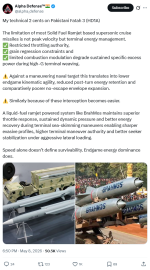
There was a comment by AlphaDefence sometime ago comparing liquid fueled ramjets vs solid fueled ramjets. Solid fueled ramjets are not as maneuverable as liquid fueled ramjets at the end stage.

So, why not try to make a BVR missile out of Brahmos-NG??? Seems more logical than a solid fueled Astra mk3.
Meteor design is being abandoned anyways. No one else is rushing to make a solid fueled ramjet/Meteor equivalent either. Maybe, meteor design is not as feasible as it was envisioned before. I think DRDO just went with SFDR development because they saw meteor's success and just wanted a desi equivalent.
 
  • Like
Reactions: _Anonymous_
There was a comment by AlphaDefence sometime ago comparing liquid fueled ramjets vs solid fueled ramjets. Solid fueled ramjets are not as maneuverable as liquid fueled ramjets at the end stage.

So, why not try to make a BVR missile out of Brahmos-NG??? Seems more logical than a solid fueled Astra mk3.
Meteor design is being abandoned anyways. No one else is rushing to make a solid fueled ramjet/Meteor equivalent either. Maybe, meteor design is not as feasible as it was envisioned before. I think DRDO just went with SFDR development because they saw meteor's success and just wanted a desi equivalent.
China is also developing Ramjet powered PL-21
 
There was a comment by AlphaDefence sometime ago comparing liquid fueled ramjets vs solid fueled ramjets. Solid fueled ramjets are not as maneuverable as liquid fueled ramjets at the end stage.

So, why not try to make a BVR missile out of Brahmos-NG??? Seems more logical than a solid fueled Astra mk3.
Meteor design is being abandoned anyways. No one else is rushing to make a solid fueled ramjet/Meteor equivalent either. Maybe, meteor design is not as feasible as it was envisioned before. I think DRDO just went with SFDR development because they saw meteor's success and just wanted a desi equivalent.
Liquid fuel has more specific impulse, hence theoretically more range.

A technologically comparable liquid fuel ramjet Astra Mk3 should easily give over 400 km of range vs 340 km.

And i don't their is much difference in menurabality, both have limited angle of attack due to air intake.

And menurabality depends upon energy and aerodynamic control surfaces and its algorithm.
 
Liquid fuel has more specific impulse, hence theoretically more range.

A technologically comparable liquid fuel ramjet Astra Mk3 should easily give over 400 km of range vs 340 km.

And i don't their is much difference in menurabality, both have limited angle of attack due to air intake.

And menurabality depends upon energy and aerodynamic control surfaces and its algorithm.


1783961265875.png
 
There was a comment by AlphaDefence sometime ago comparing liquid fueled ramjets vs solid fueled ramjets. Solid fueled ramjets are not as maneuverable as liquid fueled ramjets at the end stage.

So, why not try to make a BVR missile out of Brahmos-NG??? Seems more logical than a solid fueled Astra mk3.
Meteor design is being abandoned anyways. No one else is rushing to make a solid fueled ramjet/Meteor equivalent either. Maybe, meteor design is not as feasible as it was envisioned before. I think DRDO just went with SFDR development because they saw meteor's success and just wanted a desi equivalent.
1000117246.webp
1000117248.jpg

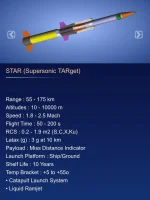
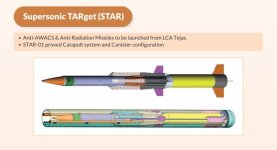
Well STAR is there

What happened to this?
1000117250.png
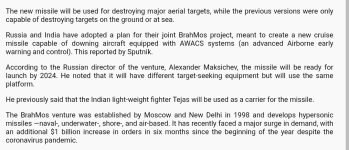
Designing and developing a new missile for such a limited number of targets − however important these may be − with the associated cost might be a less attractive option than first trying to adapt, or at least use elements of, an already in-service system. The Brahmos airframe is less than ideal, with an annular intake placing greater limitations on the seeker size than a conventionally designed AAM. It does, however, use a ramjet sustainer motor, which provides the missile with a comparatively high cruise speed. Furthermore, the missile would remain powered for far longer than if it used a simple solid-rocket motor. And, of course, it is already in production.
 
Last edited: