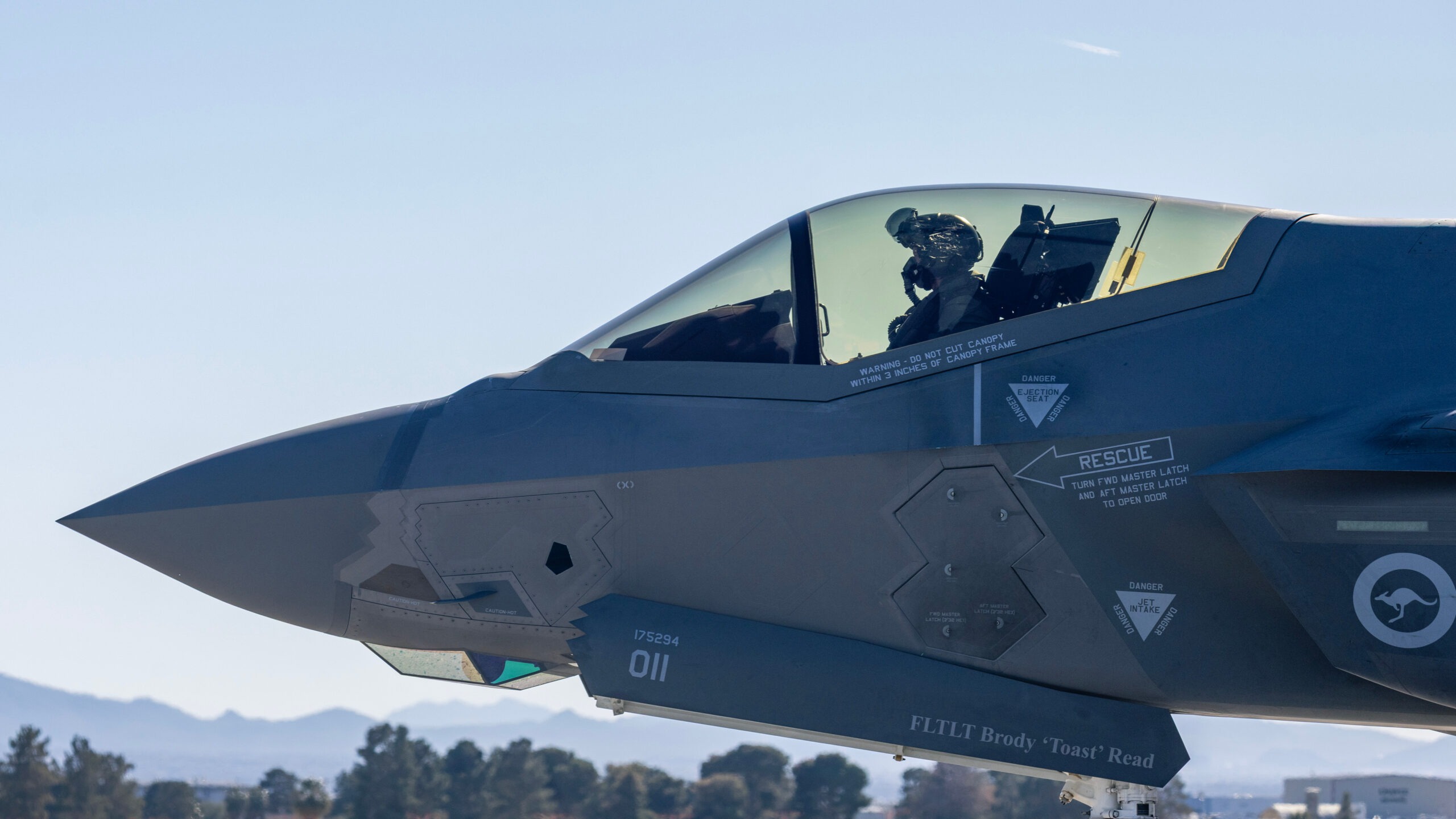
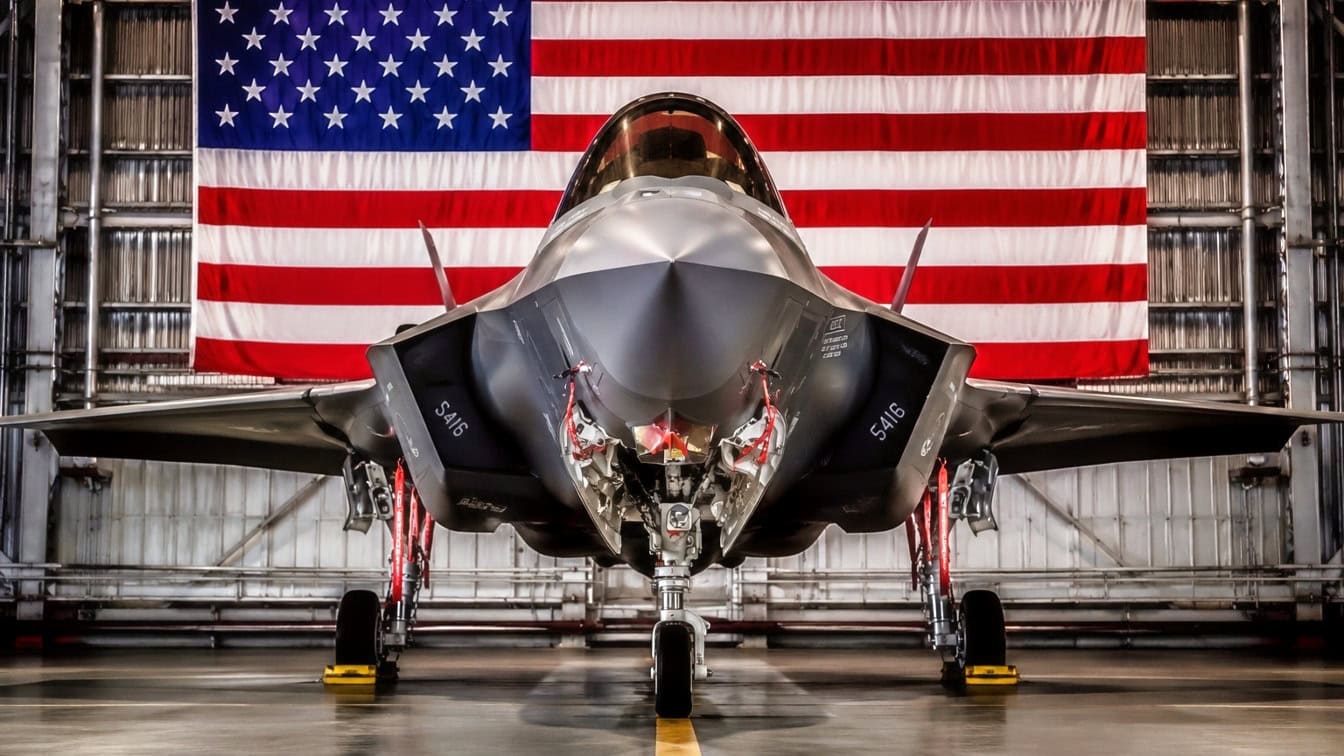
Lockheed Martin F-35 Lightning and F-22 'Raptor' : News & Discussion


- F135 engine has 2 generators giving 2x80=160 KW electric power.
- F110 engine on ramp was tested to give 1 MW power.
- DEW pods have been tested om AH-64 Apache, etc.
- Jen Latka, F135 program Vice-president said - F-135 engine is getting ECU, not just for better avionics but probably also for DEW upgrade later.
- F-22 getting MLU of stealhy EFTS, 2x stealthy sensor pods, TacIRST, etc.

I wonder how much power F135 will give after ECU
& if F119 also getting some engine upgrade to compensate for increase in weight & drag of F-22.

1782633576595.jpeg

1782632524737.jpeg


1782634203741.jpeg

1782634287398.jpeg
 
  • Informative
Reactions: Bon Plan
Taiwan has an extraordinarily powerful ally, provided that the war waits until its factories have replenished their ammunition stocks and its aircraft are finally completed. :D
 

Six F-35Bs Delivered To Marines So Far Without New Radars

Lockheed Martin has delivered six F-35Bs to the U.S. Marine Corps without radars due to ongoing delays with a powerful new upgrade, the head of the F-35 Joint Program Office (JPO) told lawmakers on June 23.

The Marine Corps chose to wait for the arrival of the Northrop Grumman APG-85 active electronically scanned array (AESA) radar rather than accept F-35Bs equipped with the existing radar, Lt. Gen. Gregory Masiello said during a Senate Armed Services Committee hearing.

The APG-85 reportedly requires modifications to the internal bulkhead and structure in the nose of the F-35 compared to the baseline version with the Northrop APG-81. Most details about the APG-85 radar performance within the U.S.-only portion of the Block 4 upgrade program remain classified.

Sen. Mark Kelly, a former Navy fighter pilot, also linked the future performance of the radar to a power and thermal management system (PTMS) upgrade now underway for the F-35’s Pratt & Whitney F135 engine.

“Right now you’re cooling [system supports] about 30 kW [of waste heat],” Kelly said. “Block 4 requires 32 [kW] is what I have here. But to get to the cooling needed for the full capability of the APG-85, it needs to be somewhat higher. It seems like 62 kW of cooling?”

Masiello sidestepped directly answering the question about the power needs of the APG-85, but said the overall power and thermal management system program is aiming to produce 62-80 kW.

But Masiello said that the PTMS upgrade will not be required or available at the time that the APG-85 is ready to be installed on the six F-35Bs that the Marine Corps has received so far without radars. An initial version of the PTMS with incremental improvement will arrive by fiscal 2031, Masiello said, with the full capability arriving a few years later. But the APG-85 will be ready before fiscal 2031.

Masiello also agreed to discuss any performance shortfalls with the APG-85 radar before the cooling system upgrades arrive with Kelly in a classified follow-on hearing.

 
French shouldn't make fun of APG85 delays considering even the existing APG81 is bigger and longer ranged than RBE2 AESA
Firstly, the standard RBE2 has exactly the same range as the APG-81, namely 160 km against a 1 m² target; secondly, its range is far greater than that of the ballast used by the Americans in the aircraft they are currently producing; and finally, the RBE2 XG will be operational before the APG-85.
 
Firstly, the standard RBE2 has exactly the same range as the APG-81, namely 160 km against a 1 m² target; secondly, its range is far greater than that of the ballast used by the Americans in the aircraft they are currently producing; and finally, the RBE2 XG will be operational before the APG-85.
What's the source of this range figure? It's highly dubious. The radar is 14% smaller than APG-81 and has 50% fewer TRMs. The power figure is likely similar, less than 50%.
 
  • Agree
Reactions: Photon Vish
What's the source of this range figure? It's highly dubious. The radar is 14% smaller than APG-81 and has 50% fewer TRMs. The power figure is likely similar, less than 50%.
Thales has compensated for this by:
  • more compact and powerful transmit-receive modules;
  • a high module density within the available aperture;
  • excellent heat dissipation, enabling this power to be fully utilised;
  • a high-performance receiver;
  • more efficient signal processing.
 
What's the source of this range figure? It's highly dubious. The radar is 14% smaller than APG-81 and has 50% fewer TRMs. The power figure is likely similar, less than 50%.
Real range may even be more :
PESA RBE2 was said to have a similar range than Mirage 2000-5 RDY : >=100km over 1m² target.
AESA RBE2 was said to double this range.
 
The source is their immagination
The first prototyp of RBE2 AESA (called AA) was built with US T/R modules. It showed a deceiptfull range improvement over PESA of 25%

Then the european modules came. The range improvement was then of 100%.

Do the conclusion by your self Stud.
 
HPM is not just a type of jamming. A form of directed energy, it is the targeting of an adversary’s radio-frequency (RF) devices, such as radars, communications radios and passive receivers, with pulses of energy so intense that the system is forced offline or even physically damaged. The technology is being widely offered for use against battlefield drones, but those are RF-susceptible targets at distances of a few kilometres at most.

Masiello was talking about something that could give Godzilla a round of electroshock therapy at 200 km range.
And this involves not just the Lockheed Martin F-35 Lightning but also British Eurofighter Typhoons and the multinational Global Combat Aircraft Program (GCAP).
 
Thales has compensated for this by:
  • more compact and powerful transmit-receive modules;
  • a high module density within the available aperture;
  • excellent heat dissipation, enabling this power to be fully utilised;
  • a high-performance receiver;
  • more efficient signal processing.
Brag when your RBE2 not only has direct EW capability but electronic virus capability.
 
Brag when your RBE2 not only has direct EW capability but electronic virus capability.
Does it even has GMTI yet? It was something Indian was suppose to get, That the F-15,16,18 had in the 80's,

I think they may have to wait for the new radar in F5, in many years time and obsolete as a first day aircraft even now against China etc

After FCAS
"When asked about the alternative, Trappier was equally clear: “ Plan B is an evolution of the Rafale .”
He also has a begging cup out, looking for new investors, but they get nothing back of the pie
 
Let me know when the Rafale has a similar headline to this

Or and the AIM-260 will be even further said to be upto 300km range
The longest known air-to-air missile shot occurred in March 2021 when a U.S. Air Force F-15C fired an AIM-120D AMRAAM to destroy a BQM-167 target drone over the Gulf of Mexico. The exact distance remains classified, but the USAF confirmed it as the longest aerial kill in history
 
Last edited:
We will see what a said, MACH 5 missile can do at up to 300km

Although many of the AIM-260’s technical details remain classified, the sale marks a strategically significant moment, suggesting that Washington is willing to share one of its next-generation air-to-air weapons with a close ally.
 
Last edited:
Firstly, the standard RBE2 has exactly the same range as the APG-81, namely 160 km against a 1 m² target; secondly, its range is far greater than that of the ballast used by the Americans in the aircraft they are currently producing; and finally, the RBE2 XG will be operational before the APG-85.
The first prototyp of RBE2 AESA (called AA) was built with US T/R modules. It showed a deceiptfull range improvement over PESA of 25%

Then the european modules came. The range improvement was then of 100%.

Do the conclusion by your self Stud.
Why you people believe propoganda of your corporate like its god's word.

Eiether french are lying about RBE-2 range or whole world is lying about their
( if RBE-2 has 160km for 1m² then APG 81 will probably have over 210 km for 1m² )

Americans will probably have better or equally competent algorithm and hardware tech for APG 81 as comapred to RBE-2.

then how a radar(APG-81) having 100% more T/R module and much more power has same range ??
 
Why you people believe propoganda of your corporate like its god's word.

Eiether french are lying about RBE-2 range or whole world is lying about their
( if RBE-2 has 160km for 1m² then APG 81 will probably have over 210 km for 1m² )

Americans will probably have better or equally competent algorithm and hardware tech for APG 81 as comapred to RBE-2.

then how a radar(APG-81) having 100% more T/R module and much more power has same range ??
You’re paying too much attention to American fanboys – the very same people who claim the F-35 is marvellous, even though official US reports describe it as an industrial and operational disaster. The APG-81’s T/R units have a power output of 8 W each, whilst those on the Rafale have 10 W, which can be boosted to 14 W; the number of US transmitters/receivers is indeed 1,600, whereas the production-model RBE2 antenna (of which no photos have been made public) has around 1,100 transmitters/receivers, as they are smaller than those on the prototype, which used American transmitters/receivers. So, based on the basic data, the difference is not as great as you might think. Another, rather little-known explanation for the RBE2’s strong performance is that it has exceptional heat dissipation and is a more recent radar that has benefited from the technological advances made in the meantime.
 
  • Like
Reactions: Bon Plan
I'll just plop this here.


The Air Force Life Cycle Management Center (AFLCMC) Armament Directorate (EB) is hosting a classified Industry Day to provide information and requirements to interested vendors regarding the new Air Force Longe Range Weapon (AFLRW). The AFLRW is aimed at addressing the next generation of Air-Launched Standoff Weapon variants in line with Department of War priorities. AFLRW may select multiple vendors for both the Air-to-Air (A/A) and Air-to-Surface (A/S) variants with a focus on A/A solutions for Initial Operational Capability.

Both variants will have a threshold minimum range of 1,000 NM and be capable of striking respective A/A and A/S targets in Defense Planning Scenario 2.1 and 7.1 environments in a responsive manner. AFLRW will seek vendors for each variant’s initial production rounds to meet threshold requirements.