

Dassault Rafale - Updates and Discussion
- Thread starter Domobran7
- Start date
You are using an out of date browser. It may not display this or other websites correctly.
You should upgrade or use an alternative browser.
You should upgrade or use an alternative browser.


Not much info on the Comète missile from the MBDA CEO (~17min), but from their pov it's not a Meteor replacement but it will complement their current offer

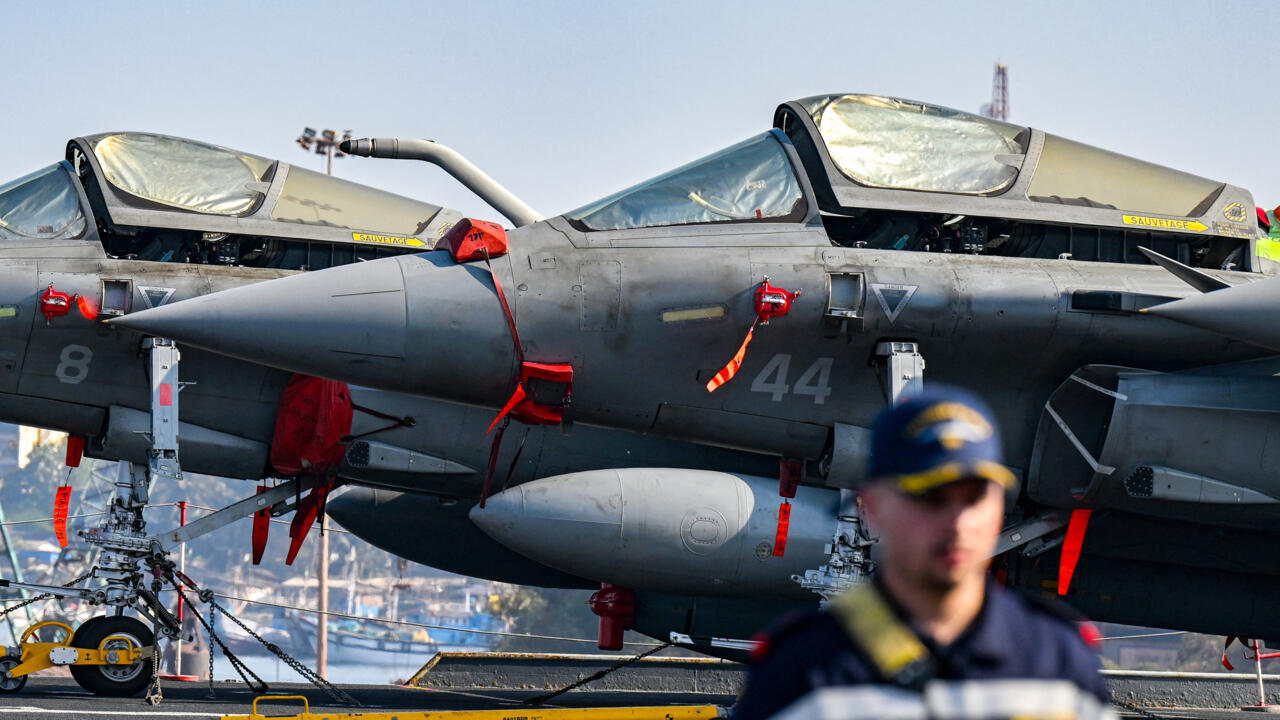
What's your take on Rafale vs Su-35S & Rafale vs Su-57S in both BVR & WVR(with both guns and HOBS IR missiles)?Two Rafale aircraft from the @Armee_de_lair, part of the Baltic Air Policing detachment, intercepted six Russian aircraft IN BALTIC AIRSPACE, including three Su-35, Su-34 and Su-24 fighters, an Il-76 transport aircraft, and two An-12 and An-30 reconnaissance aircraft.
if you would allow me to interrupt,What's your take on Rafale vs Su-35S & Rafale vs Su-57S in both BVR & WVR(with both guns and HOBS IR missiles)?
rafale vs su35S is bascically equal and depends heavily on the circumstances of the battle, same with the su30SM2.
rafale vs su57S in a non networked environemnt without any freindly assets is easy kills for the su57S.
Rafale vs su57S in a networked environment is a 65-35 to the su57 because it now depends in ground based assets and AD etc to limit the su57.


With the tactics France has developed that take into account the Rafale's capabilities, the Rafale today fears no aircraft. When you imagine the most dangerous possible situations with the best aircraft as adversaries and present them to a French Rafale pilot, he replies, "I'm not afraid!"What's your take on Rafale vs Su-35S & Rafale vs Su-57S in both BVR & WVR(with both guns and HOBS IR missiles)?
With the tactics France has developed that take into account the Rafale's capabilities, the Rafale today fears no aircraft. When you imagine the most dangerous possible situations with the best aircraft as adversaries and present them to a French Rafale pilot, he replies, "I'm not afraid!"
Yes, French Rafale pilots are clearly fearless. It seems they are confident the French system won't jail them or they are not afraid of going to jail. As many of them were busy training the Chinese, and maybe even passed on the secrets of the aircraft to the Chinese.
China/France • French court revokes clearance for Rafale instructor who previously trained Chinese pilots - 11/06/2026 - Intelligence Online
A court ruling has revealed that a French former fighter pilot hired as an instructor by Dassault Aviation in 2019 was deemed a security risk and had his clearance revoked after it emerged that he - 6/11/2026
A French former fighter pilot hired as an instructor by Dassault Aviation in 2019 was deemed a security risk and had his clearance revoked after it emerged that he had previously trained pilots for the Chinese People's Liberation Army.
China/France • French probe into ex-pilot's alleged work for Beijing reveals how China gleans Western aviation expertise - 09/04/2025 - Intelligence Online
Frenchman Pierre-Henri Chuet, a former French Air Force pilot turned YouTube star, is the subject of a preliminary investigation by the Paris Public Prosecutor's Office for allegedly spying for - 4/9/2025
At least three French pilots were trained on the Rafale as part of a scheme put in place by Beijing to train its pilots using Western expertise which was first revealed by Intelligence Online in 2019.
"Frenchman Pierre-Henri Chuet, a former French Air Force pilot turned YouTube star, is the subject of a preliminary investigation by the Paris Public Prosecutor's Office for allegedly spying for China. Intelligence Online already reported back in 2019 on how the Chinese army has for years been training with Western pilots.
Former French pilot suspected of sharing defence intelligence with China
A French former naval fighter pilot is under investigation over allegations he shared sensitive military information with Chinese authorities during two training trips to China.
 www.rfi.fr
The pilot, identified by Le Parisien and Mediapart as Pierre-Henri Chuet, reportedly travelled to China in September 2018 and August 2019 to run training sessions for Chinese military pilots.
At the time, he was still serving in the French Navy.
A source close to the case told French media that Chuet did not inform his superiors about the trips, which is required under French defence regulations.

Didn't a declassified French report came out where they said that Rafale with its current sensors can't take on F-35?With the tactics France has developed that take into account the Rafale's capabilities, the Rafale today fears no aircraft. When you imagine the most dangerous possible situations with the best aircraft as adversaries and present them to a French Rafale pilot, he replies, "I'm not afraid!"
EDIT: Found this :

He is french, obviously he will consider french militry in its current form as potent.Didn't a declassified French report came out where they said that Rafale with its current sensors can't take on F-35?
EDIT: Found this :
French are specifically developing Rafake F5 to counter 5th gen threats. Rafale, as of now, doesn't have sensors to detect and attack F-35 at BVR distance.He is french, obviously he will consider french militry in its current form as potent.
Just because they're trying to develope does not mean it can.French are specifically developing Rafake F5 to counter 5th gen threats. Rafale, as of now, doesn't have sensors to detect and attack F-35 at BVR distance.
I will always bet on the group of low experienced piolets with 5th gen than a group of experienced piolets with Rafale F5.

Su-57 is so potent that Russia don't use it againt Ukraine. strange isn't it?if you would allow me to interrupt,
rafale vs su35S is bascically equal and depends heavily on the circumstances of the battle, same with the su30SM2.
rafale vs su57S in a non networked environemnt without any freindly assets is easy kills for the su57S.
Rafale vs su57S in a networked environment is a 65-35 to the su57 because it now depends in ground based assets and AD etc to limit the su57.
a BS source.Didn't a declassified French report came out where they said that Rafale with its current sensors can't take on F-35?
EDIT: Found this :
And what about OSF ?French are specifically developing Rafake F5 to counter 5th gen threats. Rafale, as of now, doesn't have sensors to detect and attack F-35 at BVR distance.
OSF is a stealthy detector, very potent on huge IR trace of, for exemple, F-35.
French polls are so funny
With the failure of FCAS, we will only hear more on how Rafale is really a 6th gen and the best in the world
With the failure of FCAS, we will only hear more on how Rafale is really a 6th gen and the best in the world
That's why I was surprised when the report said that the current sensors aren't good enough to beat F-22/35. Maybe, F-35 uses TWS or RWS modes of APG-81 to paint Rafale outside of reach of OSF. It's a well known fact that F5 will feature the most advance OSF version till date especially tuned to track VLO jets above 150+kms in frontal subsonic state.And what about OSF ?
OSF is a stealthy detector, very potent on huge IR trace of, for exemple, F-35.
Tracking a jet from front with IRST for over 150+km is far from happening any time soon.That's why I was surprised when the report said that the current sensors aren't good enough to beat F-22/35. Maybe, F-35 uses TWS or RWS modes of APG-81 to paint Rafale outside of reach of OSF. It's a well known fact that F5 will feature the most advance OSF version till date especially tuned to track VLO jets above 150+kms in frontal subsonic state.
IRST is passive system, so you can not increase IR signature of target, you need to have larger aperture and better processing system for more resolution.
And even in next 2 decade, we wont seen IRST on fighter jet having over 150km detection range from front.
Put up the specs and I'll show you why you are talking nonsense, I'll start with the difference between scanning and staringAnd what about OSF ?
OSF is a stealthy detector, very potent on huge IR trace of, for exemple, F-35.
Rafale: the silent killer that can spot stealth aircraftPut up the specs and I'll show you why you are talking nonsense, I'll start with the difference between scanning and staring
Published on 6 April 2026 at 7.05 am • Denis Mayet
Stealth fighters think they are invisible. The Rafale tracks them silently from 100 km away thanks to the OSF-IRST, an infrared sensor that emits no detectable signal.
Whilst fifth-generation fighters rely on their radar stealth to evade detection, the Rafale has a system that tracks them without emitting the slightest signal: the Frontal Sector Optronics (OSF-IRST). With the integration of the OSF-IRST into the F4.2 standard, this sensor has just been radically redesigned to counter the threat posed by aircraft with a very low electromagnetic signature.
A new sensor to address an old weakness
Under the F4.2 standard, the Rafale is fitted with an entirely new infrared optical system, known as the OSF-IRST (Infra Red Search and Track). This sensor is not an incremental improvement on the previous system: it restores a capability that Dassault Aviation had deliberately sacrificed during the transition to the F3 standard, when the dual infrared channel was removed in favour of an improved TV channel, deemed sufficient at the time for the missions at hand.
The return of high-intensity threats has rendered that choice obsolete. The proliferation of stealth aircraft — the F-35 in allied or potentially hostile fleets, the Russian Su-57 and the Chinese J-20 — makes it essential to detect aircraft that conventional radars struggle to lock onto. The OSF-IRST specifically addresses this need, providing the Rafale with a passive day-and-night detection capability tailored to this type of target.
A subsequent upgrade is already planned. The F5, expected around 2035, will incorporate a revolutionary IRST whose detection range for LO/VLO aircraft will be directly commensurate with the range of new-generation enemy missiles. This upgrade will accompany the renewal of France’s airborne nuclear capability.
What stealth coatings do not cover
The stealth capabilities of fifth-generation fighters are based on two principles: shapes designed to deflect radar waves, and absorptive materials to reduce their reflection. These treatments operate exclusively within the radio-frequency spectrum.
Optronics operates in a different domain. In the infrared, visible and ultraviolet bands, the absorptive coatings on an F-35 or a J-20 have no effect. The heat produced by the engines, aerodynamic friction at high speeds, the airframe’s raw thermal signature — none of this can be masked by stealth paint. An aircraft undetectable by radar remains a heat source that the OSF can lock onto from over 100 kilometres away.
It is this physical asymmetry, rather than a marginal technological advantage, that underpins the system’s operational value.
80 litres to see 100 kilometres away
Developed jointly by Thomson-CSF — now Thales — and Sagem-SAT, the OSF occupies a volume of 80 litres, housed at the base of the cockpit canopy. This position, as close as possible to the RBE2-AESA radar, is no coincidence: it facilitates data fusion between the two sensors.
In its original design, the system combines a dual-band infrared channel — 3 to 5 micrometres and 8 to 12 micrometres — with a TV channel and a laser rangefinder. The infrared channel detects targets in rain, fog or at night at ranges of over 100 kilometres. The TV channel enables the aircraft to be positively identified and its armament distinguished at ranges of over 50 kilometres. The laser rangefinder measures the distance in three dimensions to prepare for firing.
None of these functions emits any electromagnetic radiation. Enemy aircraft warning systems, designed to detect high-power radar or laser emissions, remain blind to them. The Rafale observes without giving itself away.
Firing at 50 kilometres without being detected
The rules of engagement in force within most Western coalitions require formal visual identification before any fire is opened. This constraint, intended to prevent friendly fire, effectively obliges the pilot to see the target aircraft — which, without a dedicated system, means approaching it to within a few kilometres, i.e. within the lethal range of its missiles.
The OSF’s TV link extends this limit to 50 kilometres. At this distance, the Rafale pilot can formally identify the type of aircraft, assess its weapon configuration, and launch a MICA missile whilst remaining out of range. The target is neutralised before it can engage.
During air policing missions, this capability changes the dynamics of interception. The interceptor maintains a safe distance that most fighters can only achieve by closing in dangerously. For air combat patrols, it grants the initiative: whoever identifies the target first fires first.
Three sensors, a single image
The OSF does not operate in a closed loop. Its data is transmitted to the EMTI — Modular Information Processing System —, the Rafale’s central computer, which merges it in real time with data from the RBE2-AESA radar and the SPECTRA electronic warfare system.
What the pilot receives is not a stream of raw data from three separate sensors, but a Tactical Situation Synthesis Function — a single, pre-processed picture in which each contact is identified and located. In a high-tempo engagement, where decisions are made in a matter of seconds, this reduction in cognitive load is an operational factor in its own right.
SPECTRA detects enemy emissions. The RBE2-AESA measures distances and speeds. The OSF identifies and tracks without emitting any signals. The three work together, and it is their combination — not any one of them in isolation — that constitutes the Rafale’s detection system.
2035: detecting as far as the enemy can fire
The F5 standard, scheduled to enter service around 2035, will introduce a revolutionary IRST. Its defining characteristic is precisely set out in the programme documents: the detection range for stealth aircraft must be ‘directly consistent’ with the range of new-generation enemy air-to-air missiles.
This wording reflects a practical problem. If an enemy fighter can launch a missile from 200 kilometres away, it must be detected at least at that distance to allow for the necessary reaction time. Current IRSTs, including the F4.2’s OSF-IRST, do not meet this threshold against stealth targets. The F5 must bridge this gap.
This programme is set against a backdrop where access-denial bubbles — A2/AD systems — are becoming denser and more extensive. In these zones, emitting an active radar signal is tantamount to revealing one’s position to any adversary equipped with electronic support measures sensors. Submariners have been solving this problem for decades by basing their survival on passive detection. The Rafale F5 programme teams are applying the same principle to fighter aviation.
"The infrared channel detects targets in rain, fog or at night at ranges of over 100 kilometres"
The author Denis Mayet is an idiot, Everything is BS, Rain and fog severely inhibits range due to scattering and absorption, atmospheric dust is also an issue after bombing
put up the specs
The author Denis Mayet is an idiot, Everything is BS, Rain and fog severely inhibits range due to scattering and absorption, atmospheric dust is also an issue after bombing
put up the specs
Last edited:
The Americans have long been turning a conditional capability into a marketing certainty, and repetition eventually becomes the prevailing perception."The infrared channel detects targets in rain, fog or at night at ranges of over 100 kilometres"
The author Denis Mayet is an idiot, Everything is BS, Rain and fog severely inhibits range due to scattering and absorption, atmospheric dust is also an issue after bombing
put up the specs
We do the same here:
This is not surprising. The technical foundation is very real: passive IRST, fusion with SPECTRA and RBE2, optronic identification, multi-sensor architecture. We are not inventing an imaginary capability; we are simply presenting it in the best possible light.
And commercially, this is necessary. A performance described too cautiously quickly becomes invisible when compared with American communications that do not bother with the same precautions.
After all, Lockheed Martin does not run a headline saying: ‘The F-35 is stealthy in certain frequency bands and in certain respects, with availability depending on its configuration’.