PAK-FA / Sukhoi Su-57 - Updates and Discussions

Russian air combat doctrine is to use air defence like S500, S400 against stealth and use aircrafts to go hot, chase and hunt down in WVR. USAF brought in BVR to avoid direct contact with Russian aircrafts because Russian aircrafts have superior kinematics. But it just the matter of few minutes that BVR turns into WVR engagement. There you can't escape Russian aircrafts with powerful radars, no matter if it is F22, F35 or any thing.
 
  • Like
Reactions: Rajput Lion
F404 powers a 6.5 ton aircraft and M88-4E powers a 9.5 ton aircraft. I don't see the problem here.

LCA Mk1A
empty weight = 6.5 tons
thrust = 8.62 tons
TWR = 1.32

Rafale C
empty weight = 9.5 tons
thrust = 7.65 tons x 2
TWR = 1.61

Su-30MKI
empty weight = 18.4 tons
thrust = 12.55 tons x 2
TWR = 1.36

So what's the problem?
That’s not how the math works, kiddo.

First of all, let’s establish the baseline scenario: to satisfy the operational profile of 2 minutes at full afterburner plus 35 minutes at maximum dry thrust for a round-trip combat patrol, the fuel fractions required are highly specific.

Su-30MKI, it must carry 7,600 kg of fuel. Combined with an ordnance package of 4x R-77s and 2x R-73s totaling 980 kg, and an empty weight of 18.8 tons, we look at the official performance charts. Under these exact parameters:

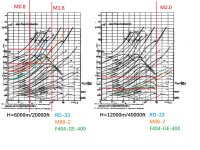
At 6,000 meters / Mach 0.8: The dual AL-31FP engines put out a combined 160 kN of thrust, yielding an overall thrust-to-weight ratio (TWR) of 0.60.
At 6,000 meters / Mach 1.5: The ram effect spikes the total dual-engine thrust to 240 kN, pushing the TWR to 0.90.
At 12,000 meters / Mach 2.0: The thin air drops total thrust to 114 kN, leaving a TWR of 0.43.


Rafale C under the exact same operational profile. It demands 5,500 kg of fuel. Since its internal fuel capacity maxes out at only 4,700 kg, it is forced to bolt on a 115 kg supersonic drop tank. Factor in an air-to-air loadout of 4x MICA and 2x Magic II missiles totaling 1,152 kg, and cross-reference the exact same flight regimes. The Rafale C’s dual-engine thrust figures clock in at 116 kN, 170 kN, and 76 kN, yielding TWRs of 0.73, 1.07, and 0.48, respectively.

Tejas Mk1A. To fulfill this mission, it requires 3,200 kg of fuel. Given its abysmal internal fuel capacity of just 2,458 kg, even assuming it can magically integrate the Rafale's 115 kg supersonic drop tank, you must add that 115 kg penalty. Slap on 4x Astra Mk1s and 2x R-73s totaling 836 kg, and check the charts. Under the identical three test conditions, its total thrust collapses to 47 kN, 60 kN, and 20 kN, resulting in pathetic TWRs of 0.45, 0.57, and 0.19.

Keep in mind, these raw numbers don't even factor in Sukhoi’s massive aerodynamic advantages—such as its Blended Wing-Body (BWB) lift generation and thrust-vectoring superiority—nor do they account for the severe parasitic drag and aerodynamic degradation inflicted on the Rafale and Tejas by forcing them to haul external drop tanks just to stay airborne.


Furthermore, why on earth are you using the Su-30MKI—a heavy, twin-seat strike fighter—as your baseline comparison?

If you look at a single-seat Su-27SM3 paired with the AL-31FM1 (which shifts the entire thrust curve upward by 5% to 10%), the aircraft's empty weight drops to just 16.X tons. Under the exact same mission profiles, its estimated TWRs rocket to 0.73, 1.06, and 0.51, completely obliterating the Rafale across the entire envelope.

Your version of 'armchair physics' is completely disconnected from actual aerospace engineering.

View attachment 52256


So what's the problem?

The root of the problem is that you lack even the most basic aviation common sense.

You take a few flat, isolated numbers off a Wikipedia page and forcefully shoehorn them into your own imaginary, fictionalized universe. You don't even grasp the elementary concept that an engine outputs entirely different thrust levels at varying altitudes and speeds, which means a fighter jet's thrust-to-weight ratio fluctuates constantly under different flight regimes. Instead, you just blindly copy-paste that worthless, sea-level, Mach 0.4 thrust data over and over again, sitting there looking utterly smug about your own ignorance


Are you honestly suggesting that the pathetic, underwhelming Rafale can achieved a thrust-to-weight ratio that outclasses the Su-27—the absolute gold standard of heavy-class supermaneuverability? Or that the F/A-18, that hilarious joke of a 'subsonic brick,' could have its engines ripped Half out and still seamlessly trade blows with a Su-30MKI?

To leap out and look so utterly proud of yourself after concocting such an absurdly bizarre conclusion is truly a sight to behold.

Before anything else, you might want to go back to school and learn how to comprehend the endless pile of PPTs you’re throwing around.

 
Last edited:
小家伙,数学可不是这么算的。

首先,让我们确定基准场景:为了满足往返战斗巡逻中 2 分钟全加力燃烧加上 35 分钟最大干推力的运行要求,所需的燃料比例非常具体。

苏-30MKI战斗机必须携带7600公斤燃料。加上4枚R-77火箭弹和2枚R-73火箭弹共计980公斤的武器载荷,以及18.8吨的空重,我们来看一下官方性能图表。在这些具体参数下:

在 6,000 米/马赫 0.8 处两台 AL-31FP 发动机共产生160 kN的推力,总推重比 ( TWR ) 为0.60
在 6,000 米/马赫 1.5 时:冲压效应使双引擎总推力达到240 千牛,推重比达到0.90
在 12,000 米/马赫 2.0 处:稀薄的空气使总推力下降到114 千牛,推重比为0.43


在完全相同的作战模式下,阵风C型战斗机需要5500公斤燃油。由于其内部燃油容量最大仅为4700公斤,因此必须外挂一个115公斤的超音速副油箱。再加上4枚MICA导弹和2枚Magic II导弹(总重1152公斤)的空对空挂载,并参考完全相同的飞行状态,阵风C型战斗机的双发推力分别为116千牛170千牛76 千牛,对应的推重比分别为0.73、1.07 0.48

Tejas Mk1A 战斗机要完成这项任务需要3200 公斤燃料。鉴于其内部燃料容量仅为 2458 公斤,即使假设它能神奇地集成 Rafale 战斗机的 115 公斤超音速副油箱,也必须加上这 115 公斤的额外重量。再加上 4 枚 Astra Mk1 发动机和 2 枚 R-73 发动机,总重 836 公斤,然后查看图表。在相同的三个测试条件下,其总推力分别骤降至47千牛60 千牛 20 千牛,导致推重比仅为可怜的0.45、0.570.19

请记住,这些原始数字甚至没有考虑到苏霍伊巨大的空气动力学优势——例如其混合翼身(BWB)升力产生推力矢量优势——也没有考虑到阵风和光辉战斗机为了保持飞行而被迫携带外部副油箱所造成的严重寄生阻力和空气动力学性能下降。


此外,你究竟为什么会选择苏-30MKI——一款重型双座攻击战斗机——作为基准比较对象?

如果将单座苏-27SM3AL-31FM1发动机搭配使用(该发动机可将整个推力曲线提升5%至10%),则飞机的空重将降至仅16.X吨。在完全相同的任务剖面下,其推重比预计分别飙升至0.73、1.060.51 整个飞行包线范围内都彻底超越了阵风战斗机。

你所谓的“纸上谈兵的物理学”与真正的航空航天工程完全脱节。

View attachment 52256


问题的根源在于你连最基本的航空常识都缺乏。

你从维基百科页面上摘取几个冷冰冰的数字,硬生生地把它们塞进你自己臆想出来的虚构世界里。你甚至连发动机在不同高度和速度下输出的推力完全不同的基本概念都搞不明白,这意味着战斗机的推重比会在不同的飞行状态下不断波动。相反,你只是盲目地一遍又一遍地复制粘贴那些毫无价值的、海平面、0.4马赫的推力数据,然后坐在那里,一脸沾沾自喜地炫耀自己的无知。


你真的认为那架可怜兮兮、性能平庸的“阵风”战斗机能够达到超越苏-27——重型超机动性战斗机的绝对标杆——的推重比吗?或者你认为那架滑稽可笑的“亚音速砖头”F/A-18,即使发动机被拆掉一半,也能与苏-30MKI轻松交锋?

想出如此荒谬离奇的结论后,还能跳出来一副无比自豪的样子,真是令人叹为观止。

在此之前,你或许应该回学校好好学习一下,如何才能看懂你到处乱扔的那些没完没了的PPT。
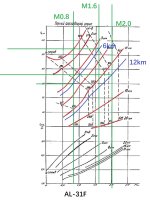
Apologies, I spoke too soon on the last post. I misread the graph and mistook the AL-31F's thrust at Mach 1.6 for Mach 1.5, which unfortunately lowballed the Su-30MKI's actual performance. But hey, even with my data accidentally dialed down, it still completely ran circles over your little paper jet.


↓↓↓↓↓↓↓↓↓↓

7c70df57-c65e-49b4-bf49-2199fa985ff7.png


原图1 - 副本 (2) - 副本 - 副本.jpg
大 - 副本 - 副本.jpg

b4e959ac-5088-42f5-807c-cccbfbea35cf.png
 
Last edited:
So what if AMCA or its engine is not ready, it's a development program that will begin soon. I don't get the point of you attacking AMCA. It serves no purpose. IAF decided to go after AMCA instead of Su-57 because AMCA has been designed to surpass it. If it fails to do that, the IAF will import.

And what's Rafale or Su-30's canards got to do with J-20 or J-10? Canards add more lift, that's all. It's got nothing to do with superiority or inferiority. If your airframe has sufficient lift and controls well at high AoA, then don't add canards. Or else add canards. Rafale adds canards to generate more lift, Su-30 adds canards to stabilise center of gravity due to the heavy nose. The J-10 and J-20 will have canards for their own reasons.

The F110 see a 25% loss in thrust when it's installed in the F-15E. And it's around 20% for F-16 with F100. That's why you get 22000 lbs for F-15E and 24000 lbs for F-16.

When the F-15E starts its engines and goes full burner, the pressure loss in the inlet is 5%, which translates into a direct thrust loss of 10%. Once you take away bleed air for cooling and mechanical energy for electricity generation and other losses, the overall thrust loss is at 25%. So 29500 lbs becomes 22000 lbs at the exhaust.

Here: Mig-29.
View attachment 52252

Your pet jet here's delivering 13600 kgf of installed thrust versus it's uninstalled thrust of 16600 kgf. That's almost 20% loss in thrust.

So what now?

This is not an engine problem, it's an airframe problem.

And who cares what engines the Chinese have ripped off, the only thing that matters is if the performance goal was achieved. If it wasn't, then it failed. But if it has, it doesn't matter if it's of worse quality or better 'cause overhaul doesn't matter when you are fighting. Quality is for peacetime, performance is for wartime.
A 25% installed thrust loss'—you really just love pulling numbers straight out of thin air, don't you?

Like I said before,
every single time you post, you just invent a brand-new lie just to cover up your previous one.

At this point, it’s a statistical nightmare trying to find even two correct sentences in that entire mountain of garbage you just typed

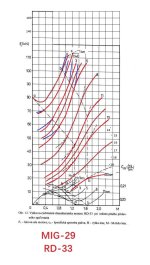
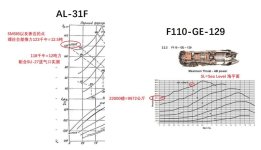
As for exactly how much power the RD-33 loses inside the MiG-29's intake—this exact chart spells it out in black and white. The dashed lines represent the uninstalled thrust, and I’ve highlighted the low-altitude ones in blue.
321- 副本.jpg


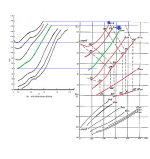
And for your further education, this is the exact comparison chart showing the uninstalled thrust of the AL-31F versus the actual installed thrust curves of the Su-27.
↓↓

原图1 - 副本 (2).png


To claim this somehow reaches a 25% loss from F110-GE-129 is downright delusional.

Just to be absolutely sure, I’m going to keep pressing you on this: what exactly does that 22,000 lbs in your picture equate to in metric tons of thrust? Did GE explicitly leave a footnote telling you that this number already accounts for your imaginary '25% installed loss' or whatever nonsense you're preaching?

Oh, so according to your twisted logic, the gap between the Su-27's installed thrust and test-bench thrust is a mere 500 kg, but somehow the American F-15E suffers a catastrophic 25% loss? Are you seriously trying to tell us that American engineering is that incompetent?
qq_pic_merged_1781198118968.jpg
 
Last edited:
May be fly AMCA with leased Izd177 only for test purpose if that fits in.
Different size, length and diameter both. So its can not fit at all.

And France is not as independent as people think, and France as a state and its population as well as EU is very anti-Russia.

So if CAATSA is imposed on India, there is good possibility that France might stop the engine JV too.

So if we are buying Su-57, we must also insure that we form a JV with Russia for engine development.
 
Now Indians can calmly forget GE414. Su57 will come and then there is plenty of time to develop indigenous engine. May be fly AMCA with leased Izd177 only for test purpose if that fits in.
No way that would fit in the AMCA, the ge414 is meant for medium weight fighters like AMCA, KF21 or other 4th generation aircraft of similar weight category.

Izd 177 is meant for heavy weight aircrafts like Su57, its like 25% longer, 44% wider, 30% heavier and produced like 70-80% more thrust than GE414, even if we completely redesign the AMCA, I'm not sure about it being able to house the engine, a better solution would be to go with the Advanced Heavy Combat Aircraft or AHCA for our 6th gen engine with Izd 177 is the saffran engine isn't deemed good enough.
 
A 25% installed thrust loss'—you really just love pulling numbers straight out of thin air, don't you?

Like I said before,
every single time you post, you just invent a brand-new lie just to cover up your previous one.

At this point, it’s a statistical nightmare trying to find even two correct sentences in that entire mountain of garbage you just typed

As for exactly how much power the RD-33 loses inside the MiG-29's intake—this exact chart spells it out in black and white. The dashed lines represent the uninstalled thrust, and I’ve highlighted the low-altitude ones in blue.
View attachment 52266


And for your further education, this is the exact comparison chart showing the uninstalled thrust of the AL-31F versus the actual installed thrust curves of the Su-27.
↓↓

View attachment 52268


To claim this somehow reaches a 25% loss from F110-GE-129 is downright delusional.

Just to be absolutely sure, I’m going to keep pressing you on this: what exactly does that 22,000 lbs in your picture equate to in metric tons of thrust? Did GE explicitly leave a footnote telling you that this number already accounts for your imaginary '25% installed loss' or whatever nonsense you're preaching?

Oh, so according to your twisted logic, the gap between the Su-27's installed thrust and test-bench thrust is a mere 500 kg, but somehow the American F-15E suffers a catastrophic 25% loss? Are you seriously trying to tell us that American engineering is that incompetent?
View attachment 52267
Why are you arguing about those engine's anyway? Most people know the Flankers are better than the Eagle. So what's the point of this debate?
 
  • Like
Reactions: PhotonVish
Now Indians can calmly forget GE414. Su57 will come and then there is plenty of time to develop indigenous engine. May be fly AMCA with leased Izd177 only for test purpose if that fits in.
The redesign will be too much.
AMCA needs to be built on the Kaveri Derivative Engine. It will be underpowered but atleast we will have complete owner ship of the system. We can re engine with the rd-33 mk it is already produced by us and has fadec. Offers similar lifetime of 4000 hrs to ge414 4000-6000 hrs.

While the ge414 gets produced we need atleast two squadrons of AMCA powered by RD-33.
 
That’s not how the math works, kiddo.

First of all, let’s establish the baseline scenario: to satisfy the operational profile of 2 minutes at full afterburner plus 35 minutes at maximum dry thrust for a round-trip combat patrol, the fuel fractions required are highly specific.

Su-30MKI, it must carry 7,600 kg of fuel. Combined with an ordnance package of 4x R-77s and 2x R-73s totaling 980 kg, and an empty weight of 18.8 tons, we look at the official performance charts. Under these exact parameters:

At 6,000 meters / Mach 0.8: The dual AL-31FP engines put out a combined 160 kN of thrust, yielding an overall thrust-to-weight ratio (TWR) of 0.60.
At 6,000 meters / Mach 1.5: The ram effect spikes the total dual-engine thrust to 240 kN, pushing the TWR to 0.90.
At 12,000 meters / Mach 2.0: The thin air drops total thrust to 114 kN, leaving a TWR of 0.43.


Rafale C under the exact same operational profile. It demands 5,500 kg of fuel. Since its internal fuel capacity maxes out at only 4,700 kg, it is forced to bolt on a 115 kg supersonic drop tank. Factor in an air-to-air loadout of 4x MICA and 2x Magic II missiles totaling 1,152 kg, and cross-reference the exact same flight regimes. The Rafale C’s dual-engine thrust figures clock in at 116 kN, 170 kN, and 76 kN, yielding TWRs of 0.73, 1.07, and 0.48, respectively.

Tejas Mk1A. To fulfill this mission, it requires 3,200 kg of fuel. Given its abysmal internal fuel capacity of just 2,458 kg, even assuming it can magically integrate the Rafale's 115 kg supersonic drop tank, you must add that 115 kg penalty. Slap on 4x Astra Mk1s and 2x R-73s totaling 836 kg, and check the charts. Under the identical three test conditions, its total thrust collapses to 47 kN, 60 kN, and 20 kN, resulting in pathetic TWRs of 0.45, 0.57, and 0.19.

Keep in mind, these raw numbers don't even factor in Sukhoi’s massive aerodynamic advantages—such as its Blended Wing-Body (BWB) lift generation and thrust-vectoring superiority—nor do they account for the severe parasitic drag and aerodynamic degradation inflicted on the Rafale and Tejas by forcing them to haul external drop tanks just to stay airborne.


Furthermore, why on earth are you using the Su-30MKI—a heavy, twin-seat strike fighter—as your baseline comparison?

If you look at a single-seat Su-27SM3 paired with the AL-31FM1 (which shifts the entire thrust curve upward by 5% to 10%), the aircraft's empty weight drops to just 16.X tons. Under the exact same mission profiles, its estimated TWRs rocket to 0.73, 1.06, and 0.51, completely obliterating the Rafale across the entire envelope.

Your version of 'armchair physics' is completely disconnected from actual aerospace engineering.

View attachment 52256


The root of the problem is that you lack even the most basic aviation common sense.

You take a few flat, isolated numbers off a Wikipedia page and forcefully shoehorn them into your own imaginary, fictionalized universe. You don't even grasp the elementary concept that an engine outputs entirely different thrust levels at varying altitudes and speeds, which means a fighter jet's thrust-to-weight ratio fluctuates constantly under different flight regimes. Instead, you just blindly copy-paste that worthless, sea-level, Mach 0.4 thrust data over and over again, sitting there looking utterly smug about your own ignorance


Are you honestly suggesting that the pathetic, underwhelming Rafale can achieved a thrust-to-weight ratio that outclasses the Su-27—the absolute gold standard of heavy-class supermaneuverability? Or that the F/A-18, that hilarious joke of a 'subsonic brick,' could have its engines ripped Half out and still seamlessly trade blows with a Su-30MKI?

To leap out and look so utterly proud of yourself after concocting such an absurdly bizarre conclusion is truly a sight to behold.

Before anything else, you might want to go back to school and learn how to comprehend the endless pile of PPTs you’re throwing around.

The calculations I provided provide the baseline performance of an aircraft at static conditions at sea level. That's apples-to-apples.

The calculations you provided only give the Su-30 the advantage, the other two jets do not operate in that way in those conditions. That's why I said you don't tend to make apples-to-apples comparisons.

And as I said, the only thing the Flankers are good for is long range, which I've already admitted to due to its higher fuel fraction, and that's what you have proved, nothing else has changed.

A Rafale with full strike loadout, with full external fuel, 6 Hammers, and 4 MICAs, gives a range that exceeds the Su-30MKI's clean ferry range. So the real world advantage of the Rafale remains. That static TWR advantage helps achieve this mission, hence 2.6 times the body weight advantage. That's why Su-30 has to choose between fuel and payload, Rafale does not. I don't see where the advantage remains at this point. If Su-30 is to carry external fuel, then it won't carry bombs due to MTOW limitations.

LCA Mk1A's job is interception. It takes off quickly with single engine, uses its very low wingloading to achieve high supersonic agility. It operates from 70 to 120 km from the border, so there's very little need for it to operate at full speed. That's why the IAF is fine with mach 1.6, it will almost never achieve that speed.

For the IAF, the LCA and Rafale do things the Flanker cannot, so they make up for the Flanker's weaknesses.

In air to air role, flight performance alone, the Su-30 provides long range with decent 4th gen era performance in BVR and 5th gen performance using supermaneuverability in WVR. Rafale provides superior sustained 5th gen flight performance in terms of climb, acceleration, supercruise etc. LCA provides the fastest scramble time and is very cheap to operate.

None of these jets have to do 35 minutes of combat patrol at military thrust in India. Plus Rafale cruises at mach 0.9 at 50% dry thrust with its full loadout, so at least your calculation for Rafale is incorrect.

You are unable to appreciate the advantages of real world applications of different technologies within their specific geographical environments.
 
Apologies, I spoke too soon on the last post. I misread the graph and mistook the AL-31F's thrust at Mach 1.6 for Mach 1.5, which unfortunately lowballed the Su-30MKI's actual performance. But hey, even with my data accidentally dialed down, it still completely ran circles over your little paper jet.


↓↓↓↓↓↓↓↓↓↓

View attachment 52265


View attachment 52263
View attachment 52261

View attachment 52264

The F404 thrust curve for LCA is wrong. It uses a new engine with a thrust of 84.5 kN in static conditions. The dry thrust is 54 kN. It's more powerful than M88-2.
 
A 25% installed thrust loss'—you really just love pulling numbers straight out of thin air, don't you?

Like I said before,
every single time you post, you just invent a brand-new lie just to cover up your previous one.

At this point, it’s a statistical nightmare trying to find even two correct sentences in that entire mountain of garbage you just typed

If it's wrong, then try countering them.

As for exactly how much power the RD-33 loses inside the MiG-29's intake—this exact chart spells it out in black and white. The dashed lines represent the uninstalled thrust, and I’ve highlighted the low-altitude ones in blue.
View attachment 52266

The graph I posted came with weapons using the Soviet configuration, the graph you posted is from the German air force using the lighter Warsaw Pact's configuration with clean airframe.

And for your further education, this is the exact comparison chart showing the uninstalled thrust of the AL-31F versus the actual installed thrust curves of the Su-27.
↓↓

View attachment 52268

Yes. Su-27 has excellent inlet pressure recovery of 97-98%. The difference between installed and uninstalled thrust is much lower than for the F-15E.

To claim this somehow reaches a 25% loss from F110-GE-129 is downright delusional.

NASA proved it for sharp-lip inlets vs rounded-inlets.

In particular, at the take-off condition, the total pressure and the mass flow for a choked inlet are only 79 percent of the values ideally attainable with a rounded lip. Experimental data obtained at zero speed with a sharp-lip supersonic inlet model were in substantial agreement with the theoretical results.

Even with inlet design, it does not fully mitigate the loss to the same degree as the Su-27.

This is not an engine problem, it's an aircraft problem.

That's why F-15E's max thrust is 22000 lbs with 131 kN engine but F-16's is 24000 lbs with 129 kN engine.

F100.jpg

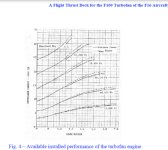
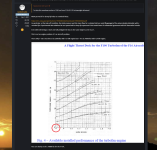
You can clearly see it's 24000 lbs for the F-16A.

Just to be absolutely sure, I’m going to keep pressing you on this: what exactly does that 22,000 lbs in your picture equate to in metric tons of thrust? Did GE explicitly leave a footnote telling you that this number already accounts for your imaginary '25% installed loss' or whatever nonsense you're preaching?

I already said it. 22000 lbs = 9979 kg = 9.979 metric tons.

Yes. The diagram considers the inlet and other losses. You can clearly clearly see the difference between F110 and F100. All American figures we have used in our discussion are installed thrusts.

Oh, so according to your twisted logic, the gap between the Su-27's installed thrust and test-bench thrust is a mere 500 kg, but somehow the American F-15E suffers a catastrophic 25% loss? Are you seriously trying to tell us that American engineering is that incompetent?
View attachment 52267

Yes, why not? The loss is 4% for Su-27 and 25% for F-15E.

Su-27 has been made for faster takeoffs from unprepared, short runways. It has a shorter inlet and better recovery. And it has auxiliary doors that open up to provide more air.

The F-15E requires long takeoff runs, and has a lot of inefficiencies in static conditions. It uses more bleed air to avoid seperation losses. In static conditions, the air flow is not uniform, so the distortions produce inefficiencies in the compressor. It has poor nozzle expansion in static conditions. Couple this with inlet losses, the overall losses are very high. It's simply not been made for subsonic sea level conditions below mach 0.5.

The F-15E comes with better subsonic performance than the F-15A/C while still retaining the subsonic inefficiencies of the F-15A/C below mach 0.5. The F-15E is not a good design for such low speeds. That's why the F-15A/C avoids turning battles.

The Mig-25 frightened the Americans. They overestimated its performance and came out with the F-15A to counter it. In exchange they didn't care much about its low speed performance while maximising its supersonic performance and agility.
 
Why are you arguing about those engine's anyway? Most people know the Flankers are better than the Eagle. So what's the point of this debate?

We're just pointlessly debating.

He's already dismissed everything else of substance. AMCA is fictional. Su-57 is da best. Rafale sucks. So on. There's nothing else left except this, where at least there's official data.
 
  • Haha
Reactions: Rajput Lion
The calculations I provided provide the baseline performance of an aircraft at static conditions at sea level. That's apples-to-apples.
We are both using the exact same 26 letters of the English alphabet, yet for the life of me, I cannot comprehend the absolute gibberish you type out. What on earth do you mean by 'it’s fairer to compare fighter jets using sea-level thrust'? What's your grand plan here? Are these multi-million-dollar air-superiority weapons supposed to be racing down the runway, competing for the fastest cornering speed?

To somehow calculate that an aircraft powered by just half of an F-18’s powerplant—and a legacy F-18C at that, not even an F-18E—could somehow match the thrust-to-weight ratio of a heavy-duty Su-30MKI... you seriously need to check yourself into a hospital and get a psychological diagnosis for your terminal case of Western colonial worship

We're just pointlessly debating.

He's already dismissed everything else of substance. AMCA is fictional. Su-57 is da best. Rafale sucks. So on. There's nothing else left except this, where at least there's official data.
If it's wrong, then try countering them.

The fact remains that nobody on this planet has ever laid eyes on your mythical 'AMCA.' If it actually exists, please, enlighten us with a real photo.
Second, you can't even fabricate a plausible designation for that phantom 110-140 kN engine you keep dreaming up.
Third, the Su-57 remains supreme in its domain. The longest endurance, the sharpest agility, the most powerful radar, the longest-range air-to-air missiles, and the most devastating air-to-ground ordnance—all backed by a brutal, combat-proven record. The mere existence of the Su-57 utterly shatters your fragile worldview.
And fourth, The Rafale is indeed a thoroughly overrated piece of junk. I mean, it’s already 2026, and the fact that there are still clowns hopelessly obsessed with this historical relic is mind-boggling. But watching someone attempt to use it to gaslight the Su-57 is a level of delusional circus I haven't witnessed in all my years on the internet.
Let's be real: running into a MiG-31BM or a Su-35S alone would already result in a swift, chaotic, kinetic slaughter for the Rafale----------It wouldn’t even be a dogfight; it would be a modern-day version of the Great Marianas Turkey Shoot. How anyone possesses the sheer, unadulterated ignorance to try and pit it against a fifth-generation heavy-hitter like the Su-57 is completely beyond human comprehension

If it's wrong, then try countering them.
 
  • Like
Reactions: batman
Listen Im not going to support his claims about the Su57 but asking why russia hasn't achieved air superiority over the densest AD on the planet(or at least among the densest) is very funny.
The claim is it will blow Rafale out of water. So obviously the question is justified. Why can't the plane which can blow the Rafale out of water destroy this air defence? Is SEAD/DEAD not a term?
 
If it's wrong, then try countering them.


The graph I posted came with weapons using the Soviet configuration, the graph you posted is from the German air force using the lighter Warsaw Pact's configuration with clean airframe.


Yes. Su-27 has excellent inlet pressure recovery of 97-98%. The difference between installed and uninstalled thrust is much lower than for the F-15E.


NASA proved it for sharp-lip inlets vs rounded-inlets.

In particular, at the take-off condition, the total pressure and the mass flow for a choked inlet are only 79 percent of the values ideally attainable with a rounded lip. Experimental data obtained at zero speed with a sharp-lip supersonic inlet model were in substantial agreement with the theoretical results.

Even with inlet design, it does not fully mitigate the loss to the same degree as the Su-27.

This is not an engine problem, it's an aircraft problem.

That's why F-15E's max thrust is 22000 lbs with 131 kN engine but F-16's is 24000 lbs with 129 kN engine.

View attachment 52275

You can clearly see it's 24000 lbs for the F-16A.


I already said it. 22000 lbs = 9979 kg = 9.979 metric tons.

Yes. The diagram considers the inlet and other losses. You can clearly clearly see the difference between F110 and F100. All American figures we have used in our discussion are installed thrusts.


Yes, why not? The loss is 4% for Su-27 and 25% for F-15E.

Su-27 has been made for faster takeoffs from unprepared, short runways. It has a shorter inlet and better recovery. And it has auxiliary doors that open up to provide more air.

The F-15E requires long takeoff runs, and has a lot of inefficiencies in static conditions. It uses more bleed air to avoid seperation losses. In static conditions, the air flow is not uniform, so the distortions produce inefficiencies in the compressor. It has poor nozzle expansion in static conditions. Couple this with inlet losses, the overall losses are very high. It's simply not been made for subsonic sea level conditions below mach 0.5.

The F-15E comes with better subsonic performance than the F-15A/C while still retaining the subsonic inefficiencies of the F-15A/C below mach 0.5. The F-15E is not a good design for such low speeds. That's why the F-15A/C avoids turning battles.

The Mig-25 frightened the Americans. They overestimated its performance and came out with the F-15A to counter it. In exchange they didn't care much about its low speed performance while maximising its supersonic performance and agility.
QQ20260616-020411.pngF7279844CA2A5338310066A4977D8FA1111.png


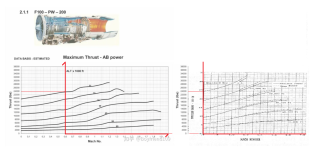
The first chart you posted successfully proved exactly what I said all along: that the US inflates its sea-level engine thrust figures by indexing them to Mach 0.4, whereas Russian engines utilize absolute, zero-velocity static thrust at sea level. Under the rigorous Russian testing benchmark, your precious F110 drops to a measly 10 tons of thrust.

--------------------That image you just provided clearly shows the horizontal axis starting right at '.6'—which matches the installed thrust curves of the F100-PW-200 on the F-15A with virtually zero deviation.
And today, the charts you dumped have once again exposed the truth: the US doesn’t just stop at Mach 0.4 to pad its numbers—they go all the way up to Mach 0.6 just to fake that 'sea-level' performance.


At the same time, you have once again personally debunked your own hilarious lie claiming that 'the F-16's inlet efficiency is far superior to the F-15, which supposedly suffers a 25% thrust loss.' Your own data just proved that entire narrative was nothing but a fabricated joke.

ac9932de0b8680e34ce627b49d193d161.jpg

↑↑↑↑↑↑↑↑
Furthermore, anyone with a shred of aerodynamic common sense knows that the static Pitot inlet on the F-16 is complete trash compared to the F-15's highly advanced, variable-geometry intake. Its pressure recovery efficiency is utterly inferior.
The F-16's static Pitot inlet was sacrificed entirely for extreme lightweighting. Once airspeed exceeds Mach 1.3, its total pressure recovery drops like a stone, as if it slammed into a concrete wall—performing significantly worse than even the ancient F-105.

If it's wrong, then try countering them.


Let me emphasize this one more time: you seriously need to learn how to comprehend the very images you keep spamming before you come here trying to bluff and scam everyone. Without a doubt, you are the undisputed star clown of this entire circus

Just as I predicted, in a desperate attempt to save face, you keep trapping yourself in a vicious cycle: fabricating a second, third, and fourth lie, only to watch them get systematically demolished one by one. You started this stubborn denial to salvage whatever dignity you had left, but the hilarious irony is that you’re only losing more of it with every single post.

By all means, please, keep digging your own grave like this.
 
Last edited:
Ukraine is fielding Mirage 2000 and F16s. If Su57 is so good, why hasn't Russia achieved air superiority over Ukraine?
By your logic, we should cancel the Rafale, go back to buying Mirage 2000s and F-16A/Cs, instead of purchasing Su-57s, Su-75s, or developing things like AMCA.
Iran "defeated" the United States with F-5s and a few beat-up F-14s, so the U.S. should retire its F-22s and F-35s and go back to buying F-5s and F-14s — besides, I just like Top Gun.
And let's not forget: in the '90s, NATO coalition forces bombed Serbia — a country not even as big as the Donbas region — for 40 days, yet they still couldn't hunt down and wipe out all the MiG-29s. Those battle-hardened "three-dynasty veterans" are still serving in Serbia today, and have even been equipped with Chinese missiles.
As for the F-117 and F-35, they must have been shot down by magic, or maybe the American pilots sneezed or something. Might as well just go back to 1963. — In Vietnam, the U.S. military lost nearly 9,000 aircraft, lost the war, and its air force was utterly worthless.