

Eurofighter Typhoon - Updates and Discussions
- Thread starter Ashwin
- Start date
You are using an out of date browser. It may not display this or other websites correctly.
You should upgrade or use an alternative browser.
You should upgrade or use an alternative browser.


BAE says its Eurofighter pipeline is filled until first GCAP assembly
Europe accounted for 32% of the BAE order book at the end of December, while accounting for 11% of sales in 2025, the company said.
 www.defensenews.com

Image analysis and comparison
It's crap.
Paper documents, super complex tooling, tedious setup. In short, it comes down from underneath, but it's not as simple as on the Rafale.
Any other comments on the hatches, the removal of the leading-edge slats?
No, actually, the slats don't bother me. Neither do the hatches, except for their manufacture. They're incredibly complex, with lots of changes in shape and reinforcements. In short, a nightmare to make.
The alternator bays: there are hydraulic pipes running in front of the equipment. No maintenance can be done without opening the circuits, so it requires a partial drain, then purging. It takes time. Clearly, not much effort was put into designing a slightly more organized bay… Now, I'm not saying that on the Rafale they never remove a pipe to access equipment. But not to this extent.
For the engine removal, the fact that the apex is removed immediately after the lift arrives is a real pain. It's a stupid solution that wasn't considered during the aircraft's design.
Above the aircraft, I hadn't noticed, but they remove an entire panel to access their lifting equipment. There are no panels on the Rafale, no access hatches. Just a trunnion for the gantry cable, and that's it. They also don't need to remove the ridge coverings or the apex at the base of the tail fin. It's a huge amount of disassembly for very little gain. Again, they clearly didn't consider the ease of access for attaching the engines.
And I love the tools they carry at arm's length and swing over the aircraft. Zero safety, and everything is done manually…
At our company, Snecma developed a specific engine hoist that moves and conforms to the shape of the aircraft's side. But we can do this because our engine hatches are removed and taken off the aircraft. On the Typhoon, they're just open, which prevents us from passing tools underneath the plane.
Speaking of engine hatches, ours don't have hinges like theirs, just captive screws attached to them. It's simple but incredibly effective; the screws stay on the hatch, and the hatch comes off the aircraft. And we don't risk cracking our skulls like on their planes (where the screws stay on the aircraft and stick out when they're not tightened).
Similarly, the trolley that receives the removed engine is a funny thing. No shock absorbers, nothing. The thing must be getting a real beating from every bump… Our trolleys are equipped with slats and springs; it's more comfortable than a Citroën Xantia Activa.
But what shocked me the most is how clean their planes are, damn it. Don't they ever fly? Here, we clearly don't have time to wash them. Maintenance done, they go back to the tarmac; we'll see about washing them when they're turned into flowerpots.
A small example of the tooling that fascinates me most on the Rafale: the radar. Thales has created a marvel of engineering, full of common sense.
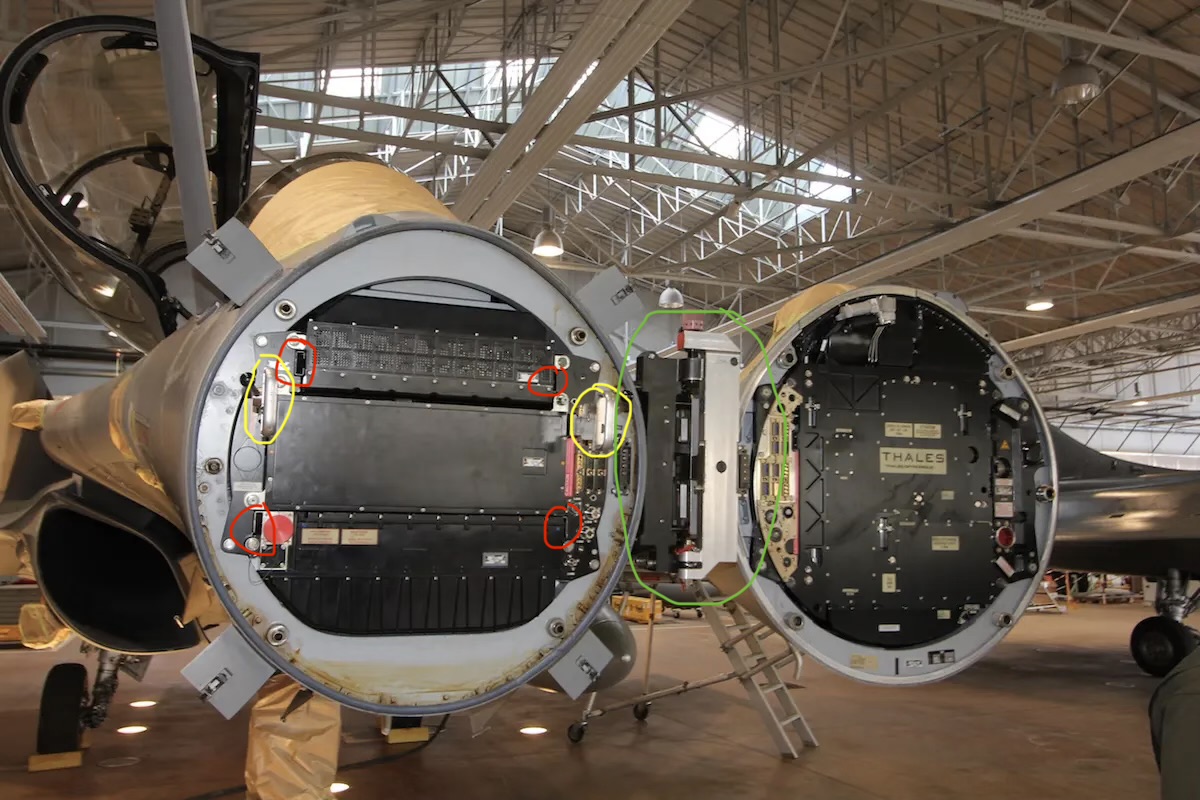
In green, the tooling that holds the radar housing, with the radar inside, and allows for the addition of accessories to the axis.
In yellow, the two handles that allow the equipment to be removed from the entire radar bay. In red, the openings of the slides into which the handles fit.
You unscrew the two or four screws of the equipment, pull, and that's it. No cables, nothing. And it's the same ease for each module. You just need two people for the larger ones because they are quite heavy!
To remove the radar, a kind of hoist, with a rail and winch, is added to the green tooling, and the radar is lifted out of its housing and lowered onto its trolley.
Everything is so well thought out. From the design of the plug&play modules to the installation/removal tools, and with all modules equipped with slides, nothing needs to be added, everything is integrated. I love it.
You can switch radars in no time. Whether it's PESA or AESA, the modules are physically identical, and for the aircraft, it makes no difference.
It's crap.
Paper documents, super complex tooling, tedious setup. In short, it comes down from underneath, but it's not as simple as on the Rafale.
Any other comments on the hatches, the removal of the leading-edge slats?
No, actually, the slats don't bother me. Neither do the hatches, except for their manufacture. They're incredibly complex, with lots of changes in shape and reinforcements. In short, a nightmare to make.
The alternator bays: there are hydraulic pipes running in front of the equipment. No maintenance can be done without opening the circuits, so it requires a partial drain, then purging. It takes time. Clearly, not much effort was put into designing a slightly more organized bay… Now, I'm not saying that on the Rafale they never remove a pipe to access equipment. But not to this extent.
For the engine removal, the fact that the apex is removed immediately after the lift arrives is a real pain. It's a stupid solution that wasn't considered during the aircraft's design.
Above the aircraft, I hadn't noticed, but they remove an entire panel to access their lifting equipment. There are no panels on the Rafale, no access hatches. Just a trunnion for the gantry cable, and that's it. They also don't need to remove the ridge coverings or the apex at the base of the tail fin. It's a huge amount of disassembly for very little gain. Again, they clearly didn't consider the ease of access for attaching the engines.
And I love the tools they carry at arm's length and swing over the aircraft. Zero safety, and everything is done manually…
At our company, Snecma developed a specific engine hoist that moves and conforms to the shape of the aircraft's side. But we can do this because our engine hatches are removed and taken off the aircraft. On the Typhoon, they're just open, which prevents us from passing tools underneath the plane.
Speaking of engine hatches, ours don't have hinges like theirs, just captive screws attached to them. It's simple but incredibly effective; the screws stay on the hatch, and the hatch comes off the aircraft. And we don't risk cracking our skulls like on their planes (where the screws stay on the aircraft and stick out when they're not tightened).
Similarly, the trolley that receives the removed engine is a funny thing. No shock absorbers, nothing. The thing must be getting a real beating from every bump… Our trolleys are equipped with slats and springs; it's more comfortable than a Citroën Xantia Activa.
But what shocked me the most is how clean their planes are, damn it. Don't they ever fly? Here, we clearly don't have time to wash them. Maintenance done, they go back to the tarmac; we'll see about washing them when they're turned into flowerpots.
A small example of the tooling that fascinates me most on the Rafale: the radar. Thales has created a marvel of engineering, full of common sense.
In green, the tooling that holds the radar housing, with the radar inside, and allows for the addition of accessories to the axis.
In yellow, the two handles that allow the equipment to be removed from the entire radar bay. In red, the openings of the slides into which the handles fit.
You unscrew the two or four screws of the equipment, pull, and that's it. No cables, nothing. And it's the same ease for each module. You just need two people for the larger ones because they are quite heavy!
To remove the radar, a kind of hoist, with a rail and winch, is added to the green tooling, and the radar is lifted out of its housing and lowered onto its trolley.
Everything is so well thought out. From the design of the plug&play modules to the installation/removal tools, and with all modules equipped with slides, nothing needs to be added, everything is integrated. I love it.
You can switch radars in no time. Whether it's PESA or AESA, the modules are physically identical, and for the aircraft, it makes no difference.
Last edited:


Germany Unveils Latest Tranche 4 Eurofighter
With an advanced radar and other upgrades, the Tranche 4 Eurofighter is increasingly central to Berlin’s airpower plans. With cutting-edge radar and other upgrades, the Tranche 4 Eurofighter is increasingly central to Berlin’s airpower plans.
 www.twz.com
Tranche 4 aircraft unveiled today still lacks the PIRATE (Passive InfraRed Airborne Track Equipment). The important forward-looking infrared and infrared search and track sensor was omitted by Germany, originally on budget grounds.

Germany Unveils Latest Tranche 4 Eurofighter
With an advanced radar and other upgrades, the Tranche 4 Eurofighter is increasingly central to Berlin’s airpower plans. With cutting-edge radar and other upgrades, the Tranche 4 Eurofighter is increasingly central to Berlin’s airpower plans.
Tranche 4 aircraft unveiled today still lacks the PIRATE (Passive InfraRed Airborne Track Equipment). The important forward-looking infrared and infrared search and track sensor was omitted by Germany, originally on budget grounds.
The German-Spanish ECRS Mk1 radar is still not ready...As such, the ECRS Mk 0 is fitted in aircraft for Kuwait and Qatar, and initial Tranche 4 deliveries for Germany.
The Mk 1 is the definitive standard for Germany and Spain, with the German Tranche 4s being delivered with the so-called ECRS Mk 1 Step 0 configuration (effectively, a Mk 0 with a new antenna). In a second development phase, the Mk 1 Step 1 configuration will be installed in the Quadriga aircraft from mid-2027.
Meanwhile, the United Kingdom gets the more advanced ECRS Mk 2, which you can read about here.
UK details billions in upgrades to Typhoon fighter jets
New radar, communications, defensive aids and an upgraded helmet sight for 107 Typhoon jets are covered by the Defence Investment Plan's Typhoon spending, MPs have been told.
 ukdefencejournal.org.uk
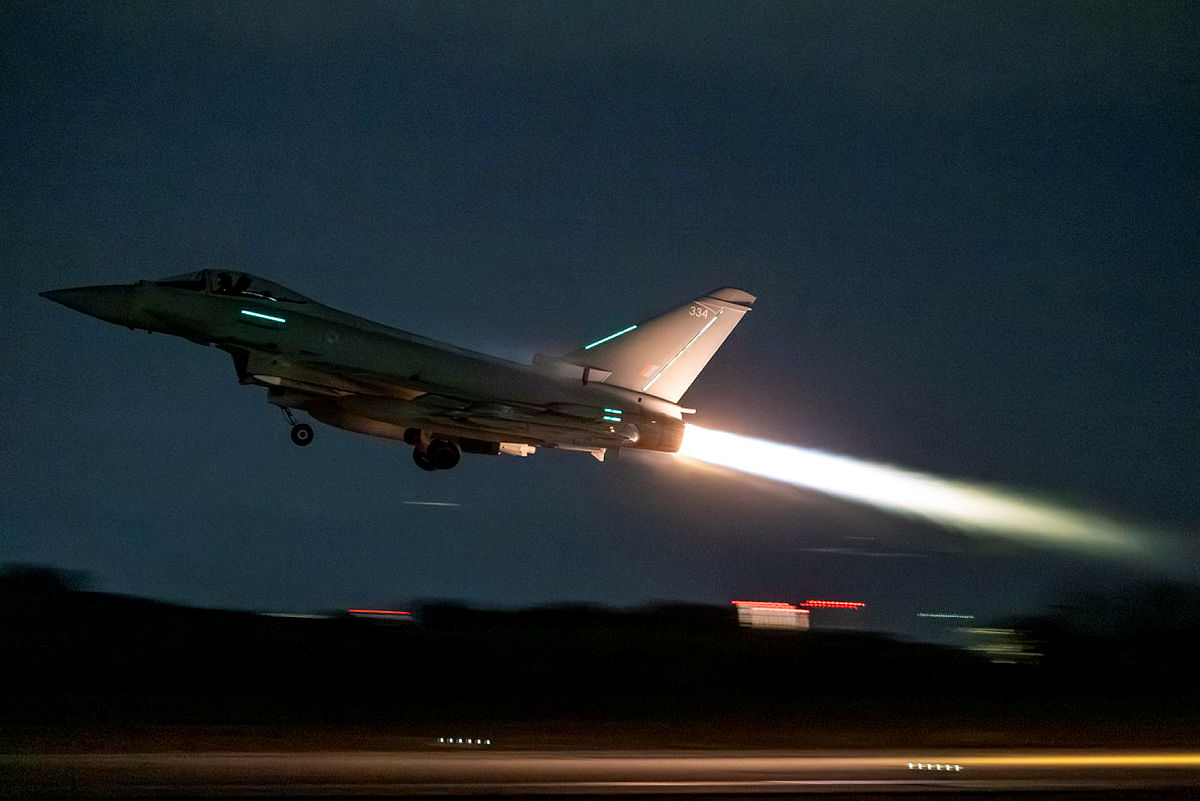
The Ministry of Defence has set out how it will spend £5.4 billion maintaining and upgrading the UK’s Typhoon fleet, confirming the programme covers 107 aircraft and includes new radar, communications, software, defensive aids and an upgraded helmet-mounted sight.

Half a billion investment to upgrade RAF Typhoons and secure 1,500 British jobs
The government has this week committed over £650 million to upgrade the RAF's Typhoon fighter jet fleet, securing over 1,500 jobs across the UK.
The investment will deliver an additional 40 advanced European Common Radar System (ECRS) Mk2 radars for RAF Typhoons, including 38 new systems and modifications to two test systems, ensuring radars will be fitted to 40 aircraft. These radars will simultaneously detect, identify and track multiple targets in the air and on the ground.
The ECRS Mk2 radar will ensure the RAF maintains its operational advantage in contested environments. It provides high-powered jamming capability whilst engaging targets beyond the reach of threats.
reading elsewhere it's unclear whether the modules are GaN and GaAs, or whether the GaAs is used elsewhere.
Last edited:
In older articles, I read that the ECRS Mk2 antenna uses a mix of GaAs and GaN T/R modules; I believe this is to reduce the cost of the antenna, which comprises a large number of modules.reading elsewhere it's unclear whether the modules are GaN and GaAs, or whether the GaAs is used elsewhere.
Typhoons Paired With CCA Fighter Drones Armed With Meteor Missiles Eyed By UK
https://www.twz.com/air/typhoons-pa...-drones-armed-with-meteor-missiles-eyed-by-ukThe emerging concepts envision Typhoon commanding loyal wingman drones with help of new radar and next-gen cockpit.