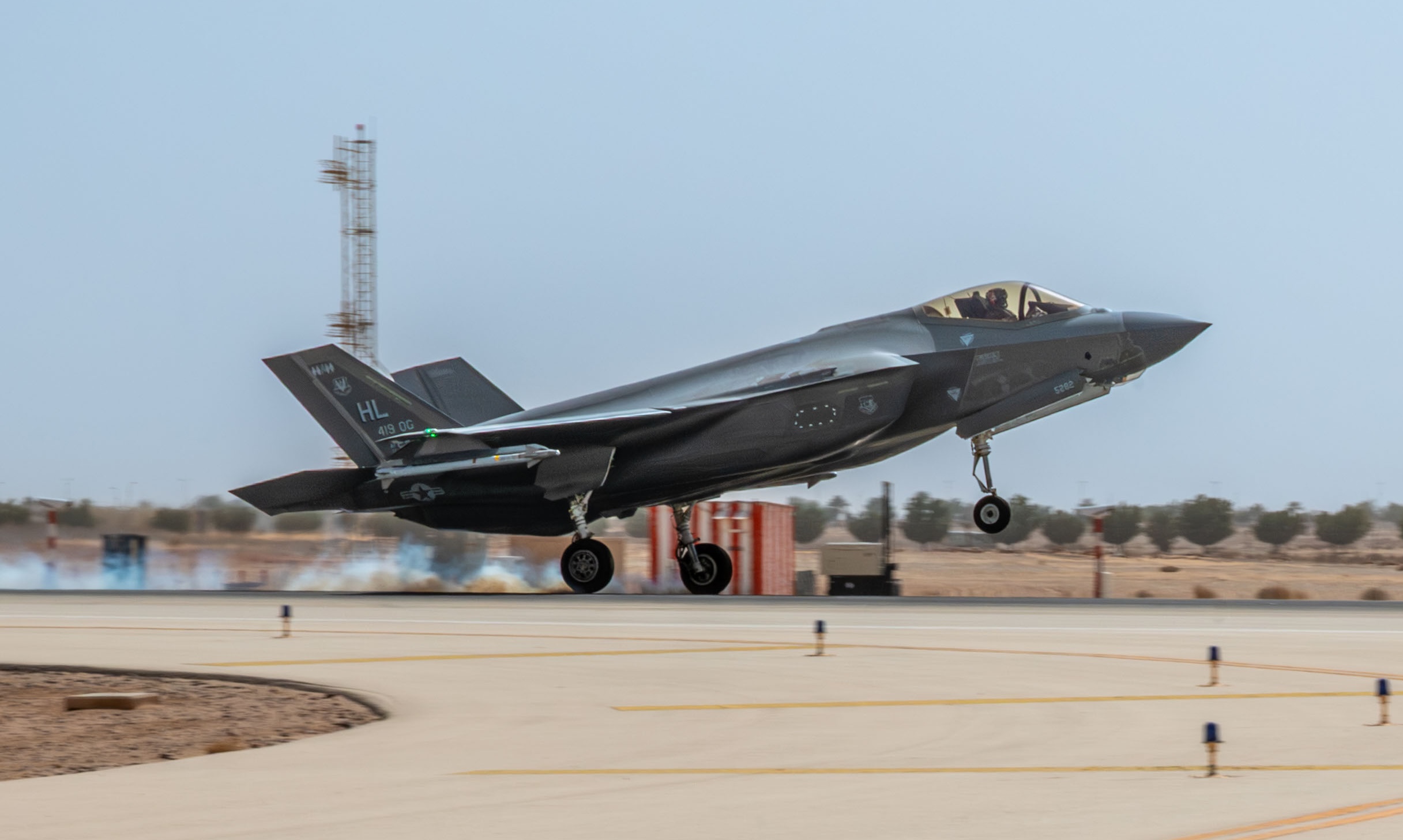
Lockheed Martin F-35 Lightning and F-22 'Raptor' : News & Discussion

The GaN antenna on Rafales will be modular and will be ready by 28-29. It will have options to control uavs inbuilt in it. Spectra also will get an update during the same time based on the new radar. At least what I read online.
Don't take my comments to Radio too seriously, There is a lot of teasing
Rafale will likely get a GaN antenna upgrade, before 2030, I also read that, It is like the AESA upgrade on the RBE2, The disadvantage is that it still has the old backend, I haven't seen where the promised upgrade, for Indian specific requirements have been delivered

The new radar will likely be mid 30's
 
  • Like
Reactions: Rajput Lion
Don't take my comments to Radio too seriously, There is a lot of teasing
Rafale will likely get a GaN antenna upgrade, before 2030, I also read that, It is like the AESA upgrade on the RBE2, The disadvantage is that it still has the old backend, I haven't seen where the promised upgrade, for Indian specific requirements have been delivered

The new radar will likely be mid 30's

New radar for 2030, the old radar could be upgraded with GaN from the time the IAF signed the deal in 2016. The French DGA seemed to have put a stop to it. They didn't want a foreign air force getting more advanced capabilities before them. Apparently, they denied the technology to India simply because they themselves couldn't afford it. They couldn't get it done even for F4.

So yeah, RBE2 could have had GaN operational by 2019 had they been a lot more flexible. Years before the Hornet, a decade before the F-35.

I'm hoping the deal for 114 will come with GaN right from the start, while the French get the new RBE2 XG at the same time, ie, 2030. Of course, I'm hoping we are gonna get it with the navy's deal too.
 
There is a bit of chaos with the FCAS dying, So they will need to recost and defer a lot of stuff, To fund whatever the new aircraft will be

Dassault would actually like that to happen. They don't seem too keen on it, at least with Germany.

While Macron wants a JV with Germany, Dassault prefers to keep developing Rafale instead while pushing a next gen program to a later date. They believe Rafale F5 can compete with 6th gen too.

I don't know when you think Hornet got/will get GaN, but it was 4 years ago Feb 2022


Yeah, and RBE2 was capable of getting GaN anytime after 2016. I only said 2019 'cause that's when IAF got their first Rafales. The French could have deployed GaN anytime they wanted after 2016, years before Hornet would get GaN in 2022.
 
  • Like
Reactions: Rajput Lion

F-35 availability will drop as corrosion backlog clears


The Ministry of Defence has warned that F-35 availability will fall in the short term as it works through a backlog of corrosion-related maintenance, according to a letter from Permanent Secretary Jeremy Pocklington to the Public Accounts Committee.​

Pocklington’s letter, dated 30 April 2026, describes corrosion worsened by maritime exposure as a growing concern that “impacts the availability of aircraft and will need constant management throughout the life of the programme.” While acknowledging the issue affects all F-35 nations, the letter states that “as maintenance activities intensify a short-term reduction is expected to clear the backlog.”

The MoD says it is addressing the problem through enhanced corrosion awareness and preventative practices at front line squadrons, deeper inspections conducted with UK and US industry partners, the development of more corrosion-resistant solutions within the wider F-35 programme, and by pushing the F-35 Joint Programme Office and industry to create what the letter describes as “rapid, agile and coordinated responses to corrosion occurrences.”

The admission of a forthcoming availability reduction is notable given that the PAC’s October 2025 report already found F-35 availability to be below both UK and global programme targets. The corrosion problem was exacerbated during Operation HIGHMAST, the carrier strike group deployment to the Middle East, with the letter noting that prolonged maritime deployment worsened corrosion issues and increased post-deployment recovery time. Those lessons have since informed planning for subsequent detachments including the early 2026 Cyprus deployment.

Corrosion is a challenge for carrier-based aviation more broadly, with salt air and humidity accelerating degradation of airframe components and coatings. For a stealth aircraft like the F-35, whose radar-absorbent surface treatments are critical to its low-observable characteristics, corrosion management carries operational as well as maintenance implications.
 
@Picdelamirand-oil

Post 3819

3822

What do you think?
 
  • Like
Reactions: Rajput Lion

The Pentagon Declared The F-35's Most Critical Upgrade 'Predominantly Unusable'

After a prolonged battery of testing and evaluation, the US Armed Forces determined that the latest fleetwide upgrade to the flagship Joint Strike Fighter stealth aircraft has failed to deliver any new combat capabilities. In 2024, Lockheed Martin upgraded the fleet of 5th-generation F-35 Lightning II fighter jets with the technology refresh 3 software package. Published in March 2026, the 2025 report from the Director of Operational Test and Evaluation does not expect full capability until 2031.

The fallout from this situation includes a massive cut to 2026 orders for the F-35. The current budget drafted by the Pentagon slashes USAF F-35A procurement by 45%, according to Defense News. The USAF is also significantly increasing funding for the 6th-Gen Next Generation Air Dominance program, with as much as $5 billion potentially being allocated. Allies that fly the F-35 are now reconsidering their full order quantities, such as Canada, Switzerland, and the United Kingdom, and even some potential sales have fallen through, such as the proposals to Spain and Portugal.

Not only did the new software fall short of the 37 times better processing power and 20 times increased memory that it promised, but the software has been barely usable since rollout. After initial delivery, the Department of Defense pushed to declare that it was unsuitable for dedicated operational testing. The testing cycle is 3 years behind schedule now. TR-3 software is still undergoing a fly-fix-fly process at Edwards Air Force Base to address chronic crashes and bugs.

All In On NGAD


The Pentagon cannot dub the TR-3 upgrade 'mission-ready' until it completes the cycle underway now. As a result, the fleet is limited in capabilities like electronic warfare and advanced sensor functions. This is made worse because it is compounded by a supply chain issue that has seen recent examples of the F-35 delivered without a radar at all. Heralded as the next evolution in air power for the US and its allies, the JSF program has come under scrutiny and intense criticism due to these shortcomings.

The US Air Force originally planned to buy 48 of the land-based, conventional F-35A variant for the USAF in 2026, but is now reducing that to just 24. On top of that, critics from within the military and federal government argue that continuing to invest funding in an aircraft that has been problematic since its debut represents a sunk cost that may not return on investment. Opponents proposed that funding the NGAD is a better alternative now that Boeing has begun working on the 6th-Gen F-47 after being awarded the contract in early 2025.

Redirecting funding from the F-35 can accelerate development of the NGAD as well as the Collaborative Combat Aircraft, or loyal wingman drones, that are now also entering the final stages of prototyping. The first F-47 is not expected to fly until 2028, but the aggressive schedule that the US has established would make it the first to field a combat-capable 6th-Gen stealth fighter paired with CCAs if it can successfully deliver by 2030.

The 30,000 Foot View​

After a prolonged battery of testing and evaluation, the US Armed Forces determined that the latest fleetwide upgrade to the flagship Joint Strike Fighter stealth aircraft has failed to deliver any new combat capabilities. In 2024, Lockheed Martin upgraded the fleet of 5th-generation F-35 Lightning II fighter jets with the technology refresh 3 software package. Published in March 2026, the 2025 report from the Director of Operational Test and Evaluation does not expect full capability until 2031.

The fallout from this situation includes a massive cut to 2026 orders for the F-35. The current budget drafted by the Pentagon slashes USAF F-35A procurement by 45%, according to Defense News. The USAF is also significantly increasing funding for the 6th-Gen Next Generation Air Dominance program, with as much as $5 billion potentially being allocated. Allies that fly the F-35 are now reconsidering their full order quantities, such as Canada, Switzerland, and the United Kingdom, and even some potential sales have fallen through, such as the proposals to Spain and Portugal.

Not only did the new software fall short of the 37 times better processing power and 20 times increased memory that it promised, but the software has been barely usable since rollout. After initial delivery, the Department of Defense pushed to declare that it was unsuitable for dedicated operational testing. The testing cycle is 3 years behind schedule now. TR-3 software is still undergoing a fly-fix-fly process at Edwards Air Force Base to address chronic crashes and bugs.

What Is Block Four?

The broad and sweeping improvement that was expected from the newest upgrade to Fat Amy's software, as the F-35 is dubbed, was a bump up in 'computational horsepower.' The optimized algorithms to refine and streamline on-board processing would make the F-35 a true 'quarterback' on the battlefield as it is intended to be. Given the ongoing issues, the jet remains incapable of truly fulfilling its primary mission as the premier 5th-Gen stealth fighter of 20 air forces around the world.

TR-3's Block Four upgrades were intended to significantly improve the capability of the AN/APG-85 active electronically scanned array radar to make it compatible with a wider range of long-range precision weapons, potentially including hypersonic missile integration. The unstable and defective software has left this option locked out for the USAF until it can be remedied.

Block Four was also meant to significantly improve the performance of the Next Generation Distributed Aperture System. This would unlock more powerful infrared imaging and tracking capabilities that the airplane already has the hardware to employ. Just like the radar on the F-35, all of the necessary components are already installed, but the software of the TR-3 package cannot enable their use until it is fixed.

The Pentagon now expects fully combat-capable software later this year. The Block Four modernization has been significantly reimagined and downscoped to ensure a more predictable delivery pace. The engine core upgrade by Pratt & Whitney that was originally intended to improve system power and cooling is being pushed out to 2030 at the earliest. Lockheed is focused on upgrades for weapons, radar, and other sensors in the short term, but with the ECU delay, Block Four will not be fully delivered until at least 2031, according to Breaking Defense.

The F-35's Headache

Some of these specific issues that have been reported include the 360-degree DAS camera system flagging or freezing. This is the stitched EO/IR view that allows the F-35 pilots to look through the bottom of their plane via the helmet-mounted display. Lockheed Martin promised a 'God's eye view' with the HMDS III and DAS system pairing, but it is currently limited to training use and unavailable for full combat application.

Another vital area in which the JSF was designed to provide a technological upgrade from legacy airframes was electronic warfare. The issues with TR-3 have also hamstrung the AN/ASQ-239 suite. It is engineered to be a kind of digital shield by providing enemy sensor detection and jamming. With the current limitations, it only provides simple threat detection from targeting radar, like surface-to-air missiles or enemy fighter jets, instead of the advanced electronic attack functions that were promised.

One of the more significant weapons-related problems that stems from the TR-3 delays is the inability to use the new 'sidekick' air-to-air missile racks designed to increase the F-35's internal capacity from four to six AIM-120D3 or Joint Strike missiles. Beyond that, the newly integrated core processor continues to underperform, and the aircraft suffers from overheating issues because of all the strain the systems put on the P&W F135 engine to generate electricity.

A Global Burden​


The F-35 production line has rolled out more than 1,300 aircraft that now serve three branches of the US military and a growing list of 19 partner nations. The cascading delays and trickle-down system limitations are having just as significant an impact on readiness and capability outside of the US. As the next era in air power for any allied partner nations, air forces around the world have divested their legacy airframes and retired 4th-Gen fighter jets that were in service, which has left them facing chronic problems for their entire fleet, in some cases.

Countries like Denmark and Belgium have committed to donating their older F-16s to Ukraine. Because their new F-35s arrived late or in training-only condition, they have had to extend the service life of their F-16s, slowing down the transfer of those jets to the front lines. Denmark was even forced to recall six of its older TR-2 jets from Luke Air Force Base to its home soil, according to Air and Space Forces Magazine. They did this to maintain a basic level of pilot training while they wait for combat-ready TR-3 aircraft that are currently stuck in testing.

Israel remains the most active combat user, with its F-35I Adir. While they have received new jets as recently as January, they are managing the crisis differently because they have unique permission to install domestic hardware and software. TR-2 aircraft are currently serving as the tip of the spear because of the more stable operating system build, according to the Jerusalem Post. At the same time, the IAF has bypassed some of the software bottlenecks meant for newer munitions and deployed legacy ordnance available on hand, like JDAMs, using under-wing hardpoints.

 
  • Like
Reactions: Rajput Lion
@Picdelamirand-oil

Post 3819

3822

What do you think?
Normally, we don't have technical issues with buses because radio links will always be slower than buses.
 
  • Like
Reactions: Rajput Lion
Normally, we don't have technical issues with buses because radio links will always be slower than buses.

That's not what I was talking about.

What I managed to prove here is the F-22 and F-35 use low-level sensor fusion using I/Q signals while Rafale uses mid-level sensor fusion using plots. This means Rafale's sensor fusion is a generation behind the F-22 itself, while the F-35 with its greater array of sensors is at an even more complex level to the point of non-comparison.

Rafale F5 intends to catch up with this standard, hence the need for a new bus to compete with the bus that's 100 times faster than what's on the F4. CMAC's developing a bus that's up to 500 times faster than the existing bus.

There was talk of a 1 Gbps line in Typhoon as an upgrade to the 3910 as part of AESA upgrade, thereby the assumption that RBE2 would need it to when it converted to AESA, but it turned out to be a cumulatively added number across multiple buses rather than a single line between sensor and processor, which led to the incorrect assumption that it would match/exceed the link in the F-22. Both jets have just 20 Mbps instead. There's a 2015 upgrade for the Typhoon that would have raised it to 100 Mbps, but wasn't taken up at the time, probably because the radar was delayed. So now we have the new 10 Gbps upgrade for next gen. It could also primarily be meant for GCAP instead of Typhoon, although it's unclear if GCAP will also use 3910.
 
That's not what I was talking about.

What I managed to prove here is the F-22 and F-35 use low-level sensor fusion using I/Q signals while Rafale uses mid-level sensor fusion using plots. This means Rafale's sensor fusion is a generation behind the F-22 itself, while the F-35 with its greater array of sensors is at an even more complex level to the point of non-comparison.

Rafale F5 intends to catch up with this standard, hence the need for a new bus to compete with the bus that's 100 times faster than what's on the F4. CMAC's developing a bus that's up to 500 times faster than the existing bus.

There was talk of a 1 Gbps line in Typhoon as an upgrade to the 3910 as part of AESA upgrade, thereby the assumption that RBE2 would need it to when it converted to AESA, but it turned out to be a cumulatively added number across multiple buses rather than a single line between sensor and processor, which led to the incorrect assumption that it would match/exceed the link in the F-22. Both jets have just 20 Mbps instead. There's a 2015 upgrade for the Typhoon that would have raised it to 100 Mbps, but wasn't taken up at the time, probably because the radar was delayed. So now we have the new 10 Gbps upgrade for next gen. It could also primarily be meant for GCAP instead of Typhoon, although it's unclear if GCAP will also use 3910.
You under estimate Rafale: as soon as the 3910 bus was available, Rafale used it and the Rafale fusion is able to use low-level sensor fusion using I/Q signal natively and it is what's done with embeded sensor (Radar, IR, GE, pod...) the only problem was to external sensor due to the data link. But the new datalink is for F4 and not for F5.
 
  • Like
Reactions: Rajput Lion
You under estimate Rafale: as soon as the 3910 bus was available, Rafale used it and the Rafale fusion is able to use low-level sensor fusion using I/Q signal natively and it is what's done with embeded sensor (Radar, IR, GE, pod...) the only problem was to external sensor due to the data link. But the new datalink is for F4 and not for F5.

RBE2 has a signal processor, not just a down converter. On the F-22, the radar only has a down converter to generate I/Q signal and then the I/Q signal is transferred over to the CIP for signal processing.

With just 20 Mbps, it's impossible to transfer I/Q signals to MDPU. I/Q memory generation capacity is as high as 2 or 3 Gbps to 5-10 Gbps. Once decimated, you can reduce that to hundreds of Mbps, which is what we see on F-22. So we need a HS fiber line with a few hundred Mbps to transfer to the processor.

On the F-35, I/Q signals are in Gbps 'cause of advanced SAR imagery and GMTI. So it needs a 2 Gbps bus.

But Rafale has only 20 Mbps, not 1 Gbps, which means the signal processor on RBE2 generates plots and then transfers plots over to the MDPU. For this you only need <1 Mbps for multiple A2A plots and about 10 Mbps for SAR imagery. It's enough for 1-3 m resolution SAR images. The 1 Mbps limit on MKI is also why Bars can only transfer 20-30 m SAR images.

Basically, full 3D map generation is done by the RBE2 itself before sensor fusion in MDPU. Whereas on F-22 and F-35, all functions after down conversion are carried out by the CIPs.

What works in Rafale's favor is the F-22 came with limited avionics, only radar and raw data sensor fusion only with passive EW suite whereas Rafale came with limited sensor fusion but with wider array of sensors. And the F-35 doesn't work yet, and by the time it does, Rafale F5 will be ready with raw data sensor fusion and more sensors, like the 360 deg MAWS. So both jets will be ready at roughly the same time, ie, 2030-35.

Of course, like F-35, F5 is also under risk of delays, especially funding risk. But there's higher level of trust for the French to follow through due to the maturity of the Rafale. But we can tell that it needs a new engine and new avionics data bus to match/exceed the F-35's capabilities.

The patrol link is fine for F4. It has the same limitation as MADL, so it's only for mid and high-level fusion. The APG-81 is capable of communication at hundreds of Mbps, so I/Q transfers can happen at this level between offboard radars, and only RBE-XG is capable of this, so we already know this. That's why the multiarray radar is necessary for F5. We need I/Q level transfers between the primary radars and the side arrays to create MIMO class multistatic networks. Patrol link won't help with this.