
nazi germany is a very interesting example considering they quite literally lost the war but alr................
Israel, US Strike Iran After Weeks Of Warning, Explosions Heard In Tehran
- Thread starter Ashwin
- Start date
You are using an out of date browser. It may not display this or other websites correctly.
You should upgrade or use an alternative browser.
You should upgrade or use an alternative browser.
- Status
- Not open for further replies.


Well Paddy you can't really expect that Iranian professor to cite the war time economies of the US or little britain can you now ? I mean if you haven't noticed a little detail both Iran & the US plus little britain are at war with each other .
So what do you expect that Iranian professor to do ? Give examples of your war time experiences ? Unfortunately for you the Iranians aren't victims of Paddyitis. They're victims of Zionism & their own hubris.
In other words they got here all on their own .

Adam Smith Blasts Pete Hegseth Over Iran War Strategy
Well, thank you, Mr. Chairman. I appreciate those opening remarks. I I want to start by agreeing with you on the last point. Our troops have performed incredibly well in the last 15 months.
They have been asked to do more than anyone expected and they have demonstrated the incredible capability of the United States military. I think we should all recognize that even if we question the strategy, some of the decisions behind it, our troops deserve nothing but our praise for the incredible job that they have done. It has not been perfect. Certainly mistakes have been made, but we have demonstrated to the world that we have a highly capable military. And I hear the chairman on the, you know, need for an increased budget. I think there's a whole lot of needs across the United States of America that would have the same attitude about health care, about education, about infrastructure.
But the problem is we have a $40 trillion debt and we insist on cutting taxes for absolutely everybody. So we reduce the amount of revenue that is available to that. We also have to have a security strategy that lives within a sound fiscal picture. Most experts would say that the most profound threat to our national security right now is exactly that is our fiscal picture. How are we going to continue to be able to afford to fund the things we need to fund as we run the debt ever higher?
The other thing worth worrying about is the Pentagon has not yet passed an audit. If we give them what is roughly a 50 to 60% increase, is that money going to be well spent? We have every reason to doubt that. Now, I will say and I praise the chairman, this committee, and in a bipartisan biccameal way, we have tackled the problem of acquisition reform. I think last year's bill put us on a good trajectory to get to the point where we can in fact innovate faster at scale.
I also believe the Pentagon and has been working on that. We've had many meetings with Deputy Secretary Fineberg who is focused on that. But we got a long way to go. Can the Pentagon really absorb another five $600 billion depending on what the supplemental and the reconciliation package are? I don't think so. We need to pay as much attention to how we're spending the money as to how much we're spending. And we never seem to do that.
But the larger problem is the strategy that has been put before us. I I looked through the secretary's remarks and I've heard you give speeches before about this about how realism is our strategy. A and I find that absurd. Um and given what we are doing, you can say a lot of things about the strategy, but calling it realistic, we started a fullscale war in the Middle East against Iran to try to reshape the Middle East. Now, we can talk about that in a bunch of different ways, but it is the exact opposite of realism.
And in fact, starting wars in the Middle East that get out of control and lead us to have far greater costs for the benefits is one of the cornerstones of the unrealistic strategy that this administration has criticized over and over and over again. And yet here we are in a full-scale M East war. And we seen the costs of that. Certainly at the top of that list is 13 service members killed and hundreds wounded. But it goes way beyond that that thousands of civilians have been killed. Over a dozen countries now have been dragged into this war in one way or another.
The Israel Lebanese Lebanon war has exploded since this war started. We now have a conflict between the Shia militias in Iraq and Kurdistan that is straining um to put it mildly our relationship with Iraq and also causing greater chaos throughout the Middle East. We've seen the impact on the economy certainly here at home. Gas prices up by over a dollar.
The impact of the fertilizer increase is going to come later as food prices skyrocket. But what it's happening to us is a small part of what's happening to the rest of the world. Certainly, the Middle East's economy has been tossed up in the air, but dozens of countries are rationing gasoline as we speak and experiencing extreme economic pain because of this war. So, there's nothing realistic about that. And one of the big questions that we need to get answered today is where is this going? what is the plan to achieve our objectives?
We've seen the cost and the cost is very very high. All we keep hearing on the objectives is we keep seeing all of the targets that we have struck and again that is an incredible accomplishment uh from a tactical standpoint. I think the proficiency of our military has been on display, but we're not in this for a tactical advantage. We're in this to fundamentally change Iran. And as we sit here today, Iran's nuclear program is exactly what it was before this war started. They have not lost their capacity to inflict pain. They still have a ballistic missile program.
They're still still able to blockade the straight of Hormuz and have the ships that are capable of doing that. What is the plan to get that to change? And most disturbingly, the president keeps telling us that it's over. What was it? A week ago, Friday, the president announced that Iran had agreed to give up their nuclear program, to give up their ballistic missile program, to stop support for terrorist groups, to reopen the straight of Hormuz.
The only problem with that is literally none of that was true. It was he was completely making it up. It wasn't Iran hadn't even agreed to meet with us, as became embarrassingly clear as the day spun out and poor JD Vance had to keep going back and forth to the airport. We never even had a meeting. So wish fulfillment is not really a strategy. I mean maybe the president thinks he's doing some sort of Jedi mind trick and he can tell Iran you will give up your nuclear weapons and they automatically will.
But that's not working. So what we need to hear today is what is going to work? We have 50,000 troops in the region who are still at risk. How are those tactical victories going to translate into some sort of strategic success? And by the way, this is one of the things that realism recognizes.
You can win a whole lot of little small battles and lose the war, which is why you don't stumble into the war in the first place. But at the same time, we're doing all of this on our own as we increasingly push away all of our allies. Sometimes just because we want to do what we want to do, um we don't want to have to consult them. Sometimes just gratuitously insulting them.
I mean, in the middle of this war where we were asking NATO to come join us, the president took time out to insult President Macron one and his wife. Okay, how is that helping us to try and belittle everybody in the world? And I also for the people who are criticizing NATO over this war, I will remind people that NATO is a defensive alliance. What that means is every country in it pledges to defend a country if attacked.
And when we were attacked on 911, that's what NATO did. They put in article 5 and for 20 years they fought beside us. NATO is not if any one of the countries decides to unilaterally and unwisely start a war precipitously that everyone else is supposed to join. That's not the way it works.
So braiding and belittling our allies after we did that and driving them ever further away from us. How is that realistic? Not only are we going to try to reshape the Middle East, but we're going to do it alone while we're pushing everybody away from us. And then we have other tools in our arsenal. You see that those numbers on the budget, but the State Department is really important. Development is really important. These are ways to achieve our ends and we have moved away from that.
We we we got rid of the entire US ID literally causing the starvation of children in countries where we had pledged to provide food you know causing massive health care disruptions people literally dying because we've cut that off. In diplomacy we have sidelined again the entire world France and the UK have brought together 44 different countries that have an interest in trying to open up the straight of Hormuz. We've pushed them all aside and then we've even pushed aside our own diplomatic core. We have a very very talented State Department. I praise today the talent of our military and I will stand by that. They deserve that praise.
Our diplomatic corps deserves that praise too. But we've shoved them all to the side in favor of two real estate guys who are going to go negotiate all the deals in the world which to date by the way has yielded exactly nothing. So there's nothing realistic about starting a war in the Middle East, going it alone, and pushing aside all diplomacy and all develop and all other tools in our arsenal. And on top of that, of course, we also want to dominate the entire Western Hemisphere.
Um, you know, including apparently annexing Canada and invading Greenland.
How is any of that realistic? And then and then the administration comes before us and ask for what is a hopelessly unrealistic budget in this environment. Back in that chart there when we were showing how much money we were spending on defense, we had a balanced budget. We had a surplus many years.
We don't have that anymore. So call this strategy whatever you want to call it. But please don't call it realism. It's not. And forgive me. It reminds me of one of my favorite lines from A Princess Bride. It's a tense morning. I want to lighten it up a little bit. Uh when the guy keeps saying inconceivable when things happen. And finally the guy says to him, "You keep using that word. I don't think you know what it means. I don't think we know what the word realism means.
So please, can we not have the realism conversation? Let's have the conversation about what the strategy actually is." And I'm sure you have a different definition of it than I do. But as I look at it, the strategy seems to be to use as much violence, as much threats, as much coercion as possible to bend the world to our will.
I think that is a very dangerous strategy because one of the oldest cliches in the military is the enemy gets a vote. And we may think that we can stand up and talk tough and talk about how strong we are and how we're burying our enemies and they're begging for a deal. We can do that all day long. All right, but the enemy gets a vote. They don't have to do what we tell them to do. And meanwhile, that coercive, violent strategy undermines our credibility in the world because the chairman is absolutely right.
And this is one area where I strongly disagree with the folks on the far left who say that we don't really face any threats that the US is a maligned influence in the world and always has been. I don't agree with that. China, Russia, Iran, North Korea, Hezbollah, Hamas, the Houthies, v variety of other transnational terrorist groups, including yes, naroterrorists um and human traffickers over here.
They all are trying to weaken us. All right? They don't want a rules-based order. They want to play by their own rules. They want to push us aside. We want to be the side that stands up for the rules. But if what we're saying to the rest of the world is stick with us because we're a better bully than China. We we coersse countries more effectively, that undercuts the very message we're trying to spread to build the coalition we need to be successful.
I also worry about the values that we are showing the world when the president threatens to kill off an entire civilization. That that is the message coming out of the United States of America. If we are going to be this big powerful force that throws our weight around the world. The world wants to know at a minimum that we're doing it for the right reasons and with a sense of values to protect people, not to destroy entire civilizations.
And we all hear that and we all go, "Well, gosh, you know, he probably doesn't mean it." Well, that is so reassuring, okay, that he's just making it up. was supposed to be the United States of America. I grew up on stories of the US at the end of World War II being the country that the Germans wanted to surrender to, not the Russians, because they knew they could trust our values. We don't seem to care about those values. No rules of engagement. Give them no quarter. All right? That is not who we are supposed to be. And just one final point on that.
The girl school that got hit in the first days of this war. There is absolutely no question at this point what happened. We made a mistake and that happens in war. We identified this target based on earlier charts and yet two months after it happened. We refuse to say anything about it, giving the world the impression that we just don't care.
We do not care about the casualties and the chaos that is caused by our war. and we should care even if we want to prosecute that war. Now, I agree with the chairman. We need a strategy. We face the most complex threat environment that we've faced in a very, very long time. So, we really want to hear from the administration.
Don't give us this realism chest thumping stuff. What are we really going to do to meet those threats to deal with the challenges we face? And I'll close just by saying one of the other ironies of this of course is we have a great example in the world right now of what our strategy should be and where our values should be and that's Ukraine. And I'm really curious, you know, here we are. We roll out the red carpet for Vladimir Putin.
We belittle and insult President Zullinsky in the White House.He has no cards, right? Well, here we are a year after that. Looks like he had a couple cards to play because Ukraine is actually winning against Russia.
Ukraine, a sovereign democracy, standing up against a brutal, oppressive, coercive dictatorship and we can't even bring ourselves on a consistent basis to say we are with Ukraine and we are against what Putin is doing and stand up and support them. So I want to see that strategy to meet the complex threat environment that we have.
But simply saying we've already won and boasting and bragging and trying to belittle and insult the entire world, that's not going to get us to the posture that we need. So I hope we have a conversation about how we can build a strategy that makes sense and is actually realistic. Without a yield back.


You are acting like it is UK vs Iran war. Slave of Israel.

The Iranians are claiming that two of their missiles hit a US vessel after it ignored warnings to turn back.
Waiting on updates...
Waiting on updates...
The Iranians are claiming that two of their missiles hit a US vessel after it ignored warnings to turn back.
Waiting on updates...
You are acting like a reusable IRGC c0ck-sock. Until Iran allows ships to pass through Hormuz, it's them vs the world.You are acting like it is UK vs Iran war. Slave of Israel.
I understand you are mostly in the US news bubble, Remind me again, Who started this illegal war?You are acting like a reusable IRGC c0ck-sock. Until Iran allows ships to pass through Hormuz, it's them vs the world.
So you want Iran to just roll over,

Iran, when they used their Hezbollah and Houthi divisions to attack Israel and then fired ballistic missiles at them when the Hezbollah leader was killed. And by giving Hamas $350m/year in the lead up to the October 2023 attacks.I understand you are mostly in the US news bubble, Remind me again, Who started this illegal war?
So you want Iran to just roll over,
Sorry but this whole argument that they were just minding their own business is bullcrap.
Dude I'm old, I've lived through that Israel and the US are the terrorists, since the UK gave then a piece, Read some historyIran, when they used their Hezbollah and Houthi divisions to attack Israel and then fired ballistic missiles at them when the Hezbollah leader was killed. And by giving Hamas $350m/year in the lead up to the October 2023 attacks.
Sorry but this whole argument that they were just minding their own business is bullcrap.
Have done and Iran is the terrorist through and through. You can understand the 1979 coup, sure, but they introduced a regime that was even worse, even the people say so. The Shah regime was corrupt and poliically oppressive, the IRGC regime is corrupt, ultra-politically oppressive and culturally repressive in terms of basic freedoms and seemingly trivial personal choices even. At least under the Shah people could do what they wanted besides p1ssing the Shah off.Dude I'm old, I've lived through that Israel and the US are the terrorists, since the UK gave then a piece, Read some history
Under the Shah, 4000 people were killed total, the IRGC killed 30,000 in 2 days.
It was a democracy , the US put the Shah in, he was eventually overthrown, Of course it is worse
You need to bring in other countries and people to see the full picture, Start with Arafat
You need to bring in other countries and people to see the full picture, Start with Arafat
Appreciate that but it was a very long time ago. The current regime is even worse than the Shah though; they overthrew the Shah and made it even worse.It was a democracy , the US put the Shah in, he was eventually overthrown, Of course it is worse
Start with 1948 attempt to wipe out Israel, or WWII conspiracy to capture Jews and hand them over to Nazi Germany, or Arabs driving Jews out of the region in the first place. If you want to go back then start at the beginning.You need to bring in other countries and people to see the full picture, Start with Arafat
Zionist jew, the persecuted become the persecutor
We are talking Islam and the ME, They helped the jew in nth Africa during WWll and bit the hand that helped them
Even the western wiki disagrees with you, Israel is the aggressive terrorist that took and continues to take land
1948? starts 1917
Since the 1917 Balfour Declaration and the 1920 creation of the British Mandate of Palestine, and in the context of Zionism and the mass migration of European Jews to Palestine, there had been tension and conflict between Arabs, Jews, and the British in Palestine. The conflict escalated into a civil war on 30 November 1947, the day after the United Nations adopted the Partition Plan for Palestine proposing to divide the territory into an Arab state, a Jewish state, and an internationally administered corpus separatum for the cities of Jerusalem and Bethlehem.
The civil war began with attacks by Arab militias and mobs on Jewish areas as a reaction to the UN Partition Plan vote. As the two communities battled, the British withdrew. In April 1948, Zionist forces launched an offensive codenamed Plan Dalet, during which they conquered and depopulated cities
We are talking Islam and the ME, They helped the jew in nth Africa during WWll and bit the hand that helped them
Even the western wiki disagrees with you, Israel is the aggressive terrorist that took and continues to take land
1948? starts 1917
Since the 1917 Balfour Declaration and the 1920 creation of the British Mandate of Palestine, and in the context of Zionism and the mass migration of European Jews to Palestine, there had been tension and conflict between Arabs, Jews, and the British in Palestine. The conflict escalated into a civil war on 30 November 1947, the day after the United Nations adopted the Partition Plan for Palestine proposing to divide the territory into an Arab state, a Jewish state, and an internationally administered corpus separatum for the cities of Jerusalem and Bethlehem.
The civil war began with attacks by Arab militias and mobs on Jewish areas as a reaction to the UN Partition Plan vote. As the two communities battled, the British withdrew. In April 1948, Zionist forces launched an offensive codenamed Plan Dalet, during which they conquered and depopulated cities
As of early 2026, the population of the State of Israel (within its recognized borders) is approximately 73–75% Jewish and 21% Arab/Palestinian. Palestinian citizens (some identifying as Arab-Israeli, others as Palestinian) represent just over one-fifth of the country’s roughly 9.84 million residents. [1, 2, 3, 4]
Key Demographic Data for Israel (2025/2026 Estimates):
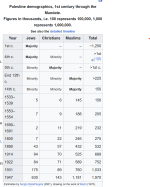
Key Demographic Data for Israel (2025/2026 Estimates):
- Total Population: Approx. 9.84–10 million.
- Jewish Residents: Approx. 73%–75% (including around 500,000+ settlers in the West Bank/East Jerusalem).
- Palestinian / Arab Citizens: Approx. 21%–21.5%.
- Other/Others: Roughly 5% (including non-Arab Christians or those not classified by religion). [1, 2, 3, 4, 5, 6, 7]
Last edited:

- Status
- Not open for further replies.