
High speed / Semi-High speed rail projects of Indian Railways
- Thread starter Ashwin
- Start date
You are using an out of date browser. It may not display this or other websites correctly.
You should upgrade or use an alternative browser.
You should upgrade or use an alternative browser.


hyderabad timin is a misprint, thats supposed to be the bangalore chennai timing. Its a bit over 2 hrs for hyderabad bangalore.


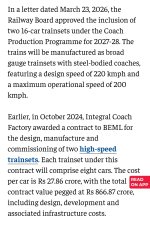
India’s fastest train gets nod: New train can run up to 220 kmph
Indian Railways is set to manufacture advanced trainsets with a design speed of 220 kmph. This marks a significant upgrade from current Vande Bharat Express trains. The railways will also implement AI-based track monitoring systems. Composite sleepers will be used for improved track performance...
India should aim small & achieve the lower hanging fruits for lasting gains. The track upgrade process have been painfully slow. All new tracks needs to be capable of 240kmph. The ICF team had plans for T20 or 200kmph trains immediately after T-18. Vigilance Enquiry put a stop to all that.
Even if VB trains run at their full operational speed of 160kmph at 75% of their journey India wins. Same goes for 220kmph trains. No dedicated RRTS lines are required as normal 200kmph trains can run on the same track saving money & time.
Even if VB trains run at their full operational speed of 160kmph at 75% of their journey India wins. Same goes for 220kmph trains. No dedicated RRTS lines are required as normal 200kmph trains can run on the same track saving money & time.
Even if all the existing tracks in India is upgraded to 250 kmph speed limit, no Govt. in this Indian Democracy was/is/will be able to run trains at average speed of 180+ kmph . Reason is the beautiful public of India and their nice CIVIC-SENSE. A country where public splits and keeps littering on Platforms and tracks in place of Dustbins,A country where public illegally occupy lands of Railway and build slums just beside railway tracks , A country where people let their cattle to move on tracks, A country where public prefers to change platforms through tracks in spite of having FOBs and Under-Pass , A country where public loves to urinate on tracks , A country where public start bathing, cooking, sleeping and all on platform floor rather than using restrooms, washrooms , A country where majority of non-reserved public love to board on train without tickets & sometimes even on reserved coaches instead of General coaches, A country where there is no limit to carry luggage by one passenger in a train.... You are saying for 160-180 kmph average speed ? Are you living in delusion ?... Yes, GOVT. is not up to the mark , was never before and Govt. should be criticised at maximum... But don't we , as public, need to look at ourselves first before putting every single blame on Govt. ? Whenever a new train is launched, public starts throwing stones to damage it... And when any accident/ mishap will occur all the public + Human Rights Organisations + social media experts will come to defend public ...Are we, as public of India, really deserving ?India should aim small & achieve the lower hanging fruits for lasting gains. The track upgrade process have been painfully slow. All new tracks needs to be capable of 240kmph. The ICF team had plans for T20 or 200kmph trains immediately after T-18. Vigilance Enquiry put a stop to all that.
Even if VB trains run at their full operational speed of 160kmph at 75% of their journey India wins. Same goes for 220kmph trains. No dedicated RRTS lines are required as normal 200kmph trains can run on the same track saving money & time.
Last edited:
It's like reading comments from 5 years ago with outdated assumptions and stories.India should aim small & achieve the lower hanging fruits for lasting gains. The track upgrade process have been painfully slow. All new tracks needs to be capable of 240kmph. The ICF team had plans for T20 or 200kmph trains immediately after T-18. Vigilance Enquiry put a stop to all that.
Even if VB trains run at their full operational speed of 160kmph at 75% of their journey India wins. Same goes for 220kmph trains. No dedicated RRTS lines are required as normal 200kmph trains can run on the same track saving money & time.
Track upgrade progress has been remarkably fast 5 years, Already completed 54,000 km. Track upgrade wont magically increase average speed to 160+ kmph.
The biggest issues are curves and congestion. Congestion can be mitigated by increasing the number of tracks and implementing signaling upgrades like ETCS level 2. However, it is impossible to achieve an average speed of over 200km/h on current tracks due to curves.
We will have 800+ Vande Bharat operational in next 5 years. Thats exactly the type of incremental progress that you are talking about.
RRTS and normal railway lines are different categories. Think of RRTS as a modern version of suburban railway. Big urban clusters like Delhi absolutely need it.

Track speeds can be enhanced to an extent to achieve 200 kmph thru adoption of tilting technology .
However since this is India we've gone ahead with building trainsets capable of 180 kmph speeds without incorporating either tilting technology in the existing trainsets or straightening the tracks .
There're reports we may go in for this technology in future VB trainsets but that would involve technical collaboration with a Foreign OEM . Till date there's no news of any such tie up or discussions with prospective collaborators whatsoever.
However since this is India we've gone ahead with building trainsets capable of 180 kmph speeds without incorporating either tilting technology in the existing trainsets or straightening the tracks .
There're reports we may go in for this technology in future VB trainsets but that would involve technical collaboration with a Foreign OEM . Till date there's no news of any such tie up or discussions with prospective collaborators whatsoever.
tilting tech is not useful in all circum stance. Anyway it simply does not matter when the vast majority of our tracks cant even uspport 180kmh. only the golden quad lines will be upgraded to the limit as well as long highly used lines. And no you cant upgrade the vast majority of lines either because they need new land aquisiton through densely populated areas which makes it simply unviable.Track speeds can be enhanced to an extent to achieve 200 kmph thru adoption of tilting technology .
However since this is India we've gone ahead with building trainsets capable of 180 kmph speeds without incorporating either tilting technology in the existing trainsets or straightening the tracks .
There're reports we may go in for this technology in future VB trainsets but that would involve technical collaboration with a Foreign OEM . Till date there's no news of any such tie up or discussions with prospective collaborators whatsoever.
getting the skeletons to 180kmh-200kmh while making the HSR for 320-350kmh is the right choice for India.
Changes have started showing now. My own village railway tracks have doubled, electrification done, flyover & underpass made and railway crossing discontinued. Even saw barriers installed on both sides of the track for the first time.It's like reading comments from 5 years ago with outdated assumptions and stories.
Track upgrade progress has been remarkably fast 5 years, Already completed 54,000 km. Track upgrade wont magically increase average speed to 160+ kmph.
The biggest issues are curves and congestion. Congestion can be mitigated by increasing the number of tracks and implementing signaling upgrades like ETCS level 2. However, it is impossible to achieve an average speed of over 200km/h on current tracks due to curves.
We will have 800+ Vande Bharat operational in next 5 years. Thats exactly the type of incremental progress that you are talking about.
RRTS and normal railway lines are different categories. Think of RRTS as a modern version of suburban railway. Big urban clusters like Delhi absolutely need it.

Did I say it was ?tilting tech is not useful in all circum stance.
Hence tilting technology.Anyway it simply does not matter when the vast majority of our tracks cant even uspport 180kmh.
Those proposed new lines along the Golden Quadrilateral would be dedicated HSR lines like the Mum Ahm HSR line.only the golden quad lines will be upgraded to the limit as well as long highly used lines.
Hence tilting technology. Did you even go thru the link I've attached?And no you cant upgrade the vast majority of lines either because they need new land aquisiton through densely populated areas which makes it simply unviable.
That requires a holistic plan . Right now there's none. This is what I wrote on another forum on this very subject around a year ago.getting the skeletons to 180kmh-200kmh while making the HSR for 320-350kmh is the right choice for India.
I've a slightly different take on this . I believe the Ministry of Railways ought to first classify what they mean by HSR & Semi HSR. This need not be copied from western or even Japanese definitions of classifying Railways but can take a leaf out of their book. This is important as I'd attempt to explain below.
If anything > 300 kmph is classified as HSR how do we define SHSR? There has to be a bandwidth. As of now there's none. This is also important to plan out a road map for passenger travel, for the next , say 50 years, wherein the idea would be to clearly plan for lines which would be HSR, lines which would be SHSR & lines which would be standard speeds wherein SHSR ( Semi HSR ) should operate at speeds of between 200-250 kmph with peak speeds of not over> 250 kmph otherwise this would kill the market for HSR & standard speeds would be between 100-150 kmph wih no passenger train operating at speeds of below 100kmph .
Now you can come up with average speeds within this bandwidth at which these trains will operate in & a time period in which you're supposed to implement this.
Once you've clarity on this aspect you can move to classification of railway lines whether broad or standard gauge & which one should we adopt after a thorough cost benefit analysis & so on.
IMO we ought to have dedicated lines for HSR for speed & safety related issues apart from upgradation of speeds since tomorrow we could well see HSR trains in India at 450-500 kmph. Hopefully our railroad planners have ensured that these tracks can cater to such speeds & modifications if any are minor.
We can then move on to broad gauge & reserve that for SHSR & below which is as I defined it above as Standard Speed Railways. These are your existing train tracks modified to handle speeds of upto 250 kmph. That way you are spared the costs of building new lines except modifying them & rendering them safe by erecting fences on both sides of the rail road with gang men patrolling them charged with looking after not only the well being of tracks but also the security fences.
Quite obviously implementing these recommendations will be a tall order & will require a 30 year finance intensive time bound plan to be reviewed every year on the progress achieved & course correction if any. I expect the Kavach program & other such safety & security program along with rail station modernization to continue concurrently though tbh the station modernization is to my mind an ill conceived plan.
And that's precisely the problem with the way this government especially the Ministry of Railways is going about things. There's no big picture as in a holistic view with the result everything is being planned & implemented on whims. The introduction of VB without upgradation of tracks to handle such speeds is case in point. 100% electrification of railways was another such scheme, this after orders for 1000s of diesel locomotives were signed & the factory set up ready to churn out locomotives.
I could go on. Trust you would've gotten the drift

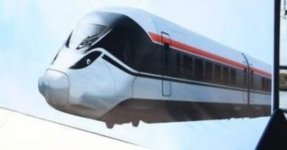


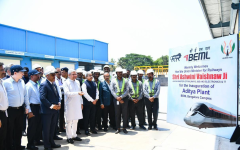

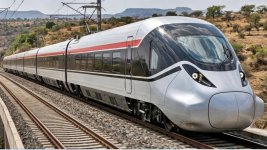
Nose cone in the BEML's poster looked compressed due to editing , but as per the official B28 document and design the nose cone will be elongated like this .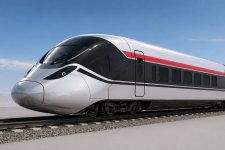
Last edited:
Another angleNose cone in the BEML's poster looked compressed due to editing , but as per the official B28 document and design the nose cone will be elongated like this .
It's like reading comments from 5 years ago with outdated assumptions and stories.
Track upgrade progress has been remarkably fast 5 years, Already completed 54,000 km. Track upgrade wont magically increase average speed to 160+ kmph.
The biggest issues are curves and congestion. Congestion can be mitigated by increasing the number of tracks and implementing signaling upgrades like ETCS level 2. However, it is impossible to achieve an average speed of over 200km/h on current tracks due to curves.
We will have 800+ Vande Bharat operational in next 5 years. Thats exactly the type of incremental progress that you are talking about.
RRTS and normal railway lines are different categories. Think of RRTS as a modern version of suburban railway. Big urban clusters like Delhi absolutely need it.
I am talking about removal of curves, upgrades of Signalling & installations of Kavach systems. Track upgrades in the PIB update you shared mostly means conversion of broad gauge. When VB was introduced, it was already mentioned, the angle of curves needs to be reduced so it can travel at 180 kmph ( top speed of VB trains). And that’s what I am talking about. When tracks are updated with less curves, running trains at 200km avg should happen. Even speed of goods trains will increase. I would like to travel to Mumbai from Chennai overnight journey.
Another reason for RRTS or MRTS in normal rail line is to reduce costs. Rail highways in dense cities save time & costs over long duration. For eg Chennai has only 3 main tracks for local railway. 4th is being built. Chennai should have 6-8. Mumbai probably 8-12. This is how one can run trains at max capacity while havving capacity for express trains & RRTS. Existing stations can be reused. It needs lots of lands but it’s worth it.
Track upgrade is different from conversion of broad gauge. It was done 90+% more than a decade back. Some mountainous terrain left preserved for heritage purposes. As i said, you are quoting stats from a decade back. The PIB release actually lists out what's included in the track upgrade.I am talking about removal of curves, upgrades of Signalling & installations of Kavach systems. Track upgrades in the PIB update you shared mostly means conversion of broad gauge. When VB was introduced, it was already mentioned, the angle of curves needs to be reduced so it can travel at 180 kmph ( top speed of VB trains). And that’s what I am talking about. When tracks are updated with less curves, running trains at 200km avg should happen. Even speed of goods trains will increase. I would like to travel to Mumbai from Chennai overnight journey.
Another reason for RRTS or MRTS in normal rail line is to reduce costs. Rail highways in dense cities save time & costs over long duration. For eg Chennai has only 3 main tracks for local railway. 4th is being built. Chennai should have 6-8. Mumbai probably 8-12. This is how one can run trains at max capacity while havving capacity for express trains & RRTS. Existing stations can be reused. It needs lots of lands but it’s worth it.
You cannot magically reduce curves and add parallel tracks without significant land acquisition. It is as Herculean a task as creating a new, mostly elevated high-speed rail. The cost advantage of improving the old railway will be minimal when considering entity separation and better financing for a new clean-slate project.
At our current per capita level today, china had already build 5,000 km of new HSR lines. NRI's like you will appreciate it and tell us how we are lagging, then criticize us for not having long-term vision and ambitions.
When the parallel track thing was being implemented, the railway had procured quite a bit of land on both sides of the tracks to cater for future requirements.Track upgrade is different from conversion of broad gauge. It was done 90+% more than a decade back. Some mountainous terrain left preserved for heritage purposes. As i said, you are quoting stats from a decade back. The PIB release actually lists out what's included in the track upgrade.
You cannot magically reduce curves and add parallel tracks without significant land acquisition. It is as Herculean a task as creating a new, mostly elevated high-speed rail. The cost advantage of improving the old railway will be minimal when considering entity separation and better financing for a new clean-slate project.
At our current per capita level today, china had already build 5,000 km of new HSR lines. NRI's like you will appreciate it and tell us how we are lagging, then criticize us for not having long-term vision and ambitions.
mate its not that simple. we are not talking some land aquisiton alongside tracks, to hit 200kmph we need to cut straight through populated areas. the extra space is reserved for quadrupling not for track alignementWhen the parallel track thing was being implemented, the railway had procured quite a bit of land on both sides of the tracks to cater for future requirements.