

Yes, that is the only known use of the HTFE.CATS warrior mk2 maybe? i mean wasnt their plan to have a 5 tonne class CCA powered by 2 HTFEs for high subsonic or supersonic flight and good payload? If its HTFE then its prolly that.
Yes, that is the only known use of the HTFE.CATS warrior mk2 maybe? i mean wasnt their plan to have a 5 tonne class CCA powered by 2 HTFEs for high subsonic or supersonic flight and good payload? If its HTFE then its prolly that.

& Future HALE UAV.Yes, that is the only known use of the HTFE.
the HALE UAV uses the 1200 Hp engine. Not this one& Future HALE UAV.
The illustration shows a turbojet/turbofan powered HALE uav flying at 60k feet.the HALE UAV uses the 1200 Hp engine. Not this one
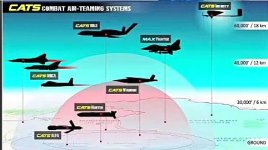

And he is correct. Sooner or later we are going to be self-sufficient in high-tech jet engine technology and have our own engines in our own fighters.

I can see now how those 6th Gen TF & 140 KN TF stories came about .

Mitsubishi Heavy Industries, a defining proof point. We are also pleased to share another significant milestone. Azad has been awarded a prestigious contract by Mitsubishi Heavy Industries Japan as a single-source supplier partner. And we have signed an 8-year long contract
and purchase agreement for the supply of highly engineered hot section Nozzle Vanes segments for the combustion of a gas turbine engine.
Single source qualification for hot section components of a turbine nozzle vane for an OEM of MHI stature is the strongest possible endorsement of our technical and process capabilities. This product is not just being awarded, and it is awarded by many, many audits and many, many qualifications prior to even they think of awarding such product to any company.
But I can only give you one statement that there are only 3 players around the world of precision manufacturing that have been able to crack this materially, okay?
So the complexity in manufacturing these components is very, very high.
Yes. So in this 4 engine manufacturers on the airfoil is what we started. The first one was Rolls-Royce. So we have -- in H2, we are expecting to supply the first qualification batch. And once that is approved, and I think from -- we can see some momentum coming from Q4 FY '27 or early of FY '28.
That's where the supply starts. And followed by -- as you can see, it took 2.5, 2.5 years to come to the stage, and this is normal. And we could do it in 2.5 years. It's also a great thing. It's not a small thing to do it in 2.5 years. So same cycle will be followed. The next is Pratt & Whitney, then comes Safran and then it's followed by then.
So that is coming up. In terms of the engine ecosystem, I think I would make it broad-based even further saying that the opportunity that Azad today is sitting on, we've -- Azad has positioned itself always as a manufacturer of highly engineered critical components across these 3
segments, which are mission and life critical. With the demand for these engines going up over time with backlogs of our customers increasing, Azad is obviously looking at a much larger opportunity in this domain and which also means that the ecosystem in India should be thriving.
And with indigenization plans of the government, with indigenization plans of how we are stacking up, we are moving from building capability for one engine, and we will only scale it up like from the engine that we are building, we will move from the current 3.7 to 4 kiloton engine
to a higher capacity going forward and eventually contribute to much larger programs. But the entire engine ecosystem, we are seeing this demand grow and capacity is being added for -- a lot of capacity being added in the country.
We won't be able to talk too much about the Indian program. But yes, I see -- we see that India is going through that phase where we will now start contributing meaningfully to our GDP from a precision manufacturing industry perspective.

I think DcPP tender was for manufacturing, 10 JVs have responded afaik, Godrej, HAL, Tata, L&T etc.
The challenge becomes even greater with India’s Advanced Medium Combat Aircraft (AMCA), which will require a new 120 kN-class engine, far more sophisticated than anything India has produced so far. Recognising this gap, the government has, however, launched the Advanced High Thrust Engine (AHTE) programme while simultaneously pursuing co-development with France’s Safran.
Unlike earlier technology-transfer arrangements, Indian negotiators are seeking genuine design know-how in critical technologies such as single-crystal turbine blades, high-temperature materials and thermal barrier coatings - the important technologies that prevented Kaveri from achieving operational success.
What would be the realistic timeline, and would the engine be clean sheet or be based loosely around M88-4?I think DcPP tender was for manufacturing, 10 JVs have responded afaik, Godrej, HAL, Tata, L&T etc.
The DcPP is to absorb whatever Safran and GTRE design and later handle the manufacturing side of things to assemble and set up manufacturing line.
18 engines over 10 years, then get contract for 200 engines, 12-16 engine per year initially then 24 per year after bigger orders.
12 years, Safran quoted. Add CCS delay, enginnering issues, other things. So 15 years hopefully still optimistic imo.What would be the realistic timeline, and would the engine be clean sheet or be based loosely around M88-4?
I'm guessing it's 3-4 for start of engine testing, and another 12-14 afterwards.
MoD wants some fairytale timeline


