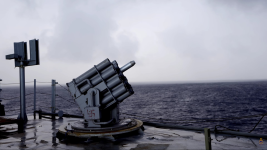
Shivalik-class & Nilgiri-class (Project 17 A/B) Frigates : Discussions

Bhargavastra's ground version has it's own standalone EOIR/FCR mounted on the truck. On a ship, it's possible we can integrate it with the ship's EO/radar systems for guidance but if it turns out a co-located fire control system is best for anti-drone launches, then a swivel mount will be optimal.

We'll see how it goes.


If you're integrated with the ship's main FCR, you'll always seen them coming much sooner than a ground launcher ever could.

Bhargavastra's missile will need primary sensor integration. It's LOAL.

No terrain so the horizon is the only limitation. Ship's radars are mounted much higher than the truck's radar. It's just physics.

But because it's a swarm, some will get through. 100% interception is theoretical.

VLS pop-up won't be high enough to make a difference.

50-100 m is enough. This is a sub-5 km range missile. Most targets will be killed well below 2 km.

CIWS missiles/rockets need to operate up to 20 km.

That argument supports the trainable launcher option. You retain kinetic performance for a longer period as you don't expend any of it on initial orientation.

This system consists of two layers anyway, unguided and guided. The loss in energy doesn't matter, the missile will already have been designed to compensate, especially considering the unguided system can defeat threats from just 20 m away. Achieving altitude and dropping down is what makes it more effective. The alternative is to fire more missiles to increase pk, which is not desirable. The unguided portion will have to compensate for the failure of the guided system.

Depends on the footprint & how big of a launcher you want. You don't necessarily have to go with the full 64-round pack.

Bhargavastra is very tiny. If it fits in the back of a truck in 8x8 config, then the space it needs is practically nothing on a ship.

It's probably the same size as an ATGM.

Regardless, there's many more spots for a trainable mount as you only have to worry about above-deck space. For a VLS, you have to worry about both above-deck & below-deck space. So the number of options will inherently be fewer. No way around it.

Our ship designs have more space below deck, not on the deck. In fact, we could only install 2 CIWS on our frigates.
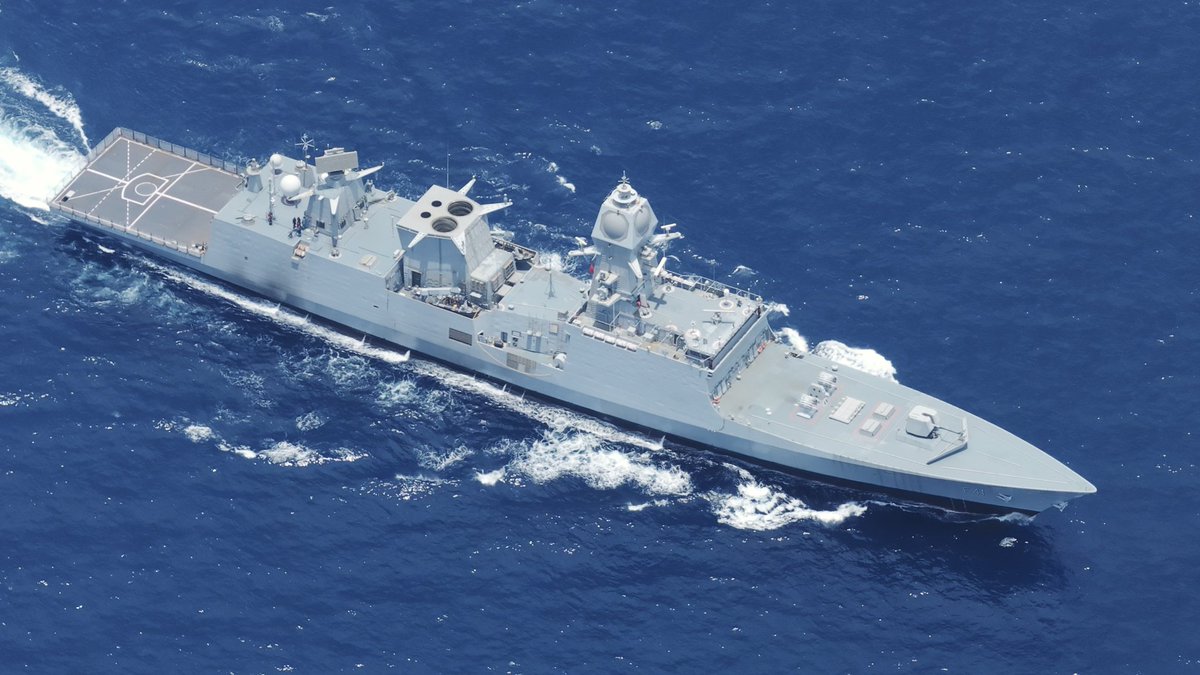
HD_lHU3agAAg1dd.jpg


VLS space is insanely high.

I mean, your only real argument is space for VLS, otherwise every other factor that affects an anti-drone system is in favor of VLS.

In fact, if we have more space for a swivel mount, it would be better to put something like the RIM-116 on it instead of Bhargavastra.

As I said, that would mean you're installing this capability at the expense of additional land-attack/point-defence/area-defence capability (which is ostensibly what those spaces were made for considering anti-swarm wasn't what anyone had in mind back then).

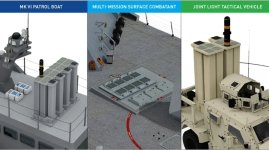
The system is so small, you can fit it in the gaps of the primary VLS. Just like on Arleigh Burke.

And your argument is more in favor of using a swivel mount for RIM-116, which is lacking on our ships.

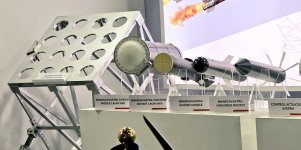
Anyway, let's just wait to see how we do it. As of now even the ground version of Bhargavastra isn't ready...which means even the 64-cell launcher with standalone FCS that we're seeing now may not be how it finally turns out.

Land-based system's sensor design and restrictions will be different, but the missiles themselves will be the same.
 
Bhargavastra's missile will need primary sensor integration. It's LOAL.

It needs a radar. Whether it'll be the ship's primary MFR or its own co-located radar (like on Phalanx) remains to be seen. If the current truck-mounted setup is migrated onto a ship as-is, we'll go with the standalone co-located radar option, which by extension will necessitate a trainable launcher.

This system consists of two layers anyway, unguided and guided. The loss in energy doesn't matter, the missile will already have been designed to compensate, especially considering the unguided system can defeat threats from just 20 m away.

The unguided version is just a rocket, not unlike some of the ones going on Thales' MPLS.

GlHIVXKbAAApfoK.jpg

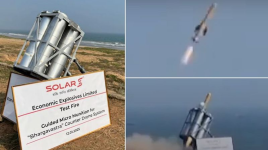
And as you can see, they're currently testing with an inclined launcher with trainable elevation (hydraulics) actually, not a VLS:

Screenshot 2026-03-26 155311.png

We'll see how it goes in the end.

Achieving altitude and dropping down is what makes it more effective. The alternative is to fire more missiles to increase pk, which is not desirable. The unguided portion will have to compensate for the failure of the guided system.

It'll have to do that regardless of type of launch though.

Bhargavastra is very tiny. If it fits in the back of a truck in 8x8 config, then the space it needs is practically nothing on a ship.

It's probably the same size as an ATGM.

Our ship designs have more space below deck, not on the deck. In fact, we could only install 2 CIWS on our frigates.

HD_lHU3agAAg1dd.jpg


VLS space is insanely high.

The truck's just a 4x4 actually, not even 8x8.

As of ships, we've got loads of space for an above-deck launcher as well. Which way we'll go will be based on tactical considerations. We might even decide to just take the existing land-based launcher and bolt it onto the deck. Won't be the most efficient solution, but it would be the fastest.

I mean, your only real argument is space for VLS, otherwise every other factor that affects an anti-drone system is in favor of VLS.

Gonna have to agree to disagree on that.

In fact, if we have more space for a swivel mount, it would be better to put something like the RIM-116 on it instead of Bhargavastra.

The system is so small, you can fit it in the gaps of the primary VLS. Just like on Arleigh Burke.

And your argument is more in favor of using a swivel mount for RIM-116, which is lacking on our ships.

We could do what the French are trying with MPLS. Common launcher for both Bhargavastra and a future RIM116-equivalent. The Bhargavastra launcher is already designed for tubes of two different diameters (don't know why though, as both guided & unguided munitions appear to be of same size). We can take that further.

Each launcher can be configured to have 32 x micromissiles, 12 x unguided rockets, 8 x larger CIWS missiles, or really any combination we want.

Land-based system's sensor design and restrictions will be different, but the missiles themselves will be the same.

What I'm saying is the land based configuration itself isn't yet set in stone. We have to wait for the testing program to progress, and for the forces to give their inputs. The 64-cell concept image we've seen may or may not be how things turn out in the end.
 
Lets think about usability as well. A big drawback of VLS is that they are not reloadable while a ship is underway. A hard kill CUAS would need rapid reloadability to do its job.

Theoretically, it may be possible to reload sub-caliber missiles like Bhargavastra manually. But I cannot imagine you could just drop new rounds into a VLS cell like you would an inclined launcher (think mortar rounds).

Bhargavastra would ideally have to be loaded from the rear (as with other systems like RBU-6000 or Mareech decoy launchers aboard ship). That makes VLS impracticable.
 
It needs a radar. Whether it'll be the ship's primary MFR or its own co-located radar (like on Phalanx) remains to be seen. If the current truck-mounted setup is migrated onto a ship as-is, we'll go with the standalone co-located radar option, which by extension will necessitate a trainable launcher.

Anti-drone requires tracking dozens to hundreds, it's not feasibe to have multiple standalone radars.

The unguided version is just a rocket, not unlike some of the ones going on Thales' MPLS.

View attachment 50723

Yeah, I know. It's a combo, but the primary is the micromissile. Did you check after I told you about it?

And as you can see, they're currently testing with an inclined launcher with trainable elevation (hydraulics) actually, not a VLS:

View attachment 50724

We'll see how it goes in the end.

Solar has already confirmed VLS. The inclined launcher is only for development tests.

It'll have to do that regardless of type of launch though.

It's to deal with failure of the top layer, like PDV and AAD.

The truck's just a 4x4 actually, not even 8x8.

8x8 VLS. 64 missiles. :LOL:

As of ships, we've got loads of space for an above-deck launcher as well. Which way we'll go will be based on tactical considerations. We might even decide to just take the existing land-based launcher and bolt it onto the deck. Won't be the most efficient solution, but it would be the fastest.

There's no safety wall or barrier for the backblast. And if you add shielding, it will affect stealth.

The launcher itself is just a basic design, not a true ruggedised launcher.
121159743.jpg


We could do what the French are trying with MPLS. Common launcher for both Bhargavastra and a future RIM116-equivalent. The Bhargavastra launcher is already designed for tubes of two different diameters (don't know why though, as both guided & unguided munitions appear to be of same size). We can take that further.

Each launcher can be configured to have 32 x micromissiles, 12 x unguided rockets, 8 x larger CIWS missiles, or really any combination we want.

The CIWS missile numbers are too small for your MPLS. RIM-116 comes with 21.

Different sizes mean they can pack more missiles in.

What I'm saying is the land based configuration itself isn't yet set in stone. We have to wait for the testing program to progress, and for the forces to give their inputs. The 64-cell concept image we've seen may or may not be how things turn out in the end.

No, they have already confirmed.
 
Lets think about usability as well. A big drawback of VLS is that they are not reloadable while a ship is underway. A hard kill CUAS would need rapid reloadability to do its job.

Theoretically, it may be possible to reload sub-caliber missiles like Bhargavastra manually. But I cannot imagine you could just drop new rounds into a VLS cell like you would an inclined launcher (think mortar rounds).

Bhargavastra would ideally have to be loaded from the rear (as with other systems like RBU-6000 or Mareech decoy launchers aboard ship). That makes VLS impracticable.

1122.jpg

It's not that big. Just 1 m.

1212.jpg
 

Unless the missiles themselves come in sealed 32 round crates, I don't see how live rounds could be lowered into VLS by hand. And even so it might need some kind of hoist mechanism.

It's a different matter if the missile warheads are based on insensitive munition (IM) tech, though. Solar is known to be working on it.
 
Anti-drone requires tracking dozens to hundreds, it's not feasibe to have multiple standalone radars.

Can be done both ways. It'll be down to tactical & cost considerations. Kinda like regular RIM-116 vs SeaRAM variant. Standalone radar comes with its own pros & cons. One of the pros being you don't have to lose all AD capability in that direction/sector in case some of the MFR's faces are damaged.

We're just speculating regarding the config though, cuz a naval variant doesn't even seem to be in consideration yet.

Yeah, I know. It's a combo, but the primary is the micromissile. Did you check after I told you about it?

Solar has already confirmed VLS. The inclined launcher is only for development tests.

It's to deal with failure of the top layer, like PDV and AAD.

I'm saying the final config is going to be case sensitive as per customer needs and intended application/platform. The 64-cell pack is just OEM's idea.

8x8 VLS. 64 missiles. :LOL:

Ah, OK. I've never heard a VLS farm referred to in that way so I got confused. Usually they're referred to by segments within the VLS. The Bhargavastra concept is arranged into 4 segments of 16 cells each. So it would've been 4x16. The Barak-8/MRSAM VLS comes in 8-cell segments. Most shipborne missiles come in 8-cell segments so I get why you would think that. Bhargavastra comes in 16-cell ones.

Adds up to the same thing though, so no worries.

There's no safety wall or barrier for the backblast. And if you add shielding, it will affect stealth.

Hey, even our latest P-17As come with RBUs so it's not like we're that worried about stealth. :p

The CIWS missile numbers are too small for your MPLS. RIM-116 comes with 21.

Different sizes mean they can pack more missiles in.

Standard RIM-116 that depends on ship's radar has 21, but the SeaRAM (standalone version with own radar) comes with 11.

It's all config & customer dependent.

No, they have already confirmed.

Good to know. But customer will get the final say is all I'm saying.
 
  • Like
Reactions: Rajput Lion
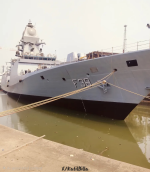
INS Dunagiri (F36) being moved out of the outfitting yard at GRSE. Thes ship is undergoing contractor trials now. Will be delivered to the Navy within a month or so:
View attachment INS_Dunagiri.mp4

INS Mahendragiri (F38) at MDL's outfitting yard:
1774635561618.png

The Navy will commission all 4 of the remaining Nilgiri class & 1 Talwar class frigate this year.
 
Unless the missiles themselves come in sealed 32 round crates, I don't see how live rounds could be lowered into VLS by hand. And even so it might need some kind of hoist mechanism.

It's a different matter if the missile warheads are based on insensitive munition (IM) tech, though. Solar is known to be working on it.

Since it looks as small as an ATGM, then 2 people can do it.
 
Can be done both ways. It'll be down to tactical & cost considerations. Kinda like regular RIM-116 vs SeaRAM variant. Standalone radar comes with its own pros & cons. One of the pros being you don't have to lose all AD capability in that direction/sector in case some of the MFR's faces are damaged.

We're just speculating regarding the config though, cuz a naval variant doesn't even seem to be in consideration yet.


I'm saying the final config is going to be case sensitive as per customer needs and intended application/platform. The 64-cell pack is just OEM's idea.


Ah, OK. I've never heard a VLS farm referred to in that way so I got confused. Usually they're referred to by segments within the VLS. The Bhargavastra concept is arranged into 4 segments of 16 cells each. So it would've been 4x16. The Barak-8/MRSAM VLS comes in 8-cell segments. Most shipborne missiles come in 8-cell segments so I get why you would think that. Bhargavastra comes in 16-cell ones.

Adds up to the same thing though, so no worries.


Hey, even our latest P-17As come with RBUs so it's not like we're that worried about stealth. :p


Standard RIM-116 that depends on ship's radar has 21, but the SeaRAM (standalone version with own radar) comes with 11.

It's all config & customer dependent.


Good to know. But customer will get the final say is all I'm saying.

For now, all I'm saying is there's no deck space for a swivel launcher, and if there is, then it's better to install a full-fledged CIWS like RIM-116. Even the MPLS, but with CIWS. But there's plenty of deck space for VLS, and yes, in whatever configuration the IN thinks is good for them. The 8x8 VLS on truck is specific to the truck after all.

But it's important for the anti-drone system to come on VLS because of the angles of attack. Trump recently said one of USN's ships was attacked by many drones from 17 different angles every 32 seconds. A swivel launcher won't do anything against such a threat if the swarms come in greater numbers and at far lower intervals, practically simultaneously.

Imagine a VLS firing off all its missiles in a matter of seconds and pairs of missiles start flying off at different angles. A swivel launcher cannot do that, nor can it fire through blindspots. Hence the importance of VLS.
 

Three frontline naval platforms — INS Dunagiri, INS Sanshodhak, and INS Agray — were delivered to the Navy on Monday (March 30, 2026) by Garden Reach Shipbuilders and Engineers Ltd. (GRSE), marking a significant boost to India’s indigenous defence manufacturing capabilities under the Aatmanirbhar Bharat initiative.

INS Dunagiri, the second Project 17A advanced guided-missile frigate built by GRSE, represents a leap in indigenous warship design. The 149-metre-long, 6,670-tonne stealth frigate is equipped with advanced weapons and sensors, including BrahMos cruise missiles, AESA radar, and an integrated combat management system. Powered by a combined diesel and gas turbine configuration, it is capable of multi-dimensional operations across air, surface, and sub-surface domains.
 
3 in service, 2 ready for induction and other 2 in sea-trials. Noice.

Only sad part is still no deal for P-17B, I think it will slip to 2027 for deal signing.
Hopefully the Project 17B contract is wrapped up prior to March 31st 2027.
Right now the MoD seems focused on concluding the 8 Next Gen Corvette deal.
 
  • Agree
Reactions: Rajput Lion