

Brahmos Supersonic Cruise Missile : News, Updates and Discussions
- Thread starter Manmohan_MMY
- Start date
You are using an out of date browser. It may not display this or other websites correctly.
You should upgrade or use an alternative browser.
You should upgrade or use an alternative browser.


Need to find a cheap alternative to this overpriced, over hyped missile........ A subsonic VLO cruise missile will do the trick & we can have 3 times as many for the same price.

^^ Explains why the entire western world is trying to move into supersonic & hypersonic weapon systems so desperately.
Overhyped to the point that you need to sacrifice your airbases and runways in order to intercept itNeed to find a cheap alternative to this overpriced, over hyped missile........ A subsonic VLO cruise missile will do the trick & we can have 3 times as many for the same price.
Storm shadow have more interception rate than oynx in Russian-ukraine war, JASSM-ER is the only truest VLO missile out there,Need to find a cheap alternative to this overpriced, over hyped missile........ A subsonic VLO cruise missile will do the trick & we can have 3 times as many for the same price.
Both storm shadow, brahmos & it's sister missiles have showed Good combat track records, brahmos isn't overhyped, a slavo of brahmos will always hit the target,
JASSM-ER costs more than brahmos,
Yes we do need a VLO missile in the likes of Strom shadow & Taurus KEPD, but none of the missiles system can replace brahmos,
And with brahmos NG, the missile system will be far ahead of it's western counterparts, only the YJ system 15 will be it's truest competitor
No they are not.... America will be concentrating more on VLO based cruise missile like AGM-158C LRASM.^^ Explains why the entire western world is trying to move into supersonic & hypersonic weapon systems so desperately.
Storm shadow doesn't have more interception rate than oynx........ Take Russian claims with pinch of salt.... Storm shadow performance in Russian Ukrainian war has been spectacular just like in operation Sindoor & I never said about replacing just an alternative we can mass produce in numbers cheaply.Storm shadow have more interception rate than oynx in Russian-ukraine war, JASSM-ER is the only truest VLO missile out there,
Both storm shadow, brahmos & it's sister missiles have showed Good combat track records, brahmos isn't overhyped, a slavo of brahmos will always hit the target,
JASSM-ER costs more than brahmos,
Yes we do need a VLO missile in the likes of Strom shadow & Taurus KEPD, but none of the missiles system can replace brahmos,
And with brahmos NG, the missile system will be far ahead of it's western counterparts, only the YJ system 15 will be it's truest competitor
Overhyped to the point that you need to sacrifice your airbases and runways in order to intercept it
Over hyped in a sense it's trajectory is far easily predictable, it can't maneuver, sensor capabilities are limited because of speed, can't fly low over land & can't carry heavy warhead payload..... Speed is not some magic weapon...... Stealth is.... and that's where we need to concentrate more in future.
Nope it has, yesterday one got downed,Storm shadow doesn't have more interception rate than oynx........ Take Russian claims with pinch of salt.... Storm shadow performance in Russian Ukrainian war has been spectacular just like in operation Sindoor & I never said about replacing just an alternative we can mass produce in numbers cheaply
It sensors works finesensor capabilities are limited because of speed, can't fly low over land
While desperately testing the ARRW & LRHW to prove & operationalise the system.No they are not.... America will be concentrating more on VLO based cruise missile like AGM-158C LRASM.
Haha what?Over hyped in a sense it's trajectory is far easily predictable, it can't maneuver, sensor capabilities are limited because of speed, can't fly low over land & can't carry heavy warhead payload..... Speed is not some magic weapon...... Stealth is.... and that's where we need to concentrate more in future.
you have much to learn about weapon complex systems by every involved domain of application.
Let's agree to disagree........ as they say every one is a bad a** until they get punched in a face.While desperately testing the ARRW & LRHW to prove & operationalise the system.
Haha what?
you have much to learn about weapon complex systems by every involved domain of application.

Doesn't Brahmos is considered to have quite a high bit of maneuverability and terrain hugging/sea skimming capability for a super-sonic missile?Haha what?
you have much to learn about weapon complex systems by every involved domain of application
I'm not that knowledgeable on these things, just saying that from what I have heard in some past interviews of ex-DRDO folks.
No problem with that, but there are several mistaken assumption in the reply post that can be identified very easily. So its a case of bad input generating bad/false output.Let's agree to disagree........ as they say every one is a bad a** until they get punched in a face.
It is, which is why entire flight mission from launch to target hit is divided into several phase, and in the 3 primary segments (ascent, cruise, descent) still further trajectory planning is done by several variables (waypoint navigation, altitude, speed etc) so the flight mission can be as unpredictable as possible.Doesn't Brahmos is considered to have quite a high bit of maneuverability and terrain hugging/sea skimming capability for a super-sonic missile?
I'm not that knowledgeable on these things, just saying that from what I have heard in some past interviews of ex-DRDO folks.

Doesn't Brahmos is considered to have quite a high bit of maneuverability and terrain hugging/sea skimming capability for a super-sonic missile?
I'm not that knowledgeable on these things, just saying that from what I have heard in some past interviews of ex-DRDO folks.
Sea skimming over sea & over land is completely different thing..... ocean surface is relatively flat & predictable,.... allowing Brahmos radar altimeter & navigation system to maintain a constant altitude of 5 to 10 meters without risk of sudden terrain change.
Over land however terrain changes are abrupt, irregular & highly variable...... mountains, hills, valleys, buildings, tree lines, ridges, etc etc....... At Mach 3 brahmos covers one kilometer every 1 second..... meaning it has almost no reaction time to detect, process & maneuver around obstacles...... Terrain following over land requires, High resolution terrain contour matching sensors (TERCOM), Real time EO/IR terrain readers, High agility control surfaces, Lower flight speed to allow maneuvering.
BrahMos land attack variant does have TERCOM/DSMAC for mid course navigation & accurate position updates..... But it's not a real time obstacle avoidance tool & rely on pre- loaded terrain maps & image correlation, not instant detection of unexpected elevation or terrain changes.......... At Mach 3 even with TERCOM/DSMAC Brahmos has no time or maneuvering margin to avoid sudden terrain features & its control surfaces cannot generate high G turns needed for true terrain following at such high speeds........ Attempting ultra-low-altitude land flight would exceed its aerodynamic & guidance limits & risk terrain impact...... Reason why Brahmos land attack profile includes flying higher until the terminal dive........ which make it more susceptible for interception against a well defended enemy with a good Air defence system..... whereas over the sea, smooth & predictable surface conditions allow very low sea skimming even at Mach 3.
Now let's talk about its seeker...... It uses ARH based seeker & new phased array monopulse seeker which have limitations, it has no other option by the way because of its inherent design......... Active radar is excellent for detecting large metallic targets like ships but is less effective at identifying small, camouflaged or clutter masked land targets especially in environments with heavy electronic countermeasures or decoys....... Modern Subsonic VLO cruise missiles can integrate EO/IR, IIR, multispectral sensors & Automatic Target Recognition algorithms, which provide much higher target discrimination & can visually confirm or classify the target in real time....... This means missiles like JASSM ER, Storm Shadow can strike hardened relocatable or time sensitive land targets with greater autonomy & lower chances of misidentification.
Radar seekers are inherently more susceptible to jamming, deception & clutter spoofing......... whereas passive IR/IIR, high fidelity electro optical/TV seekers are immune to RF jamming & offer far better discrimination in difficult environments...... Brahmos inability to use passive optical seekers due to heating, shock, plasma interference & extremely short observation windows at Mach 3 reduces its effectiveness in deep strike, stealthy & complex terrain missions...... It's seeker is good for say speed driven naval strike roles but inferior for land attack precision, target classification, anti jamming resilience & multi sensor fusion, all of which subsonic stealthy cruise missiles can achieve far better with their more diverse seeker suites.
Active radar is excellent for detecting large metallic targets like ships but is less effective at identifying small, camouflaged or clutter masked land targets especially in environments with heavy electronic countermeasures or decoys....... Modern Subsonic VLO cruise missiles can integrate

It can select it's target even in a dense environment
Not seen that many land target that need the missile to fly parallel to surface few meter above ground and hit the land target ie where angle of attack is below 5 deg. That sort of AoA is not acceptable for the endgame because it will never give the desired destructive effect. Even anti radar version, where you are precise hitting a radar target , the AoA is almost 40 deg to maximise the damage, pf warhead small tungsten alloy cuboids disperse in correct manner to inflict the damage intended. For PCB, obviously penetration is better diving from above with full kinetic energy available.
Ship targets are entirely another thing, ships are hit at broadside and at specific zone sometimes. One reason subsonic missiles need to loiter in the area of interest is to acquire its target before the final approach. If Brahmos had to do that, it would be counterproductive. The usp of brahmos is that it flies as a cruise vehicle, but strikes like a ballistic missile. Steep dive is to hit target protected in a hill area right under a cliff. It is effective alternative to subsonic regime flight, which is basically any airplane, any simple plane that fly below sound speed.
below are your intended trajectory patterns for 3 different speed regimes in a simplified form. Now draw your own conclusion.
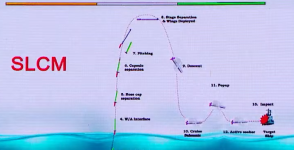
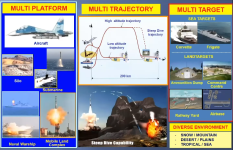
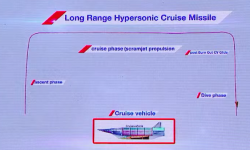
Btw, this assumption that a 2.5 ton article will dive down is kinda misrepresented for obvious reason, the 2 boosters used are 60 kg and 760 kg that are spent & ejected + liquid fuel also spent for ramjet. So its just north of 1-1.2 ton when it hits, might be even less. That is due to retaining the airframe, avionics and other items like seeker, sam, gas bottles, battery etc do not weigh too heavy. This is where weight reduction has happened considerably.
I mean think how much rudram 2 would weight when hitting its target. Its a single solid rocket motor, fuel mass is the highest which will get spent & maybe ejected. So its about 270-274kg glide body with the 155kg pf warhead + seeker payload that hits the target.
Ship targets are entirely another thing, ships are hit at broadside and at specific zone sometimes. One reason subsonic missiles need to loiter in the area of interest is to acquire its target before the final approach. If Brahmos had to do that, it would be counterproductive. The usp of brahmos is that it flies as a cruise vehicle, but strikes like a ballistic missile. Steep dive is to hit target protected in a hill area right under a cliff. It is effective alternative to subsonic regime flight, which is basically any airplane, any simple plane that fly below sound speed.
below are your intended trajectory patterns for 3 different speed regimes in a simplified form. Now draw your own conclusion.
Btw, this assumption that a 2.5 ton article will dive down is kinda misrepresented for obvious reason, the 2 boosters used are 60 kg and 760 kg that are spent & ejected + liquid fuel also spent for ramjet. So its just north of 1-1.2 ton when it hits, might be even less. That is due to retaining the airframe, avionics and other items like seeker, sam, gas bottles, battery etc do not weigh too heavy. This is where weight reduction has happened considerably.
I mean think how much rudram 2 would weight when hitting its target. Its a single solid rocket motor, fuel mass is the highest which will get spent & maybe ejected. So its about 270-274kg glide body with the 155kg pf warhead + seeker payload that hits the target.
Aster 30 intercepting Brahmos
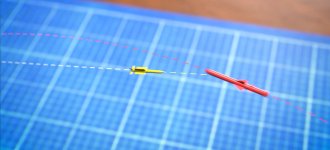
98% kill probability against Brahmos type target.
98% kill probability against Brahmos type target.

Yea as if it was the Scalps which showed the PAF its place right?Need to find a cheap alternative to this overpriced, over hyped missile........ A subsonic VLO cruise missile will do the trick & we can have 3 times as many for the same price.
"Here's proof my point is correct!!!" - shows animation.Aster 30 intercepting Brahmos
View attachment 48168
98% kill probability against Brahmos type target.
Source: Trust Me BroAster 30 intercepting Brahmos
View attachment 48168
98% kill probability against Brahmos type target.
Aster 30 intercepting Brahmos
View attachment 48168
98% kill probability against Brahmos type target.
A naval missile deployed by Europeans in 2000s should have capability to intercept supersonic missiles given their primary enemy has Kh-32, Oniks.
98% kill probability by a single missile is just cope though.