ISRO & Indian Space Program: News & Discussions
- Thread starter Tarun
- Start date
-
- Tags
- isro
You are using an out of date browser. It may not display this or other websites correctly.
You should upgrade or use an alternative browser.
You should upgrade or use an alternative browser.
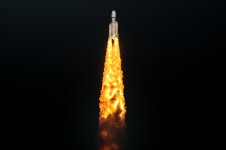
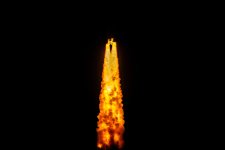
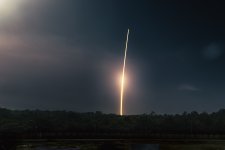
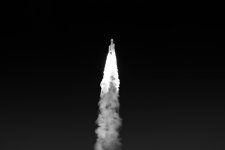


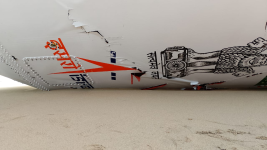
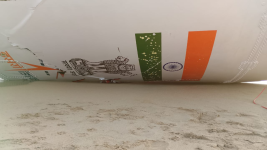
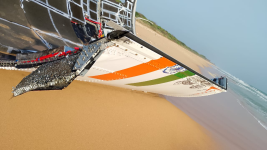
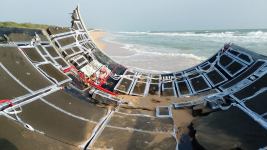
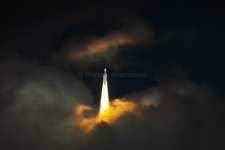
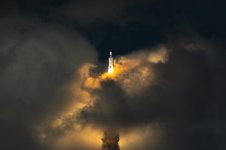
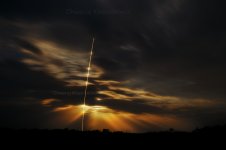
This launch has given us some of the coolest photos in a while:
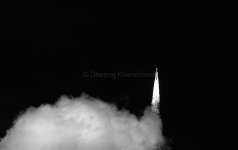
Attachments
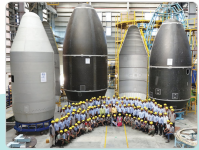
Doesn't this remind of Minions


NISAR Mission enters Science Phase
November 28, 2025
RADAR Antenna Deployment
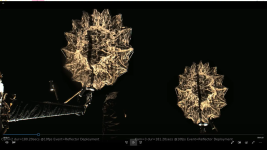
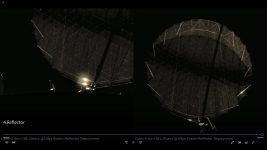
After the successful launch of NASA ISRO Synthetic Aperture Radar (NISAR) satellite onboard GSLV – F16 on July 30, 2025, the 12m diameter Antenna reflector has been successfully deployed. The 12-meter diameter antenna reflector plays a key role for both ISRO’s S-Band and NASA’s L-Band Synthetic Aperture Radar (SAR) Payload. The antenna was launched in a stowed condition on a 9m long boom, which was tucked closed to the satellite. The antenna and the 9m boom was developed by NASA.
The unfolding of the joints of the boom commenced on August 09, 2025 and was carried out over a period of five (05) days (Wrist, Shoulder, Elbow and Root deployments). The reflector assembly mounted on the end of the boom was deployed successfully on August 15, 2025 and the performance of the antenna systems are satisfactory.
The entire operations were carried out from ISRO Telemetry Tracking and Command Network (ISTRAC), ISRO with the support of JPL/NASA.
12m dia antenna reflector deployment images:
Pre-Deployment:
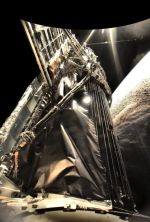
Deployment:
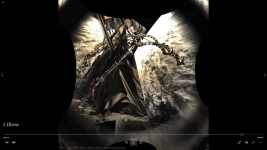
Root Deployment:
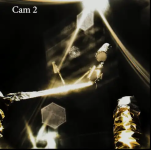
Reflector Deployment:
Completion of Commissioning Phase:
Since the first acquisition on 19th August, 2025, NISAR S-Band SAR is regularly imaging over Indian Landmass and Global Calibration-Validation sites in various payload operating configurations. Reference targets such as Corner reflectors were deployed around Ahmedabad, Gujarat and a few more locations in India for calibration of the images. Data acquired over Amazon rainforests were also used for calibration of spacecraft pointing and images. Based on this, payload data acquisition parameters were fine-tuned resulting in high quality images. Initial analysis by scientists and engineers revealed the potential of S-Band SAR data for various targeted science and application areas like agriculture, forestry, geo-sciences, hydrology, Polar/Himalayan ice/snow and oceanic studies. The first image of S-band SAR acquired on 19th Aug 2025 captures the fertile Godavari River Delta in Andhra Pradesh, India. Various vegetation classes like mangroves, agriculture, arecanut plantations, acquaculture fields, etc are clearly seen in the image. The image highlights NISAR’s S-Band SAR ability to map river deltas and agricultural landscapes with precision.
In the 100th day of NISAR in-orbit, the S-SAR images are released to the public by Chairman, ISRO/ Secretary DOS. With this, the commencement of science phase has also been announced.
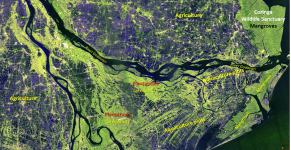
S-SAR hybrid polarimetric image showing mangroves and other land use in Godavari Delta, Andhra Pradesh. RGB: |RH|2, |RV|2, RH/RV
NISAR Mission enters Science Phase
November 28, 2025
RADAR Antenna Deployment
After the successful launch of NASA ISRO Synthetic Aperture Radar (NISAR) satellite onboard GSLV – F16 on July 30, 2025, the 12m diameter Antenna reflector has been successfully deployed. The 12-meter diameter antenna reflector plays a key role for both ISRO’s S-Band and NASA’s L-Band Synthetic Aperture Radar (SAR) Payload. The antenna was launched in a stowed condition on a 9m long boom, which was tucked closed to the satellite. The antenna and the 9m boom was developed by NASA.
The unfolding of the joints of the boom commenced on August 09, 2025 and was carried out over a period of five (05) days (Wrist, Shoulder, Elbow and Root deployments). The reflector assembly mounted on the end of the boom was deployed successfully on August 15, 2025 and the performance of the antenna systems are satisfactory.
The entire operations were carried out from ISRO Telemetry Tracking and Command Network (ISTRAC), ISRO with the support of JPL/NASA.
12m dia antenna reflector deployment images:
Pre-Deployment:
Deployment:
Root Deployment:
Reflector Deployment:
Completion of Commissioning Phase:
Since the first acquisition on 19th August, 2025, NISAR S-Band SAR is regularly imaging over Indian Landmass and Global Calibration-Validation sites in various payload operating configurations. Reference targets such as Corner reflectors were deployed around Ahmedabad, Gujarat and a few more locations in India for calibration of the images. Data acquired over Amazon rainforests were also used for calibration of spacecraft pointing and images. Based on this, payload data acquisition parameters were fine-tuned resulting in high quality images. Initial analysis by scientists and engineers revealed the potential of S-Band SAR data for various targeted science and application areas like agriculture, forestry, geo-sciences, hydrology, Polar/Himalayan ice/snow and oceanic studies. The first image of S-band SAR acquired on 19th Aug 2025 captures the fertile Godavari River Delta in Andhra Pradesh, India. Various vegetation classes like mangroves, agriculture, arecanut plantations, acquaculture fields, etc are clearly seen in the image. The image highlights NISAR’s S-Band SAR ability to map river deltas and agricultural landscapes with precision.
In the 100th day of NISAR in-orbit, the S-SAR images are released to the public by Chairman, ISRO/ Secretary DOS. With this, the commencement of science phase has also been announced.
S-SAR hybrid polarimetric image showing mangroves and other land use in Godavari Delta, Andhra Pradesh. RGB: |RH|2, |RV|2, RH/RV
NISAR Mission enters Science Phase

see this is my gripe with ISRO. they have such high quality cameras to show but nooo they have to show some shitty graphic to the rest of us and keep the good visuals only to themselves. Like good pics can do wonders for your PR but our babaus dont understand that at all.NISAR Mission enters Science Phase
November 28, 2025
RADAR Antenna Deployment
After the successful launch of NASA ISRO Synthetic Aperture Radar (NISAR) satellite onboard GSLV – F16 on July 30, 2025, the 12m diameter Antenna reflector has been successfully deployed. The 12-meter diameter antenna reflector plays a key role for both ISRO’s S-Band and NASA’s L-Band Synthetic Aperture Radar (SAR) Payload. The antenna was launched in a stowed condition on a 9m long boom, which was tucked closed to the satellite. The antenna and the 9m boom was developed by NASA.
The unfolding of the joints of the boom commenced on August 09, 2025 and was carried out over a period of five (05) days (Wrist, Shoulder, Elbow and Root deployments). The reflector assembly mounted on the end of the boom was deployed successfully on August 15, 2025 and the performance of the antenna systems are satisfactory.
The entire operations were carried out from ISRO Telemetry Tracking and Command Network (ISTRAC), ISRO with the support of JPL/NASA.
12m dia antenna reflector deployment images:
Pre-Deployment:
View attachment 48072
Deployment:
View attachment 48073
Root Deployment:
View attachment 48074
Reflector Deployment:
View attachment 48070
View attachment 48071
Completion of Commissioning Phase:
Since the first acquisition on 19th August, 2025, NISAR S-Band SAR is regularly imaging over Indian Landmass and Global Calibration-Validation sites in various payload operating configurations. Reference targets such as Corner reflectors were deployed around Ahmedabad, Gujarat and a few more locations in India for calibration of the images. Data acquired over Amazon rainforests were also used for calibration of spacecraft pointing and images. Based on this, payload data acquisition parameters were fine-tuned resulting in high quality images. Initial analysis by scientists and engineers revealed the potential of S-Band SAR data for various targeted science and application areas like agriculture, forestry, geo-sciences, hydrology, Polar/Himalayan ice/snow and oceanic studies. The first image of S-band SAR acquired on 19th Aug 2025 captures the fertile Godavari River Delta in Andhra Pradesh, India. Various vegetation classes like mangroves, agriculture, arecanut plantations, acquaculture fields, etc are clearly seen in the image. The image highlights NISAR’s S-Band SAR ability to map river deltas and agricultural landscapes with precision.
In the 100th day of NISAR in-orbit, the S-SAR images are released to the public by Chairman, ISRO/ Secretary DOS. With this, the commencement of science phase has also been announced.
View attachment 48069
View attachment 48068
S-SAR hybrid polarimetric image showing mangroves and other land use in Godavari Delta, Andhra Pradesh. RGB: |RH|2, |RV|2, RH/RV
NISAR Mission enters Science Phase
They shared screenshots of a video instead of the full video. I mean....see this is my gripe with ISRO. they have such high quality cameras to show but nooo they have to show some shitty graphic to the rest of us and keep the good visuals only to themselves. Like good pics can do wonders for your PR but our babaus dont understand that at all.

 . Wonder how many marvels are stored in databases of NASA, ISRO and others.
India’s Aditya-L1 Joins Global Effort in Landmark Solar Storm Study
December 09, 2025
In May 2024, our planet faced the strongest solar storm in more than two decades, which disturbed Earth’s environment severely – an event now called “Gannon’s storm”. The solar storm is composed of a series of giant explosions on the Sun, known as coronal mass ejections (CMEs). A CME is like a massive bubble of hot gas and magnetic energy thrown out from the Sun into space. When these bubbles hit Earth, they can shake our planet’s magnetic shield and cause serious trouble for satellites, communication systems, GPS, and even power grids.
A team of Indian scientists has published a breakthrough study in the Astrophysical Journal Letters (DOI:10.3847/2041-8213/adfe60, September 2025) that possibly explains why this storm behaved so unusually.
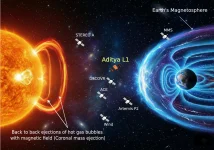
Figure: Artistic illustration of the ejection of hot gas bubbles and magnetic field from the Sun, known as Coronal Mass Ejections. These two back-to-back CMEs collided in interplanetary space, and the embedded magnetic field lines snapped and rejoined, as captured by Aditya-L1 and six other spacecraft from NASA and NOAA, as shown in the above figure. The figure and spacecraft positions are not drawn to scale and are for illustrative purposes only.
During the May 2024 solar storm, scientists discovered something unusual: the Sun’s magnetic fields, which are like twisted ropes inside a solar storm, were breaking and rejoining within the storm. Usually, a CME carries a twisted “magnetic rope” that interacts with Earth’s magnetic shield as it approaches Earth. But this time, two CMEs collided in space and squeezed each other so firmly that the magnetic field lines inside one of them snapped and rejoined in new ways, a process called magnetic reconnection. This sudden reversal of the magnetic field made the storm's impact much stronger than expected. Satellites also detected particles suddenly speeding up, indicating an increase in their energy, confirming the magnetic reconnection event.
At the heart of this discovery is India’s first solar observatory, Aditya-L1, which joined forces with six U.S. satellites (NASA’s Wind, ACE, THEMIS-C, STEREO-A, MMS, and NASA-NOAA joint mission DSCOVR). For the first time, researchers could study the same extreme solar storm from multiple vantage points in space. Thanks to precise magnetic field measurements from India’s Aditya-L1 mission, scientists were able to map this reconnection region. They found that the area where the CME’s magnetic field was tearing and reconnecting was enormous – about 1.3 million kilometers across, i.e, nearly 100 times the size of Earth. It was the first time such a giant magnetic breakup and rejoining had ever been seen inside a CME.
This discovery matters because it enhances our understanding of how solar storms evolve as they travel from the Sun to Earth. This demonstrates India’s growing leadership in global space science. With Aditya-L1’s contributions, India is now better prepared to understand and predict powerful solar storms.
Reference: Shibotosh Biswas, AnkushBhaskar, Anil Raghav, Ajay Kumar, KalpeshGhag, Smitha V. Thampi, and Vipin K. Yadav. "Pinching of ICME Flux Rope: Unprecedented Multipoint Observations of Internal Magnetic Reconnection during Gannon's Superstorm." DOI: 10.3847/2041-8213/adfe60, The Astrophysical Journal Letters, (2025).
India’s Aditya-L1 Joins Global Effort in Landmark Solar Storm Study
December 09, 2025
In May 2024, our planet faced the strongest solar storm in more than two decades, which disturbed Earth’s environment severely – an event now called “Gannon’s storm”. The solar storm is composed of a series of giant explosions on the Sun, known as coronal mass ejections (CMEs). A CME is like a massive bubble of hot gas and magnetic energy thrown out from the Sun into space. When these bubbles hit Earth, they can shake our planet’s magnetic shield and cause serious trouble for satellites, communication systems, GPS, and even power grids.
A team of Indian scientists has published a breakthrough study in the Astrophysical Journal Letters (DOI:10.3847/2041-8213/adfe60, September 2025) that possibly explains why this storm behaved so unusually.
Figure: Artistic illustration of the ejection of hot gas bubbles and magnetic field from the Sun, known as Coronal Mass Ejections. These two back-to-back CMEs collided in interplanetary space, and the embedded magnetic field lines snapped and rejoined, as captured by Aditya-L1 and six other spacecraft from NASA and NOAA, as shown in the above figure. The figure and spacecraft positions are not drawn to scale and are for illustrative purposes only.
During the May 2024 solar storm, scientists discovered something unusual: the Sun’s magnetic fields, which are like twisted ropes inside a solar storm, were breaking and rejoining within the storm. Usually, a CME carries a twisted “magnetic rope” that interacts with Earth’s magnetic shield as it approaches Earth. But this time, two CMEs collided in space and squeezed each other so firmly that the magnetic field lines inside one of them snapped and rejoined in new ways, a process called magnetic reconnection. This sudden reversal of the magnetic field made the storm's impact much stronger than expected. Satellites also detected particles suddenly speeding up, indicating an increase in their energy, confirming the magnetic reconnection event.
At the heart of this discovery is India’s first solar observatory, Aditya-L1, which joined forces with six U.S. satellites (NASA’s Wind, ACE, THEMIS-C, STEREO-A, MMS, and NASA-NOAA joint mission DSCOVR). For the first time, researchers could study the same extreme solar storm from multiple vantage points in space. Thanks to precise magnetic field measurements from India’s Aditya-L1 mission, scientists were able to map this reconnection region. They found that the area where the CME’s magnetic field was tearing and reconnecting was enormous – about 1.3 million kilometers across, i.e, nearly 100 times the size of Earth. It was the first time such a giant magnetic breakup and rejoining had ever been seen inside a CME.
This discovery matters because it enhances our understanding of how solar storms evolve as they travel from the Sun to Earth. This demonstrates India’s growing leadership in global space science. With Aditya-L1’s contributions, India is now better prepared to understand and predict powerful solar storms.
Reference: Shibotosh Biswas, AnkushBhaskar, Anil Raghav, Ajay Kumar, KalpeshGhag, Smitha V. Thampi, and Vipin K. Yadav. "Pinching of ICME Flux Rope: Unprecedented Multipoint Observations of Internal Magnetic Reconnection during Gannon's Superstorm." DOI: 10.3847/2041-8213/adfe60, The Astrophysical Journal Letters, (2025).
India’s Aditya-L1 Joins Global Effort in Landmark Solar Storm Study

How much does India spend on space missions? Budget of ₹1,200 crore for Gaganyaan, ₹150 crore for... | Today News
Not just for Chandrayaan-4, but the Department of Space declared project- and year-wise details of funds sanctioned, released, and utilised for all projects of the Indian Space Research Organisation since 2020-21.
 www.livemint.com
Gaganyaan allocated budget: 1200 crore.
Utilised budget till date: 677.9 crore.
The government allocated a budget of ₹150 crore for the Chandrayaan-4 mission in the financial year 2025-26, while the actual expenditure until November 2025 has been recorded at ₹24.47 crore.
Last edited:
why? like if they can expedite programs with more budget spent why dont they?
How much does India spend on space missions? Budget of ₹1,200 crore for Gaganyaan, ₹150 crore for... | Today News
Not just for Chandrayaan-4, but the Department of Space declared project- and year-wise details of funds sanctioned, released, and utilised for all projects of the Indian Space Research Organisation since 2020-21.
Gaganyaan allocated budget: 1200 crore.
Utilised budget till date: 677.9 crore.
The government allocated a budget of ₹150 crore for the Chandrayaan-4 mission in the financial year 2025-26, while the actual expenditure until November 2025 has been recorded at ₹24.47 crore.

Heaviest payload launched by LVM3 from Indian soil.