Pralay and Shaurya: Conventional Strike Surface-to-Surface Missiles

Thats a new missile.
Whenever an air launched variant is created it becomes somewhat new tbh, it would need its own line of supply chain, repair, checkout etc even with commonality with the original. That is the user concern , in this case IAF.
 
Whenever an air launched variant is created it becomes somewhat new tbh, it would need its own line of supply chain, repair, checkout etc even with commonality with the original. That is the user concern , in this case IAF.
Not really, Brahmos and Brahmos-A are the same missile, very little changes. Recently, Israel made Air Lora our of Lora. South Korea is now doing the same with their equivalent.

 
No, I am saying if Pralay airframe is modified to create some 800km variant air launched LRSOW R4 then it is a possibility, it is feasible to make such a long range standoff weapon to hit a target from 800km away and launched from a jet which is a huge capability. Do not think about just in land attack mode ie Su30 with such a weapon system over the land area. Rather think about Su30 with such standoff weapon over the vast IOR area and you can understand the strategic force multiplier of such a capability.

This is just for the basic design part. How the missile is made to fly, in which trajectory, how fast , how target acquisition is done, ability to deceive enemy air defence and keeping datalink comm, long range navigation & guidance are where it would differentiate from another (plus the cost , utility etc) missile system. Then it is upto the mission commander to decide which choice is to use depending on battlefield situation. That part is what I can not tell because its a practical war use aspect I do not know much about.
Atleast 500kg payload in an A2G varient
Or higher range of min. ~700km
Will make enough sense to warrant its development.
I already mentioned the increased range making it viable.

But we don'T know if A2G pralay is supposed to have higher range than G2G pralay.
 
  • Like
Reactions: RationalGuy
Not really, Brahmos and Brahmos-A are the same missile, very little changes. Recently, Israel made Air Lora our of Lora. South Korea is now doing the same with their equivalent.

Minute difference because of the nature ie cruise vehicle activation both cases one with start from a standstill position while the other with short booster in air due to already in motion, but we can not say 100% same, there will always be some difference hence air launch version is very difficult and it took so long to make the same. The INS initiation itself for the strapdown nav system is critical and took time to achieve desired accuracy because accurate initiation while flying at subsonic speed is very hard. Even from a standpoint ground launch the canister telemetry antenna needs to initiate the position update to the strapdown module accurately else the INS would give larger error > 10m not acceptable. Some critical challenges are always there that we do not get to know.

major difference is the trajectory optimisation which is computation dependent, on board comp will calculate on a fed program model with data from real time flight and shape trajectory. This is heavy computation intensive and basically flying differently to how Israelis or Koreans do. Theirs also can maneuver but not in all 3 phases of flight. DRDO have done that to defeat ad in all 3 phases.
 
Minute difference because of the nature ie cruise vehicle activation both cases one with start from a standstill position while the other with short booster in air due to already in motion, but we can not say 100% same, there will always be some difference hence air launch version is very difficult and it took so long to make the same. The INS initiation itself for the strapdown nav system is critical and took time to achieve desired accuracy because accurate initiation while flying at subsonic speed is very hard. Even from a standpoint ground launch the canister telemetry antenna needs to initiate the position update to the strapdown module accurately else the INS would give larger error > 10m not acceptable. Some critical challenges are always there that we do not get to know.
That is very far from making a 5ton missile to 2ton. He was probably referring to Rudram-IV nothing to do with Pralay.
 
I already mentioned the increased range making it viable.

But we don'T know if A2G pralay is supposed to have higher range than G2G pralay.
Viable to us as a concept, it has to be viable to the user and the way drdo make missiles its highly programming centric, a computer program model will make the vehicle fly the way they want. So obviously there will be glitches in the flight software that need regular update and error fixing same as any software update life cycle. A faulty product won't be acceptable to the user, hence so much work.

Natural for a modified air launch system to have more range than the ground launch one by at least 1.2-1.5 times in conservative estimate.
For the payload part , the configuration is restricted by the max weight our jet can pull. Since that is restricted so would be the article config. If we had some bomber that can pull a 3.5-4 ton Kinzhal like article, it would be a matter of finding stable center of gravity and stabilised version with higher payload. In general 200-300kg warhead is lethal enough since supersonic impact.

Pralay itself got 370kg warhead for tactical precision use, very little scope to use the higher payload warhead except some limited cases of heavy hitting. For prithvi they made the 1 ton warhead only a few nos, small use scope compared to the 500kg warhead nos used.
That is very far from making a 5ton missile to 2ton. He was probably referring to Rudram-IV nothing to do with Pralay.
Yeah possible, hence i think it can be R3 like non uniform dia airframe. Easier to restrict weight with a 600mm dia booster + a 530mm dia kv than with the 740mm dia stages.
 
Pralay is 5 tonne missile so even with best optimisation its A2G variant shall be around 4 tonne. That brings the question of how IAF plans to use it because current inventory & planned platforms dont have the capability to air launch such heavy missile.
Good question. IIRC IAF also had the Prithvi which even then were SSMs. Why so ? I've no clue but we didn't have the SFC around the time these Prithvis were inducted into the IAF.
 
Good question. IIRC IAF also had the Prithvi which even then were SSMs. Why so ? I've no clue but we didn't have the SFC around the time these Prithvis were inducted into the IAF.
Iaf does operate ground launched missiles.
Prithvi's can be used with conventional warhead against airfields
 
The more diverse your inventory is, the more operative freedom it can create if used intelligently and correctly by a well trained user group.
Similar case to harrop as anti rad role. In future if you have such a system but with dew that can find the enemy radar, disable it via laser and return back it will be another tool of choice compared to mainstream use of ngarm like missile for hardkill purpose. All progressive development is done that way.
 
The more diverse your inventory is, the more operative freedom it can create if used intelligently and correctly by a well trained user group.
It also comes at a financial cost and maintenance.
And the caviet of " used correctly".

Haroop and ngarm are entirely different systems for similar role.
The way they operate is vastly different.

An air launched pralay and rudram 3 won't be.
Unless air-launched pralay like missiles can carry ~500kg Warhead or min 700km range, it doesn't make sense to pursue it given rudram 3 is in works.
 
  • Like
Reactions: _Anonymous_
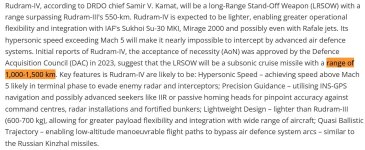
View attachment 45890
If Rudram iv fills the criteria for LRSOW, then Why the need for A2G pralay? @marich01 @babablacksheep
Initially LROW was assumed to be a "subsonic" cruise missile with range of 1000-1500km.
Man, read what you read.

Later, lrsow was changed to a hypersonic weapon.
What @marich01 is speculating now is that LRSOW/rudram 4 could be missile based on pralay's tech.
A lighter Air launched version of pralay/based on pralay.
 
We should first realize mass deployment of Rudram Mk2 and Mk3 as well as air launched 800 km Brahmos before embarking on a 1,000 km ALBM. Such a weapon can only be fielded by Su 30 MKI wherase Rudrams can be carried by Tejas, Sukhoi, MiG etc making it a cross platform SEAD and A2G weapon. After that Rudram Mk4 should be pursued as an extension of Mk3, a hypersonic 1,000 km ALBM.

Experts with SAM envelops not surpassing 500 km and BVRMs not reaching beyond 400 KM, so we really need to stretch our R and D thin with developing a whopping 1000 km ALBM? What we need now are very effective SEAD weapons and BVRMs reaching 200-250 km. I am not sure whether we need a 1000 km ALBM especially if ALCM Brahmos reaches 800km.
 
We should first realize mass deployment of Rudram Mk2 and Mk3 as well as air launched 800 km Brahmos before embarking on a 1,000 km ALBM. Such a weapon can only be fielded by Su 30 MKI wherase Rudrams can be carried by Tejas, Sukhoi, MiG etc making it a cross platform SEAD and A2G weapon. After that Rudram Mk4 should be pursued as an extension of Mk3, a hypersonic 1,000 km ALBM.

Experts with SAM envelops not surpassing 500 km and BVRMs not reaching beyond 400 KM, so we really need to stretch our R and D thin with developing a whopping 1000 km ALBM? What we need now are very effective SEAD weapons and BVRMs reaching 200-250 km. I am not sure whether we need a 1000 km ALBM especially if ALCM Brahmos reaches 800km.
Rudram 1,2,3 are in various stages of "user trails".

Rudram 4/LRSOW approval will mean "development will "start".

If development of LRSOW starts today's, it will be only till mid2030's that it will go into full scale production.

Rudram 3 and longer range air launched brahmos will enter full scale production before or at late by 2030.


LRSOW with ~800 km range if made based on pralay's tech, will carry ~2× the kill energy compared to brahmos, if we conservatively assume same warhead weight as brahmos,
Not just that, the type of warhead matters.
In pralay based missile due to its shape, you can put warheads with submunitons to cover wider area, you can't in brahmos.
And it will also be a more potent bunker buster with more penetration than brahmos like missiles can achieve.

Also, AFAIK it will be more difficult to intercept than brahmos.
And will require more expensive, larger interceptor missiles by an enemy to attempt to intercept.
 
  • Like
Reactions: RationalGuy
It also comes at a financial cost and maintenance.
And the caviet of " used correctly".
Arre that is no problem for a military force. Its a herculean task to feed and get trained the manpower. In comparison logistics for the single use expendables is much more minuscule, they have lived all their lives with logistics. Integrated weapons these days are contained system and the company does the amc work , sometimes keep low end lru supply themselves. It require much less line items to maintain. In comparison the large inventory of jets need way large inventory of lru items and they manage it precisely with tens of thousands of items for each jet type.

Use correctly is the basic part that makes one a soldier in the India tri services. Its well trained force down to the lowest rank. The tri services will not accept anything random , and will not make something cleared for operational use until the manpower is fully versed with it in the training ranges. Most of the high end items are mil grade complex systems, and missiles are inherently large complex systems. So are the loitering ammo or drones, it looks easy to launch and forget but the back end work is taught for weeks. So many training method now and also getting automated via simulator use.

Haroop and ngarm are entirely different systems for similar role.
The way they operate is vastly different.

this is quite evident, and in future the former will exceed the use case utility of the latter so the latter itself will need to offer some unique utility. Maybe someday a future harrop will carry a future ngarm type object on it and complete the mission together.

An air launched pralay and rudram 3 won't be.
Unless air-launched pralay like missiles can carry ~500kg Warhead or min 700km range, it doesn't make sense to pursue it given rudram 3 is in works.

Payload restriction is not much matter of concern since its mainly self imposed somewhat. Idea was to make the weapon system available for all in service jets. That means the LCA , MWF, mirages and Su30 all should be able to carry it which is a stretch obviously. Then you need to consider mission range constraint it has to cater for via solid propulsion which has a topline wrt rocket motor use.

Rudrams are basically the first gen systems, nobody expects these to be best in class right away even though its performance will be unique. After the basic aerodynamic system is established , weight optimization will follow to increase payload. Our capability is in a transition period now. The high mach impact negates the use of higher size warhead and a single jet can carry multiple missiles so it is not to be much concern to have one single big warhead. Precision strike is done with this config.
 
Also, AFAIK it will be more difficult to intercept than brahmos.
And will require more expensive, larger interceptor missiles by an enemy to attempt to intercept.
So what happens , brahmos retain the full airframe and hits the target, while something like R2 it will have the top kv body hitting the target which after spending the solid propellant would weight less, say for a 200kg warhead you have got the seeker , some avionics part obc , battery etc together the kv part weight about 250-270kg approx that will hit ts target. This is post burnout of the rocket motor and for the entire glide phase.

This is one reason why its so hard for AD systems to target R2 like missile and shoot down. First of all its rcs is very low , then the physical size is also much small to get affected, then the speed is very high even in midcourse and terminal > 600m/sec . Then the maneuverable trajectory and flying above 22-25km altitude thereby staying out of reach of interceptors, then the waypoint nav. All these features make it something that had ballistic motor, but flew like a cruiser/glider in phases and hit like a ballistic missile high impact.

If you say bmd systems interceptor can intercept due to higher ceiling of , no those won't be. BMD ones target object with higher rcs, even the mirv there each rv has base dia higher than R2 R3 kv of 455mm which is very small and will evade any ad/bmd interceptor. Exo-atmos interceptor target rocket rv with base dia 1 meter or more. Quite improbable for any existing system to try.
 
If Rudram iv fills the criteria for LRSOW, then Why the need for A2G pralay? @marich01 @babablacksheep
We simply do not have enough information on hand atm.

- We know IAF mentioned LRSOW (> 300km standoff range) being in the work, separately drdo chief mentioned about R4 in development. We do not know whether the 2 are the same or different. If all are the same then case closed.
- We do not know what IAF meant by standoff weapon, whether it is land launched or specifically air launched standoff weapon.
- The Pralay being made into an air launched variant came from the Manish Tv program, this is technologically challenging but feasible. We have to see how it pan out.
- It is feasible to make LRSOW a subsonic long range weapon because technology exist for such, theoretically an ITCM derivative.
- It is also feasible to make R4 as an aeroballistic Pralay derivative , though due to weight restriction constraint it is unlikely to be for a very long range use beyond 800km sort.
- An air launched standoff weapon really does not need to be for > 600-800km since the carrier jet itself is way more mobile, has a very large area coverage, and will have to spend long time being airborne till the missile hits target (unless guidance control confirmation handed over to another asset).

LRSOW can be the air launched vector of the Project LR overall, making a single platform diversify into multi platform is always a force multiplier. This is how shore based anti ship Brahmos became multi platform asset. The same progressive development can be done for Pralay. It is a derivative of K-15 so we already have submarine and land vectors (shaurya) , plus the SMART. Further diversifying can lead to deployment on ship and fighter jet in some capacity.
 
We simply do not have enough information on hand atm.

- We know IAF mentioned LRSOW (> 300km standoff range) being in the work, separately drdo chief mentioned about R4 in development. We do not know whether the 2 are the same or different. If all are the same then case closed.
- We do not know what IAF meant by standoff weapon, whether it is land launched or specifically air launched standoff weapon.
- The Pralay being made into an air launched variant came from the Manish Tv program, this is technologically challenging but feasible. We have to see how it pan out.
- It is feasible to make LRSOW a subsonic long range weapon because technology exist for such, theoretically an ITCM derivative.
- It is also feasible to make R4 as an aeroballistic Pralay derivative , though due to weight restriction constraint it is unlikely to be for a very long range use beyond 800km sort.
- An air launched standoff weapon really does not need to be for > 600-800km since the carrier jet itself is way more mobile, has a very large area coverage, and will have to spend long time being airborne till the missile hits target (unless guidance control confirmation handed over to another asset).

LRSOW can be the air launched vector of the Project LR overall, making a single platform diversify into multi platform is always a force multiplier. This is how shore based anti ship Brahmos became multi platform asset. The same progressive development can be done for Pralay. It is a derivative of K-15 so we already have submarine and land vectors (shaurya) , plus the SMART. Further diversifying can lead to deployment on ship and fighter jet in some capacity.
IMO, its not worth to make "air launched" weapon with 1000km or more range.
At that distance, the targets are few and important ones inside china.
For that we can just make a ground launched missile, make it somewhat bigger, give it more range to compensate for launching it from deep inside our territory.
That way we can give the missile a bigger warhead, and not restricted by weight as such relative to air launched, we can make it fly a more complex radar evasive but less efficient trajectories or higher speeds or both.


~1000km or more range air launched will make sense in case of American needs.
Or if we have proper bombers like China and russia, even then those air launched 1000+km missiles in our case it wouldn't be of much help on land, can be somewhat useful in naval role in future.
Proper bombers if our case would be more useful as delivery platforms of large payload, rather than payload at 1000+km ranges.


From what I beleive, even the scramjet missile we are working on will have a 1000km or less range in its air launched varient.
While ground launched can be 1500+km.


If rudram 4 can have ~800km range, it will be more than sufficient, or close to 1000km if we push it.
More than that, then ground launched is better IMO.