
Nuclear Energy in India : Updates
- Thread starter Himanshu
- Start date
You are using an out of date browser. It may not display this or other websites correctly.
You should upgrade or use an alternative browser.
You should upgrade or use an alternative browser.


PressReader.com - Digital Newspaper & Magazine Subscriptions
Digital newsstand featuring 7000+ of the world’s most popular newspapers & magazines. Enjoy unlimited reading on up to 5 devices with 7-day free trial.
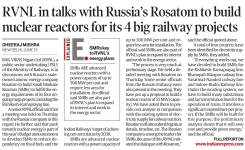
Companies including Reliance Industries, Adani Group, Indian Railways, Greenko, Vedanta, HPCL-Mittal Energy Ltd (HMEL), JSW Group, and Hindalco Industries have responded to a request for proposal (RFP) floated by state-run Nuclear Power Corporation of India Ltd (NPCIL) for setting up two units of 220-Mwe pressurized heavy water reactor (PHWR) BSRs
India's Gorakhpur slated for 2031 operation
Tuesday, 17 June 2025
The first concrete for unit 1 at Nuclear Power Corporation of India's four-unit Gorakhpur Haryana Anu Vidyut Pariyojana plant is to be poured in October, Minister of Power Manohar Lal Khattar has said.
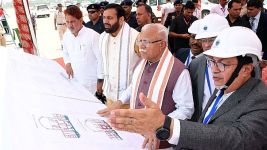
The minister reviewed progress at the Gorakhpur site (Image: Office of Manohar Lal/X)
Gorakhpur, in the Fatehabad district of Haryana, is earmarked for the construction of four Indian-designed 700 MWe pressurized heavy water reactors (PHWRs) to be built in two phases. India's Atomic Energy Regulatory Board (AERB) granted a siting licence in 2015 and approved the start of excavation work for the construction of the first two units as long ago as 2018 - several years after an official groundbreaking ceremony had been held.
At that time, first concrete had been expected to be poured for unit 1 in 2019, with construction expected to take five and a half years. Consent for the pouring of first concrete was given by the AERB in 2020.
According to the Press Trust of India, the minister visited the site on 14 July "to review the progress of the nuclear power project being implemented by the Nuclear Power Corporation of India Limited (NPCIL) under the Department of Atomic Energy" and confirmed that the first pour of concrete for unit 1 is targeted "by October 2025". First criticality is targeted by June 2030 and commercial operation by March 2031. Unit 2 is expected to follow "with a 6-month gap from Unit 1".
The Indian government already classes Gorakhpur 1 and 2 as "under construction", although the International Atomic Energy Agency's PRIS database does not consider a reactor to be under construction until the first major placing of concrete for the base mat of the reactor building is made.
The second phase at Gorakhpur - units 3 and 4 - are amongst ten units that the Indian government has sanctioned to be built under a "fleet" approach: the others are Mahi Banswara units 1-4 (in Rajasthan), Kaiga units 5 and 6 (in Karnataka), Gorakhpur units 3 and 4 (Haryana), and Chutka units 1 and 2 (Madhyar Pradesh).
India currently has 24 operable nuclear energy reactors with a total installed capacity of 8.88 GW, with six units - totalling 4,768 MWe - under construction. The country is targeting an aiming to increase its nuclear energy capacity to 100 GW by 2047.
India's Gorakhpur slated for 2031 operation
Tuesday, 17 June 2025
The first concrete for unit 1 at Nuclear Power Corporation of India's four-unit Gorakhpur Haryana Anu Vidyut Pariyojana plant is to be poured in October, Minister of Power Manohar Lal Khattar has said.
The minister reviewed progress at the Gorakhpur site (Image: Office of Manohar Lal/X)
Gorakhpur, in the Fatehabad district of Haryana, is earmarked for the construction of four Indian-designed 700 MWe pressurized heavy water reactors (PHWRs) to be built in two phases. India's Atomic Energy Regulatory Board (AERB) granted a siting licence in 2015 and approved the start of excavation work for the construction of the first two units as long ago as 2018 - several years after an official groundbreaking ceremony had been held.
At that time, first concrete had been expected to be poured for unit 1 in 2019, with construction expected to take five and a half years. Consent for the pouring of first concrete was given by the AERB in 2020.
According to the Press Trust of India, the minister visited the site on 14 July "to review the progress of the nuclear power project being implemented by the Nuclear Power Corporation of India Limited (NPCIL) under the Department of Atomic Energy" and confirmed that the first pour of concrete for unit 1 is targeted "by October 2025". First criticality is targeted by June 2030 and commercial operation by March 2031. Unit 2 is expected to follow "with a 6-month gap from Unit 1".
The Indian government already classes Gorakhpur 1 and 2 as "under construction", although the International Atomic Energy Agency's PRIS database does not consider a reactor to be under construction until the first major placing of concrete for the base mat of the reactor building is made.
The second phase at Gorakhpur - units 3 and 4 - are amongst ten units that the Indian government has sanctioned to be built under a "fleet" approach: the others are Mahi Banswara units 1-4 (in Rajasthan), Kaiga units 5 and 6 (in Karnataka), Gorakhpur units 3 and 4 (Haryana), and Chutka units 1 and 2 (Madhyar Pradesh).
India currently has 24 operable nuclear energy reactors with a total installed capacity of 8.88 GW, with six units - totalling 4,768 MWe - under construction. The country is targeting an aiming to increase its nuclear energy capacity to 100 GW by 2047.
India's Gorakhpur slated for 2031 operation

When did the 500 MWe PFBR attain criticality? And did it attain full power ops in May 2025?
According to DAEIndia's calendar of events celebrating its platinum jubilee year, full power operation of the 500 MWe Prototype Fast Breeder Reactor (PFBR) at Kalpakkam is scheduled for May 2025.
The PFBR is so delayed that it's surprising the government is still backing the project and coping with the increasing cost overruns.India developing three types of small modular reactors: Jitendra Singh
PTI / Jul 24, 2025, 17:21 IST
View attachment 45465
NEWS DELHI: India is developing three different types of small modular reactors (SMRs), including one dedicated to the production of hydrogen, mostly in the form of captive plants for energy-intensive industries, Union minister Jitendra Singh said on Thursday.
In a written reply to the Rajya Sabha, Singh said the three types of SMRs, 200 MWe Bharat Small Modular Reactor (BSMR), 55 MWe SMR and 5 MWth High Temperature Gas Cooled Reactor, for the production of hydrogen are being designed and developed indigenously.
"In-principle approval has been obtained for the construction of these demonstration reactors. These demonstration reactors are likely to be constructed in 60 to 72 months after receipt of administrative sanction of projects," he said.
The minister said the lead units of BSMR and SMR are planned to be installed at Department of Atomic Energy (DAE) sites in collaboration with Nuclear Power Corporation of India Limited (NPCIL).
"An estimate prepared based on the experience of setting up of 220 MWe plants indicates that the overall cost for the lead unit of 200 MWe Bharat Small Modular Reactor (BSMR-200) will be about Rs 5,750 crore," said Singh, the Minister of State in the Prime Minister's Office that oversees the DAE.
A 5 MWth high temperature Gas Cooled Reactor (GCR) is also planned to be used exclusively for hydrogen production by coupling with a suitable thermochemical hydrogen production process, he said.
The potential thermo-chemical technologies for hydrogen production, such as Copper-Chloride (Cu-Cl) and Iodine-Sulphur (I-S) cycles, have already been developed and demonstrated by the Bhabha Atomic Research Centre (BARC), Singh said.
Necessary technology for the deployment of these reactors is available in the country and the majority of equipment is within the manufacturing capability of the Indian industry with technological handholding by the DAE, he said.
"These plants are designed & developed considering deployment as captive power plants, repurposing of retiring fossil fuel-based plants and hydrogen production to support the transport sector with the prime objective of decarbonisation," Singh said.
Presently, the installed nuclear power capacity in the country comprises 25 reactors with a total capacity of 8,880 MW, including RAPS-1 (100 MW), which is under long-term shutdown.
Two units of 700 MWe each - Kakrapar Atomic Power Station (KAPS) 3 and 4 and one 700 MWe unit at Rajasthan Atomic Power Project (RAPP-7) have already commenced commercial operation.
At present, 18 reactors with a total capacity of 13,600 MW, including 500 MW Prototype Fast Breeder Reactor implemented by BHAVINI, are at various stages of implementation. On the progressive completion of these units, the installed nuclear power capacity will reach 22,480 MW, Singh said.
India developing three types of small modular reactors: Jitendra Singh | India News - Times of India

BARC, NPCIL unveil India’s first private test facility for depleted heavy water upgradation
Nuclear Power Corporation Of India Limited: NPCIL and BARC inaugurate India's first private sector facility for upgrading depleted heavy water, enhancing nuclear power efficiency. TEMA India plays a crucial role in this technological advancement aimed at supporting India’s nuclear power growth.

We import a lot of engineering items to support our nuclear capacity from China. It's actually in the top 10 categories of our imports from China.However, officials said since the UK does not have many companies that build nuclear reactors, imports from the country are likely to be limited.
Maybe UK industries can help us diversify our supplychains there.
The UK itself imports a lot of machinery from France for its under-construction nuclear reactors. For a country with a dying steel industry, we cant expect them to provide us with boilers and reactor parts, the best way is to build up our industries over time.We import a lot of engineering items to support our nuclear capacity from China. It's actually in the top 10 categories of our imports from China.
Maybe UK industries can help us diversify our supplychains there.

Centre plans entry norms for private sector in nuclear power push
India is considering allowing private companies to operate nuclear power plants by setting qualifying criteria focused on financial health, technical expertise, and large-scale project experience. Proposed changes to the Atomic Energy and Civil Liability for Nuclear Damage Acts are under legal review. The move aims to boost clean energy capacity from 8.8 GW to 100 GW by 2047 under Viksit Bharat.
Centre plans entry norms for private sector in nuclear power push
India is considering allowing private companies to operate nuclear power plants by setting qualifying criteria focused on financial health, technical expertise, and large-scale project experience. Proposed changes to the Atomic Energy and Civil Liability for Nuclear Damage Acts are under legal review. The move aims to boost clean energy capacity from 8.8 GW to 100 GW by 2047 under Viksit Bharat.
Nuclear Power plant takes a long time to construct and commission
It is not lucrative enough for Private sector to invest in it
They would prefer supplying machinery like L and T and BHEL do right now
But investment looks difficult
Secondly the lack of trained manpower
How many Private sector people can handle Enriched Uranium and the Consequent Radiation Risks and Safeguards
NPCIL and DAE have 6 decades of experience
Goal is 2047. Gotta start somewhere. It's easy to think it as a failure if you look at current capabilities. But these are entry norms, with good training, oversight, there's no reason that private players can't handle it. At the end of the day, human beings are going to handle tasks, wether gov or private.Nuclear Power plant takes a long time to construct and commission
It is not lucrative enough for Private sector to invest in it
They would prefer supplying machinery like L and T and BHEL do right now
But investment looks difficult
Secondly the lack of trained manpower
How many Private sector people can handle Enriched Uranium and the Consequent Radiation Risks and Safeguards
NPCIL and DAE have 6 decades of experience
Private defense, self reliant, make in India.. all seemed very odd at the beginning with so many doubting them. But 5-7 years later, we are making steady progress.
The most thing to be concerned about is oversight to prevent proliferation. Other than that, there so much talent waiting to be utilised to bring innovation to this domain. Nuclear energy is ever important given the huge energy demand for AI infrastructure and push for clean energy. Big Tech giants are even tying up and investing in companies that can build a dedicated powerplant for them. If India wants to establish its place in AI+Quantum+robotic space... it needs to be ready with energy infrastructure in place.
While nuclear energy isn't the only option, it's a major one which is tried and tested.
Then you've got concept compact reactors for propulsion, engine etc. It's a step in good faith which requires robust Collab and work ethics.. as does any other technology.
Last edited:
Goal is 2047. Gotta start somewhere. It's easy to think it as a failure if you look at current capabilities. But these are entry norms, with good training, oversight, there's no reason that private players can't handle it. At the end of the day, human beings are going to handle tasks, wether gov or private.
Private defense, self reliant, make in India.. all seemed very odd at the beginning with so many doubting them. But 5-7 years later, we are making steady progress.
The most thing to be concerned about is oversight to prevent proliferation. Other than that, there so much talent waiting to be utilised to bring innovation to this domain. Nuclear energy is ever important given the huge energy demand for AI infrastructure and push for clean energy. Big Tech giants are even tying up and investing in companies that can build a dedicated powerplant for them. If India wants to establish its place in AI+Quantum+robotic space... it needs to be ready with energy infrastructure in place.
While nuclear energy isn't the only option, it's a major one which is tried and tested.
Then you've got concept compact reactors for propulsion, engine etc. It's a step in good faith which requires robust Collab and work ethics.. as does any other technology.
Nuclear Energy as a percentage of Energy mix is stagnant worldwide
This has happened because of Solar and Wind
Add to it Coal and Gas and Hydel , I don't see private sector being very keen on Nuclear Energy
Private Sector in Defence was a different thing , Because the Demand was clearly available for Defence equipment
Here In India it is a complex task to set up a Nuclear plant with Activists protesting about Safety hazard
It is only when there is a looming power crisis , that we will see a big jump in Nuclear energy production , ie when we run out of Coal and Gas
Let's see.. The activism is not unique to India. Coal is gonna go down due to things like carbon tax. Even if GOI talks it out with UK, the precedent would've been set. And Indian coal powerplants are already suffering from inefficiencies and environmental concern. For all the fanfare about solar, wind, hydel.. all of them takes time and betting on limited no. Of sources isn't enough. All three are limited by geography, climate and comes with their own risk.Nuclear Energy as a percentage of Energy mix is stagnant worldwide
This has happened because of Solar and Wind
Add to it Coal and Gas and Hydel , I don't see private sector being very keen on Nuclear Energy
Private Sector in Defence was a different thing , Because the Demand was clearly available for Defence equipment
Here In India it is a complex task to set up a Nuclear plant with Activists protesting about Safety hazard
It is only when there is a looming power crisis , that we will see a big jump in Nuclear energy production , ie when we run out of Coal and Gas
Nuclear power is one of the option. Not the only option. India needs to diversify it's energy resources for redundancy and keeping up with the world.
As for demand, I did mention above the nature of AI infra being very resource hungry. Every data center worth something will require dedicated power lines to maintain smooth running. You don't see the demand today, but what about 10 years later? Are you sure solar, wind, hydel will be able to meet the energy demand of then? Don't activist hamper the development of these projects either? For some it's trees, for some it's raw material extracted, for some it's safety, it's always one thing or another.
As for safety hazards.. nuclear plants are a reality. They are running all over the world including india as we are having this discussion. The point is to have safeguards in policies that prevent plants in habitable zones, have robust safety mechanisms etc..
As for interest from private players, it's not gonna be there since say one. Maybe not on day two either. But as our economy grows, demand grows and innovation in nuclear technology grows... private players will start entering the sector.
But for that to happen, first there needs to be some kind of initiative... which the policy vision is. The govt hasn't changed or made a new policy yet. With the willingness shown from govt.. it will wait for private players to reach out, or maybe they are already engaging with various players.. understanding the needs, demand projection etc while consulting with experts on regulations too keeping safety and extent of liberalisation in mind.
This is the first baby step. But one thing is for sure, energy demand will only increase and we must explore every means possible to meet those demands.
One more innovative technology being developed in Japan, China etc is leveraging underseal currents for power generation. That also complements the undersea data centres and AI clusters for efficient cooling.
So, nuclear energy has the potential.. the verdict on its role in wider energy market isn't out yet cause we are just at the beginning.
Last edited:
Nuclear Energy as a percentage of Energy mix is stagnant worldwide
This has happened because of Solar and Wind
Add to it Coal and Gas and Hydel , I don't see private sector being very keen on Nuclear Energy
Private Sector in Defence was a different thing , Because the Demand was clearly available for Defence equipment
Here In India it is a complex task to set up a Nuclear plant with Activists protesting about Safety hazard
It is only when there is a looming power crisis , that we will see a big jump in Nuclear energy production , ie when we run out of Coal and Gas

Why Tech Giants Are Investing Billions in Nuclear Power Over Renewables? — Nuclear Business Platform
Big Tech is turning to nuclear power! Facing AI's insatiable energy demands and net-zero goals, companies like Amazon, Google, and Microsoft are investing billions in nuclear solutions, particularly SMRs. This strategic shift ensures reliable, low-carbon power for data centers.
 www.nuclearbusiness-platform.com
Going by the trends.. nuclear energy is far from obsolete and stagnant
PFBR's first-of-a-kind issues 'being solved systematically'
Tuesday, 5 August 2025
Atomic Energy Minister Jitendra Singh told India's parliament that a "delay in completion of the Prototype Fast Breeder Reactor project is mainly due to first-of-a-kind technological issues being faced in the integrated commissioning phase of the project".

India's prime minister visited the site in March 2024 (Image: DAE)
In a written answer to the Lok Sabha, he said: "These issues are being solved systematically in close co-ordination with the designers."
He had been asked "whether any delay has been observed in critical projects such as the Prototype Fast Breeder Reactor, Advanced Heavy Water Reactor, and Indian High Temperature Reactor; and if so, the reasons therefor?"
In the answer he added that "the design validation of Advanced Heavy Water Reactor is on-going along with peer review of the design. The project ... is not formally launched hence, no delay has incurred. Molten Salt Reactor is a version of Indian High Temperature Reactor. The establishment of reactor technology as part of proof in design concept is being carried out, hence no delay has incurred".
A separate part of the question was "whether India is implementing the three-stage nuclear power program as envisioned by Dr Homi Bhabha, and the present status of each stage".
The answer to this question was: "Yes. The first stage of the country’s sequential three stage program comprising of the Pressurized Heavy Water Reactors has attained maturity. For realization of second stage of nuclear power program, Fast Breeder Test Reactor and other facilities were established for material research and proof of design concepts. The 500 MWe Prototype Fast Breeder Reactor is at advanced stage of commissioning at Kalapakkam, implemented by BHAVINI. The third stage of the program for utilizing the vast resources of thorium reserves of the country is presently under development."
Background
Fast breeder reactors form the second stage of India's three-stage nuclear program, using plutonium recovered from the reprocessing of used fuel from the pressurized heavy water and light water reactors that form the first stage of the program. The third stage envisages using advanced heavy water reactors to burn thorium-plutonium fuels and breed fissile uranium-233, achieving a thorium-based closed nuclear fuel cycle.
The PFBR has been developed by BHAVINI (Bharatiya Nabhikiya Vidyut Nigam Limited), a government enterprise under the Department of Atomic Energy. Construction began in 2004, with an original expected completion date of 2010. It will initially use a core of uranium-plutonium mixed oxide (MOX) fuel, surrounded by a uranium-238 'blanket', with plans to use a blanket of uranium and thorium to breed plutonium and uranium-233 for use as driver fuels for AHWRs.
In August 2024 India's Atomic Energy Regulatory Board officially granted permission for the Prototype Fast Breeder Reactor to move to the next stage of the commissioning process, the First Approach to Criticality. This includes the loading of fuel into the reactor core and the start of low power physics experiments.
PFBR's first-of-a-kind issues 'being solved systematically'
Tuesday, 5 August 2025
Atomic Energy Minister Jitendra Singh told India's parliament that a "delay in completion of the Prototype Fast Breeder Reactor project is mainly due to first-of-a-kind technological issues being faced in the integrated commissioning phase of the project".
India's prime minister visited the site in March 2024 (Image: DAE)
In a written answer to the Lok Sabha, he said: "These issues are being solved systematically in close co-ordination with the designers."
He had been asked "whether any delay has been observed in critical projects such as the Prototype Fast Breeder Reactor, Advanced Heavy Water Reactor, and Indian High Temperature Reactor; and if so, the reasons therefor?"
In the answer he added that "the design validation of Advanced Heavy Water Reactor is on-going along with peer review of the design. The project ... is not formally launched hence, no delay has incurred. Molten Salt Reactor is a version of Indian High Temperature Reactor. The establishment of reactor technology as part of proof in design concept is being carried out, hence no delay has incurred".
A separate part of the question was "whether India is implementing the three-stage nuclear power program as envisioned by Dr Homi Bhabha, and the present status of each stage".
The answer to this question was: "Yes. The first stage of the country’s sequential three stage program comprising of the Pressurized Heavy Water Reactors has attained maturity. For realization of second stage of nuclear power program, Fast Breeder Test Reactor and other facilities were established for material research and proof of design concepts. The 500 MWe Prototype Fast Breeder Reactor is at advanced stage of commissioning at Kalapakkam, implemented by BHAVINI. The third stage of the program for utilizing the vast resources of thorium reserves of the country is presently under development."
Background
Fast breeder reactors form the second stage of India's three-stage nuclear program, using plutonium recovered from the reprocessing of used fuel from the pressurized heavy water and light water reactors that form the first stage of the program. The third stage envisages using advanced heavy water reactors to burn thorium-plutonium fuels and breed fissile uranium-233, achieving a thorium-based closed nuclear fuel cycle.
The PFBR has been developed by BHAVINI (Bharatiya Nabhikiya Vidyut Nigam Limited), a government enterprise under the Department of Atomic Energy. Construction began in 2004, with an original expected completion date of 2010. It will initially use a core of uranium-plutonium mixed oxide (MOX) fuel, surrounded by a uranium-238 'blanket', with plans to use a blanket of uranium and thorium to breed plutonium and uranium-233 for use as driver fuels for AHWRs.
In August 2024 India's Atomic Energy Regulatory Board officially granted permission for the Prototype Fast Breeder Reactor to move to the next stage of the commissioning process, the First Approach to Criticality. This includes the loading of fuel into the reactor core and the start of low power physics experiments.
PFBR's first-of-a-kind issues 'being solved systematically'
Steam generator marks milestone for Indian fleet construction
Wednesday, 20 August 2025
Nuclear Power Corporation of India Ltd and L&T Heavy Engineering have held a "flagging off" ceremony to mark the completion and dispatch of the steam generator for the second phase of the Gorakhpur nuclear power plant.
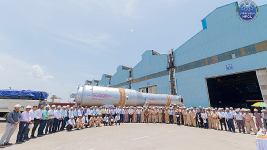
(Image: NPCIL)
The completion of this major component was hailed by Nuclear Power Corporation of India Ltd (NPCIL) as a "significant step" for India's nuclear expansion.
"Manufactured and dispatched seven months ahead of schedule, this Steam Generator underscores the capability of India’s industry to deliver critical nuclear components with speed and quality," the company said.
"As NPCIL spearheads the fleet of 10 indigenously designed 700 MWe PHWRs, this achievement strengthens the foundation of our proactive expansion strategy and reinforces our commitment to India’s vision of 100 GWe nuclear power capacity by 2047, ensuring reliable, clean and sustainable energy for a Viksit Bharat." (Viksit Bharat is the government's strategy to make India into a completely developed nation by 2047)
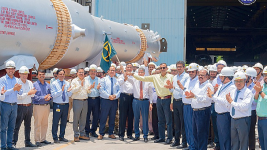
The flagging off ceremony (Image: NPCIL)
Steam generators are heat exchangers which convert heat generated by the reactor core from the reactor coolant into steam to power the turbogenerator. The reactor coolant system is known as the primary circuit; the system in which the steam is produced is the secondary circuit.
The Gorakhpur plant - its full name is Gorakhpur Haryana Anu Vidyut Pariyojana, sometimes abbreviated to GHAVP - will be home to four 700 MWe Indian-designed pressurised heavy water reactors, or PHWRs. These are to be built in two phases. India's Atomic Energy Regulatory Board (AERB) granted a siting licence in 2015, and the government accorded administrative approval and financial sanction for the first two units in 2014. Gorakhpur units 3 and 4 are among ten 700 MWe PHWRs accorded administrative approval and financial sanction by the government in 2018, for construction in "fleet" mode.
Excavation work for Gorakhpur units 1 and 2 began at the site in 2018, and construction of peripheral buildings and structures is under way, although work on the main nuclear island has been delayed because of the need for extra ground stabilisation. According to recent written answers to the Indian parliament, the first two units are now penciled in for completion by 2031-32.
Steam generator marks milestone for Indian fleet construction
Wednesday, 20 August 2025
Nuclear Power Corporation of India Ltd and L&T Heavy Engineering have held a "flagging off" ceremony to mark the completion and dispatch of the steam generator for the second phase of the Gorakhpur nuclear power plant.
(Image: NPCIL)
The completion of this major component was hailed by Nuclear Power Corporation of India Ltd (NPCIL) as a "significant step" for India's nuclear expansion.
"Manufactured and dispatched seven months ahead of schedule, this Steam Generator underscores the capability of India’s industry to deliver critical nuclear components with speed and quality," the company said.
"As NPCIL spearheads the fleet of 10 indigenously designed 700 MWe PHWRs, this achievement strengthens the foundation of our proactive expansion strategy and reinforces our commitment to India’s vision of 100 GWe nuclear power capacity by 2047, ensuring reliable, clean and sustainable energy for a Viksit Bharat." (Viksit Bharat is the government's strategy to make India into a completely developed nation by 2047)
The flagging off ceremony (Image: NPCIL)
Steam generators are heat exchangers which convert heat generated by the reactor core from the reactor coolant into steam to power the turbogenerator. The reactor coolant system is known as the primary circuit; the system in which the steam is produced is the secondary circuit.
The Gorakhpur plant - its full name is Gorakhpur Haryana Anu Vidyut Pariyojana, sometimes abbreviated to GHAVP - will be home to four 700 MWe Indian-designed pressurised heavy water reactors, or PHWRs. These are to be built in two phases. India's Atomic Energy Regulatory Board (AERB) granted a siting licence in 2015, and the government accorded administrative approval and financial sanction for the first two units in 2014. Gorakhpur units 3 and 4 are among ten 700 MWe PHWRs accorded administrative approval and financial sanction by the government in 2018, for construction in "fleet" mode.
Excavation work for Gorakhpur units 1 and 2 began at the site in 2018, and construction of peripheral buildings and structures is under way, although work on the main nuclear island has been delayed because of the need for extra ground stabilisation. According to recent written answers to the Indian parliament, the first two units are now penciled in for completion by 2031-32.
Steam generator marks milestone for Indian fleet construction
NTPC to mark nuclear power entry with 2,800 MW project next month
The project will house four pressurized heavy water reactors (PHWRs) of 700 MW capacity each
By Sudheer Pal Singh New Delhi
Last Updated: Aug 24, 2025, 10:58 PM IST
The first unit of the Rajasthan project is planned for commissioning in 2031, and the full plant is to be commissioned in 2036.
Marking its entry into the nuclear power domain, state-owned power generator NTPC Ltd will next month lay the foundation stone for its 2,800 megawatt (MW) nuclear power project at Banswara in Rajasthan. The project will house four pressurized heavy water reactors (PHWRs) of 700 MW capacity each.
“We have decided, rightfully, we will go very aggressive on nuclear. We plan to add 30 gigawatt (GW) nuclear power capacity by 2047,” NTPC Chairman and Managing Director Gurdeep Singh said at the BloombergNEF Summit here.
“The foundation stone laying as part of the JV project with NPCIL should happen next month. It is as close as that,” he added.
NTPC plans to set up nuclear power projects both as part of an existing JV with Nuclear Power Corporation of India Limited (NPCIL), called Anushakti Vidhyut Nigam Ltd (ASVINI), and on a standalone basis. The Mahi Banswara project is being set up under the JV, where NTPC has a 49 per cent stake.
The first unit of the Rajasthan project is planned for commissioning in 2031, and the full plant is to be commissioned in 2036.
“By that time, we will take up many other plants too. We are in discussion with Tata Consulting Engineers (TCE), L&T, EDF, Rosatom, and Holtec and a few international consultants,” Singh said. NTPC is keen to join hands with service and technology providers, and it is exploring many sites across the country.
India currently has 8,800 MW installed nuclear power generation capacity, and plans to raise that figure to 200,000 MW (or 200 GW) by 2047. As part of the efforts to boost the sector, the government had announced a provision of around ₹20,000 crore in the last Union Budget.
“There is work already going on to set up 6,600 MW under construction projects and additional 7,000 MW capacity is under various stages of development, where our Mahi Banswara project is also coming. These plants are likely to come by 2030. So, we are going to get to around 20 GW. NPCIL itself has a target of reaching 50-55 GW capacity by 2047,” Singh said.
According to Singh, as the country moves towards 2036-37, it will be in a position to add around 10 GW of nuclear power generation capacity annually. “This is because work will be going on at 3-4 sites and also there is an exclusive mandatory zone for these nuclear power plants,” he said.
Given the low emission profile of nuclear power, and its use as a baseload source for the grid, the government is working to implement a slew of measures to ramp up nuclear power capacity addition, including allowing private sector entry into the sensitive industry.
https://www.business-standard.com/c...-power-project-next-month-125082400402_1.html
The project will house four pressurized heavy water reactors (PHWRs) of 700 MW capacity each
By Sudheer Pal Singh New Delhi
Last Updated: Aug 24, 2025, 10:58 PM IST
The first unit of the Rajasthan project is planned for commissioning in 2031, and the full plant is to be commissioned in 2036.
Marking its entry into the nuclear power domain, state-owned power generator NTPC Ltd will next month lay the foundation stone for its 2,800 megawatt (MW) nuclear power project at Banswara in Rajasthan. The project will house four pressurized heavy water reactors (PHWRs) of 700 MW capacity each.
“We have decided, rightfully, we will go very aggressive on nuclear. We plan to add 30 gigawatt (GW) nuclear power capacity by 2047,” NTPC Chairman and Managing Director Gurdeep Singh said at the BloombergNEF Summit here.
“The foundation stone laying as part of the JV project with NPCIL should happen next month. It is as close as that,” he added.
NTPC plans to set up nuclear power projects both as part of an existing JV with Nuclear Power Corporation of India Limited (NPCIL), called Anushakti Vidhyut Nigam Ltd (ASVINI), and on a standalone basis. The Mahi Banswara project is being set up under the JV, where NTPC has a 49 per cent stake.
The first unit of the Rajasthan project is planned for commissioning in 2031, and the full plant is to be commissioned in 2036.
“By that time, we will take up many other plants too. We are in discussion with Tata Consulting Engineers (TCE), L&T, EDF, Rosatom, and Holtec and a few international consultants,” Singh said. NTPC is keen to join hands with service and technology providers, and it is exploring many sites across the country.
India currently has 8,800 MW installed nuclear power generation capacity, and plans to raise that figure to 200,000 MW (or 200 GW) by 2047. As part of the efforts to boost the sector, the government had announced a provision of around ₹20,000 crore in the last Union Budget.
“There is work already going on to set up 6,600 MW under construction projects and additional 7,000 MW capacity is under various stages of development, where our Mahi Banswara project is also coming. These plants are likely to come by 2030. So, we are going to get to around 20 GW. NPCIL itself has a target of reaching 50-55 GW capacity by 2047,” Singh said.
According to Singh, as the country moves towards 2036-37, it will be in a position to add around 10 GW of nuclear power generation capacity annually. “This is because work will be going on at 3-4 sites and also there is an exclusive mandatory zone for these nuclear power plants,” he said.
Given the low emission profile of nuclear power, and its use as a baseload source for the grid, the government is working to implement a slew of measures to ramp up nuclear power capacity addition, including allowing private sector entry into the sensitive industry.
https://www.business-standard.com/c...-power-project-next-month-125082400402_1.html