

US Military Technology
- Thread starter BMD
- Start date
You are using an out of date browser. It may not display this or other websites correctly.
You should upgrade or use an alternative browser.
You should upgrade or use an alternative browser.

Barracuda-500 Selected to Move Forward on the Enterprise Test Vehicle Prototype Project
The Air Force Armament Directorate (EB) and the Defense Innovation Unit (DIU) have selected Anduril’s Barracuda-500 autonomous air vehicle (AAV) to move forward to the next phase of the Enterprise Test Vehicle (ETV) prototype project.
 www.anduril.com


DARPA Thinks Stealth is Obsolete in Future Wars
America's stealth aircraft will lose their combat edge thanks to quantum sensors, the deputy head of DARPA argues.
 www.airandspaceforces.com
@Parthu @randomradio @Ashwin @Rajput Lion thoughts? Maybe India should collaborate with US in this field, as Chinese 5th and 6th generation platforms pose a serious threat to us.

No country will collaborate for a future technology when they have a lead, especially if you are not even close to them. In fact no one collaborates for up and coming technology anyway, you'll have to build it yourself.DARPA Thinks Stealth is Obsolete in Future Wars
America's stealth aircraft will lose their combat edge thanks to quantum sensors, the deputy head of DARPA argues.
@Parthu @randomradio @Ashwin @Rajput Lion thoughts? Maybe India should collaborate with US in this field, as Chinese 5th and 6th generation platforms pose a serious threat to us.

UK and France want to collaborate for jet engine tech even though both are significantly ahead of us.No country will collaborate for a future technology when they have a lead, especially if you are not even close to them. In fact no one collaborates for up and coming technology anyway, you'll have to build it yourself.
UK has started work on 6th gen jet engine, France will follow suit. In fact we won't be getting most of the sensitive technology from the JV, they are getting into the JV for the money for their own R&D, we'll have to develop the technology ourselves. They'll basically manufacture the core of the engine and won't give most of the technology.UK and France want to collaborate for jet engine tech even though both are significantly ahead of us.
We have also started work on developing 5th gen jet engine tech ourselves if I remember properly.

Were not doing jv for tech, but more of a looking for "supervisor/instructor", to make sure the next gen engine for amca is ready in time.UK has started work on 6th gen jet engine, France will follow suit. In fact we won't be getting most of the sensitive technology from the JV, they are getting into the JV for the money for their own R&D, we'll have to develop the technology ourselves. They'll basically manufacture the core of the engine and won't give most of the technology.
We have also started work on developing 5th gen jet engine tech ourselves if I remember properly.

Our Quantum tech is also in quite advance stage. Stealth isn't a panacea but a feature that enhances survivability. Stealth airframe + ACT + EW+ Speed + Kinematics + Sensors(Active/Passive) will always remain at the core of air-combat. Period.DARPA Thinks Stealth is Obsolete in Future Wars
America's stealth aircraft will lose their combat edge thanks to quantum sensors, the deputy head of DARPA argues.
@Parthu @randomradio @Ashwin @Rajput Lion thoughts? Maybe India should collaborate with US in this field, as Chinese 5th and 6th generation platforms pose a serious threat to us.
Yeah, we are in their to fast track the process of jet development and maybe get some of the crucial testing facilities for jet engines.Were not doing jv for tech, but more of a looking for "supervisor/instructor", to make sure the next gen engine for amca is ready in time.

DARPA Thinks Stealth is Obsolete in Future Wars
America's stealth aircraft will lose their combat edge thanks to quantum sensors, the deputy head of DARPA argues.
@Parthu @randomradio @Ashwin @Rajput Lion thoughts? Maybe India should collaborate with US in this field, as Chinese 5th and 6th generation platforms pose a serious threat to us.
Yeah, old news. Quantum systems will defeat shaping-based stealth.
Next Generation Adaptive Propulsion, or NGAP, calls for the development of adaptive cycle engines that can be reconfigured in flight between high performance and high efficiency modes by adjusting the engine’s bypass ratio. The winning design from the program is expected to eventually power the U.S. Air Force’s next generation fighter, the Boeing F-47, though with NGAP not expected to be finalised until 2030 there is a strong possibility that initial models will have to rely on an interim engine option.
The Precision Grenadier System (PGS) is a lightweight, shoulder-fired, 25mm weapon system designed to provide the infantry with enhanced firepower. Defeating targets in defilade, close quarters battle, and small unmanned aerial systems, PGS provides next-generation Soldier lethality.
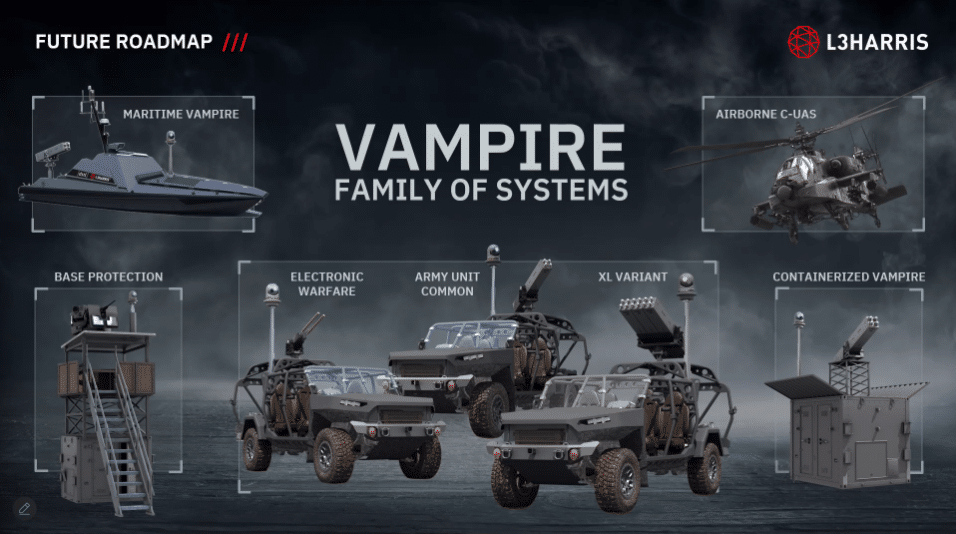
L3Harris Reveals Details on Naval VAMPIRE Counter Drone System
L3Harris officially introduced their Naval adaptation of their combat-proven VAMPIRE counter drone system. Adapting VAMPIRE to the Navy's needs has been an ongoing effort
 www.navalnews.com
During a media brief on October 8th, L3Harris officially introduced their Naval adaptation of their combat-proven VAMPIRE counter drone system. Adapting VAMPIRE to the Navy’s needs has been an ongoing effort, with the option reportedly eyed since sometime last year.
L3Harris’s Naval VAMPIRE variant is targeted towards the Navy’s ongoing efforts to field cheaper C-UAS systems amidst the rising prevalence of drones in ongoing Naval warfare. VAMPIRE gives vessels the capability to rapidly engage cheap one way drones without expending more expensive missiles such as Raytheon’s RIM-162 Evolved Sea Sparrow Missile (ESSM).
A VAMPIRE missile pod along with the WESCAM MX-series EO/IR sensor equipping a rendition of a Navy Unmanned Surface Vessel has been depicted amongst the planned future variant that L3Harris has proposed for future adoption. L3Harris has also stated that adoption on larger manned platforms is being considered for further development.
Day 2 of AUSA 2025 in Washington, D.C. delivers major breakthroughs in U.S. Army modernization. Join the Army Recognition team for exclusive footage and in-depth analysis from the show floor as Oshkosh Defense unveils its groundbreaking X-MAV, M-MAV, and L-MAV autonomous vehicles. See the world premiere of the V2X Tempest fast attack anti-tank vehicle, BAE Systems' upgraded M109A7 howitzer with a 52-caliber cannon, and Airbus U.S.'s new MQ72C Lakota Connector unmanned logistics helicopter. Plus, we reveal new squad-level firepower with the Barrett-MARS Squad Support Rifle System.

The Rise Of X-BAT
Shield AI's highly ambitious plan to disrupt the autonomous combat aircraft market with its VTOL stealth drone.
 www.twz.com
Shield AI has unveiled X-BAT, a stealthy jet-powered ‘autonomous fighter’ designed to take off vertically and land the same way, tail first, after completing its mission. The company is best known for its Hivemind autonomy software and its much less complex, but combat-proven V-BAT vertical takeoff and landing drone. Now it wants to have a very disruptive impact on the growing marketplace for Collaborative Combat Aircraft (CCA) and Unmanned Combat Air Vehicle (UCAV) type drones with a design that aims to offer a totally different level of mission flexibility from launch and recovery points on land or at sea.
Ahead of today’s reveal, TWZ had a candid and in-depth conversation about the vertical takeoff and landing (VTOL) X-BAT, its genesis, features, benefits, and the potential roadblocks to making it a reality, with Shield AI’s Armor Harris, Senior Vice President and General Manager of the company’s aircraft division.