The part of the Meta-Defense article that presents the French counter-narrative:
Rafale vs J-10 : Au Bourget, une tout autre version de l'engagement du 7 mai fait surface
"At the Paris Air Show, a completely different interpretation of the May 7 engagement emerges"
It is in this context that the Rafale reappeared at the heart of the news at the 2025 Paris Air Show, at the crossroads of several strategic and industrial issues. On one side, Dassault Aviation and the French Air and Space Force sought to defend the operational credibility of the Rafale in anticipation of the F5 standard, while negotiations over the industrial sharing of the SCAF program entered a new phase of tension with Airbus DS. On the other side, the Sino-Pakistani offensive in the field of strategic communication forced France, traditionally reserved on Indo-Pakistani affairs, to step out of its façade of neutrality.
In an article published by RFI, journalists Olivier Fourt and Franck Alexandre revealed the main lines of a French counter-narrative, based on anonymous military and industrial sources, but “directly involved in monitoring Operation Sindoor.” According to these sources, the May 7 attack was carried out with full awareness of the risk of escalation, with communication deliberately transmitted to Islamabad beforehand to limit the probability of an uncontrolled bilateral escalation. This revelation, if confirmed, is of paramount importance: it would not only explain the rapid mobilization of Pakistani air assets — notably J-10CE and JF-17 — but also the density of the radar surveillance and surface-to-air defense system activated by the PAF.
Rafale in standoff attack version with two SCALP-EG cruise missiles
Still according to RFI, Indian authorities expected intense aerial opposition and accepted the risks associated with this planned operation. This tactical choice — warning the adversary to avoid escalation while accepting a constrained aerial confrontation — constitutes a textbook case in controlled de-escalation doctrine. It fits into a much more nuanced approach than generally described in Western media circles and tends to demonstrate a level of strategic maturity rarely commented on from the Indian side.
Furthermore, French sources claim that the Indian Rafales engaged, armed with MICA air-to-air missiles, SCALP-EG cruise missiles, and Hammer guided bombs, inflicted heavy losses on the Pakistan Air Force. The figures advanced — about ten Pakistani aircraft shot down for four or five losses on the Indian side — are unsourced and should be taken with caution. Nevertheless, if confirmed, these data would completely overturn the narrative built by Islamabad.
The French narrative also specifies that the IAF’s objectives during the May 7 raid went far beyond the initially mentioned terrorist targets. In total, nine sites were reportedly struck, including not only camps linked to Islamist networks active in Kashmir but also command posts, surface-to-air defense systems, and at least two sensitive installations of the Pakistani Air Force. These strikes were executed in three successive waves, and operational results reportedly exceeded initial expectations, with Pakistani defenses apparently caught off guard despite prior warning.
This version of events, presented for the first time on the sidelines of the Paris Air Show, marks a clear break with the usual silence posture adopted by French authorities on sensitive non-European theaters. Although it was relayed cautiously — no official statement, no public declaration by a state representative — it nevertheless constitutes an obvious countermeasure against the influence campaign orchestrated around the J-10CE. The objective is clear: to protect the Rafale’s image internationally, secure ongoing export contracts (notably in Indonesia, Egypt, and the Emirates), and prevent the May 7 incident from becoming a structural point of attack against the aircraft in upcoming commercial competitions.
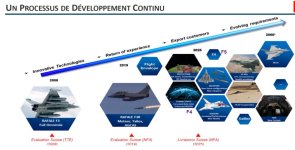
By implication, this positioning also fits into the perspective of the F5 standard. Because if the demonstration shows that the Rafale “as is” is already capable of surviving a high threat density (PL-15 missiles, interconnected radar networks, HQ-9B defense), then the upgrade to the F5 — with electronic warfare, collaborative command, next-generation armament, and drone capability — becomes a consolidation of an existing tactical success, not a defensive response to operational inferiority. A nuance that changes everything, both in the industrial narrative and doctrinal posture.
A French version difficult to verify, and the J-35A order as an ambiguous indicator
In many respects, the version presented on the sidelines of the Paris Air Show by French sources — and relayed by RFI — constitutes an attractive counter-narrative for Rafale supporters, and more broadly for those defending the tactical superiority of Indian forces. By completely overturning the dominant Sino-Pakistani narrative, it restores a clear advantage to the Indian Air Force, both technologically and operationally. But precisely because it seems too perfect, this version must be examined with caution.
J-35A at the Zhuhai Airshow
Apart from the explicit mention of General Bruno Mignot, a former French Air Force officer now publishing director at the Thémis Institute, no names, documents, or even visual or audio evidence support the claims made. The figure of about ten Pakistani aircraft shot down — which would literally overturn the strategic perception of the May 7 engagement — is not backed by any technical or independent element. Even satellite images showing successful strikes cannot, as things stand, be directly linked to the alleged air-to-air combats.
This does not mean the French version is false. But like the Pakistani narrative of May 7, it fits into a logic of offensive communication serving specific strategic interests: preserving the Rafale’s image, strengthening the legitimacy of the F5 program, and reassuring France’s export partners. Under these conditions, it cannot be accepted without the same critical rigor applied to Islamabad’s initial narrative.
However, if this caution is essential, some external signals do partly support the sense of tactical fragility on the Pakistani side. The most striking among them is undoubtedly the announcement, barely two weeks after the May 7 engagement, of Islamabad’s order for about forty J-35A fighters, the land-based version of the fifth-generation stealth fighter developed by Shenyang Aircraft Corporation for the Chinese Navy.
According to Breaking Defense, this order would come with accelerated deliveries scheduled before the end of 2025 — in parallel with the first deliveries to the Chinese naval aviation itself, which constitutes a clear break with China’s export doctrine of the past thirty years, where the most advanced systems were always reserved for national use before any external sale.
J-10C of the People’s Liberation Army Air Force
Such haste raises several questions. Why did Islamabad, which claimed a clear tactical victory on May 7 thanks to the J-10CE/PL-15 combination, rush to acquire a new aircraft whose technical maturity remains to be proven? Why did China agree to divert part of its national production in favor of an external client despite its historically cautious approach on these matters?
It is tempting to see this as a form of indirect admission: an admission from Pakistan that the J-10CE — although performant — did not provide the expected degree of superiority in a contested environment; and an admission from Beijing that the media impact of the May 7 engagement offers an unprecedented commercial window to impose the J-35 as a credible alternative to the F-35A, even before the market closes under Western diplomatic constraints.
That said, there is also an opposite reading. If the J-10CE indeed performed as announced, the media shockwave caused by this victory may have convinced Islamabad to accelerate its shift to a stealthier fleet, anticipating the entry into service of the J-35. In this logic, the order is not a disavowal of the J-10 but rather a strategic validation of a technological alignment choice with Beijing.
In the absence of precise data, both interpretations remain valid. But they both reflect a shift: the Sino-Pakistani campaign around May 7 has already produced concrete industrial, commercial, and geopolitical effects, regardless of the veracity of the claimed losses.
Rafale vs J-10 : Au Bourget, une tout autre version de l'engagement du 7 mai fait surface
"At the Paris Air Show, a completely different interpretation of the May 7 engagement emerges"
It is in this context that the Rafale reappeared at the heart of the news at the 2025 Paris Air Show, at the crossroads of several strategic and industrial issues. On one side, Dassault Aviation and the French Air and Space Force sought to defend the operational credibility of the Rafale in anticipation of the F5 standard, while negotiations over the industrial sharing of the SCAF program entered a new phase of tension with Airbus DS. On the other side, the Sino-Pakistani offensive in the field of strategic communication forced France, traditionally reserved on Indo-Pakistani affairs, to step out of its façade of neutrality.
In an article published by RFI, journalists Olivier Fourt and Franck Alexandre revealed the main lines of a French counter-narrative, based on anonymous military and industrial sources, but “directly involved in monitoring Operation Sindoor.” According to these sources, the May 7 attack was carried out with full awareness of the risk of escalation, with communication deliberately transmitted to Islamabad beforehand to limit the probability of an uncontrolled bilateral escalation. This revelation, if confirmed, is of paramount importance: it would not only explain the rapid mobilization of Pakistani air assets — notably J-10CE and JF-17 — but also the density of the radar surveillance and surface-to-air defense system activated by the PAF.
Rafale in standoff attack version with two SCALP-EG cruise missiles
Still according to RFI, Indian authorities expected intense aerial opposition and accepted the risks associated with this planned operation. This tactical choice — warning the adversary to avoid escalation while accepting a constrained aerial confrontation — constitutes a textbook case in controlled de-escalation doctrine. It fits into a much more nuanced approach than generally described in Western media circles and tends to demonstrate a level of strategic maturity rarely commented on from the Indian side.
Furthermore, French sources claim that the Indian Rafales engaged, armed with MICA air-to-air missiles, SCALP-EG cruise missiles, and Hammer guided bombs, inflicted heavy losses on the Pakistan Air Force. The figures advanced — about ten Pakistani aircraft shot down for four or five losses on the Indian side — are unsourced and should be taken with caution. Nevertheless, if confirmed, these data would completely overturn the narrative built by Islamabad.
The French narrative also specifies that the IAF’s objectives during the May 7 raid went far beyond the initially mentioned terrorist targets. In total, nine sites were reportedly struck, including not only camps linked to Islamist networks active in Kashmir but also command posts, surface-to-air defense systems, and at least two sensitive installations of the Pakistani Air Force. These strikes were executed in three successive waves, and operational results reportedly exceeded initial expectations, with Pakistani defenses apparently caught off guard despite prior warning.
This version of events, presented for the first time on the sidelines of the Paris Air Show, marks a clear break with the usual silence posture adopted by French authorities on sensitive non-European theaters. Although it was relayed cautiously — no official statement, no public declaration by a state representative — it nevertheless constitutes an obvious countermeasure against the influence campaign orchestrated around the J-10CE. The objective is clear: to protect the Rafale’s image internationally, secure ongoing export contracts (notably in Indonesia, Egypt, and the Emirates), and prevent the May 7 incident from becoming a structural point of attack against the aircraft in upcoming commercial competitions.
By implication, this positioning also fits into the perspective of the F5 standard. Because if the demonstration shows that the Rafale “as is” is already capable of surviving a high threat density (PL-15 missiles, interconnected radar networks, HQ-9B defense), then the upgrade to the F5 — with electronic warfare, collaborative command, next-generation armament, and drone capability — becomes a consolidation of an existing tactical success, not a defensive response to operational inferiority. A nuance that changes everything, both in the industrial narrative and doctrinal posture.
A French version difficult to verify, and the J-35A order as an ambiguous indicator
In many respects, the version presented on the sidelines of the Paris Air Show by French sources — and relayed by RFI — constitutes an attractive counter-narrative for Rafale supporters, and more broadly for those defending the tactical superiority of Indian forces. By completely overturning the dominant Sino-Pakistani narrative, it restores a clear advantage to the Indian Air Force, both technologically and operationally. But precisely because it seems too perfect, this version must be examined with caution.
J-35A at the Zhuhai Airshow
Apart from the explicit mention of General Bruno Mignot, a former French Air Force officer now publishing director at the Thémis Institute, no names, documents, or even visual or audio evidence support the claims made. The figure of about ten Pakistani aircraft shot down — which would literally overturn the strategic perception of the May 7 engagement — is not backed by any technical or independent element. Even satellite images showing successful strikes cannot, as things stand, be directly linked to the alleged air-to-air combats.
This does not mean the French version is false. But like the Pakistani narrative of May 7, it fits into a logic of offensive communication serving specific strategic interests: preserving the Rafale’s image, strengthening the legitimacy of the F5 program, and reassuring France’s export partners. Under these conditions, it cannot be accepted without the same critical rigor applied to Islamabad’s initial narrative.
However, if this caution is essential, some external signals do partly support the sense of tactical fragility on the Pakistani side. The most striking among them is undoubtedly the announcement, barely two weeks after the May 7 engagement, of Islamabad’s order for about forty J-35A fighters, the land-based version of the fifth-generation stealth fighter developed by Shenyang Aircraft Corporation for the Chinese Navy.
According to Breaking Defense, this order would come with accelerated deliveries scheduled before the end of 2025 — in parallel with the first deliveries to the Chinese naval aviation itself, which constitutes a clear break with China’s export doctrine of the past thirty years, where the most advanced systems were always reserved for national use before any external sale.
J-10C of the People’s Liberation Army Air Force
Such haste raises several questions. Why did Islamabad, which claimed a clear tactical victory on May 7 thanks to the J-10CE/PL-15 combination, rush to acquire a new aircraft whose technical maturity remains to be proven? Why did China agree to divert part of its national production in favor of an external client despite its historically cautious approach on these matters?
It is tempting to see this as a form of indirect admission: an admission from Pakistan that the J-10CE — although performant — did not provide the expected degree of superiority in a contested environment; and an admission from Beijing that the media impact of the May 7 engagement offers an unprecedented commercial window to impose the J-35 as a credible alternative to the F-35A, even before the market closes under Western diplomatic constraints.
That said, there is also an opposite reading. If the J-10CE indeed performed as announced, the media shockwave caused by this victory may have convinced Islamabad to accelerate its shift to a stealthier fleet, anticipating the entry into service of the J-35. In this logic, the order is not a disavowal of the J-10 but rather a strategic validation of a technological alignment choice with Beijing.
In the absence of precise data, both interpretations remain valid. But they both reflect a shift: the Sino-Pakistani campaign around May 7 has already produced concrete industrial, commercial, and geopolitical effects, regardless of the veracity of the claimed losses.