Space Based Surveillance (SBS) Phase III Mission

Ankit Kumar

Team StratFront
Nov 30, 2017
7,049
8,573
Bangalore
The Cabinet Committee on Security (CCS) headed by Prime Minister Narendra Modi has approved phase III of its Space Based Surveillance (SBS) mission for better land and maritime domain awareness for civilian and military applications. The project is being handled by the National Security Council Secretariat along with the Defence Space Agency under the integrated headquarters in the Defence Ministry.

While the Modi government is silent on the approval, it is understood that the proposal cleared by CCS involves the launch of at least 52 satellites in low earth orbit and geostationary orbit for surveillance. Costing ₹26,968 crore, the proposal involves the construction and launch of 21 satellites by ISRO and the remaining 31 by private companies.

SBS 1 was initiated by the Vajpayee government in 2001, and involved the launch of four satellites for surveillance, Cartosat 2A, Cartosat 2B, Eros B and Risat 2. SBS 2 came in 2013 with the launch of six satellites, Cartosat 2C, Cartosat 2D, Cartosat 3A, Cartosat 3B, Microsat 1 and Risat 2A. The newly cleared SBS 3 shows that India will be launching 52 satellites within the next decade.
HT learns that the three services will have dedicated satellites for their land, sea or air-based missions.

With the Modi government already signing in January, a letter of intent with France for the joint construction and launch of military satellites, the Indian focus is to acquire capabilities which can detect enemy submarines in the Indo-Pacific as well as track infrastructure construction by its adversaries on the land and sea border with India.


The SBS 3 mission will also be helped by the Indian acquisition of 31 Predator drones from US-based General Atomics as the platform has very potent surveillance capabilities apart from its weapons package. India tested its anti-satellite capabilities through test firing on March 29, 2019, when an Indian missile destroyed a live satellite in orbit.
 
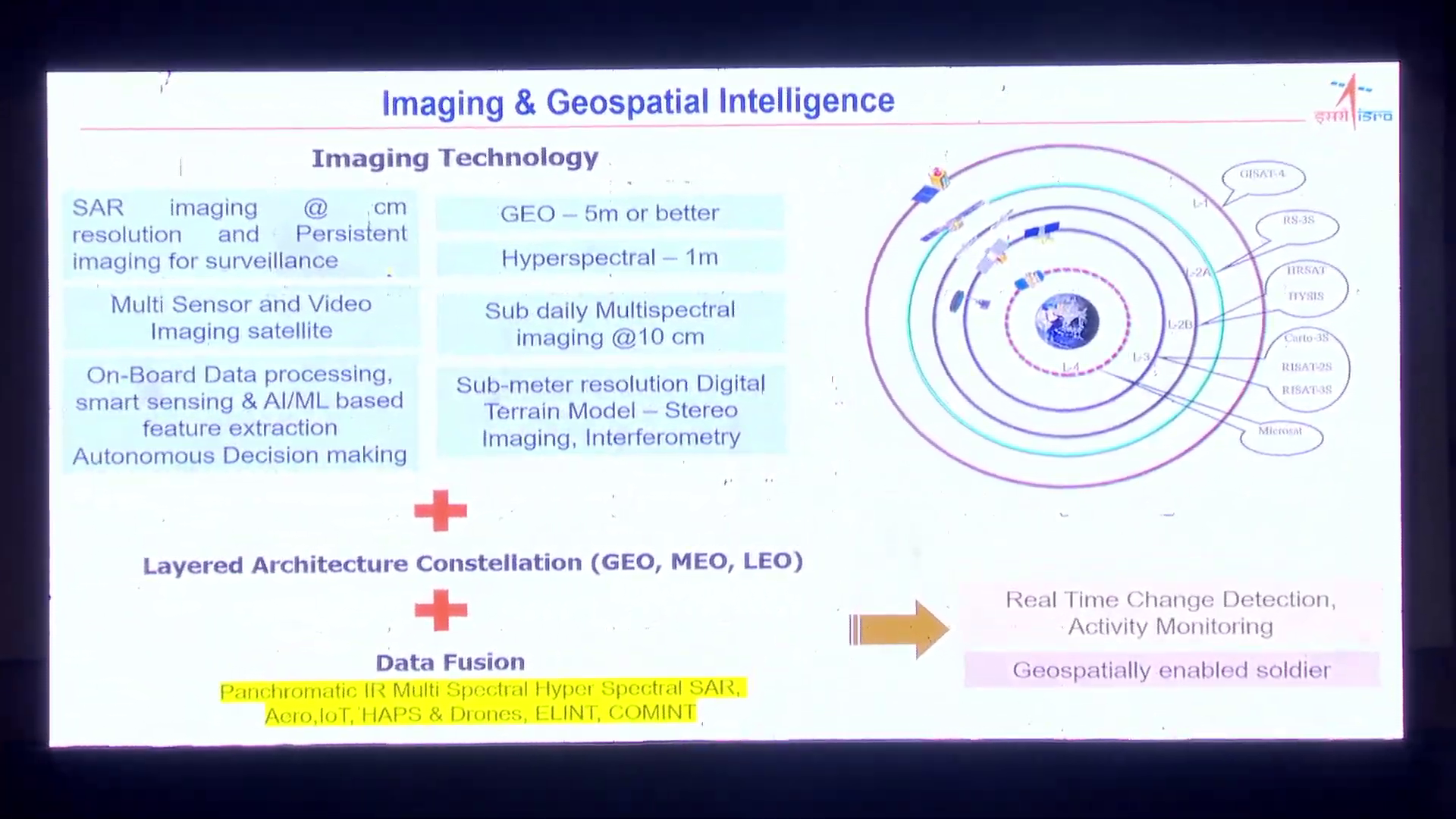
“We will have communication between satellites, so that if some satellite detects something, which is at GEO at 36,000 km (altitude), it can task another satellite in the lower orbit (at 400- 600 km altitude) to check much more carefully and then give more information. This capability gives us enormous potential,” the ISRO chief said.

 
With the Modi government already signing in January, a letter of intent with France for the joint construction and launch of military satellites, the Indian focus is to acquire capabilities which can detect enemy submarines in the Indo-Pacific as well as track infrastructure construction by its adversaries on the land and sea border with India.

This deal with France for a joint maritime surviellance constellation of 8-10 sats has been in the works for a long time now. The Jan signing event seems to have gone under the radar.
 
This deal with France for a joint maritime surviellance constellation of 8-10 sats has been in the works for a long time now. The Jan signing event seems to have gone under the radar.
I am expecting some material from ISRO within next few months. Let's see.
 
b53sAtn.png


kGwQUuk.png


From 'Strategic Capability Development in Space' by S Somanath
 
There's at least 2 types of radar sats under development that we know of- RISAT-2 and ANVESHA. The planned Indo-French maritime surveillance constellation might include a third type.

The ISRO-NASA NISAR sat is likely civilian-only. In addition, the pvt sector has a couple of designs of its own.

I find the tidbit about IR sats very interesting- possible missile defence applications like US SBIRS, I imagine.

Overall, this is a massive boost for India's space-based ISR capabilities!
 
Last edited:

India fast-tracks $3-billion spy satellite scheme following Operation Sindoor


New Delhi: India is looking to give its satellite-based surveillance capabilities a rapid makeover, as the country navigates a tenuous ceasefire with neighbour Pakistan after the worst hostilities seen since a war between them in 1971.
The Centre has tasked three private firms–Ananth Technologies, Centum Electronics, and Alpha Design Technologies–to compress their satellite development timeline from four years to 12-18 months, according to three people aware of the matter. The satellites are now targeted to be ready by end-2026 or earlier instead of end-2028, the three people said, requesting anonymity due to the matter’s sensitivity.

One of the satellites–under advanced stages of development by Ananth Technologies–may even be ready this year itself, one of the people cited above said. It would be launched either aboard Isro’s heavy rocket, Launch Vehicle Mark-III (LVM3), or Elon Musk-backed SpaceX—depending on their respective mission schedules this year.

The soft orders to expedite the latest generation of surveillance satellites were issued from the ministry of defence (MoD) just before India commenced Operation Sindoor against Pakistan.

The accelerated effort is part of the $3-billion Space-based Surveillance-3 (SBS-3) scheme, which was approved by the cabinet committee on security (CCS) last October with a net budgetary outlay of $3 billion subject to revisions.

In this scheme, a total of 52 surveillance satellites are being built. While the three private companies are building 31 of these, the remaining will be built and deployed gradually by India’s central space agency, Indian Space Research Organisation (Isro).

“It is a necessary move in light of such sensitive geopolitical interactions," one of the people cited above said, adding that the SBS-3 constellation will work as a crucial piece of infrastructure for India’s national security, and is a prime example of the kind of large contracts that the Centre can offer private space firms.

Emailed queries sent to the three companies, as well as the defence ministry—the nodal ministry that will access the satellites for national defence and security usage—did not receive responses till press time.

Spy satellite builders

The three private-sector companies—Hyderabad-based Ananth Technologies, and Bengaluru-based Centum Electronics and Alpha Design Technologies—are long-standing partners, suppliers and vendors of Isro, and have played key roles in previous surveillance satellites, as well as landmark Indian space missions such as the successful Chandrayaan-3.

Ananth Technologies, led by former Isro veteran Subba Rao Pavuluri, was a key supplier of components to the Chandrayaan-3 mission. So, too, was Centum—led by its chairman, Apparao Mallavarapu.

Ananth Technologies earned ₹270 crore in revenue in FY24. In the same fiscal year, Centum, which is publicly listed on the National Stock Exchange, reported ₹632 crore in revenue. In FY25 (nine months to December 2024), it reported revenue of ₹479 crore.

The third company, Alpha Design, was wholly acquired by Adani Defence and Aerospace, which is a subsidiary of Adani Enterprises, in April 2019. Alpha Design has been one of Isro’s key partners in building and deploying the Indian Regional Navigation Satellite System (IRNSS), which seeks to replace the global positioning system (GPS) in India with NavIC, an indigenous navigation standard. The company reported ₹536 crore in operating revenue in FY24, as per data from credit rating agency, Crisil

All three companies are rated highly by credit rating agencies Care Edge and Crisil, based on large pending orders driven by Isro and the ministry of defence (MoD), among others.

For space firms, internal government contracts are key. In July 2024, former Isro chairman S. Somanath told Mint on the sidelines of a space conclave in New Delhi that the Centre, along with Isro and multiple agencies across ministries, is working to create awareness of the capabilities that private space firms bring to the table, and how they can be tapped for cutting-edge purposes such as secure communications, data analytics and more.

Industry veterans, too, believe that private firms can play key roles. Chaitanya Giri, space fellow at global think-tank Observer Research Foundation (ORF), told Mint that private space firms will continue to be preferred in large-scale, sensitive projects such as SBS-3.

“Each of these private players are already suppliers to the central space agency, which makes the manufacturing and eventual deployment of satellites for various purposes a project right up their alley," Giri said. “In the long run, more such government projects will see India start to drive revenue to the private space sector in the same model as the rest of the world—despite them wanting to showcase the Indian space sector as an open market."
 

'The Ministry of Defence is finalizing a multi-year plan to launch a constellation of satellites that will monitor potential reconnaissance efforts targeting India. This ambitious initiative is estimated to cost around Rs 150 crore annually and is expected to become operational by the end of 2026. Bengaluru-based space startup Digantara, backed by Peak XV Partners, has reportedly secured the contract to lead the project.' From the Article
 
Soon stealth satellites would be required. Total black in colour, nano ones, with special radar absorbing material not to be detected by any ASAT.
We also need satellite satellite warfare capability, satellite armed with robotic arm and capable of changing orbits. ISRO has a concept for a satellite with arm to remove space junk, we can use it for anti satellite capability.
 
  • Like
Reactions: screambowl
Asats rely more on IR sensors than radars.
With satellites using solar panels for power generation, they shine brightly against 🥶 very cold space in the surrounding.

Nice.
What if you add foldable solar panels and use nuclear fuel instead. Need to cool the the heat dissipation by electronics and absorb IR radiation, some what like blackbody.
 

India’s new space revenue driver: surveillance satellites

New Delhi: India’s private space firms may be getting the revenue boost they hoped for: Thanks to geopolitical tensions, several countries have tapped them to build satellites as demand for space-based surveillance grows.
Bengaluru-based Ananth Technologies, a long-time engineering partner for the Indian Space Research Organisation (Isro), has been executing an order from Australia for defence surveillance satellites over the past year. Peer Digantara is also part of this contract under the Mission for Australia-India's Technology, Research and Innovation or Maitri programme.

Norway, Hungary and Poland, besides nations from West Asia and the global south, are also engaging with multiple Indian space firms, including Adani Defence and Aerospace-backed Alpha Design, according to at least five industry executives Mint spoke with.

Most of these countries do not have their own satellite programmes, but changing geopolitical alignments and global tensions have amplified the need for space surveillance. And while revenue generated from such projects has still not reached hundreds of millions of dollars, India’s friendly relations are offering local space startups an opportunity to drive growth through such partnerships.

Moreover, surveillance satellite giants in the US, such as Boeing, Lockheed Martin and Northrop Grumman, focus mostly on large contracts, according to Chaitanya Giri, space fellow at global think-tank, Observer Research Foundation. Since most of the contracts coming India’s way range from $5-25 million per year, Giri said these “are too small for the American behemoths, but cumulatively could add up to a significant boost for India".

Satellite assembly line

Ananth Technologies and Digantara will offer end-to-end design and manufacturing of satellites and provide surveillance data to Australia. While neither divulged the exact size of the deals, both said the multi-year pactsare leading to monetization of their business models in India.

“We have three satellite manufacturing and design engineering centres across Hyderabad, Bengaluru and Thiruvananthapuram, where we build and design high-resolution surveillance, imaging and earth observation satellites based on requirements from clients," Subba Rao Pavuluri, chairman and managing director of Ananth Technologies, told Mint.

The company has the reputation to back it, having manufactured surveillance satellites for India. These are in orbit and operated by Isro.

In FY24, Ananth Technologies, incorporated in 1992, earned operating revenue of ₹270 crore, according to data from the ministry of corporate affairs.

Digantara, incorporated six years ago, earned ₹3.2 crore and projects its revenue to increase to ₹250 crore by FY27 on surveillance satellite data and manufacturing contracts. Over ₹100 crore of Digantara's revenue growth is set to come from through its contract with India’s ministry of defence, Mint reported on 13 June.

Anirudh Sharma, chief executive of the Peak XV-backed startup, is also setting up the company’s own satellite assembly line. Mint visited the company’s headquarters in Bengaluru. The startup will offer satellite observation and data analytics services to paying customers.

“We’re currently working with other clients, too, including the government of India as well as interested parties from the European Union," Sharma said. “There is an increasing demand for sovereign surveillance capabilities around the world, for which we are offering white-label services to various governments."

Surveillance as a service

Beyond manufacturing for other nations, Indian space startups are looking to put their own surveillance satellites in orbit, and offer high-resolution surveillance data to countries. GalaxEye Space, a four-year-old, Chennai-headquartered startup, announced earlier this month that it will place its first, owned surveillance satellite in orbit as part of its business expansion plan.

“...the current rise in interest for surveillance satellites is also boosting our case for innovation—where we are placing a high-resolution synthetic aperture radar (Sar) satellite that can observe the earth at up to 0.5 metres resolution," said Suyash Singh, founder of GalaxEye. “We’re already having early-stage conversations with hundreds of clients, which is what spurred our decision to build this satellite. In the next six to eight months, we’ll offer a revenue projection for the coming years, launch the satellite in orbit, and raise funds for our next phase of operations."

The company’s early-stage demand is largely coming from West Asia and the global south, Singh said.

One year ago, the government of Australia signed an $18-million contract with Isro’s commercial business unit, NewSpace India Limited (Nsil), to use its satellite launch services.

Speaking with Mint on the sidelines of 2025 Indian Space Congress in New Delhi on Wednesday, Philip Green, high commissioner of Australia to India, said that space is an active area of collaboration between the two nations.

“We actively leverage the strength that each of us have in our nations to collaborate in various fields, including technology. In space, Australia is a global innovation leader—we bring this to India and tap its massive engineering talent pool with private firms that are highly skilled in niche areas. In turn, this helps both the geographies prosper and grow—Australia, leveraging this, is seeing its space economy already grow at 10% per annum," he said.

“With a strategic partner such as India, we can collaborate across the line and the ecosystem, and do so more intensively. That’s where the India-Australia space collaborations are at the moment," Green said.

ORF’s Giri calls this a “natural evolution".

“The US has moved on from manufacturing a long time ago, and Europe’s markets are too expensive to manufacture at scale," he said. “With the current geopolitical balances at play, India’s biggest strength lies in leveraging this position to emerge as a default choice for global satellite manufacturing."

Giri expects these contracts to help India’s private space firms reinforce their reputation in the global market. “With space and surveillance being seen as key areas of engineering and innovation, India is in a strong position to leverage its relations globally—and help private firms expand globally as critical infrastructure providers."